Archive for the ‘14ers’ Category

Longs Peak: Kieners’…er, Notch Route

January 18, 2010

Rich (left end) and me (right end) during our Amazon river cruise in 1993.

When I first moved to Colorado in May, 1996, the only person I knew was Rich whom I met on a 1993 Ecuador mountain climbing trip that included a successful climb of Cotopaxi (19,347′) and a failed attempt on Chimborazo (20,560′) as well as a canoe exploration of a tributary of the Amazon river. I only knew him for 3 weeks, but knew him to be an excellent climber and all-around good guy.   And, he welcomed me into town in the best way I know…he invited me to join him on some adventures.

After a “try-out” trip in May, 1996 to bag Horseshoe Mountain (13,989′) and Sheridan Mountain (13,748′), Rich invited me to join him on an attempt at the Kieners route on Longs Peak.  Longs Peak was already my favorite mountain (as it was the first and only 14er I had done), and besides, I was ready to try anything if Rich was willing to let me tag along.  Rich described it as a classic mountaineering route with snow climbing and rock scrambling; I accepted with inappropriately high enthusiasm.

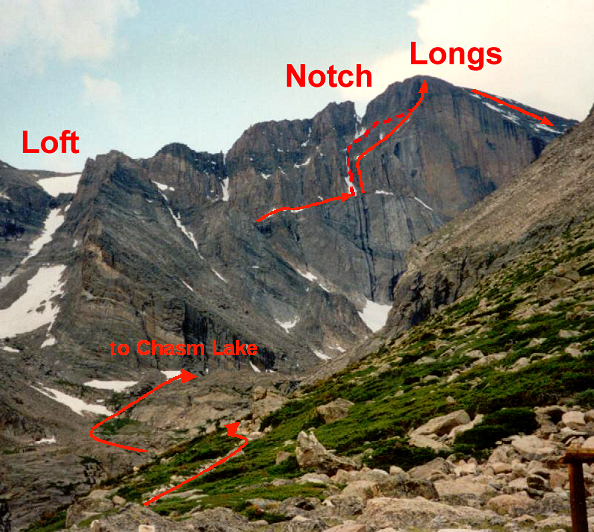
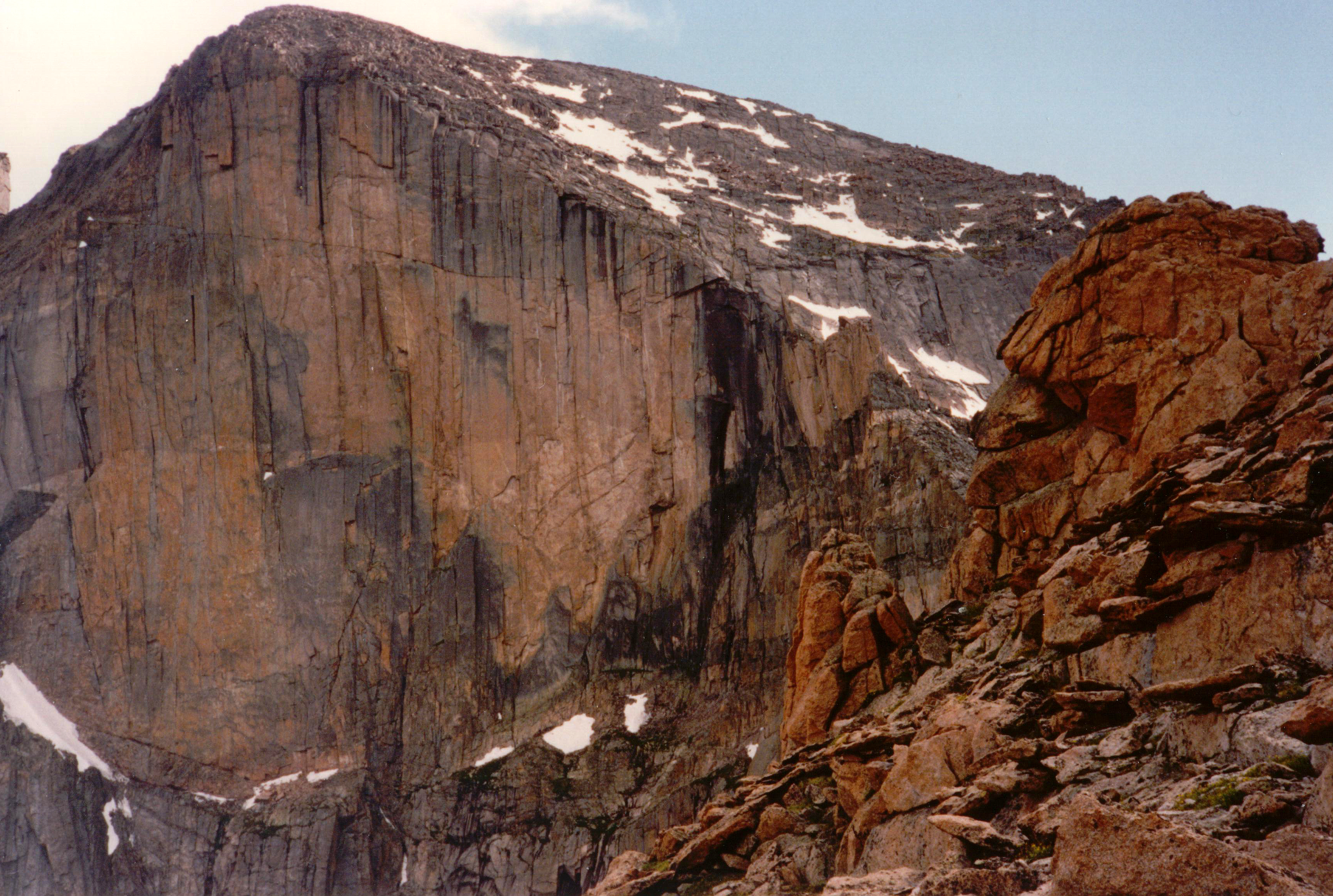
A view of the distant Kieners Route on Longs Peak, with Mt Meeker to the left and Mt Lady Washington to the right. Photo taken on descent.

On June 17, 1996 at 2am, Rich and I left for RMNP and the Longs Peak Ranger Station.  We started up the trail in the dark, and me without a headlamp, I made sure to stay on Rich’s heels to borrow some of his light.  I wasn’t in top mountain climbing shape, but Rich politely kept the pace at a level that I could survive.

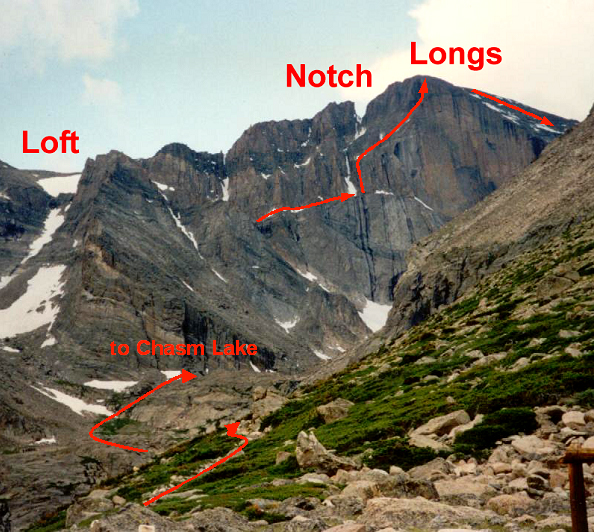
We hiked past Chasm Lake as the sun started to come up and then up to Mills Glacier at the base of Longs Peak.  I recognized a few features from my Diamond trip a couple years earlier, but most of it looked unfamiliar.  I was able to spot the Diamond which dominates the east face and the Notch which splits the east face.  According to Rich, the Kieners Route started at the base of the Notch and ascended the south edge of the Diamond.

I was past ready for a break, but we continued up to the base of Lambs Slide before stopping only long enough to put on our crampons and have a bit of water.  The plan was to ascend the Lambs Slide couloir, heading up and south along the lower east face of Longs.

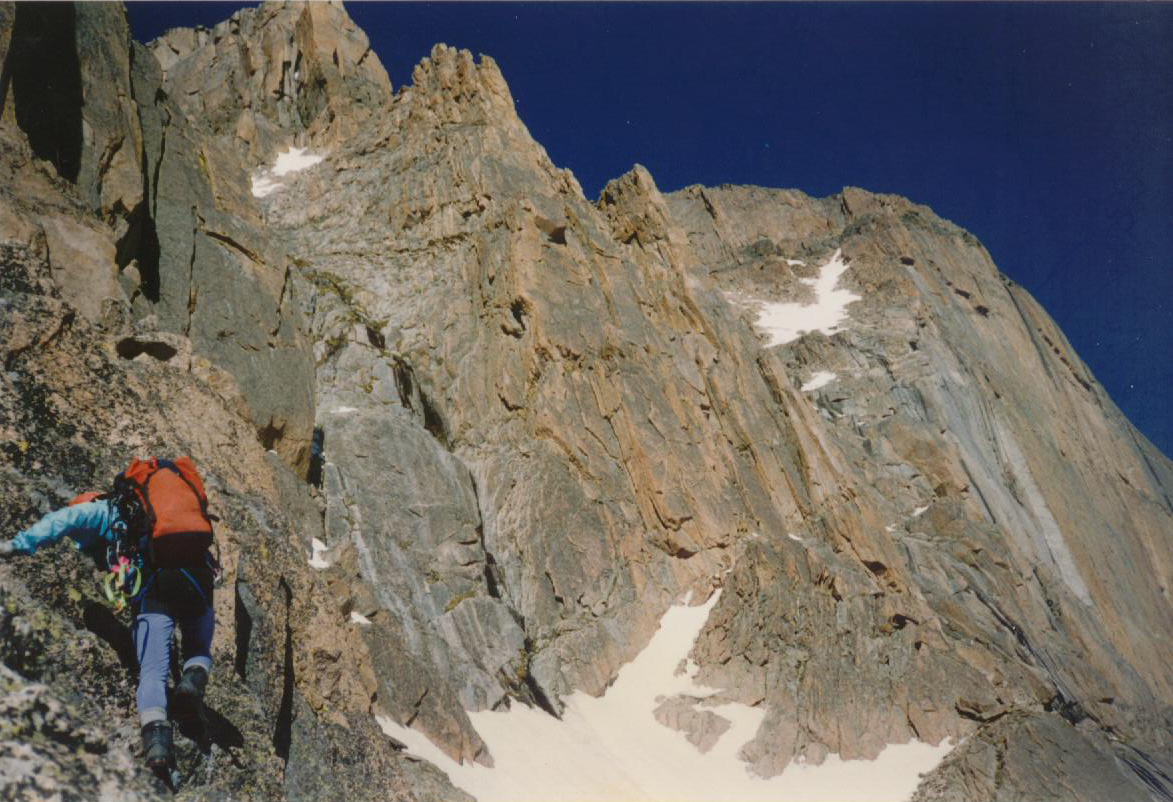
Rich heading toward the Kieners Route (the low angle rock above the steep "Diamond")

I had done several snow climbs before, so I wasn’t nervous in the days leading up to the climb. But this turned out to be an iron climb.  Lambs Slide was hard ice and I rarely got penetration from my flexible crampons. I was wishing fervently for my plastic boots and mentally going over my self-arrest training as I slowly I crept up the couloir, stepping from frozen footprints to rocks protruding from the ice wherever possible.  When the rock face to our right broke up, Rich announced we were at the start of the Broadway Ledge (~13,000′).

The scramble along the ledge was easier than I feared.  I started to think that Kieners was going to be fun after all.  Then we reached a break in the ledge blocked by a protruding boulder. Incredibly, we had to crawl around the protruding boulder with our butts hanging out over an 800′ drop back down to the bottom of Lambs Slide.  Rich saw the look on my face and asked if I’d like a belay. With a gratitude since unmatched, I accepted his offer.

Rich in the distance on the narrowing Broadway Ledge with The Diamond and Chasm View in the distance

Getting past the roadblock was easier than it looked, but I was glad to have that belay.  Once past, we continued working our way along Broadway Ledge, heading toward The Notch and The Diamond. I was disappointed that Broadway Ledge was such a frightening place, with a sloping edge and ball-bearing sized pebbles atop a smooth rock foundation with an 800′ fall rewarding the least error. I couldn’t see how people avoided slipping off with public-outrage-level regularity. But I couldn’t turn back now without re-crossing the ass-overhang.

I caught up with Rich as he stared at the rock face on the far side of the Notch.  He looked over a me and said that the start to the Kieners Route should be here, somewhere. Naturally, I was of no use except for having the sense to keep my mouth shut when I had nothing useful to say. As the official “belay slave” I hadn’t bothered to study the route and wouldn’t know where to begin to look for information anyway.

Rich decided that we’d go higher up the Notch to find a way to get onto the Kieners Route, so up we went.  The  couloir was more snow than hard ice, but it still felt insecure…and now I could fall much farther.  Up and up, we looked and hoped for a solution.  We crawled up much of the Notch before we found an exit to the right.

Looking back down the Notch Couloir

I had no idea where we were; all I could see were giant cliffs on 3-sides and a lot of air on the fourth. But faith is a powerful thing.

Rich led us across a number of gullies with ice and running melt water, one in particular felt like it would be the last thing I ever did. Stepping onto sloping ice with only the spike of my axe on a rock to save my inevitable slip did not seem to be a smart thing to do; but I had to keep moving forward as the day was getting old.

Rich said we needed to traverse back toward the east face to escape the cliffs blocking our access to the summit block. That sounded good to me as I had no notion of being off-route or what getting lost might mean; I was just following Rich.

Once past the icy gullies of death, the going was pretty easy with only a few technical rock sections; at least rock climbing was something I knew how to do.  Rich even let me lead a couple pitches.

Eventually, we reached the edge of the east face.  Rich was studying the rock when I started to remember the path I took during my guided trip up The Diamond.  For lack of a better option, we tried it and found it worked.

A few hundred feet of scrambling up talus led us to the summit of Longs Peak at around 1pm, 9 hours after we started hiking.  It was my 2nd summit of Longs Peak, and only my 2nd time above 14,000′ in Colorado; it felt even more exhilarating than my guided trip up The Diamond.  It felt like we had faced far more risk on our the snowy, icy terrain than I did going up clean rock on The Diamond.

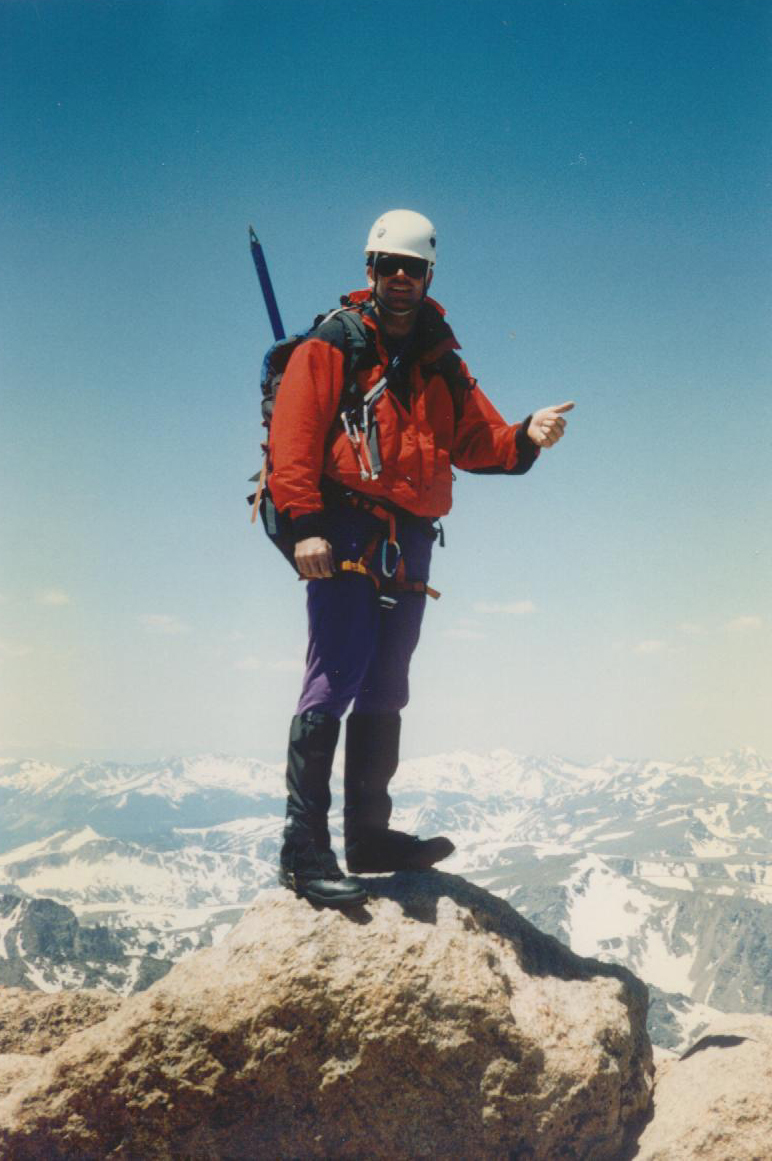
My Longs Peak summit shot

I felt wonderfully satisfied with the day until I remembered that I had to catch a flight in the evening.  I was going to have a very long day.

Without much of a rest, we scrambled down the Keyhole route.  Rich had wanted to do the Cables Route, but we met a fellow on the summit who convinced us that the Keyhole Route would be easier in the snowy conditions.  And I was hungry for the “easier” way; my sense was that I’d used up my good luck and wanted to take no more chances.

But the Keyhole Route was no cakewalk.  Ice covered the Homestretch; the Narrows was a bad surprise (I had never done the Keyhole Route); the Trough was unpleasantly loose.  It took 2 hours to reach the Keyhole, and to think I just had to do 2 rappels to get down the Cables Route.

Rule of Rational Skepticism:

Do not believe anything or anyone on the trail without sufficient reason to do so

Once we reached that little rock shelter near the Keyhole, we stopped for the last of our water.  I also checked my voicemail to see if anyone from work was looking for me; it was a relief to find no voicemails, especially from my boss wondering why I was no where to be found.

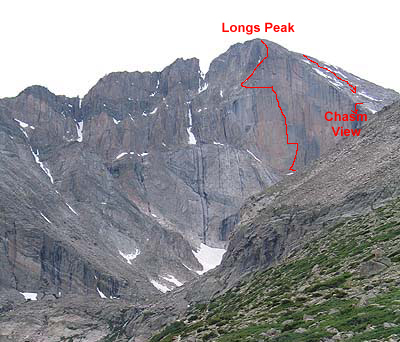
Our route up Longs. The dashed line represents our actual route vs. the correct Kieners Route. We really did the Notch Couloir route.

Another 3 hours got us to the parking lot for a total time of 14 hours.  That left me with 3 hours to drive home (1 hour), get ready for my trip (30 min.), and get to my airport gate (1.5 hours)!  I made it…the best day of work in consulting history.

I’ll admit to being a bit tired the next day after being awake for 22 hours straight and moving for 14 hours covering 14 miles while ascending and descending 5,100′. And I didn’t even realize that we hadn’t done the Kieners Route.  It took me another 2 years, in the preparation for a repeat (see Brian’s Lucky Day), to finally figure out that we had done the Notch Couloir route. But any day on Longs Peak is better than a good day in the office

And another big thanks to Rich for a great trip.  But that was the end of my following anybody up a mountain like an innocent lamb.  I would be prepared to be a good teammate on all my future adventures.

See all Trip Reports

Snow Massive

January 7, 2010

Out of the blue, Brian wanted to do a full weekend trip to collect something hard and fun; apparently, his girlfriend went out of town on short notice.  Now this is a good thing, but caught off guard, I couldn’t think of anything besides Longs Peak.  Brian says, “How about Snowmass?”

Of course, I known for a while that Brian is always interested in a few extra ski turns and my brain locked onto the obvious ski connection; “The ski resort?” I blurted out while thinking that June is way too late for that.  Brian says, “No, but close.” And that is how our “Snow Massive” adventure got started.

I had done a few 14ers that year and had a exertion-level in my mind that I thought roughly fit the requirements of a 14er.  And it was an investment that I was willing to make without any thought.  I agreed quickly while also registering with great excitement that Snowmass Mountain was a 14er I hadn’t done yet; I’m always up for checking another off that long list.

When I got off the phone, I pulled out my Dawson guidebook to check it out.  Boy, was I in for a shock!

14ers done already in 1999

  • Huron Peak on 4/24 (10 miles, 11.5 hours)
  • Mt Yale on 5/1 (10 miles, 13 hours)
  • Mt Evans on 5/30 (3 miles, 6 hours)

….compared to…

  • Snowmass Mountain (23 miles, 2 days)

Yikes!  An eight mile approach with gear for a snow climb & a cold weather bivy and then a 7 mile round trip to the summit plus an eight mile retreat to the trailhead.  Well, it sure sounded like an adventure.

I couldn’t imagine hauling an entire campsite 8 miles up 2600 feet; I’m just not in to backpacking.  I told Brian I was bringing a bivy sack and lightweight sleeping bag; I’d just have to sleep in my clothes to stay warm.  And I’d gamble on the rain.  I also decided to live on cold food to avoid bringing a stove and fuel. Even still I had to bring a ton of stuff, e.g., snowshoes, poles, crampons, ice axe, food, extra base layer, fleece, gore-tex upper and lower, water bottles, small rock rack (Brian had rope) and helmet.  Let’s just say I had to bring my big pack.

On June 19, 1999, we started the long drive up to Aspen in the early morning to allow plenty of time to reach the bivy site.  We followed Dawson’s directions to the trailhead on Snowmass Falls Ranch, and then began our very long hike to Snowmass Lake.

Snowmassive route map

Around 1/2 way up the trail, we came to a creek crossing.  I mean the trail led up to the creek and another trail started on the other side of the creek, so the evidence pointed to us needing to cross.  But there was no kind of footbridge or any sort of solid structure for us to use to cross the 90-foot wide & up to several foot deep creek; the only thing to use was a pile of dead logs that had accumulated in that spot.

Some of the logs where piled high enough to be non-floating, but they were still unstable as they tended to move and roll.  Many others were simply floating on the creek but trapped by the other stuck logs.

….and with a heavy pack on my back?  No way!.

But it was true, we had to balance our way across without a fall or lose the entire trip, or worse.  I did have my snowshoe poles with me, so I used them to help balance my pack as my feet shifted around with the unstable footing.

A failed adventure due to a creek crossing would be all the harder to live with because it wouldn’t just be a failure, it would be a stupid failure.  But we made it.

Joe posing in front of Hagerman Peak....I thought it was Snowmass at the time.

Continuing on we eventually started to get close enough to see the nearby peaks.  We posed with Hagerman’s Peak in the background thinking it was Snowmass Mountain, only to find Snowmass was still around the corner.  And then we were there; it was one of the nicest bivy spots I’ve ever seen.

Snowmass Lake is very large for its 11,000′ elevation and ringed by cliffs on one side with the peaks in the background.  It looked like a nice place to spend a couple weeks, as long as the cold temps kept away the bugs.

The first thing we did was scout the entire area to find the best spot for a tentless bivy; we didn’t want to wake up in a puddle if the rain came.  Nothing was quite perfect, but we each settled on our own “best” spot and then took care of some chores, such as getting water & hanging our food.

Sunset was around 8:30pm, which accelerated the cooling trend for the day.  I put on all my clothes and crawled into my sack to warm up.  It luxurious until the snowy rain started.  But the precipitation didn’t last long and I drifted off.

With only a 3.5 mile hike remaining, we didn’t feel the need for a pre-light start.  Plus, there was another log crossing at the start of the day, and I wanted to be able to see it. So, at rather late-ish 4:30am the alarm went off and we scurried to be ready for a 5am start.

Summit day route map

The first thing we had to do was cross that one last log bridge.  I was relieved to see it was much shorter and we started across.  About midway, I tried to plant my pole in the creek bed, but found it was too deep.  In the process, I lost my balance and had to put my foot down blindly to catch my self before toppling into the creek.  Once I caught my balance, I looked down to see that my left boot was submerged.  With my boots water proofed and my gaiters on, I wondered if I would get away with that mistake.  And in that same instant, my foot felt the flood of freezing water.

Our view of Snowmass from the bivy site.

Oh, great.

Once on the other side, it was the dreaded, yet familiar,  squish, squish, squish sound and sensation as I walked.  After 100 yards, I told Brian I needed to sort out a problem and sat down for some work.  I got the boot off and poured out a 1/2 liter of water and then wrung another pint out of my sock.  I hoped a fresh sock would do the trick but the inside of the boot soaked up too much water for that.  Twenty socks might have done the trick.

With no choice but to continue, it was squish, squish, squish all day as my softened skin eroded away.  At least the temperature was moderate, so I wouldn’t have to worry about frostbite.

Me on the summit....enjoying a well earned rest. And wondering why I didn't get a haircut.

We traversed around the lake to the terminal moraine of the Snowmass snowfield which we scrambled up to reach the giant, low-angle snowfield that must have been the source of the peak name, “snowmass”.  There wasn’t any trail, it was a loose, muddy mess.  But it went.

Once we reached the peak, we broke out the harnesses and climbing gear for the climb up the side of the ridge.  It was a steep snow climb that ended with a few mixed climbing moves to reach the summit ridge.  Brian was right to insist on the gear.

After a brief rest, we then scrambled up the long rocky ridge to stand on a spectacular summit.  It had only taken 3.5 hours; but with the sun burning down on the snow, we didn’t want to get caught in a giant puddle of soft and melting snow.  We quickly went back down the way we came up, ending with a rappel off the ridge.

Brian had carried his skis a long way for these turns.  I had my mind set on the longest glissade of my life. My record glissade to-date was almost 2/3rds of the Cristo couloir on Quandary in a single run (a 1600′ descent over 0.8 miles), only missing the top 750-1000 feet of rocky & overly steep terrain at the top. The Snowmass Big Bowl promised to be even better.

I started off slowly, to get the feel of the snow.  The snow was softening quickly and grabbing at me so I let my speed pickup to get me over any soft spots; it worked.  I was hauling ass down the snowfield, shifting my weight to steer between the rocks, and hollering all the way.  I made it almost to the terminal moraine before I lost my nerve and slowed down.  The soft snow then ended my fast paced adventure.  When Brian finally arrived sometime later, he said, “You were going very fast; that was pretty dangerous.”  It was true, but it was fun.

Brian showing off his Snowmass pride

And for the 10 years since, I have been proclaiming Snowmass Mountain as my longest glissade. But my calculations done in writing this report tell me that the glissade was a similar 1600′ over 0.8 miles…not a new record.  But I’ll still say it was the most exhilarating due to the speed I used to make it so far over soft, lower angled snow.  And, yes, I promise not to do that again.

The hike back to camp went quickly on painless adrenaline. Even the short log crossing offered little resistance.  It wasn’t until after sitting in camp for a rest while trying to dry my socks in the sun that my body started to stiffen.  The pain of pulling on that big pack and the cold, wet sock foreshadowed the agony of that hike out.

Another death march.  It went on and on.  I was so bored that I even enjoyed the 90-foot log crossing on the way back.

And then it was done.  23 miles and 5800′ over 2 days, and another 14er done.  It was a great weekend.

And only 36 more to go; I wouldn’t finish for another 8 years.

See all trip reports

My First 14er: Longs Peak via The Diamond

December 30, 2009

…being too smart is no excuse for missing out on the chance of a lifetime.

~ me

It was the summer of 1994, and I was desperately looking for an adventure to fill the long July 4th weekend. I was new and late to the rock climbing obsession having started only two years earlier at the age of 30, but I had it bad. And, as far as obsessions go, this was more like an addiction.  Sure I liked it, but more to the point, I had to have it.

I was living in the Lincoln Park area on the north side of Chicago and was earning my climbing stripes in Baraboo, WI at the Devil’s Lake Bluffs and at the Mississippi Palisades State Park near Savana, IL. These climbing areas were 3 hours away from Chicago, so rock climbing was a weekend-only affair. And with wet weather haunting so many of the warm-enough days in that part of the country, I averaged only a few days a month. Constantly suffering from withdrawals, I regularly resorted to bouldering on the stone structures in Lincoln Park just to take the edge off.  My favorite was the black (dirty?) stone structure  housing the statue of Ulysses S. Grant (see more recent photo); it had a few surprisingly good routes, all about twice my height.

For the 4th of July, the obvious answer to the question of “what to do?” was to go to Colorado again. And the hardest, biggest, baddest climb I’d heard of in Colorado was The Diamond.
The Diamond is the sheer and prominent east face of Longs Peak and named for the shape of the cliff. The face has a veritcal gain of more than 900 feet all above an elevation of 13,000 feet. It is a world famous "big wall". The easiest route on the face, the Casual Route (5.10-), was first climbed in 1977.

I learned about The Diamond during my two previous visits to the Colorado Mountain School (CMC) in Estes Park, CO. My instructors/ guides (Mike Caldwell, the dad of the famous climbing Caldwell, Tommy, and Topher Donahue, the son of the CMC Founder) led me & my pals up graduation climbs in RMNP (Sharktooth [5.6], Petite Grepon [5.8]), which always had that wonderful sense of being the absolute limit of human capability.

These fantastic “near death experiences” always led to discussions of “what was the hardest” RMNP rock to climb; the answer was always The Diamond on Longs Peak.

My Midwest climbing pals, whom I’d met at the Colorado Mountain School, would scare each other regularly with threats of “signing up for The Diamond”. We had a shared sense that The Diamond was just out of our reach where failure felt deadly. Looking back, I think  “The Diamond” served as our inspiration for improving our skills, both physical and mental.  We didn’t dare do easy (for us) climbs when we might be forced, through peer pressure, to climb the Diamond at some point in our near future.

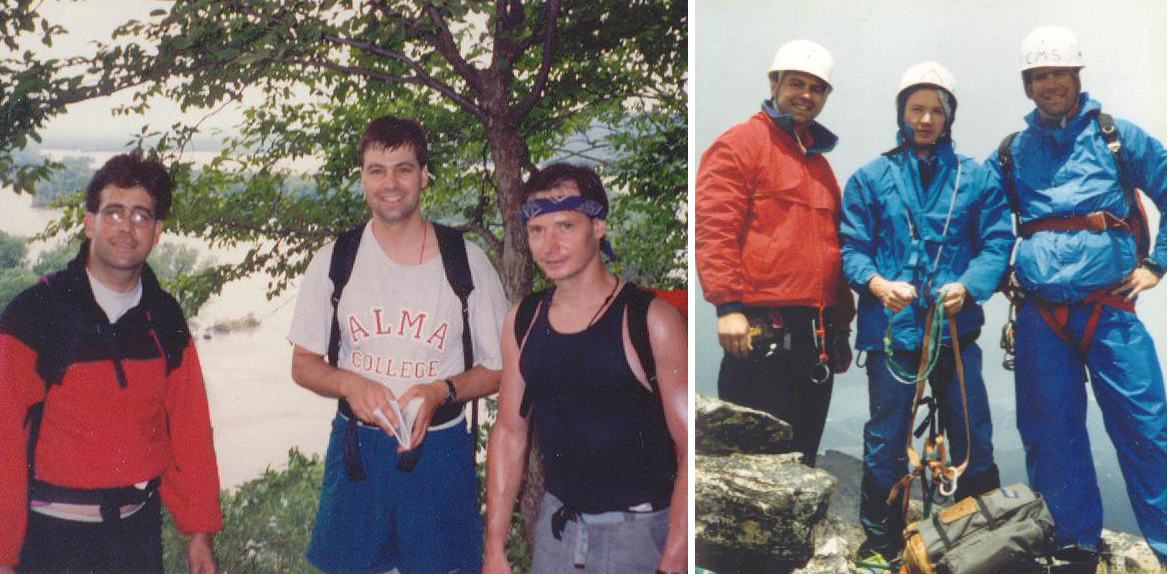
Joe, Mark & Jim at the Mississippi Palisades and on the summit of The Sharkstooth.

The Spring of 1994 had been especially rainy, particularly on weekends (it seemed). My climbing-withdrawal induced insanity lead me to think the unthinkable.  And, after a few days of hard self deception, I had myself believing that I could handle the 5.10- climbing and 14,000 feet of altitude.  To do so, I had to put two disturbing facts out of my mind:

  1. I had never climbed anything harder than 5.9, and nothing harder than 5.8 since the previous summer
  2. I had never rock climbed above 12,600′ and had not been above 600′ (plus a few floors) in many months

I suppose I didn’t really think I was ready. I just couldn’t think of anything else to do that would be hard and scary enough to feel like an adventure, even just in the attempt. Not knowing very much was part of the problem, or, perhaps, the key to the solution.

Perhaps it was unreasonable, but I was going to do it and I wanted my buddies to join me. I put the word out, but each had the plausible yet lame excuse of having July 4th plans already. Shocked and amazed into poor debate form, my feable attempts at guy-reason got me nowhere. Looking back, I suppose they were a bit smarter than me; but I’ll still argue that being too smart is no excuse for missing out on the chance of a lifetime.

Nothing was going to keep me from taking that step, even if I had to do it alone.  So, determined to proceed and with credit card in hand, I placed a call to the CMC to hire a guide to take me up. I was really going to do it.

Or not.  After all that buildup, no guides were available for the only weekend of the year I could make work. Noooooo!

What a bummer!

Maybe I should have been happy to spend a few uninterrupted days of romance with my girlfriend; maybe I should have been satisfied for the opportunity for 72 hours of personal growth.  But I wasn’t.  I couldn’t.  I was going to miss my chance.  And that is how the greatest adventure in my life would end…

…that is, unless something changed.

And a couple weeks later, the situation changed.  It was about noon on Thursday, June 29th, the 2nd to last day of work before the start of the long holiday weekend, when my cell phone buzzed.  It was Topher Donahue, one of the guides I knew at CMC, with some unexpected news; he’d come available for Saturday, July 1st if I still wanted to climb the Diamond.

YES!

Now all I had to do was get there in time.  I had to meet Topher at 1pm on Friday, June 30th, which was only 24 hours hence.  The easy thing to do was fly, but I had a company car with paid gas.  It didn’t feel like I had a choice.

From a previous trip, I knew the 1100 mile drive from Lincoln Park to Estes Park, CO would take approx. 17 hours driving straight through. And I still needed to get home and pack.  Well, don’t tell my boss, but my 1994 July 4th holiday started about 30 hours early.

The long drive from Lincoln Park to Estes Park.

As I drove home, I knew the plan would come off much better with a co-pilot. I prepared my case by getting a reservation for a tiny bed and breakfast in Boulder called The Briar Rose.  My pitch was that trip was going to be a wonderfully romantic Colorado getaway, during which time I would do only one climb.  My girlfriend bought it.

By 7pm, we were heading out I-290 west.  At first, the excitement of the adventure made the driving fun.  But, seventeen hours is a long time when waiting for each of 61,200 seconds to pass.  I really did try to sleep in the back seat for a few of those hours.  But no way; my racing mind never let me doze off for a moment.

As I tried to sleep, my mind hit on the biggest problem of all:  I was not going to get much acclimatization. During the initial 24 hour period, I would ascend from Chicago (600′) to Estes Park (7500′), and, then would continue the ascent, first to the Longs Peak Ranger Station (9500′), then to The Camel (~13000′).  Then, after another opportunity for sleep, we would climb to the Longs Peak summit (14259′) for a total of nearly 14k feet of elevation gain in 48 hours … not what the experts recommend.  I figured all I could do is try; I’d go up as far as I could and feel proud for daring much and trying hard.

The more I thought about how badly I needed sleep, the further away the chance for sleep ran.

It is terrible to not be able to fall asleep, but it is agony to have to stay awake.  I just hoped I could make it to dawn; I figured sunlight would ease the struggle.  But when the sun came up, I was in Nebraska, which is not what you’d call an interesting place to view from the highway.

“Hell, I even thought I was dead ’til I found out it was just that I was in Nebraska.”

~Little Bill Daggett, Unforgiven (1992)

But after a few more hours of suffering, I could see the mountains.  And the blood started to flow again. And then we were in the mountains.  And the adrenaline started to pump.  And then we were there, driving up Big Thompson Ave and then turning south onto Moraine Ave and then north onto Davis Street and, finally, pulling into the dirt parking lot of the Colorado Mountain School.   And it was done:  1100 miles and 5 bathroom stops in seventeen hours.

I signed in at the Colorado Mountain School and then went through my gear with Topher to make sure I had what I needed…I had enough gear to attempt Everest. After dumping most of what I brought, we set off for the Longs Peak Ranger Station.  Since Topher was planning to stay at the Boulderfield for an extra day of climbing, the plan was for my girlfriend to pick me up at the trailhead after the climb on Sunday.

And this is where things really started to fall apart.

Based on Topher’s advice, I told my girlfriend that she should ask someone “official” for directions and then pick me up at 6pm on Saturday.  What could go wrong?

The Approach

Without another thought, Topher and I took off for the trailhead and then we were quickly making our way up the trail.  I had no sleep and no acclimatization. But I was scared to death, and that made all the difference.

We used the standard trail, as best I could tell until we reached a junction to “Jim’s Grove”. Topher suggested we go that way to save some distance.  I continued following and hoped we’d also save some elevation somehow; my pack felt like 100 pounds.

Topher sitting in The Camel bivy shortly after arrival. Note the shelter provided by the overhanging rock.

We reached the Boulderfield around 5pm, just as I was running out of steam. I was thankful to be done for the day, but Topher looked up toward a peak above us (Mt. Lady Washington) and pointed to a rock formation on the ridge line called “The Camel”.  He indicated that we would sleep on the far side of that formation, in a comfortable and dry bivy spot.

Topher had been talking about the importance of doing everything quickly and efficiently on the Diamond. My plodding approach made me worry about Topher thinking I couldn’t do the climb, and leading him to bail on the effort. I tried to look strong.

Another 30 minutes and we were there; 3.5 hours from the Ranger Station.

It was as nice as Topher promised.  I chugged down a 1/2 liter of Gatorade (1/4 of my water supply), then felt ill for about 10 seconds before spraying my guts all over the rocks in front of me. At first glance, I could see my vomit was blood, and that made sense given how badly I felt.  But on second glance, I could see that it was just my red colored Gatorade.

Topher asked if I had ever had Mountain Sickness before; I went with the ignorance angle and responded with a “what is Mountain Sickness?”  Now I was really worried that Topher might bail on me, so I put on my best brave-face and busied myself soaking up (and photographing) my first up-close view of the Diamond.  It looked like nothing I had ever climbed.  Heck, it looked like nothing I’d ever seen.
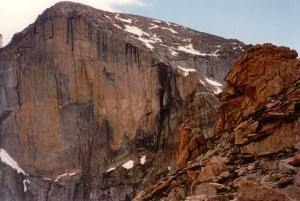
My first up-close view of The Diamond, seen from "The Camel" bivy area

A bit later, Topher asked with a knowing look if I could eat some dinner.  I didn’t know that I wasn’t supposed to be hungry; all I knew was that I was starting to feel better and I was very, very hungry. There is nothing like starvation for making a meal taste delicious, even a freeze dried one.

At last light on Friday, Topher mentioned that the weather wasn’t looking good, but hoped it would clear by dawn.  I didn’t know what to think, but didn’t struggle long.  I was exhausted.  My brain pulled the plug and I was unconscious for the next 8 hours.  It was my first bivy above 12,000′, and only my second bivy anywhere without a tent.

At first light on Saturday, around 5:00am, Topher woke me with a “the weather is bad” announcement.  I open my eyes and see wet rock and fast moving, low-level clouds not too far above.  Topher suggested we call it quits and head down to climb at Lumpy Ridge.  He promised to make it an interesting day still.

I explained that I had worked pretty hard to get to the Diamond and wanted to take every chance to climb on it.  I declared I want to stay.

Topher went on to explain that The Diamond is a particularly bad place from which to bail.  He explained that climbers have to rappel down two pitches more than they climbed (if starting from Chasm View), and then they have to climb back up to the Boulderfield to collect their gear.  He asked if I was certain I wanted to pass on a sure thing. I did not waiver.

Topher then indicated that our only hope was to wait an hour and let the bad weather clear, if it would.  In my entire life to that point, I had never argued against another hour of sleep.  I rolled over and took it.

Two seconds later (it feels like), Topher woke me again.  The sky looked the same.  He announced that the weather hadn’t improved, but we could head over to the Chasm View and see if the weather had improved at all by the time we had to commit.  I agreed.

I ate a Powerbar and finished my water supply.  Then we packed the rock gear and started over to the Chasm View.  I told Topher that I needed to get some water; he said we can “get some in the Boulderfield”.  I didn’t know where that was but felt reassured that getting water would not be a problem.

The slightly downhill traverse to the Chase View went by quickly.  And, in that brief period of time, the weather started looking a bit better.  Topher futilely gave me one last opportunity to bail, and then we started down the rappels to Broadway ledge.

The climb had begun.

The Climb

We started late enough that everything was well lit, and the poor weather had chased off all the other climbers. We quickly finished the rappels down Chasm View to the Broadway Ledge and completed the traverse over to the start of the Casual Route.

Pitch 1

The climb started up some easy terrain which let me continue to believe (read: hope) that the 5.10 rating was intended to scare beginners away even though the climber is really easy.

Pitch 2 & 3 together
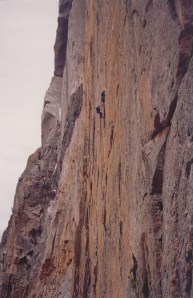
Climbers doing a hard route and showing the steepness of The Diamond face.

My illusions were shattered by a hard crack followed by a horrifying traverse.  The fantasy of easy climbing was utterly destroyed. I’d done one traverse before in my life (final pitch of Pear Buttress), and that one scared the fool out of me as well.  The lack of overhead protection meant I would take a long whipper if I fell. My increasing fear pushed me into some sort of zone where I don’t notice anything except the climbing.  My climbing skills became preternaturally sharp; I climbed better than I ever did in my life.  I had to.

Pitch 4

I was introduced to the joys (do not fail to note the sarcasm here) of squeeze chimneys 1000′ off the deck. The climbing moderated enough to keep me from vomiting as I made my way to the belay in a snowy inset.  By the time I reach the top of the 4th pitch, I was relaxed enough to notice some details beyond mere rock and climbing technique.  One detail I noticed was Topher’s rather thin anchor: a tricam and 2 nuts.  I was used to top-rope anchors with 6-8 solid pieces using several feet of webbing that could hold a falling Boeing 747.  While I was confidentTopher knew his stuff, my stress-level moved back up another notch.

Pitches 5 & 6

More hard climbing went by in a blur. When we reached the Yellow Wall Bivy ledge at the top of pitch 6, Topher suggested a quick break for lunch. And that’s when it dawned on me that I never refilled my water bottle.  With my desiccated mummy-mouth, there was no way to eat a Powerbar and live (remind me to tell you about an attempt to do so during a triathlon).  Fortunately, I also brought an orange, which I ate with such relish I didn’t waste a drop of fluid; and, I thought hard about eating the skin as well.

And, for whatever reason, despite every negative influence, I felt good.  I actually started to think I would really make it.

Pitch 7

More hard climbing led to another squeeze chimney near the top.  This one was a killer squeeze, as I had a pack on. I had to work my way out of the chimney and face face the remain few feet to reach the final move:  a bulge with a single finger-lock hold.  I pulled up on the finger-lock and found nothing above to haul on and no feet; I lowered myself back down.  Topher, at the anchor only 2 feet away, tells me this is the crux.

After trying in vain using a few different holds, I finally broke down and asked Topher for advice.  He said “you figure it out,” and then went on to say that he could not believe that I made it the entire climb without a fall only to fail here. But after a moment, he took pity on me and offered a nugget:  “use the knob on the right to stem”.

But I couldn’t make it work so I decide to summon my remaining strength and did a lay-back using the crack on the left.

I made it.  I actually stole a moment to be proud of myself for getting past the crux.

Pitch 8

But we weren’t done yet.  One last pitch; a traverse, crap.  Topher told me to lead as it would be safer in case I fell.  (Assuming I know how to place gear!)  I’d never led anything in my life; my first lead would be on The Diamond!  It turned out that I only had to clip a couple pins, but the sharp end of the rope felt electric.

And then I was on easy ground.  I’d made it.  I had actually climbed the Diamond.  I felt my life would never be the same (it wasn’t).

I belayed Topher to my ledge and then we scrambled a short distance up and left and then up and right a longer distance to reach and step around a corner that led to talus above the Diamond but below the summit. After a couple hundred feet of scrambling we were sitting on the summit of Longs Peak…my first Colorado 14er summit.

Post Climb

Sitting on the summit of Longs Peak, I thanked Topher for a great climb.  To my great surprise, he told me that I was his first guided client on The Diamond. It was yet another first for me, in an odd way.

Six Firsts for Joe:

  1. First bivy above 12,000 (a rare great night of sleep @ 13k)
  2. First (and second) squeeze chimney climbed
  3. First lead: the final pitch of The Casual Route on The Diamond
  4. First high altitude rock climb over 13000′ (up to 13,900′)
  5. First Colorado 14er summit
  6. First client of Topher Donahue on The Diamond (I lived; good job, Topher)

As the adrenaline started to wear off, I started to feel tired.  We sat to organize the gear, but since I had no water and only an orange to eat since dawn, a long stay wasn’t in the cards.  Topher led me down to the Cable Route area where we descended via rappel to the Chasm View area to complete a circuit begun 8 hours before.  On the way down I took a photo of some climbers that showed the steepness of the climbing.  I intended to make full use of my bragging rights.

Once we arrived at Chasm View, I insisted on some photos including posed shots before we scrambled back to The Camel to collect gear. I thanked Topher again and asked for directions to the water supply.  He pointed down to the Boulderfield and said to ‘follow my ears’ to find access to the water running beneath the big blocks of rock.  Then we parted ways.
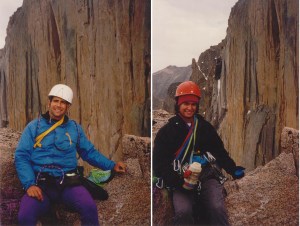
Joe and Topher posing with The Diamond in the background. Thanks to Topher for indulging me.

The Hike Out

The lack of food and water (and altitude?) started to hit me pretty hard.  I hadn’t had any water or food aside from an orange in 9 hours, and I had only consumed 2 liters of water in the last 28 hours.  And all of this on top of gaining 14k feet in elevation in a short time, vomiting, and climbing 1000′ of hard rock. (Thankfully I was still young). After a bit of following water noises, I finally found a gap in the rocks and collected a liter of the wet stuff, which I had to put away to let the iodine pills dissolve. Using and waiting for iodine pills was another first for me; it was not the last time I’d have to suffer and wait.

Once I started hiking down the trail, I felt strangely exhilarated.  Even though I was around other people and walking on or near a well established trail, it was the first time I had ever been in the “backcountry” without other people I knew.  I felt very isolated, and I liked it. Taking in the sights, snapping photos, and watching with real interest the exploits of the local marmots, I just floated down the trail.  I felt great once more.  Everything was good.
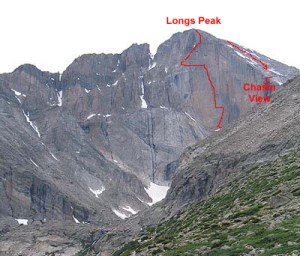
The Casual Route and descent from Longs Peak

I followed the trail signs until I reached the trail junction for Chasm Lake. I couldn’t wait any longer for water, so I stopped and ate my last Powerbar and finished my water while admiring the spectacular views of Longs Peak. I decided it was the greatest peak in the world and that I really needed to come back someday to climb it without a guide (I did so in 1998; see The Casual Route?).

I continued down the trail and reached the Ranger Station ahead of schedule. I was going to have to wait an hour for my 6pm ride, but that was okay. Nothing could spoil my great mood, I thought.

Around 5:30pm, the weather turned ugly.  The wind picked up and rain and hail/snow started beating on me. I tried to get into the Ranger Station, but it was locked.  I put on all my clothes and huddled in the roofed map alcove to hide as well as I could. I was freezing.

And, then, my ride was late.

By 8pm, I was truly miserable.  Wet & cold with only poor shelter from the wind, I knew that my girlfriend was lost and that I was screwed. As I played out the scenarios in my head, I couldn’t see a good outcome. If she couldn’t find me in the daylight with whatever directions she had gotten, how was she going to figure it out before morning? No more light to see by and no one to ask for help; oh, I was definitely screwed.
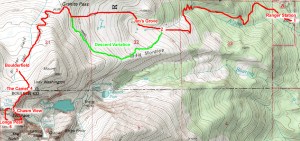
Our route up Longs Peak (red) and my descent variation used (green)

Out of the gloom, a couple walked past me, on the way to their car.  After a polite WTF question, I explained my reasons for riding out the storm.  They offered to give me a ride to town, but I declined.  I didn’t have any place to go in Estes Park.  I needed to get to Boulder, but I couldn’t even go there without getting word to my girlfriend. And I had no way to get any word to her; I was royally screwed.

A few minutes later, as the couple drove past, they paused to make one last offer before abandoning me to the elements.  I decided I would be better served by having no where to go in Estes Park than being stuck out in the open in the middle of nowhere.  I accepted. I piled my stuff and body into the couple’s car and buckled my seatbelt, and then a pair of headlights approached.  It was my ride.

And was she pissed.  While we drove to Boulder, she explained how mad she was about having to drive all over creation, etc., etc. I said that I was sorry for her troubles, but that since I had to sit for 3 hours in wind, rain & hail I probably had the worst of it, and my vote was that we should call it even and drop it.  Uncharacteristically, she agreed.  I must have looked pretty bad.

While sitting in the car and thawing out, I wondered what my climbing buddies would think and how they’d react.  I wondered when they would decide to climb The Diamond.  But as I feared for myself, sometimes the chance to take a particular road less traveled only comes once, and an opportunity missed is an opportunity lost.

“Jump as quickly at opportunities as you do at conclusions.”

~ Benjamin Franklin

See all Trip Reports

See all Longs Peak Massif Trip Reports

Brian’s Fork: Attempt on Yale

July 13, 2009

We were pushing it hard.  I was trying to get my body ready for a trip to Bolivia (to do Illimani & Huayna Potosi) while Brian was happy just to suffer at altitude.  Following the end of ski season in March (we always end resort skiing at the beginning of April to start the snow climbing season), we had done Mummy Mountain (13,425’), Mt. Silverheels (13,829’), Huron Peak (14,003’), and Missouri Mountain (14,067’).  The last peak on my prep list for Bolivia was Mt. Columbia (14,077’).  We scheduled Friday, May 1, 1999 for this ascent.

Unfortunately, the weatherman wasn’t cooperating.  In the 3 days prior to the climb, it snowed 24 inches.  We didn’t know what to expect, but we were just dumb enough to just go for it.

Friday after work, we drove south toward Buena Vista and found the access road to Columbia covered in soft snow up to the fenders.  I managed to get my 4Runner about 0.5 mile up the road before we decided that the chance for disaster was too high; then I got to enjoy backing up in the dark for a 0.5 mile.

Using a flashlight, Brian quickly rifled through the guidebook to find an alternative; we couldn’t let the weekend go to waste.  He found that Avalanche Gulch trailhead (9300’) for Mt. Yale was only 10 miles away via paved roads.  In a rush to get going, we settled on it quickly and started driving.  Looking back and considering the conditions, I can say the route selection was foolish; between the 2 winter accessible routes on Mt Yale  (Avalanche Gulch and Denny Creek), we picked the longer and more technical path.

Brian’s Fork:  if there are two ways to go and one of them is much harder and more dangerous, somebody will want to go that way (corollary to Murphy’s Law, and named in honor of my climbing partner, Brian, who is always looking to make life interesting).

As we drove down US 24, it started snowing again.  We drove through a white, ghostly Buena Vista before finding the turnoff and, eventually, the large parking lot at the trailhead.  We setup camp in front of the truck just after midnight and settled in to collect 4 hours of sleep.

Morning came quickly and we awoke to an ocean of snow.  It was only 5 miles to the summit, but 5 miles is a long way to swim and crawl while navigating via compass and dead reckoning.  The one good thing about the route selected was simple navigation…we just needed to head north until we could see the summit ridge to our left (west); and hope that the visibility would be good.

We took down the camp and set off @ 5:30am into the white hell.  And then it started snowing. The visibility during the climb was generally about 100 feet, with occasional ½ mile views.

Brian ponders the use of a map in a whiteout

Brian ponders the use of a map in a whiteout

The snow was very soft and our path was a bit meandering to overcome the terrain; the result was our progress was very slow.  It took 6 hours to travel 3 miles and ascend 2600’ to reach the 11,900’ saddle linking our route to the summit ridge.  And then it took us another 2 hours to reach approx. 13,000’.  We could barely make out that we were below a steep section of the ridge (how we gauged altitude) before fog rolled in and limited visibility to 10 feet.  We stopped at 2pm for lunch and to assess the situation.  It would be 2:30pm before we started again…5.5 hours of daylight left.  If we took 2 more hours to reach the summit, we’d only have 3.5 hours to find our way out before dark.  And we’d probably already lost our tracks to snowfall.  It was a bad bet; it was time to bail.

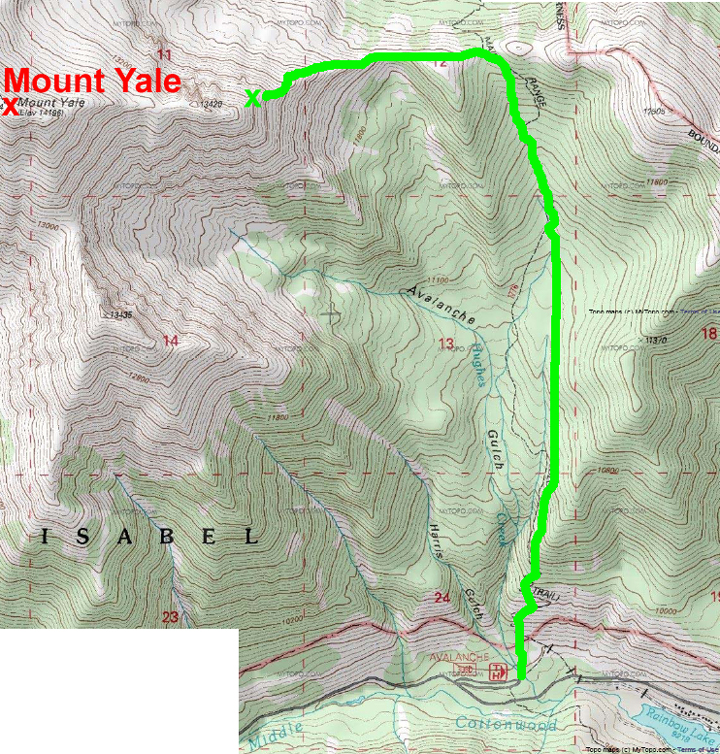
Our route up Mt. Yale's Avalaunche Gulch route

Our route up Mt. Yale's Avalanche Gulch route

I turned to retrace my steps and found that I couldn’t see the ground.  I could see my boots, but not the ground I was standing on.  The ground, the sky, the skyline…everything was white…I was floating in white air.  It was very disorienting to my sense of balance and direction to not be able to see anything for reference to my body.  And the real problem was that I was standing on a cornice.

On the ascent of the summit ridge, we were not able to stay on the ridge proper due to a cornice.  We skirted the ridge along the north side before mounting the cornice just below the steep portion of the ridge where I turned around.  And I couldn’t venture more than a foot to the south side as the angle steeped quickly and the hard-packed snow very slippery even with crampons on.   So now I had to walk along the edge of the cornice with my eyes closed!

I tried to stay toward the south side to avoid stepping too close and falling over the edge of the cornice on the north side.  But the only way I could tell if I was too far to the south side was by slipping down and self arresting.  So I tried to shift my balance carefully to avoid stepping on naught but thin air.  Twice I stepped through the cornice edge and barely caught myself with my axe.  After recovering from the initial fall, I just stood there and marveled at the absurdity of the situation.

It was a long retreat.  We couldn’t find our tracks due to the additional snowfall, but we recognized the terrain well enough to find our way back before dark.   We had taken 13 hours to climb and descend 7 miles (RT) & 3700 feet of elevation.  Some might call it pigheadedness, but we called it good exercise.

Joe catching a rest in the soft snow

Joe catching a rest in the soft snow

It was our first retreat on a 14er first attempt; I was sorry to see our record go by the boards.  But it would also be the only failure to summit on an intial 14er attempt…57 out of 58 ain’t bad.

See all trip reports

A Rainy Capitol

July 13, 2009

Capitol Peak had been highlighted on my list for some time.  I dreaded the “knife edge” but yet craved the chance to face my fears.  When my friend, Mark was coming back from Chicago for more high-altitude abuse, we decided on Capitol Peak outside of Aspen, CO to make it interesting (hard) and meaningful (tick off another 14er).  Our plan was to:

  1. Drive up Friday afternoon from Denver International Airport and make camp at Capital Lake,
  2. Get an early climbing start to beat potential weather for a Saturday summit,
  3. Spend a care-free night overlooking the Capitol Lake and Peak area, and
  4. Make an early march out to Mark’s plane for Chicago on Sunday afternoon.

What we didn’t plan on was the incredible stormy weather.

Story

On July 25, 2003, I left Boulder at 9:45am to pick up Mark at DIA.  Maneuvering through unusually heavy traffic, I managed to pickup Mark at 10:45am and we set off toward Snowmass immediately. The drive went quickly as we caught up on recent events, and we hit the Snowmass turnoff of CO-82 at approx. 2:45pm.  The road to the Capitol TH was direct, short and of good quality; and after a bit of packing we were hiking at 3:30pm.

Early in our approach...Mark posing in front of Capitol Peak

Early in our approach...Mark posing in front of Capitol Peak

We selected the longer, gentler cow path starting at the far end of the parking area , and reached Capitol Lake at 6pm.  Along the way, we had to hide from a moderate rainfall occurring between 4 and 5pm.  It was a sign of things to come.

The campsite on the knoll nearest to Capitol Lake looked the best and we set up camp on a mid-level spot overlooking the valley north of Capitol Lake.  In selecting a specific site, I couldn’t find an idea location.  I had to choose between a site with bad exposure to wind and lightning but good drainage, or a site with better shelter but a strong likelihood of pooling of water in the tent area. In a decision to be debated over the years, I elected to risk the pooling water vs. the lightning and wind.  To compensate, I spent an hour collecting and placing rocks to use as a vestibule platform and to keep the edges of the waterproof flooring off the ground.  With my enhancements, I figured I could survive a puddle as deep as 2 inches.

Our first close-up view of Capitol, as seen from near our campsite

Our first close-up view of Capitol, as seen from near our campsite

We had plenty of daylight for water bottle filling, dinner preparation and card playing before turning in for an attempt at sleep.  It was one of those silent nights where every rubbing of nylon over nylon roared in the ears. We spent most of the night listening to each other’s noises, with rare, unknown moments of unconsciousness.  But time is relentless, and the alarm went off as planned at 5am.  We rose and made ready for our climb.  Another bottle filling exercise and other duties later, we were hiking up the Daley Pass at 6am.

Our ascent route for Capitol Peak

Our ascent route for Capitol Peak

The general plan was to follow the obvious north-south (as the compass reads) ridgeline of Capitol Peak that you see from the Capitol Lake in four phases (some details added based on my own experience):

  1. Hike up the grassy slope directly east of Capitol Lake, turn right, and within a 100 yards descend a rocky gully to reach the low angle terrain below the cliffs on Capitol Peaks ridgeline on the east side of Capitol Peak
  2. Make a right turn and take a direct line south-ish toward a notch in an east-west ridge connecting Clark’s Peak and K2 … aim generally for the right side of the notch and the snowfield below it.  When K2 comes into view on the right (if you are not sure, keep going…when you see K2 you will be sure of it), head directly towards it.  Summit K2 either by circling left just below the summit and then climbing up or by going directly up to the summit.
  3. Take care but move quickly through the knife-edge area.  The rock is excellent on the hardest looking sections; simply straddle the rock to eliminate any chance of falling.  Use the good footholds.  Take care in the easier-looking sections, as obvious rock holds are often loose.  Trust nothing; test all holds before weighting them.  Follow the cairns to the east below the ridgeline.
  4. Work up and generally left through the grit-covered ledges.  Step carefully and do not push off with your toes when climbing through the loose rocks as it will cause rocks to fall on climbers below you.  When possible, get to the rocky edge (left side of face) of the east face below the main ridgeline and climb the bulging rocks (test every one you use).  This ridge will curve back toward the main ridge; once at the main ridge of Capitol Peak, head left (south) for 100 feet to the summit area.
  5. The descent back to the knife-edge is the hardest part; take care to test all holds and step on solid ground.  Return the ascent path; look for cairns lower than you may remember to stay on the correct path.
Capitol Peak elements

Capitol Peak elements

The route was fairly clear, from the plan gathered from multiple sources.  From the top of Daley Pass, we followed cairns and footprints in the snowfields down toward the valley floor.  We stopped descending at about 100 feet of elevation above the valley floor, and headed south toward the obvious notch at the backend of the valley.  There was more snow than expected, but the conditions were excellent for foot travel; the snow was soft enough for secure steps, but firm enough to support our weight.  Once we could see K2, we made a hard right and began a gradual ascent toward it.  We summitted K2 by angling to the left (as you approach K2) and then ascending to the summit from that side; the route was obvious, but loose.  I believe climbing straight on to the summit would be the easiest and safest.

A view from K2...my route noted in red

A view from K2...my route noted in red

We took a break on the summit of K2 and took in Capitol’s features; the view of the ridge to the summit was very impressive.  It was also intimidating;  Mark felt it was too difficult for a Flatlander and announced his intention to wait on K2 while I completed our plan.

Respecting his wishes, I continued, working my way down from the K2 summit via the only way I could find:  a hard class 4 move down the North face.  This difficult move turned out to be unnecessary, as I later found a much easier route via a ridge a bit further toward the right edge of the north face.  The knife-edge was a unique and pleasing climbing experience, but did not have the exposure I had expected.  I had “knife-edge” on the brain.  Still, it was exposed enough that I used a straddling position with my weight on my hands to move quickly through this section.

The next section was the worst.  I’ve heard it called “ledge madness” and “loose, awful climbing” and it is all of that and more.  Rocks falling from other climbers, loose rocks, and pebbles on small ledges made for many minutes of intense concentration.  I found that working up and left and then staying left as long as possible made the ascent the least dreadful.  When it was necessary, I moved right back toward the Capitol ridgeline.  Once at the ridge, I moved south (left) approximately 100 feet to the summit.

I reached the summit at 10am.

A view of Snowmass from Capitol

A view of Snowmass from Capitol

From the Capitol Peak summit, the view of Snowmass was spectacular.  I noted the melt-out of the massive snowfield I had glissaded a few years before.  I also took note of the cool view of our campsite…this is an incredible place.

I signed the register after a quick snack and headed back down to meet Mark on K2.

Our campsite seen from Capitol summit

Our campsite seen from Capitol summit

The descent through ledge madness and loose, awful rocks was worse on the way down.  Controlling rock fall and avoiding a personal fall on this loose junk was taxing on my mental stamina.  Getting to the knife-edge was a relief; I was tired of the stress.

Mark and I returned via our approach route and reached camp at 2pm.  Due to the worsening weather, we briefly discussed changing our plan to hike out immediately.  I successfully argued that a night spent outdoors would be far better than any other alternative.  We filled our water bottles and crawled in the tent for a quick nap.

I awoke from my post summit nap at 6ish to find it storming; Mark told me it started at 3pm.  The lightning was amazing and we were glad to have a sheltered campsite.  The tent and ground were holding up well to the rainfall so far, but we hoped the flow would stop soon.  About 8pm, the storm abated and we were able to exit the tent to make some dinner.  The sky did not look good, so we hurriedly finished and repacked the food and gear so we could eat undercover if it became necessary.  It did.  The rain and lightning resumed and lasted until 10:30pm.

Mark getting a headstart on his nap at camp

Mark getting a headstart on his nap at camp

Me and my big mouth; we should have gone home.  Or, if I had been warned by God, I would have built an ark. Approximately 7 hours of rain had overwhelmed the soil and created a wading pool upon which our tent sat.  My tent and my preparations were overwhelmed, and we floated the last few hours before rising at 4am to pack up.   On the good side, the continuing noisy weather drowned out Mark’s noises and I slept well for a soggy 5 hours.

We moved slowly and carefully around our mud hole campsite, and took an hour to get ready.  The miserable long hike out was punctuated by the massive trail damage and fecal matter from the herd of black cattle roaming Capitol Creek.  We reached the car, changed clothes and repacked in time to meet our deadline of  “driving by 8am.”

Several hours later, I dropped Mark off at DIA for his long stinky flight home.  I arrived at my home at 2pm to enjoy a few final hours of weekend that started with laying out all my gear in the sun to dry out.

It was a great trip.

See all Trip Reports

Flying Blind: Wetterhorn & Uncompahgre

April 25, 2009
Me and Isabella @ 4 years old

Me and Isabella @ 4 years old

I was going to be a dad.

My wife and I were going to have our first child, a girl whom we would name Isabella.   It was going to be the most exciting day of our lives.  But the big event was 5 days away; surely I had time to bag some Colorado 14ers beforehand.

Yet, having time and having consensus for such an adventure were two very different things.  I carefully worked out and then very carefully delivered my thinking to my wife.  I argued that it would be far, far better that I go adventuring right before rather than right after our first child is born. Right?  The Assumptive Close (changing the question about going from whether to when) was a long shot, but it was all I had.

She agreed! My wife is a very understanding and generous person. I always take credit for picking her.

With a family consensus in hand,  I made plans to leave for Lake City on July 26, 2002 to collect Wetterhorn and Uncompahgre, and possibly also San Luis.  These were three of the few unclimbed 14ers on my list of 58 Colorado peaks over fourteen thousand feet. And with the rest of the world having better things to do than climb 14ers on the far side of the state, I would go alone.

By the morning of, I had everything ready except my navigational planning.  I still didn’t have confirmation on the current information for the drive to the trailhead or the approach hike from the Matterhorn Creek trailhead.  And in the few remaining hours prior to departure, I stupidly wasted my time on unimportant and unrelated tasks, forcing me to leave unprepared and behind schedule.  Reduced to relying on the guidebooks printed years ago, I grabbed my Dawson and my Roach books and headed out into rush hour traffic; my punishment would be the trauma of  being “lost and flying blind” in the Heart of Darkness.

“Flying Blind” is an aviation term that describes a navigation scenario where the pilot/navigator cannot see the ground and must navigate by instrument alone to find a place to land before the fuel runs out (and the aircraft crashes into the ground).   When through error or mishap the aviator becomes “lost and flying blind,” he rides a ticking time-bomb while desperately gathering information to save himself.

As expected, I arrived in Lake City after dark:  no one to ask for directions and nothing to see but roadsigns.  Heck, I didn’t even have a map, just the guidebook directions that were printed years before. And yet, it might have even worked, but I was in too much of a hurry to stop for 5 minutes and read the dang directions carefully.

My simul-drive-read concluded with a simple set of instructions for me to follow:  drive into Lake City via CO-149 and turn right at the sign for Engineer Pass that I’d find near the middle of town, and then take that road to a junction near Capital City to find a sign for Matterhorn Creek.  It wouldn’t be hard, but flying blind, without any normal visual clues or basic spatial orientation, I could not afford to lose my way.  I might not find it again in time.

I had been to Lake City before, so that wasn’t hard.  Then I found the sign for Engineer Pass and made that turn; so far so good.  After 2 blocks the road ended in a T-junction with a sign that said, “Alpine Loop — 18 miles.”  Crap.  I looked down the road each way, but couldn’t see anything in the pitch dark.  I turned around and went back to the main drag to see if I could find additional clues.  Nothing. I was screwed; 5.5 hours invested (and just as much to get home) and my narrow time window quickly closing.  I couldn’t believe I had let myself get into this situation.  So stupid.

Full of dread, I went back to the T-junction and guessed left.  I followed the Alpine Loop that I feared would take me on a tour of the utterly dark mountains and deposit me back in Lake City after an hour of anxious self-loathing, and leave me with nothing to do but go home empty handed.

Now I was lost and flying blind.

It is a battle between confidence and fear.  Confidence of success desperately hangs on while pulled down by the weight of the rapidly growing fear of failure.  The driver, lost and flying blind must go on and on as long as possible, afraid to turn around because the goal might be just ahead, but afraid of being wrong and losing irreplaceable time. Desperately seeking a clear confirming clue, the driver continues until exhausting his reservoir of hope.  With his confidence broken, the driver turns around without knowing if he is actually lost. And, in the worst case, the driver returns to search for additional information, only to find that he was almost at his destination, and now does not have enough time.

A mistake of this magnitude could ruin the trip (if not a life!), and such a terrible conclusion is worthy of great fear.

Desperate to figure out where I was in the pitch dark, my solution was to go faster.  Driving at top speed with my nose in the guidebooks; I looked up periodically to stay on the road while trying to find some information in the books about the “Alpine Loop” or some clue that would confirm I was on the right road.  Heck, I’d have been delighted with indisputable evidence that I was on the wrong road.  The uncertainty was killing me.

Eventually I read that the Nellie Creek trailhead was found off the road I hoped I was on. It was only supposed to be 5 miles up the road, but when I didn’t find it (started looking too late) or any other indication of where I was, I lost hope.  I turned around.  I figured I should get back to Lake City before I forgot how.

When I got back to Lake City, I looked again for any road signs that I missed in the darkness; but found nothing.  It was time to go home; but before spending another 5.5 hours on that long, lonely drive, I thought I’d invest 5 minutes in careful, non-driving study of the directions.  I pulled over and started reading carefully; it took only one minute to find my mistake.  I was on the right road the whole time and must have been within minutes of finding the sign to Matterhorn Creek.

So, I went back up the road to Capitol City (noticing the Nellie Creek trailhead along the way), and then turned right onto North Henson Creek Road to head up to Matterhorn Creek trailhead. The road roughened significantly at this point, but still wasn’t too bad for a 4×4. After a couple miles, I entered a full parking area for the trailhead at 10,400 feet. I continued up the “four wheel drive road” for another 300 feet to reach the high parking lot below the Forest Service Gate at 10,720 feet. I continued up, taking the right fork at the end of the camping area, to an empty parking lot next to the trailhead register. I made it. It was 11pm; the drive to Lake City was 280 miles long and had taken 5.5 hours (51 miles per hour), while the drive from Lake City to the trailhead was an additional 12 miles in 2 hours.  I was so happy to still be in the game that I wasn’t even mad.

I set up camp quickly and spent the early morning studying the guidebooks. The weather had been rainy lately and was forecast to thunder in the afternoon; I would need to move quickly and without additional mistakes.  And to minimize the chance of weather interruption, I planned to start hiking at 5am.  Starting even earlier was a problem because I needed to be able to see well enough to find a switchback leaving the main trail less than 1 miles into the hike.

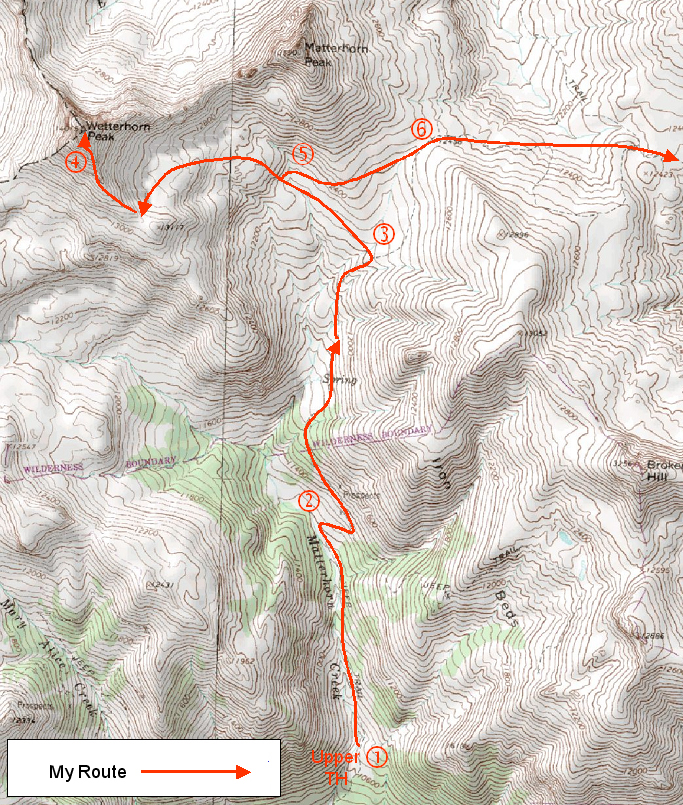
My route from the Matterhorn Creek trailhead to Wetterhorn Peak

My route from the Matterhorn Creek trailhead to Wetterhorn Peak

My guidebook study resulted in a plan what would start with five sections:

  1. Wake up and leave camp
  2. Find the place to leave the main trail and switchback up to a higher trail
  3. Find the cut-off point to leave the main trail and head toward Wetterhorn’s southeast ridge
  4. Ascend the tricky steep finish to reach the Wetterhorn summit; decide if a traverse to the Matterhorn summit was a good idea (it wasn’t)
  5. Return to the main trail heading toward Uncompahgre
  6. With a close up view of the peak, decide which route to take to the summit of Uncompahgre

The alarm went off at 4:30am. I packed my gear, my copy of Roach’s 14er book, and put on my trusty old Makalus that I had resoled after several futile attempts to break in my new Eigers. I had not seen any tents the night before and was worried that somehow I was camping in an illegal spot, so I decided to pack up the tent before leaving. This and other distractions cost me an extra 30 minutes.  I began hiking at 5:30am; yet, I was the first on the trail, somehow.  And with a near full moon, I could see the sky was already threatening.

About the time I started worrying about having missed the “switchback” I found it. Basically, the main trail is blocked off.  The only way to proceed is to follow the switchback. I continued up the trail, slowly gaining ground on the mountains until I could see the Matterhorn Peak in the early light; oh, what a misuse of a great name.

I was tempted to follow Roaches advice regarding the Wetterhorn / Uncompahgre combination, and do Uncompahgre first. But since the weather was threatening, and the most difficult climbing was on Wetterhorn, I decided to reverse that order.

Roach says to “leave the main trail at 12,040 feet”…a rather precise instruction to use with an altimeter that is never more reliable than +/- 200 feet (a variance of approximately 1/2 mile along this hiking trail). Without some sort of landmark. I tried to get my bearings by looking to the Wetterhorn Peak and its Southeast Ridge but couldn’t see much from beneath the ridge. I decided to  mimic the route drawn on the map by veering 45 degrees left (northwest) toward the saddle between Matterhorn and Wetterhorn peaks once the main trail turned toward Uncompahgre.  Of course, knowing when the trail makes a permanent turn in direction vs. just a temporary one isn’t easy.  But it was a plan.

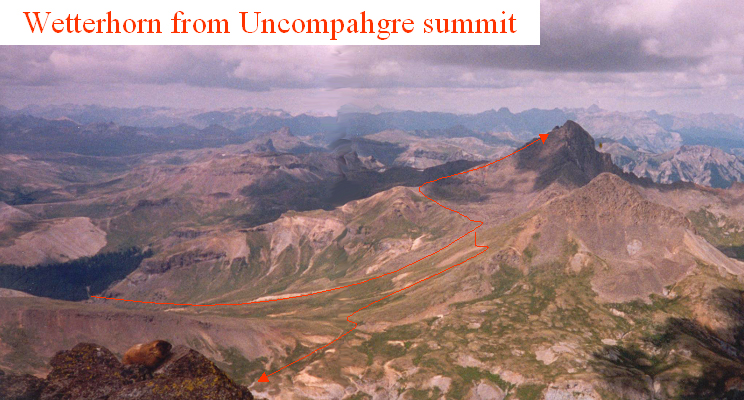
A view of Wetterhorn and my early-day route, seen from the summit of Uncompahgre

A view of Wetterhorn and my early-day route, seen from the summit of Uncompahgre. The marmot in the lower left is waiting for me to leave my food unattended.

I had a moderate amount of altitude loss and wandering.  After proceeding northeast approx. 0.25 miles, I found a well-beaten trail which I would follow up to the southeast ridge.  Looking down, I noticed a single set of fresh footprints in the mud.  I was surprised because I hadn’t seen or heard anyone on the trail. I wondered if the climber was from the bivy site I passed on a grassy slope below. I looked up toward the ridge to look for him/her when movement on the summit caught my eye – a climber! This person had summited before 7am; that’s commitment.

I had made good time (1,500 feet per hour) so far and wanted to manage my energy level. In my life-long battle to bring-enough-but-not-too-much-water, I had decided to bring four liters (I can hear Brian groaning at this admission). I just didn’t know for certain that I’d be able to find any and I had a long day of hiking. To avoid dragging nearly 10 lbs of water up Wetterhorn, I decided I would stash two liters down low.  All I had to do was remember to reclaim it.

The Middle Notch

The Middle Notch

I continued up to the saddle between Point 13,117 and Wetterhorn and then up the southeast ridge. The hiking included a significant amount of scrambling, but all easily within 2nd class difficulty. Numerous cairns revealed numerous paths; I took the path closest to the ridge and passed underneath and left of the initial towers and eventually reached a flat area to the right and beneath the peak of the “Ships Prow” tower.

From this point I could see 3 notches, which didn’t match the descriptions of my guidebooks (they mentioned either one or two notches). Fortunately, the middle notch (see photo) had a big cairn near it, so I climbed it first and found the impressive finish to the climb.

The last 100 foot stretch was very impressive:  steep and airy. In slippery conditions, I could see it would be troublesome.

And the sky looked like rain.

The final stretch beneath low clouds

The final stretch beneath low clouds

I traversed the down angle ledge to the east for 15 feet to reach the bottom of the finish. I paused to test holds a couple times, but the handholds were good enough to catch my weight if a foothold broke. I reached the tiny summit at 8am.

I looked down the ridge toward Matterhorn to see if I might bag it as well, but the ridge looked loose and steep. After a moment, I retreated back to the summit having silently agreed to leave the Matterhorn for another day. As I looked for a comfy rock to sit on, a cloud rolled over the summit obscuring my vision.

I wanted to see the footholds as I down climbed; so I descended as soon as visibility returned. Naturally, the down climb was harder than the climb up; but I only needed a few  “face-the-rock” moves to make it back to the ledge, and then the Middle Notch.

After a quick break below the “Ships Prow”, I was ready to start back down the southeast ridge. That is when I realized that I hadn’t again seen the person whom I had spied on the summit at 7am…hmmmmm. Where did he/she go? Perhaps I should name my trip report, “The Ghost of Wetterhorn”?

The descent went quickly. Once reaching the saddle with Point 13,117 on the southeast ridge, I turned left (north) off the ridge and headed toward Matterhorn. I backtracked my original route and discovered that the trail I had used earlier in the morning was a good traversing route between Wetterhorn and Uncompahgre; I didn’t lose any altitude and was able to take a nearly straight shot west to the saddle between the two 14ers at 12,380 feet. Oh, and I collected my stashed water.

Once I connected with the main trail, I followed it over to where I could see Uncompahgre where I began to consider how to climb it.

My early morning study revealed three basic options:

  1. Go the long way around to the using the Southwest Slopes route which connects with the East Slope route taking approximately 2 extra miles than the shortest route
  2. Take the shortest path, 2000 feet directly up the West Face (steep scree slope) to join the East Slope route near the summit
  3. Take a compromise path that Roach calls V1 of the Southwest slopes route, which takes a mile off the long approach and only goes up 1,000 feet of rock to the ridge line.
A view of Uncompahgre from the south, while hiking around to the east

A view of Uncompahgre from the south, while hiking around to the east

I was in a hurry to beat the weather, but I wasn’t willing to churn up the scree and cause significant erosion; I took the third option.

I left the main trail and did a bit wandering to find the start of the V1 route. It looked a bit looser than I expected, but only the first 400 feet were very steep and loose.  The rest of the route was straightforward, and I reached the ridgeline (13,260 ft) at 10:45.

The view from the ridge was impressive (see photo). A massive cliff band stood before me guarding the large, flat summit area.

My initial reaction was…”wow!…do I get to climb that cliff?”

The forbidding cliffband protecting the Uncompahgre summit

The forbidding cliffband protecting the Uncompahgre summit

But it wasn’t to be so.  The trail angled up to the south corner of the broad summit where it turned the corner and reached the south face. The trail switch backed and scrambled to the summit area, then traversed north and, finally, headed to the western edge. I reached the summit at 11:30am.

The wind was hard and cold; I was only able to remain on the summit at all by wearing my jacket, balaclava, and gloves. I enjoyed most of the rest of my dwindling water supply and a couple Balance Bars while examining my route up Wetterhorn.  I also enjoyed the views of Sunlight, Redcloud, and Handies which I had climbed a few weeks earlier (see trip report).

After a fast, enjoyable 20 minutes on top, it was time to get down.

I had climbed 5800′ and was running out of steam.  I was sorely tempted to go down the West Face route to shave some effort.  But with the weather cooperating, I still couldn’t justify the trail erosion.

I resolved to return using the trail I had ascended.

Once back down to the Matterhorn Creek trail, I took a short break near a creek to clear my boots of gravel and replenish my water supply.  I also needed another rest.

The weather was still holding; but to be prudent, I kept up a good downhill pace to reach treeline. I reached camp by 2:30pm despite another brief rest below treeline.

I was tempted to stay another day to collect San Luis Peak since I was so close to it, but I felt anxious to get home. Better late than never, my wife was probably thinking when I explained my early return.

It would take me 4 years to return to collect San Luis.

Despite a rough start, I got my 14ers:  approximately 15 miles and 5,800 feet of elevation gain in 8 hours.

My route map for summiting Wetterhorn and Uncompahgre

My route map for summiting Wetterhorn and Uncompahgre

The day included 10 sections:

  1. Wake up and leave camp
  2. Find the place to leave the main trail and switchback up to a higher trail
  3. Find the cut-off point to leave the main trail and head toward Wetterhorn’s southeast ridge
  4. Ascend the tricky steep finish to reach the Wetterhorn summit; decide if a traverse to the Matterhorn summit was a good idea (it wasn’t)
  5. Return to the main trail heading toward Uncompahgre
  6. With a close up view of the peak, decide which route to take to the summit of Uncompahgre
  7. Find the start to the V1 route to join the East Slopes finish on Uncompahgre
  8. Complete the ascent of Uncompahgre
  9. Enjoy the summit of the 6th highest mountain in Colorado and the  highest on Colorado’s Western Slope
  10. Go home and be a good husband and father
My observation of mountain name appropriateness

My observation of mountain name appropriateness

Six and one-half hours and three liters of Diet Coke (for caffeine) later, I was home. It was a great trip designed to scratch my 14er itch, but it didn’t work; two weeks later I used my in-laws visit to excuse another trip to collect Castle and Conundrum.  But, don’t worry; I would get my “just desserts.”

The Castle-Conundrum trip would be my last for a while as another “lost and flying blind” scenario conspired with errors in judgment to give me an injury.  It was time to start being a better husband, and to get serious about this father thing.

See all trip reports

See blog introduction, rules, laws, etc.

The “Casual” Route?

March 31, 2009

The Diamond.

The East Face of Rocky Mountain National Park’s Longs Peak is the greatest alpine climbing wall in the Universe.   Sure, it’s just my opinion, but read on and judge for yourself.


The Diamond of Longs Peak

The Diamond of Longs Peak (photo taken 7/1/94)


When I started rock climbing some years ago, the Diamond was a place of legend:  only the climbing Greats dared challenge the gods with an attempt on the Diamond.

It requires nearly 1,000 feet of high-altitude technical rock climbing in a lightning-filled environment over wet, cold, vertical rock that cannot even begin until completing an approach of nearly 7 miles and well over 3,000′ of elevation gain.   And the easiest route up the face requires the skill and stamina to complete two pitches of 5.9-5.10a, three pitches of 5.8, and three pitches of 5.5-5.7 at nearly 14,000′ elevation.

Adding insult to this impossible dream, the easiest route is called, “The Casual Route, ” in honor of Charlie Fowler’s description of his free solo (no rope, no protection) climb of the route in 1978…he said it was “casual” in the sense of…

…not difficult, child’s play, a cinch, easily done, effortless, inconsiderable, no problem, no sweat, no trouble, nothing to it, a picnic, a piece of cake, straightforward, and undemanding.

Uh huh.  Thanks for your opinion, Mr. Fowler.  I guess that’s one for and one against, as far as voting goes.

Back in the old days, my Midwest climbing friends and I didn’t dare admit having such ambitions; we would only talk about how amazing and crazy some climbers were, and we’d keep our true feelings of envy and aspiration to ourselves. But, over the years, as I grew into a better climber and a mountaineer, I dared imagine that I, too, could climb the Diamond. Someday.

This trip report is about the effort my buddy, Brian, and I made in an effort to climb The Diamond.

Story

Having brought ourselves to thinking that we could really do it, Brian and I decided that we’d use the Spring & Summer of 1998 to prepare our skills,  fitness and confidence for a late Summer attempt.  During the 4 month preparation, we completed the following alpine snow & rock climbs to ready ourselves physically, intellectually, & emotionally:

  1. Squaretop Mountain; snowclimb (4/98)
  2. Mt Belford; snowclimb  (4/98)
  3. Mt. Princeton; snowclimb  (5/98)
  4. Mt. Harvard; snowclimb  (5/98)
  5. Mt. Tauberguache; snowclimb  (5/98)
  6. Mt. of the Holy Cross; snowclimb  (6/98)
  7. Longs Peak via Kieners; snow and rock scramble (7/98)
  8. The Saber in RMNP; 11 pitches up to 5.9 (7/98)
  9. Jackson-Johnson on Hallets Peak; 9 pitches up to 5.9 (7/98)
  10. The Love Route on Hallets Peak; 8 pitches up to 5.9 (8/98)

We had prepared very hard and felt ready to proceed.  When the weatherman predicted good weather, we set the date:  August 8, 1998.

The overall plan was:

  1. Hike in the day before to save energy for the climbing day
  2. Camp in the Boulderfield (to avoid a free solo of the 4th class plus, 320′ plus North Chimney)
  3. Descend to Broadway Ledge via the Chasm View rappels (3 150′ rappels in the pitch black darkness)
  4. Traverse the snowy ledge to the Casual Route start, skirting the opening of the North Chimney
  5. Climb the Casual Route (7 pitches plus traversing finish)
  6. If unsuccessful, escape via many rappels down the Diamond’s face, and then ascend the Camel Route to reach our campsite
  7. If successful, traverse the Table Ledge to finish the climb via Kiener’s Route
  8. Traverse to the North Face Cable Route and rappel back to Chasm View
  9. Hike back to the Boulderfield to pack up and head home

Before it was over, we’d be sleep-deprived, starved, dehydrated, exhausted, rained and hailed on, surprised, horrified, and delighted.


Brian next to his tent in the Longs Peak Boulderfield

Brian enjoying a moment of rest in the Longs Peak Boulderfield


The Hike into Camp

We started hiking in toward the Boulderfield at 9am.  We had all day to cover the distance, so we took our time.  We arrived at the Boulderfield and setup camp; and we still had hours to kill.

We wandered up to Chasm View to take in the sights, snap a few photos, and prepare ourselves to find the rappel anchors in the dark a few hours hence. All was proceeding well until we noticed the clouds building.


Joe posing with the Diamond looming in the background

Joe posing with the Diamond looming in the background


The weatherman was wrong.

One of the key problems in climbing the Diamond is the weather.  It is east facing, so any approaching weather cannot be seen until it is overhead; and with escape only possible via multiple rappels requiring one or more hours to perform, we’d have to move very fast to have any chance.  And we’d have to be lucky.

The Approach to the Climb

We arose in the dark and started for Chasm View at 4:15am.  Using headlamps, we wandered among the refrigerator-sized boulders, orienting ourselves using the faint outline of Longs against the dark sky.

Reaching the Chasm View area, our previous day efforts paid off with the quick acquisition of the Chasm View rappel anchors.  We unpacked the harnesses and the rope and made ready for a descent into a pit of darkness.

I took the first rappel.  The light from my headlamp illuminated the canyon walls, but couldn’t reach to the bottom. It was a creepy feeling to rappel into an abyss, but my lack of sleep muted any strong emotional response.


A view of the Chasm View rappel area from the start of the Casual Route; 3 150 foot rappels to descend to Broadway Ledge.

A view of the Chasm View rappel area from the start of the Casual Route; three 150 foot rappels to descend to Broadway Ledge.


My only job besides not dying was to find the next set of rappel anchors.  I only had one chance to find them as we couldn’t go back up without losing the day.

But the day started well; I found the anchor. I clipped into the bolts and then unclipped from the rope. I called out for Brian to come on down by yelling, “Off rappel!”  Brian stepped over the edge carrying our gear pack, rappelled down and clipped in next to me.  After he unclipped from the rope, I started pulling the rope down from the initial rappel anchor while he threaded it through the 2nd anchor. As we neared the end of the process, his headlamp died.

I couldn’t believe it.  After 4 months of planning, he didn’t replace the 50 cent batteries. Fortunately, it wasn’t really a big deal.  I would just have to find the next two anchors.  Although, it was possible that we’d have to wait a few minutes at the bottom of the raps for the sky to brighten enough for Brian to accomplish the traverse to the start of the climb without falling off Broadway Ledge.

I finished getting ready for the next rappel while Brian put the dead headlamp away in our gear pack.  I heard him say, “Shit!”  With some reluctance, he explained that when he unzipped the backpack, one of his rock climbing shoes fell out and disappeared into the darkness.  Now that was a big deal.  No shoe, no climb.

If the shoe fell below Broadway Ledge, all the way down to Mills Glacier, it would take us too long to recover it even if we could find it.  We’d lose the day. Brian says, “Sorry.”  I replied, “Maybe we’ll get lucky; maybe it stopped at Broadway Ledge.”  In one part of my mind, I was mad; all this effort wasted.  In another part of my mind, I was relieved that we would be going home alive.

But we had to try to find it, so we continued down into the black pit.

At the bottom of the 2nd rappel, there it was.  Brian’s shoe had stopped on a small ledge. The climb was on.

We completed the 3rd rappel and then started the traverse immediately.  The daylight had begun, and we could see without the headlamps.  And we could see that the sky was already threatening.  Top of the North Chimney was a loose, snowy, narrow, sloping trap.  We decided to do a belay while skirting the rim of the North Chimney and then found “The Ramp” about 20 feet further.  At the top of that large sloping ledge, we started the climb with the knowledge that we had to go fast.

The Climb


Joe on top of the D1 pillar, about to start the 5.9 crack of Pitch 2

Joe on top of the D1 pillar, about to start the 5.9 crack of Pitch 2


Pitch 1: Brian gave me the pack and took the first lead up a left-facing corner, and then up and left to a ledge. I followed without incident. We were delighted to see that the weather was clearing. (5.5)

Pitch 2: I took the second lead up a short easy section to the top of a pillar, and then up a tough crack to a belay stance near the start of the traverse.  My primary concern was to find the correct traverse starting point.  The correct traverse is a protectable 5.7 while the improper one is poorly protected 5.10c.  I found it right at a spot with a nice stance. Brian followed quickly behind. (5.9)

Pitch 3: Brian took the traverse.  While technically not difficult, crawling sideways is always harder than climbing up. I found it hard to find the best route over the flakes and small ledges, negotiating past wet rock, and trying to keep the gear pack from pulling me off-balance.  We belayed beneath a squeeze chimney. (5.7)


A view straight up of Brian leading the 5th pitch

A view straight up of Brian leading the 5th pitch


Pitch 4: I led the fourth pitch up a short, challenging squeeze chimney, and then up and slightly left on easier terrain to the end of “The Ramp2.”  I made sure to continue past the initial piton to give Brian enough rope for a long 5th pitch. Brian followed without incident. The weather started worsening. (5.8)

Pitch 5: Brian then led up a long dihedral and belayed at a grassy ledge.  I followed in light rain & hail.  By the time I reached the belay, the rain & hail had stopped.  We didn’t even discuss bailing. (5.9)

Pitch 6: I took a short lead to the Yellow Wall Bivy Ledge, which was a magnificent ledge for such a vertical environment.  I could see how it would be possible to sleep on the ledge quite comfortably.  Once Brian arrived, it started to hail and rain again, but this time a bit harder.  And then it stopped again.  Still no lightning, so we didn’t speak of retreating.  We took a short break to give the wind some time to dry out the technical crux of the route.

Pitch 7: The crux pitch.  If we could get up this last pitch, we would make it. But failure was still within our grasp:  if the rock got too wet or if lightning started, we’d fail and bail.  Brian took this lead and moved very quickly.  After a short time, the slack in the rope started being pulled up.  After 3 quick rope tugs, it was my turn to make it past the several hardest moves of the climb. As I started climbing, the rain & hail started again.  I continued up through the wet, narrow inset, and then started up the squeeze chimney.  I struggled to get through the chimney with the pack on; when I finally got past it, I was completely exhausted.  I took off the pack and passed it up to Brian, then I steeled myself to move past the bulge blocking my path to Table Ledge. Then it was over.

We had made it.  I needed a short break, despite the threatening weather; but we couldn’t fail now.  We had finished the Casual Route, but we still needed to escape the face and the mountain.

The Escape


Joe sitting on the far end of Table Ledge, preparing to belay Brian to complete our escape from the East Face of Longs Peak

Joe sitting on the far end of Table Ledge, preparing to belay Brian to complete our escape from the East Face of Longs Peak


We were sitting on the Table Ledge which we needed to traverse left to link up with the Kieners Route.  But the ledge had a break in it, so we had to do a descending and then ascending traverse to find our escape.  I started by traversing left past a piton, and then down and left about 25 feet to another ledge called Almost Table Ledge.  A wet downclimb is challenging in any case, but at nearly 14000 feet and after hours of climbing, it was very unnerving.  I carefully traversed left until I could climb up to the Table Ledge again and belayed off some fixed gear backed up by two cams.  Brian followed quickly, and then we continued left, walking along the ledge until we could move above the Diamond onto the north face.

As we stepped above the Diamond, we were shaken by thunder.  To minimize our exposure to the elements, we traversed directly to the Cables Route.  We were rained and hailed upon, but no close lightning strikes.

After a short hike, we rappelled down to Chasm View, where we had started the day many hours earlier.


The Diamond, with key locations and pitches referenced.  Note:  the photo is from a different trip.

The Diamond, with key locations and pitches referenced. Note: the photo is from a different trip.


The Return Home

It seemed that the entire Boulderfield camp ground was out watching our return.  I wanted to believe that it was admiration for a job well done, but there is no doubt it was pity.  We felt like and must have looked like the walking dead, as we walked back into camp.   One wonderful fellow walked


Joe eating the greatest meal of all time...using a nut tool as a replacement spoon

Joe eating the greatest meal of all time...using a nut tool as a replacement spoon


over to our bivy site with a steaming hot dinner, which we gratefully accepted since we had no food left at all.  I had only eaten 1,000 calories during the day, and Brian even less.  That Hawaiian Chicken dinner tasted better than any meal I ever had before or since, and it got us home.

Thanks, neighbor!

It had taken us 2 days to hike 15 miles and 4,000 feet of elevation gain, while climbing nearly 1,000 feet of 5th class terrain and descending 600 feet on rappel.

It was and continues to be a great feeling to  accomplish such a long held goal.

So what’s your vote?

See all Trip Reports

See all Longs Peak Massif Trip Reports

Brian’s Lucky Day: Longs via Kieners

March 27, 2009

Neither Brian or I had ever successfully completed the classic “Kiener’s Route” on Longs Peak (I had failed on an earlier effort in June of 1996). Making this effort all the more unavoidable, this route is also called, “The Mountaineers Route.” Ensnared by the gravity of such inspiration, the limits of our so called “free will” were all too apparent.

And while this adventure shared many attributes with many other adventures, this one would be characterized by the lucky breaks Brian used to survive the day. For that reason, I call our ascent of Longs Peak via Kieners Route on July 3rd, 1998, “Brian’s Lucky Day.”

Start

We started at 4:20am and hiked up the trail toward Chasm Lake beneath the North Face of Longs Peak. It was a beautiful clear night with millions of stars filling the black sky. We took a left at the Y-Junction (right goes to Boulderfield) and arrived at Chasm Lake at 7:30am.

A preview of our plan to summit Longs Peak via the Kiener's Route

A preview of our plan to summit Longs Peak via the Kiener's Route

(1) Chasm Lake

As we approached the lake’s dam, we were hoping the lake would still be frozen over so we could hike over instead of around it. Going around is a significant bother as there is no “shore”; it requires a scramble over talus. And worse, the southern shore (the direct line to Lamb’s Slide) is blocked by cliffs, so we’d have to take a big detour to our right, around the northern side of the lake. But no; the ice was melted through in the center. We had to go around.

As I moved across the talus, I lost sight of Brian. I assumed he found a path lower down the talus, closer to the lake. Once I was about ½ way around the lake, I was surprised for a moment to see Brian walking on the ice about 20-30 feet from shore. But my surprise didn’t last as Brian frequently likes to push it when it comes to walking on lake ice.

Then I noticed he was shiny. He looked wet!

(2) Brian’s Self Rescue

Brian noticed me looking at him, and he motioned for me to approach. I moved down to the lake to join him, and found that the ice did not reach back to shore. Brian asked me to extend a hiking pole to pull him as he jumped the gap from the ice to the shore. He made it without adding significantly to his moisture level, so I asked how he came to be dripping wet. He explained that he had fallen through the ice, but had managed to escape a watery grave by crawling back onto it. I guess the ice was thin enough that when he went through, it broke up all around him into small floes: small enough to not trap him; big enough for him to get on.

He hadn’t yelled for help or even let me know he was on the ice. I would never have found him. He was lucky to be able to save himself.

(3) Complete the trek to Lamb’s Slide

After a short break to let Brian pour water out of his boots and wring out his socks, we continued around the lake and then up to the foot of Lamb’s Slide.

(4) Climb Lamb’s Slide

We reached the bottom of Lamb Slide and stopped to put on crampons and get out the ice axes. Then, we turned left to head up towards the Loft and Mt Meeker. We climbed about 800′ of elevation and exited at the first place it looked possible onto snowy ledges. We would traverse these ledges to the right until we reached the Broadway ledge proper. Along this thin ledge, we knew we would encounter snow & ice and at least one exposed technical section.

And, Brian needed to drain his boots again so we took another short break.

(5) Traverse Broadway Ledges to Horsby Direct Dihedral

The first corner we reached was covered in snow; I think it was the dihedral used by the Hornsby Direct finish to Stettner’s Ledges route. Brian headed across to check the conditions, to see if we needed a belay. He was planting his axe and kicking steps until about half-way across, he hit rocks just under the snow. Unable to gain secure footing on the main path, and with a large bulge of rock above him partially blocking his way, he moved lower to find solid footing on some exposed rocks below

I yelled out that the rocks looked unstable, and that we should setup a belay. Brian said he thought it would be okay. Just as he stepped down and put his full weight on a large boulder, it rolled over and fell out from under him.  It careened down onto Lamb’s Slide, hundreds of feet below. In that instant, I knew he was a goner. I stared blankly and screamed “rock” as a warning to anyone below.

By pure chance, Brian dropped straight down and landed squarely on another boulder only a foot or so lower that stopped his rapid descent into the afterlife. Brian looked back at me and offered up a profound, “whoa.” He then took the last step to reach the far ledge. We paused for a moment to listen for voices, but heard nothing but our own hearts pounding in our ears.

No one had been hurt, and we wanted to keep it that way.  Brian set up a belay anchor, and then I threw his end of the rope to him so I could get a belay past the airy bulge.

(6) Complete Broadway Traverse

We continued the traverse past several loose, snowy slopes to reach the far side of the notch couloir.  The route directions in Rossiter’s “High Peaks” guide book indicated a start within the Notch, but once again (as in 1996 see my Kieners’ …er, Notch Route trip report) I could not spot a likely start.  We decided to stop beneath a broken rock face leading up toward some fins of rocks. This looked to be a way to get into the Kiener’s Route.

We stopped for a snack and to change gear. Brian took his boots off and poured out a combined pint of fluid.  I didn’t think to see if it was just water, or if he’d peed himself a short while earlier.

Sitting squarely in the center of the “East Face” of Longs Peak, I felt that I was in the best spot on the greatest Colorado mountain. The combination of spectacular views, modest danger of dying at the moment, and the thrill of expected excitement to come felt unmatched.

(7) Climb Kiener’s Route to the Summit of Longs Peak

The upper portion of the Kiener's Route

The upper portion of the Kiener's Route

Brian took the first lead up the broken rock and over a chockstone; it was low 5th class climbing. I took the second lead up a narrowing chimney (about 3 feet across) to its end, and then up a waterfall to a big, grassy ledge. This pitch was 4th to low 5th class, and was the end of the technical portion of the route.

To speed things up without completely throwing caution to the wind, we simul-climbed up the broad ledges at the margin of the face (above the Diamond) for about 500′.  Once the terrain became gully-like with good hand and footholds, we unroped.  From this point on, the climbing difficulty was never harder than 3rd class.

At the end of this section, we stood in front of a massive cliff that separated us from the summit. It was very imposing and looked impossible to overcome.  I remember that my heart sank the first time I stood on that spot and looked at the impassable obstacle until I remembered the escape used by my guide to finish a climb on The Diamond.

Brian and I headed up and right, toward the Diamond face, and looked for large blocky rocks on the right. We climbed over the blocks and around the corner on a ledge to mount the north face of Longs.

From here, it was a 10-minute, 2nd class hike to the summit.  We reached the summit at 2pm; naturally the weather was deteriorating.  In addition, the summit was covered by flies and gnats, so we got ready to leave quickly.

(8) Descend the Cables Route

Just as we rose to head toward the Cable Route raps, a cloud rolled in and obscured visibility beyond 50 feet. Fortunately, we were able to feel our way down, having made the descent a couple times before. In a short time, we completed the second rappel and were looking over the impressive “Chasm View” to admire our path.

The hike down from the Boulderfield was a long one, as always. But, in the end, we had suffered and persevered 14.5 hours to ascend approximately 4800 feet and accomplish a classic mountaineering goal. And Brian had a very lucky day.

Our "lucky day" route up and down Longs Peak. The "X's" mark the spots of Brian's found luck.

Our "lucky day" route up and down Longs Peak. The "X's" mark the spots of Brian's found luck.

Our route had 8 major sections

  1. Hike to Chasm Lake
  2. Traverse around lake and Brian’s self rescue
  3. Completion of traverse to foot of Lamb’s Slide
  4. Ascent of Lamb’s Slide to Broadway Ledges
  5. Traverse to top of Hornsby Direct dihedral and Brian’s second lucky break
  6. Completion of traverse to start of Kiener’s Route
  7. Ascent of Kiener’s Route to Longs Peak summit
  8. Descent of Cables Route to Chasm View and back to car

See all Trip Reports

The East Face of Pyramid

March 18, 2009

Nearing the end of my 14er list, I finally had to face my fears about Pyramid Peak.  I wanted to fit in an attempt between my previous weekend’s climb of Capitol (with Mark) and my planned North/South Maroon traverse for the up-coming weekend (with Brian).  By “fit in” I mean, squeeze in with enough time to recover from the first and to recover for the second.  The weather report and my schedule cooperated; Wednesday was selected for a Pyramid attempt using the NorthEast Ridge route.

To alleviate my fears of this peak, and to respond to my poor route finding effort on South Maroon Bell 12 months earlier, I prepared a well researched route finding guide with photos, topos and route descriptions from multiple sources….all covered in packing tape.  What could go wrong this time?

page one

page one

page two

page two

page three

page three

page four

page four

page five

page five

page six

page six

On July 29, 2003, I left Boulder at 12:45pm for Aspen and Maroon Lake.  I arrived at 4:30pm (30 minutes before the Rangers leave) and took a minute to consider my options.  Basically, I could either enter the park now to see if the park had any available camping sites (and pay for the privilege of sleeping and parking) or wait until the Rangers left and find a place to park the 4Runner for a short sleep in the back.  I was not sure of the risks associated with an unauthorized overnight park and decided that if I could sleep and park legally, I would do so.   I ended up paying $20 for a noisy night in Silver Bell campground, but did have the use of a comfortable toilet.

Don’t laugh.  A toilet may seem like a small thing in this reading, but let me be clear about the comforting reassurance that a well-stocked bathroom can bring to a civilized person who enjoys playing at being a backcountry adventurer – it is a tremendous luxury. Perhaps one cannot be a “real” mountaineer until toilets mean nothing.  If so, I will never be a real mountaineer.

I woke up at 4am, packed up and drove to the Maroon Lake parking area.  I was hiking at 5am in total darkness (no moon).  My last trip to Maroon Lake a year ago had prepared me to find the proper trail without signage or other visual clues.  Unfortunately, I had a case of the “Slows” and could not get my speed up past moderate, but I continued to make acceptable progress given my early start.

I found the climber’s trail turnoff in a rocky area at about 10,100’ and turned left up and through the short rocky slope toward the Pyramid hanging basin.  The trail wound around the easy terrain in an absurd fashion like the desperate attempt of 2-inch tall men following the line of least resistence through a range of 2-foot tall mountains.  The trail was at least easy to follow in the morning light, and, once across the moraine, the trail turned upward and made a steep ascent of the slope directly below the Pyramid Hanging Basin.

The approach to Pyramid's hanging basin

The approach to Pyramid's hanging basin (photo taken on the descent)

At 11,600 feet I entered the hanging basin and began a boulder hopping exercise toward the North Face of Pyramid, using a narrow tongue of snow at the centerline whenever possible.

The basin was like a wild sea frozen in time. The cliffs of Pyramid and subsidiary ridges on either side have been depositing tons of rocks atop an ancient glacier, which had settled into ridges and depressions across which I climbed a circuitous route to avoid elevation loss.  I passed by an ice cliff that appeared to be the edge of the glacier that had partially melted leaving a massive depression in the rock area beneath it.  It was an amazing feature for Colorado.

From the ice cliff, I could see my route up to the eastern shoulder of Pyramid.

The climb to Pyramid's shoulder

The climb to Pyramid's eastern shoulder

At 8:30am, I reached the Northeastern ridge of Pyramid using a side gully angling right a few hundred feet from the top of the shoulder.  I took a moment to rest and eat, and I pulled out my climbing notes for a quick refresher.  I had two basic instructions gleaned from guidebooks and trip reports to guide me:  (1) stay on the ridge and go left when necessary and (2) follow the cairns.  It soon became apparent that these instructions were incompatible.

The cairned route stayed near the ridge for a short while working initially to the right side of the ridge and then back to the ridge.  Within a hundred yards, I came to a gully on the left that had cairns 30 feet below me.  I figured this was the “go left when necessary” part, but it was not so.  By leaving the ridge to follow these cairns, I would not again attain the ridge until reaching the summit.

The cairns led to a narrow walking ledge that was reminiscent of the Narrows on Long’s Peak but without the exposure.  At this point, I simply gave up on the NE Ridge and decided to place my trust in the cairns and my “nose” to guide me to the summit.  Faith comes hard, but I have learned some hard lessons.

Looking up at the East Face of Pyramid (The official name for a roughly pyramidal shaped pile of rubble near Aspen)

Looking up at the Upper East Face of Pyramid

The East face of Pyramid can be generally described as a steep rocky incline split down the middle by a great gully.  The climbing occurs on the right hand side of the gully, and eventually exits into the gully near the summit to avoid steep cliffs that cap the top of the right hand portion of the face.   The cairns generally led from the right side of the face upward and left, toward the middle of the face without entering the great gully.

The cairns marked ledges (where else can you stack a pile of rocks), between which any number of climbing options existed for ascent to the next ledge.  I simply followed my nose and found mostly 3rd class climbing.  There were two more difficult sections that required me to use a “face in” down climb method later in the day.  Overall, I was delighted to find the climbing to be straight forward.

I didn't expect to find this atop this pile of rubble

I didn't expect to find this atop this pile of rubble

I reached the summit at 9:45am.  I took a break to rest and locate the 14ers in the area.  In particular, I studied the the approach to N. Maroon Bell and the Maroon Bells ridge and that I planned to do a few days hence.  I did not find a register to sign, but I did find the survey marker.

I also saw a trail coming up from the NE ridge, which I abandoned earlier in the ascent. After my break, I walked over to inspect it and see if it would make a good descent route.  I was torn, but decided I would descend using what I knew to minimize the chance of delays on this cloudy day.  I left the summit at 10:15.

My first good look at the Maroon Bells, seen from the summit of Pyramid

My first good look at the Maroon Bells, seen from the summit of Pyramid

The descent was a bit trickier than the ascent.  Climbing up over gravel covered ledges can be done safely by controlling the weighting of each step.  However, down climbing is more difficult due to lesser control over weight shifts.  By going slowly and taking care to follow my original ascent route, I made it to the saddle without incident.

One of the unique aspects of Pyramid, shared by the Maroon Bells, is how the climbing is still strenuous even after the climb is emotionally done.  I was ready to claim victory after reaching the saddle, but still had to descend much steep and difficult terrain before returning home to my family.  I moved deliberately but purposefully and reached the Crater Lake trail by 1pm, and reached the car by 1:30pm.

It was an enjoyable adventure, but I was glad it was behind me.  Forty-seven down; eleven to go.

See all Trip Reports
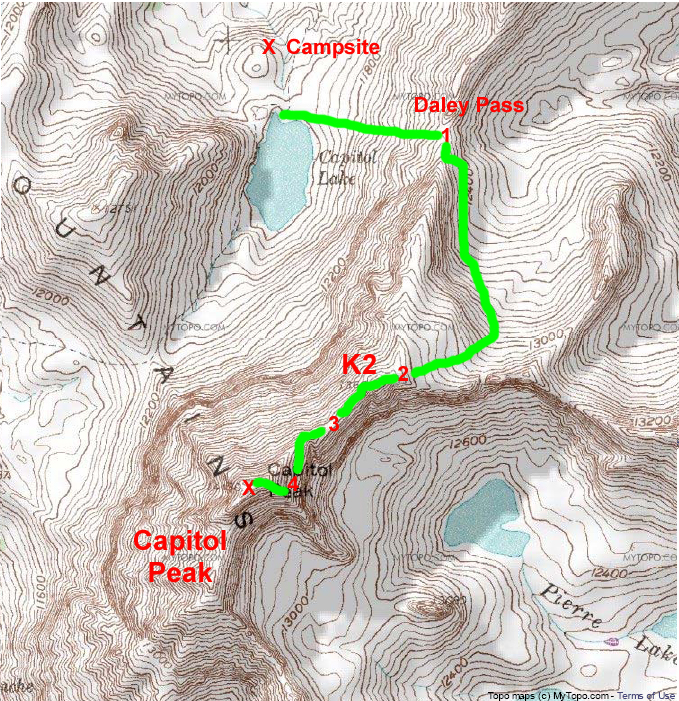
Longs Peak Keyhole Route

March 14, 2009

Story

Brian invited me to join him and some friends on a late Fall Longs Peak ascent via the Keyhole.  I had never done that route, so I was glad for the chance.

I met the group in the parking lot, and we started from the Ranger Station at 5am.  We passed the Goblins Forest and a frozen alpine brook a couple of times as we switch backed up a hill before finally crossing the brook on some log bridges approximately 1 hour and 1.5 miles from TH.  It was a cold day, but I was sweating like a boxer.  I needed to lose some layers, but I didn’t want to stop the group to shift my clothing. 

The trail left the heavy forest shortly after the log bridge crossing and continued up to tree line near 11,000′ (approximately 2.5 miles from the TH).  We stayed on the main trail through Mills Moraine heading toward Chasm Lake trail junction (11,550′) because Jim’s Grove trail was in poor shape.  We reached the Chasm Lake junction (11,550′), 3 miles from TH, and then turned toward Granite Pass.  Underneath Mt. Lady Washington, just before Granite Pass, we stopped for a water break.

My wet clothes had me shivering like a vibrating bed. The group said, “wearing cotton, eh?”…nope, just wet.  Now that I was cold and wet, I couldn’t stop wearing the clothes that got me wet in the first place.  I was dreaming of a dry base layer; I was destined for misery, but I was going to finish off the Keyhole route.

We then hiked past Granite Pass and then on to the Boulder Field. We continue through the Keyhole, then over The Ledges until we reached the Trough (~13,300′).  The Trough was full of soft snow and was very slow going for the 600′ ascent.  Once we scrambled over the top of the Trough, we started the icy Narrows, a wildly exposed ledge.  Transitioning between ice/snow and rock was nearly fatal for me twice as my crampons were as much a hazard as a lifesaver.

We reached the final pitch, called the Homestretch. It is a steep section of rock about 300′ tall that is often reported to be icy and treacherous.  However, this time it was covered in somewhat soft, but still rather stable snow.  We reached the summit quickly and took a long break.  The weather was fine, but it was getting late in the day.  I started wondering about how long before it got dark; I didn’t have a headlamp.

After our water and food break, we hurried down the Keyhole route and reached the Boulder Field when it occurred to me that we had about 1 hour of light remaining.  I decided to hurry ahead to get as far as I could with the remaining light.  I got as far as the Chasm Lake trail junction before I was hiking in the shadows.  The sky remained light for a while longer, but the icy trail was in the shadows and I couldn’t see the icy spots anymore.  I slowed to a crawl after two separate head-over-heals sliding tumbles on the ice.  I made it to the car by 7pm and drove home thinking about being better prepared.
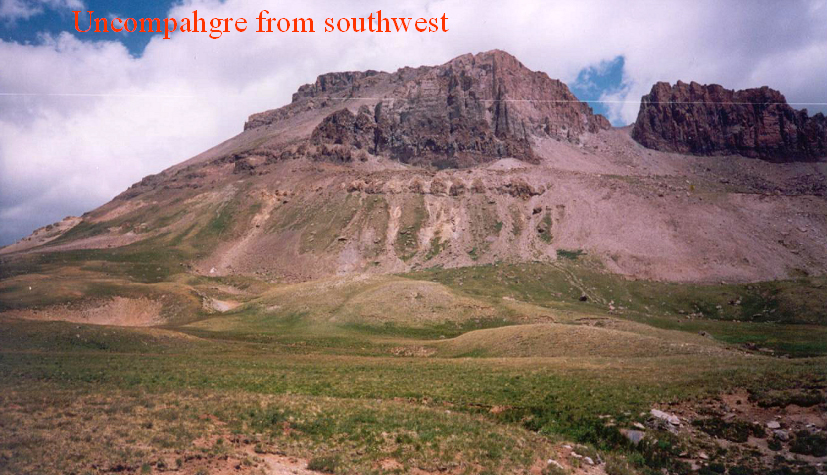
 

Complications

  • Late fall meant a short day
  • Cold weather plus fast pace makes for difficult body temperature management
  • I was the guest and just went along with the existing plans


Mistakes

(1) Managed by body temperature badly

  • Didn’t remove layers to avoid sweating


(2) Prepared badly

  1. Didn’t bring extra dry base layers
  2. Didn’t bring a headlamp
  3. Didn’t anticipate that it would be dark well before getting back to the car


(3) Made several bad decisions along the way due to flaws & biases in my thinking.

  • Denial Bias:  I just didn’t think about the trip very much; I trusted that the group I was with would have planned well.  I also didn’t think about going ahead without the rest of the group; if I had hurt myself there was a chance I could be stranded out overnight.  Besides, I could have walked more safely with them guiding the way (they had headlamps)


How I Got Lucky

  1. The weather stayed safe all day
  2. I was able to avoid hypothermia despite being wet on a cold day
  3. I managed to avoid getting injured in the dark while hiking alone 


Go to “Learning from Mistakes” index

Go to Index of all essays