Archive for the ‘Trip Reports’ Category

The Long Bell

January 12, 2009

My pace was off.  I had done 8 fourteeners in June and none in July.  Determined to reverse the trend, I set out to climb South Maroon Bell and Castle on July 19-20, 2002.

My original plan was to climb Castle (and Conundrum) as a warm up before climbing my real goal, South Maroon Bell (SMB).  However, the weather forecast was looking questionable, so I decided to go for SMB first to give myself a second day to complete the SMB climb if storms chased me off on the first attempt.

I briefly considered doing the traverse between the two Bells and bagging both summits.  However, I felt wary of the steep, exposed, loose conditions I had heard and read would be encountered, so I settled on an attempt on SMB alone.  Hell, it would be a full day’s work at approximately 10 miles and 4600 feet of elevation gain, according to the guidebook.

Since this would be a solo effort, I prepared better than I normally do.  I studied two guidebooks (Dawson & Roach) and tried to reconcil the information into a single, consistent set of directions.  I copied the topo from Dawson since it was more detailed, transcribed a single set of route directions, and even brought a picture of the southern exposure of SMB with Roach’s route roughly sketched out.  I did everything I could think to prepare for day long day of route-finding.  It wasn’t enough.

I started early, leaving the Maroon Lake trailhead at 5:15am in complete darkness, and headed toward Crater Lake.  On the way out, I met a fellow who was going to climb both peaks – he said it wouldn’t be too difficult.  With a weakened resolve to do only SMB, I started hiking with a fast pace.  I suppose I had a little extra adrenaline as a result of climbing without a partner.  Hell, even my boots felt good at first.  My water planning was also coming off well.  I had had several water shortage mishaps in recent weeks and was determined to drink enough water without carrying too much at any one time.  I brought 3 liter bottles:  one full and two empty.  I drank one liter on the hike in and was able to fill all 3 bottles at the creek just before heading up toward the South Ridge.  This was the last of my overwhelmingly good performances.

At approximately 7am, I reached the climbers trail for the South Ridge of SMB.  It was about twenty yard before the spot where the trail crossed the West Maroon Creek for the first time (there was an earlier crossing of a tributary about 0.5 mile before), and was marked by two cairns.  Since I couldn’t see the Bells from my position, I tried to figure out where I was and where I was going before heading up.  It was very confusing.

My Bell routes seen from Pyramid

My Bell routes seen from Pyramid

Overhead was a steep ridge, while to the left was a broad slope with small gullies, and further to the left was another ridge.  I could see what might be the South Ridge at the very top of the visible mountain, but I could not be sure where the SMB summit was located. More importantly, I could not make out the “SE ridge dropping from the South Ridge” which I was supposed to aim for, at least according to Dawson.  On the other hand, Roach just said to “climb west for 1.0 mile to reach the South Ridge.”  At that point I sure was sorry I wasn’t better prepared.

______________________________________________

Rule of Multiple Sources:
always use at least two independent sources of route information;
and if two disagree, then use three

______________________________________________

The topo map I had taken from the Dawson guidebook (scale:  1:50,000) displayed a route line that went left and then right up a broad slope between two ridges.  Perhaps it meant between the ridge above me and the ridge I could see to the left.  Roach’s description to “climb west for 1.0 mile to reach South Ridge” seemed to confirm this idea.  So, my best guess was to go to the left a bit and then straight up (west) between the major ridges.  While I did not know exactly what I needed to do, I had no way to gather more information.  I was happy to have a trail to follow that headed in the direction I wanted.

Then the damned trail took hard left and continued due south for an indeterminate distance at the 10,700′ level.  I couldn’t believe that was the way to go.  The key was the “SE Ridge coming down from the South ridge.”  Dawson’s directions said to go to the south side of the SE ridge, and I couldn’t believe that I was supposed to go to the far side of the ridge to my far left; it just didn’t jive with Roach’s “climb west for 1.0 mile to reach South Ridge”. And I was in a hurry to beat the weather, so I didn’t have much time to think.

In my rush to make progress, I decided that the ridge that had been above me at the start of the climbers trail and was now to my right, had to be the SE Ridge (even though it aimed in a northeasterly direction).  This allowed me to follow Dawson’s directions to climb along the south side of the SE Ridge and follow Roach’s “climb west for 1.0 mile….”.  Too bad it was wrong.

______________________________________________

Rule of Small Errors:
a small wayfinding mistake
can go a long way in the mountains

______________________________________________

So I left the trail and continued westward.  I climbed a 2nd class rocky gully and came though a thicket of willows to a lower angle slope where I studied my positions once again.  The route continued to check out.  I figured that SMB was to my right, but out of sight, and that by climbing the gully to the south of the ridge that was now to my right, I would reach the South Ridge of SMB .

A view from North Maroon Bell of my detour end point

A view from North Maroon Bell of my detour end point

About 2 hours later, at 9:30am, I mounted the crest of the ridge at 12,500 ft that I figured was the Southeast Ridge of SMB and found myself looking across a gulf to North Maroon Bell.  My eyes followed the ridgeline between the Bells to find SMB summit.  My line to SMB summit was blocked by many nasty-looking towers.  It wasn’t impossible, but very improbable that I would find a survivable path.  Crap.

______________________________________________

Possibility Razor:
everything is possible,
the question is whether we should risk it

______________________________________________

I decided it wasn’t worth the risk, and I had that infrequent, but terrible sinking feeling that I didn’t have time to finish. My original plan was to summit at noon, now I would be lucky to summit by 3pm on a day with a bad weather forecast.  I wondered if I should just call it a day.  But at least I knew where I was, and all I had to do was figure out how to get from where I was to the summit, and quickly.

_____________________________________________

Law of Disintegration:
large problems are made up of many little questions;
solve large problems by resolving easy questions

______________________________________________

I finally had to admit that the original trail that I discarded at the 10,700 ft level was the right trail. But I didn’t think I could go back down 2,000 feet, traverse south to the next ridge (the SE Ridge!), and climb 3,200 feet in loose rock and “obscure route” finding in time to beat the weather.  So my next task was to find a way to get to the SE Ridge, to the south of me, without losing too much altitude.

I descended the steep gully to the 12,000 ft level where I crossed to the crest of a smaller ridge a short way to the south of my current position.  I hoped I could traverse south at this level to reach the proper route, but there were many small ridges and probable steep drop-offs along the way.  And I was still determined to not try to force anything and get myself killed, so I backed off.  But I did managed to spot a trail far below of some quality that led over to the ridge further south which I decided would be my target.   So, I backtracked the route I had come up earlier in the day down to the 11,000 ft level and found a faint traverse that worked.  I managed to save 300 feet.

As the traverse ended and the climb began, my body began to reject the entire notion of mountain climbing.  I felt sick to my stomach and my feet were suffering a preordained tragedy in the Greek tradition.
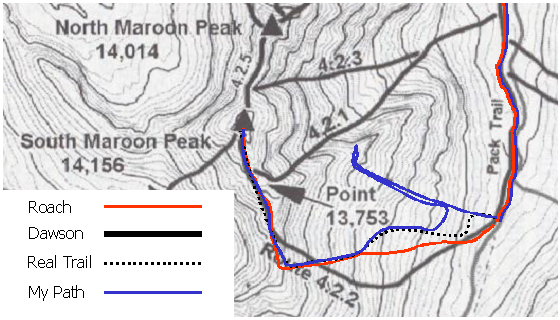
The various paths

The various paths; developed during analysis of "what went wrong"

Ever since buying a pair of La Sportiva Eigers to replace my aged Makalus, I have suffered terribly.  The boots will not break-in, attempting to force my feet to do so instead, and the excessive rubber in the boot design causes my feet to sweat profusely and skin to chaff like soft cheese.  I performed a bit of foot repair with moleskin and athletic tape, changed my socks for the third time in the day, and made the decided that I would relegate my new boots to winter and spring climbing.

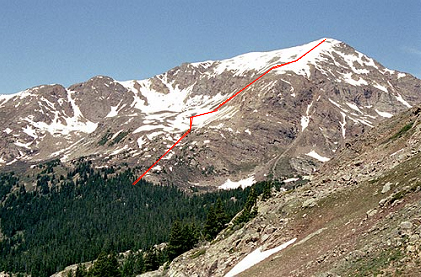
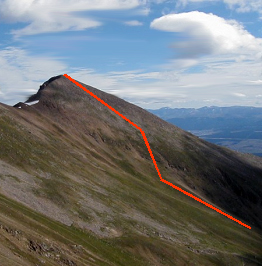
The upper section of Maroon Bell Peak with my approximate route drawn in red

Once I again reached the 12,500 ft level, my highest progress previously, my ability to move returned and was sustained for several hours.  I reached the South Ridge at 12:30pm and drank ½ liter of water leaving me with only 1 liter of water.  At that point it occurred to me that my 3-hour excursion was going to cost me a serious case of dehydration.  After a few hundred feet, I started thinking again about the best way to go; the trail of cairns seemed to go higher than necessary.  (I know, you’re thinking, “uh, oh!”)

_____________________________________________

Evidence Axiom:
when you know you don’t know how to proceed,
follow the evidence of previous human passage

______________________________________________

Fortunately, I had learned my lesson and realized that I didn’t really have any reason to think I knew a better way to go.  I resigned myself to simply follow the cairns and hope they led me to the summit.
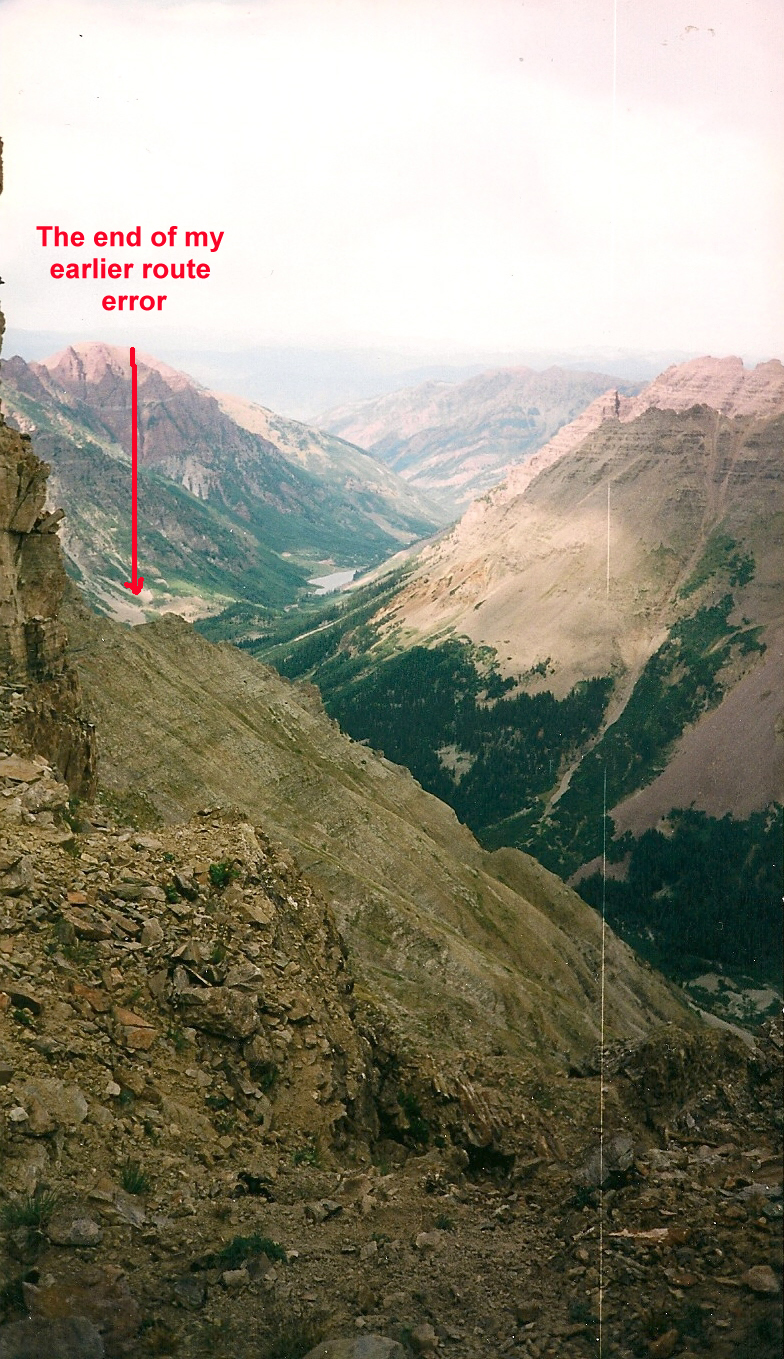
A view toward Crater Lake from Maroon Bell. The end of my earlier route finding error is visible.

The South Ridge trail quickly became flat and easy until reaching the slopes of Point 13,753.  At this point, the route seemed to disappear.  Instead of continuing in a traverse, the route seemed to ascend Point 13,753, against the commands of the guidebook know-it-alls.  Still humbled, I simply followed the cairns, linking them together in the most reasonable path.  With a sharp eye for cairns, the route finding went easily.  I was careful to examine and weigh alternatives at each juncture and make no mistakes.  The trail was exposed and terribly loose in several places, but it worked.  It felt like climbing over a pile of land mines; a misstep would be fatal.

Along this path, I met up with the fellow from the Trailhead who was going to do the traverse.  When asked how it went, he indicated that he shouldn’t have attempted it and wouldn’t do it again without a rope.  He seemed a fellow not humbled easily; I was at once glad of my decision to be conservative.

I scrambled up the SW Couloir and up the South Face and further left along the ridgeline to the summit.  I sat down at 2:15pm and drank my last ½ liter of water.  As I rested on the tiny summit among the rocks and swarming flies, I studied the weather.  The clouds had been increasing during the last couple of hours with the wind appearing to be moving west.  From the summit, I could see a massive rain to the North (turned out to be a violent and newsworthy thunderstorm in Glenwood and Basalt), but I couldn’t determine the storm’s path.  The sound of thunder sufficiently settled the question and got me up and moving.  I had to descend a long way over slow terrain to get to tree line; I hoped I’d be lucky with the weather.

But I was in trouble regarding my own water.  I was already dehydrated and had nearly 4,000 feet to descend to the West Maroon Creek.  Despite my need to escape, I scrambled over to a melting snow patch in the SW Couloir to see if I could scrounge some water.  It was dripping, but slowly.  I only waited long enough to fill two liters with cloudy water.  And I needed water right away, so I put them both in my pants pockets to warm them and continually shake them to dissolve the iodine tablets.  I must have been a sight to see.

My view from the summit of Maroon Bell Peak. The stormy weather to the north is clearly visible.

The descent to the creek was endless.  Down SMB, down and across Point 13,753, down the South Ridge, down the SE Ridge, over and down the grassy slope . . . it went on and on and on.  I was so tired that I took to sitting in the dirt every 20 minutes or so.  I finally reached the creek (10,400 ft) at 6pm, nearly 3.5 hours after leaving the summit.  I immediately went to the creek and refilled two liters while finishing the last of the melted snow I carried down from 13,500ft.   The weather had held out for me again.

On the hike out, I started cramping.  A foreshadowing of the difficult night I would have due to electrolyte loss.  I reached the car at 7:15pm and immediately drank a liter I had stashed there.  I drank nine liters of water during the day, including 1 at the car at each end of the trip.  It wasn’t enough; I urinated only once on the hike and not again until after midnight at home.

I had hiked approximately 12 miles and climbed 6,100 feet in 14.5 hours.  I was extremely pleased that I was able to overcome my route finding mishap and finish the South Maroon Bell; but I knew I had to figure out a better way to prepare better for my adventures.

And Castle would have to wait until the next trip.

Complications

  • I was alone; no one to help think it through or go for help in case of injury
  • The available route information was indefinite and limited; just the guidebooks, which were inconsistent
  • The weather forecast was iffy and the mountain was hard to escape from; I was in an extra hurry
  • The approach didn’t provide any visibility to the climb; once I could see the route, I was too close to have any perspective

Mistakes

(1) Prepared badly

  • Didn’t bring a detailed topographical map; only brought a copy of map in guidebook
  • Didn’t resolve all discrepancies between the two route descriptions I used; just thought I’d be able to figure it out as I had done many times before

(2) Made bad decisions along the way due to flaws & biases in my thinking.

  • Confirming Evidence Trap:  Based on my study of Roach’s directions, I was convinced that the route went straight west; when the trail turned south, I convinced myself that the ridge above me was the SE Ridge, rather than accept evidence of a different route path
  • Denial Bias:  I refused to think I could be wrong about the path to the South Ridge, despite not finding any trails or cairns and having some evidence to the contrary
  • Optimism Bias:  I was foolishly optimistic about being able to finish before the weather turned dangerous; I figured I could just retreat if the lightning came, but it took 3.5 hours to descend to the trees from the summit.

How I Got Lucky

  • The weather stayed good during the long day
  • My body stayed together long enough to reach water and easy terrain
  • I managed to find water on the trail
  • The cairns I followed actually lead to the summit

See all trip reports

Living by Luck in the Alps

December 29, 2008

~650 miles: A - Geneva; B - Chamonix; C - Zermatt; D - Grindelwald; E - Fontainebleau; F - Paris

In the late summer of 1994, my buddy, Pete and I did a week-long, express tour of the French & Swiss Alps with a goal of summitting on what we considered the ‘Big Three’:  Mont Blanc, The Matterhorn, and The Eiger.  We were experienced rock climbers but had little mountaineering experience.  But with a blood chemistry high in testosterone and adrenaline, and imbued with the full spirit of adventure, we were determined to make it happen.

The only obstacle we recognized was the lack of information.

In 1994 there wasn’t much of an internet and no Amazon.com to use to find answers to our questions about how to get this done.   The guiding services didn’t want to help, for obvious reasons.  So our plan was to rent a car, buy a map, and follow road signs to the city nearest each peak.  Once at the nearby city, we planned to look for a tourist center or a climbing store or even a guiding service where we’d ask questions and buy information necessary to accomplish our goals as quickly as possible.  We were hoping to do all three peaks plus a bit of bouldering outside of Fontainebleau before our ticketed departure from Paris ten days later.

What could go wrong?

The Grand Plan that we never actually wrote down is summarized below; it was an ambitious schedule, but not knowing it was impossible gave us our best shot:

alpsplan1

Wednesday, July 27 (starting the adventure)

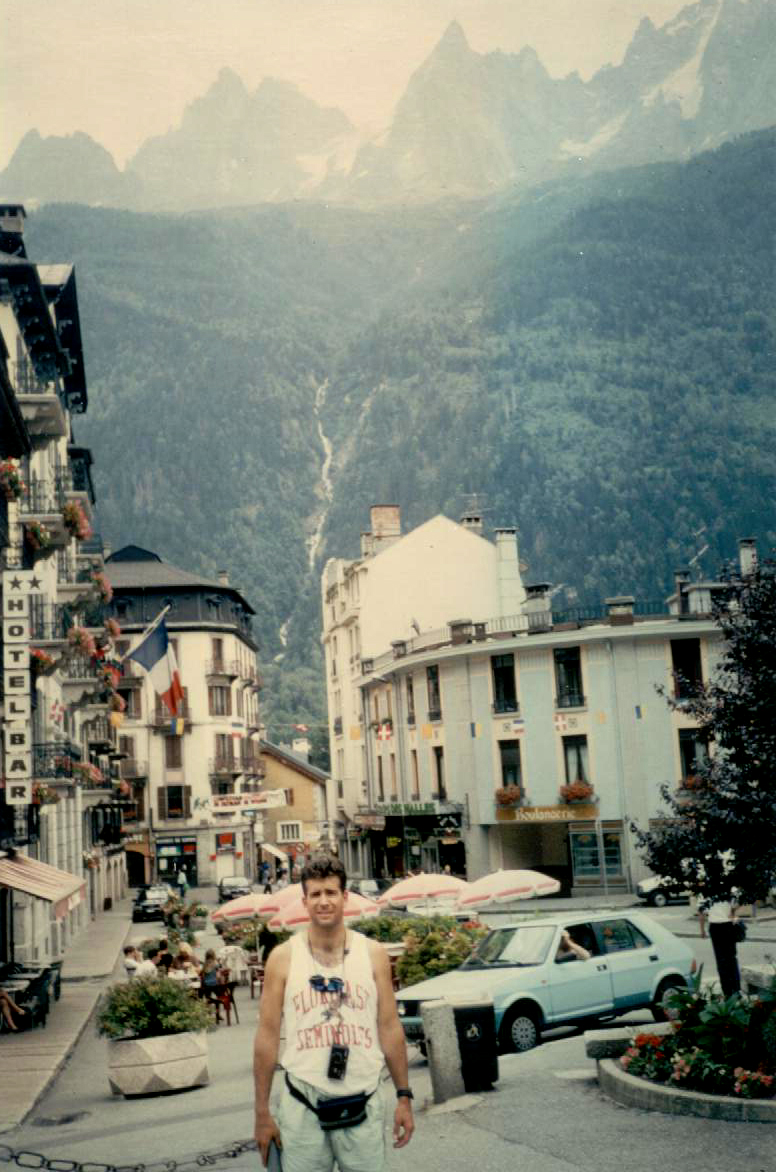
The "Ugly American" in the town of Chamonix. To get Mont Blanc in the background, Pete had to take the photo from low to the ground with an upward perspective

We landed as scheduled in Geneva, Switzerland, and drove into Chamonix to find out how best to climb Mont Blanc, and get the adventure started.  We had allotted 3 days for Mont Blanc, including the descent and drive to Zermott; we needed a fast start.  It turned out that finding other climbers or tourists was the only way to find information; the locals were both unpleasant and unwilling to help.  I guess skimping on the “casual wear” was a mistake. Eventually, we determined that (1) the Goûter route was the least risky for beginner mountaineers (low crevasse risk) and (2) there was no way to get a reservation at the Gouter Hut in the near future.

Since we had no time to spare, we took a reservation at the Tete Rousse, a lodge further down the route that would add several hours and the most dangerous section to the summit day.  But that was just a backup.  The real plan was to go to the Gouter Hut and hope for an empty corner to claim and bivy outside if necessary.  The problem was the extra volume and weight of the bivy gear.

Thursday, July 28 (heading up Mont Blanc)

In a mad rush to make room for the tent before starting up the mountain, I unpacked everything  I thought I could live without.  I cannot explain how I thought I could live without my helmet, my liner socks, or my spare socks; but I did leave them behind.  Even still, the pack was so heavy I could not lift it with one arm.  My head, still being attached to the top of my body, managed to come along despite being useless.

We checked out of our hotel and drove to the town of Les Houches (3,310′) where we planned to take the Bellvue cable car to Bellevue (5,906′) and then catch the Tramway du Mont Blanc to the Nid d’Aigle station (7,756′).  At first, I felt badly about being carried up 5,000 feet of mountain; it felt like cheating.  But, Pete & I would still have to earn it with 7,000 feet of elevation gain over 2 days with almost zero acclimatization (me coming from Chicago @ 5oo’ elevation and Pete from Las Vegas @ 2,000′ elevation).  We recognized that for us to have any chance of doing the three peaks, we’d have to live with the dishonor.  From the Nid d’Aigle station, we would have to hike & climb to the Gouter Hut (12,523′), from which we would launch our attempt on the Mont Blanc summit (15,781′).

mbmap1After the cable car and train ride, and after 2/3rds of the hike to the Gouter Hut, we decided to detour into the Tete Rousse hut (10,390′) to get lunch and a rest.  Only 2,700 feet gained with my massive pack and I was already tired.  To save some effort, we decided to follow a faint footpath across the Tete Rousee glacier where the angle was about 10-15 degrees instead of continuing for another 200-300 yards to reach a better trail on lower angle ice.  I didn’t like how rapidly the angle increased toward the slip-n-slide-of-death toward and down the Bionnassay Glacier to the bottom of Mont Blanc, but that didn’t persuade me to stop and put on my crampons or get my ice axe off of my pack.

About half-way across the glacier, just as I was thinking it would be a bad place to fall, I fell.  With a heavy pack, I went right onto my back and started sliding toward the end of my life.  I was  able to flip over and just barely create enough friction to slow, and then stop, and then crawl back to the path using elbows and boot tips against tiny grains of rock imbedded in the ice.  And when the adrenaline wore off a few minutes later, I found I now had a sprained thumb to remind me of my stupidity, and luck.

Pete & the Spanish Professor

Pete & the Spanish Professor

While eating, we shared a table with a Spanish math Professor who explained how Mont Blanc was a lifetime of ambition for many Europeans; he took a week every year to climb on the massif.

Pete & I discussed staying the night, but realized that 5,400 feet of elevation gain was too much for summit day.  So we got back on the trail to the Gouter Hut, hoping we would not need to the use tent I was laboring to bring.

After a few minutes, we reached the “Death Gully” or the Grand Couloir…a steep and loose gully with a nearly constant steam of falling rocks.  Not like an avalanche, but rather like a shooting gallery.  You could hear them whizzing past your ear every couple seconds; and me without a helmet.   Every couple minutes, a big rock would go by; big enough to kill you.  Still, the main danger was falling down the gully; so the key was to move deliberately and quickly while maintaining concentration on the footing.  We got across, but it felt like a near death experience.

Mont Blanc summit

Continuing up the steep rock climb to the Gouter Hut, the weather turned for the worse.  It started to rain, which then turned into a heavy snow which lasted until 3am.  And this was good and bad news.  The good news was the bad weather kept many climbers from keeping their bunk reservation.  We had a place to sleep.  The bad news was we couldn’t head out into a snow storm in the dark; the route was supposed to be easy to follow, but not that easy.  We were stuck waiting for the storm to end.

Friday, July 29 (Mont Blanc summit day)

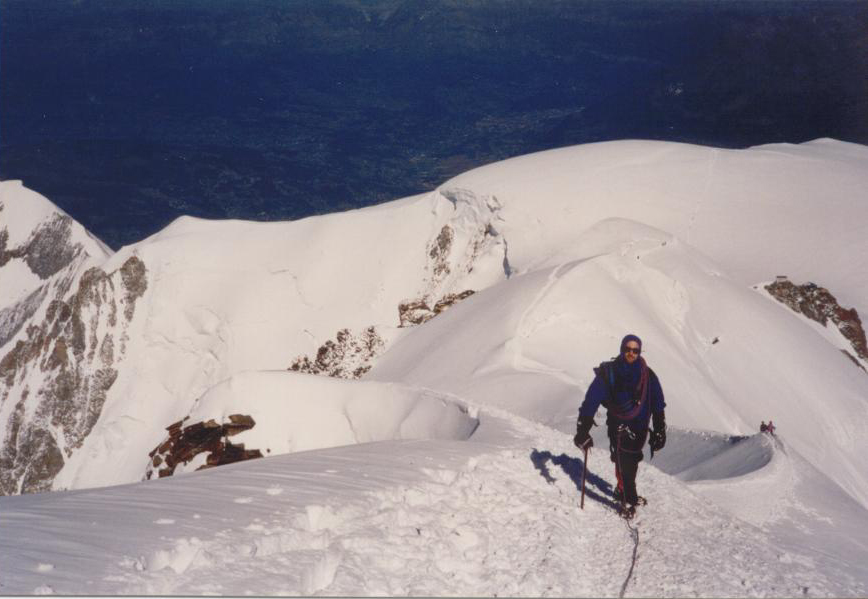
Me, Pete and our German friend on the Mont Blanc summit

Me, Pete and our German friend on the Mont Blanc summit

The storm ended at 3am, and we set out with a German fellow who wanted to join us our team.  The route finding turned out to be even easier than expected as a few guided parties got out ahead of us and blazed a trail.  The only challenging aspect of the climb was the torture of freezing to death while waiting for Pete to pee every 15 minutes.  The final summit ridge was wickedly steep on both sides, and the two-way traffic required frequent stepping down the slope. Scarey.

The summit!  We were very excited with our initial success, and pleased that the poor weather had kept the crowds away; I think there were only a dozen people on the route with us.  We had climbed the highest peak in Europe (that is what we thought, anyway).  It felt good.  A few summit photos and our thoughts turned to the need to get down and head over to Zermott.

mbmap2Down we went, following the trail back the way we came.

Reaching the Gouter Hut, we quickly packed up for a run to the Nig N’Agile train station to catch the last train to Bellvue.  But when it was time to get my pack on, I could barely manage it.  And with exhausted legs, the steep descent below the Gouter Hut seemed like inevitable death.  I was just crawling.

As we neared the rockfall ravine crossing (Grand Couloir), a massive desk-sized boulder 200 yards above us let loose and tumbled down the ravine.  It started an avalaunche of every loose rock, all of which can roaring down.  We quickly looked to see who was going to die in front of our eyes; fortunately, no one was crossing at that moment.  After a short wait to recollect our nerves and make sure no additional asteroids were coming down, we crossed without incident.  We missed a certain death by 5 minutes.

Pete posing while on the descent

Pete posing on Mont Blanc

We didn’t think we’d make it to the train station in time, and didn’t want to have to hike down the entire mountain.   We decided to stay the night in the Tete Rousse hut; it was the happiest moment of my life up to that point in the trip.

Saturday, July 30 (escape from Mont Blanc)

I slept like the dead.  Sleeping in a room with 15 snooring men isn’t a problem when your heart doesn’t beat.  Most of the inhabitants left early for a summit attempt; I didn’t stir until the need to empty my bladder ended my hibernation.  Naturally, we left Tete Rousse late (waiting for someone to show up so we could pay the bill) and ran down the mountain to catch the 9am train.  We arrived at 8:58am, and had a laugh about the story it would make.  Then we discovered that rock fall on the tracks would delay the train until noon.  Pete & I had to hike down an additional 2 hours to the cable car.

Once at the rental car, I was able to inspect the damage to my feet.  You may remember that I left behind my liner socks and my spare socks; so, my feet had been wet for 3 days and 7,000 feet of elevation gain and loss.  As I peeled off my socks, much of my skin came off as well.  I was now seriously handicapped for the rest of the trip.

We needed to get to Zermatt, but I needed to get some medical supplies.  We drove into Chamonix so I could pickup some antibiotic ointment and the French equivalent to jumbo band-aids.

While in town we discovered that 11 climbers had died on Mont Blanc due to lightning and serac fall while we were on the mountain.  One mountain down, two to go (Matterhorn and Eiger).

Driving in France and Switzerland is not a simple matter if you are trying to navigate by map.  As best as I could determine, they do not number or name their highways.  Instead the signs only indicate that it is a highway (thanks!) with a symbol and name a city along the way to indicate a direction.  Well, this approach works very poorly for visitors who do not know any of the cities in the area.  But despite the poor road signs, Pete’s relentless asking of questions to determine “how much longer will it take”, and my inability to find city names on the rental car map (so we saved a few bucks), we managed to figure out that we had to take a train to get to Zermatt (no cars allowed) and found the train station to get us there.

Matterhorn as seen from the town of Zermatt

I was in a frenzy of determination not to bring too much weight to the Matterhorn.  Pete & I put our inconsiderable heads together to figure out what to leave in the car.  Unfortunately, we talked ourselves into believing that we wouldn’t need our axes since the Matterhorn was a rock climb, not a glaciated peak.  It was a decision we’d regret terribly.  But I did remember to bring socks and a helmet.

As we exited the train station in Zermatt, we were amazed to find ourselves in a real life Disneyland.  It was beautiful with only horse drawn carriages moving through the cobblestone streets.  And the Matterhorn was a massive tooth piercing the sky!  It was the most impressive mountain I had ever seen.  Pete & I were ready to go after the Matterhorn immediately.  But the weather did not cooperate.  Our plan to climb on Monday with a Sunday approach was trashed by the weather report.  Rain/snow Sunday and Monday, good weather on Tuesday and Wednesday.  So we agreed to wait one day.

Sunday, July 31 (exploring Zermatt)

Zermatt Graveyard

Zermatt Graveyard

With a day to kill, so we turned into tourists.  And, Zermatt is a fine place to spend a day with nothing to do, as long as you don’t buy much.  Wandering around, we stumbled upon a graveyard in the middle of town.  I figured it was the ancient graveyard of the old village, but it turned out to be much more interesting and relevant.  It was mostly a graveyard of climbers who have died on the Matterhorn; a sampling of the approximately 500 people who have died in the effort.  It was a sobering experience.

What we could not find was any information on the climb. Again. The guiding service was happy to charge us a lot of money to show us, but no information was for sale.  Again. I understood that it was their livelihood. This wasn’t really Disneyland, but I didn’t want to be buried in Zermatt.  At least not yet.

Late in the day, we found a great bar, The North Wall Bar, for dinner and collecting information about the climb.  One of the bar tenders was an American; he suggested that we use the Solvey Hut as a high camp.  The idea was to climb to the Solvey Hut in the few good hours of weather, and then proceed from there the next day.  I loved the idea, considering our limited available time.  Pete thought it would be better to wait for good weather.  We agreed that in any case we should head up to the Hornli Hut the next day.  That way we’d be in position to find out more about the climb from other climbers and be able to execute whatever plan we could come up with.

The plan for the ascent, roughly, was to take the Schwarzee cable car to the Schwarzee Station  (8,474′), and then do the 2 hour hike to the Hornli Hut (10,695′) where we’d spend the night.  Then climb up to the Solvey Hut (13,123′) on the way to the summit of the Matterhorn (14,692′).  Naturally, the devil is in the details.

Monday, August 1 (trekking to the Hornli Hut)

In the cable car looking back at Zermatt

In the cable car looking back at Zermatt

When we got to the Schwarzee Station after the cable car ride, the sky opened up with wet snow/rain falling heavily.  We decided to wait it out in the restaurant.  Pete bought some food; I pulled an orange out of my pack.  The unpleasant locals working behind the counter yelled at me about their profit motive.  I spent some money on something useless and they shut up.  Hell, we were the only people in the place; it wasn’t like I was using a chair that could have been used by someone else.

While we waited for a break in the precipitation, in walked Chris from Liverpool, England.  He had just soloed the Matterhorn and was able to give us the detailed route information we’d been looking for.  However, he also told us that it had snowed very heavily Sunday night and the mountain was in no condition to climb.

During a break in the weather, Pete and I pressed on to the Hornli Hut with a quick 1.5 hour hike (vs. 2.0 hour standard). As we arrived, the weather deteriorated again and the snow continued to fall for several more hours.  We were very worried about the conditions, but hoped for the best and spent the afternoon processing the information we had and planning for our ascent.

Tuesday, August 2 (Matterhorn summit day)

After the snowfall ceased, the weather did us a favor by turning warm.  The wet snow and rain did not freeze up, so we decided to go for it at 3:30am and followed closely on the heels of a couple of guided teams though the tough route finding section below the Solvey Hut.

Heading up the Hornli Ridge

Heading up the Hornli Ridge

Unfortunately, these were slow teams, so it took over 4 hours to reach the Solvey Hut (a good time would be 2 hours). So we were behind schedule already.  But on the other hand, nearly every climber turned around at the Solvey Hut.  We had the mountain to ourselves and a couple from New Zealand, Chris and Kat.

Above the Solvey Hut, it was a snow climb; at least a foot of snow covered everything, and Pete & I without ice axes.  We put on our crampons & roped up, then we headed upwards.

With the late hour and our slow progress moving over slippery and unseen rocks, we were making a huge bet on the weather staying good.

Joe & Pete on the Matterhorn summit

Through the upper Mosley Slab and on up the ridge proper we went, very slowly.  And when we reached the shoulder area, progress was even slower.  The fixed ropes were an iced over nightmare.  Using gloves on the thick, icy ropes without solid footing due to the deep, loose snow was an exhausting exercise.  On the steepest rock (40-50 degrees), there was no snow, but the progress was still slow despite our simul-climbing.  And on the final snowfield, we could only crawl up by kicking our boots and jamming our hands into the snow to find holds on the underlying rock.

But we made it.  We reached the Matterhorn summit at 2:50pm.  We were running very late, but we just had to take in the spectacular views and a few glory photos.  A few minutes later, Chris & Kat joined us on the summit.

Rappelling down the Hornli Ridge

We had taken over 11 hours to do the normal 5-6 hour ascent, and we still had to do the descent in poor conditions.  We were already doomed to downclimbing in the dark.  If the weather didn’t hold, we figured our only hope for survival was to find the Solvey Hut for shelter from the cold, and wait out the dawn.

Actual downclimbing was out of the question until we got below the shoulder, given the conditions.  The four of us rappelled initially from the metal statue near the summit and then from whatever anchor we could find, including many fixed anchors that started to appear as the snow melted.

As I awaited my turn on the last rappel by standing on a clump of snow clinging to a rock hanging over the North Face, I noticed the anchor moving oddly.  With every bounce Pete took, moving down the stiff rope, the bolt separating us from oblivion was flexing up & down 45 degrees.  Before the anchor could pull, Chris quickly backed it up with a tricam.  Thanks, Chris.

Descending the Hornli Ridge.

Four people rappelling down a single rope is a slow process in any case, but stuck ropes and hard-to-find anchors meant terrible slowness.  It took us 7.5 hours to descend to and find the Solvey Hut by rappelling onto its roof in the pitch black darkness.  At 10:30pm, tired and thirsty (no water since 3pm) we stumbled into the Solvey Hut only to find it half full of climbers looking to get an early start on the next day’s climb.  The four of us crawled on top of each other in a space the size of a queen mattress and waited for dawn.

Wednesday, August 3 (escape from the Solvey Hut)

At first light we were frozen, dehydrated, and exhausted.  Let’s just say it was hard to get started.  But by 7am we were rappelling down the lower Mosley Slab.  The route finding from there was very difficult.  Nothing looked familiar, as the snow had melted a great deal.  And now the loose rocks were exposed.  We kept knocking rocks down the mountain, no matter how hard we tried otherwise.

Pete ready to leave the Solvey Hut

The Matterhorn is a dangerous mountain; a pile of loose rocks.  I shudder to think of the problems we could have encountered if we had climbed it crowded with people.

After down climbing several sections that only rock climbers could have worked (off-route, I suppose), Pete and I were down.

The climb took 30 hours, including our time in the Solvey Hut, and we had no water or food for the last 20 hours.  Finding a place to pee had not been one of our problems since we didn’t need to pee.  But we made it.

We stopped at the Hornli Hut for some well earned food and drink with our buddies from New Zealand.  The tourists and hikers at the Hut figured we had done the entire climb that morning and kept stopping by saying, “you guys are fast!” and “good effort!”  I guess we looked bad enough.

Two mountains down, one to go!  At this point, we had climbed two classic peaks in six days requiring over 14,000 feet of hiking/climbing elevation gain, and we had used up a lot of luck to survive.  I started feeling superstitious.  I wondered if perhaps Pete & I had pushed our luck as far as it would go.

alpsaltitudegain

Thursday, August 4 (pressing our luck in Grindelwald)

After a night’s rest in Zermatt, breakfast with Chris & Kat, and a train ride back to our car, we drove to Grindelwald for our attempt on the Eiger.  Our plan was to ascend the Mittellegi Ridge Route via a stay in the Mittellegi Hut.  It was going to take a minimum of two days.  Due to our earlier delays, we could just spare two days and make our Paris flight, but only if we managed to drive all night once off the mountain to get to the Charles de Gaulle airport in Paris (7 hours away). It felt like a bad bet, and I was feeling unlucky.

We rolled into town just before the guide office closed.  They were typically nasty and unhelpful. But they did tell us that a serious icefall danger had closed off the normal approach to the Mittellegi Ridge route.  It was all the excuse I needed.  Pete agreed and we decided to eat, drink and be merry beneath the North Face of the Eiger, and be happy for what we had accomplished already.

Friday, August 5 (bouldering in Fountainebleau)

Fountainebleau bouldering

Fountainebleau bouldering

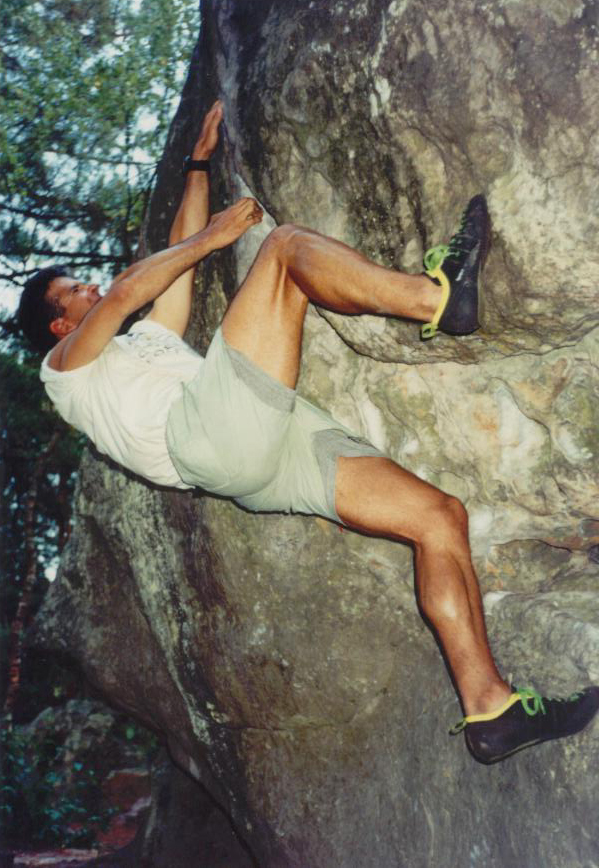
On Friday, Pete & I drove to Fontainebleau (outside of Paris) for some bouldering.  We went into town to get directions, and actually got help from an official tourist office.  We found one of the areas hidden in the Fontainebleau forest, and just marveled at the boulders.  We climbed a few before it started raining.

We decided to head to Paris to have a shower, a good meal, and a good night’s sleep before the long flight home.

Saturday, August 6 (back to the States)

Up early with a bit of logistical agony to endure.  First we had to figure out where to turn in our rental car that we picked up in Geneva.  Then we had to move ourselves and our heavy gear to the airline check-in area.  We added a bit of unnecessary complication by being late.

Pete thought we should split up, with him returning the car and me getting into the checkin line with all the gear.  It was a good plan except for the part about me being able to move 6 bags weighing hundreds of pounds from the front curb to the check-in line inside the airport without taking a chance on theft.  As I stood there wondering what I was going to do, someone abandoned a baggage trolly next to me.  Problem solved.

The flights were long, but tolerable.  We arrived back in the states right on time.  We split up in New York’s Kennedy airport, with me going to Chicago and Pete heading to Las Vegas.

Wrapup

It was a great trip that succeed in every reasonable way possible, and a few unreasonable ways as well.  We had been very lucky.

This was the first mountaineering trip that either Pete or I did without a guide; and we had not planned the trip in any detail nor had we carefully measured the riskiness of several dangerous situations before committing ourselves.  I counted eleven separate instances of close calls that could have, but did not, go against us.   We rolled a seven, eleven times in a row.

alpsuseofluck

But, instead of scaring me away from future adventure, this trip taught me the importance of planning ahead and managing risk. I never again left so much to luck.

This was the beginning of my life as a Mountaineer.

See all trip reports

Five 14ers for my 40th birthday

December 12, 2008

Story:

Susan decided that my 40th birthday should be a special one.  She worked with my climbing partner, Brian to setup a weekend trip to do something “special.”  Brian thought that the Crestone Peak – Crestone Needle traverse would be a suitably exiting adventure.

Route Map

Route Map

I was delighted with the idea beyond all reason, but still I couldn’t help but think about doing more.  I kept thinking about the other Fourteeners in the area and about how this would be the ideal time to bag them.  The Kit Carson, Challenger and Humboldt mountains were within a few miles of each other and the Crestone massif; I developed what I would later call my “Crazy Plan” to get them all.  5 Fourteeners in 2 days.

To be honest, I wasn’t entirely convinced we could do it.  I just knew that if we thought big, we could accomplish a lot.  This was my argument to Brian.  He was dubious, but was convinced that, logistically speaking, we had a chance to do 4 in a day, leaving Humboldt for a short second day (he needed to head back early).  It was a slim chance, but it was a chance.   The “Crazy Plan” was a go.

Brian got off work around 6pm on Friday, which is in itself a miracle.  I met him at his place at 6:30pm and packed my stuff into his truck. We left Golden toward C-470 and eventually hooked up with I-25 South toward Colorado Springs.  We then took Hwy 115 South to Florence, from which we took Hwy 96 to Westcliffe.  We then took Hwy 69 south for 4.5 miles to Colfax Lane, which we took (right turn) to a T-junction.  We made a right turn onto county road 120 which led directly to the passenger car trailhead.

Of course Brian wouldn’t dream of walking the 5 miles to the 4X4 parking lot.  I think the opportunity to take “one of Colorado’s toughest” roads was the primary reason for his interest in the trip.  The drive did beat walking, but just barely.  The 5-mile drive in took 1.5 hours.

We hit the 4X4 parking lot at midnight, and then hiked in the dark for 1.6 miles (1 hour) to reach the upper lake where we found a nice spot directly below the approach trail to Humboldt.  A quick camp setup, including a jury-rigged food hang using a couple sticks and a few rocks to overcome the lack of trees,  and we could rest.  And at 2am, we turned in for a few precious minutes of sleep.

A view of the Crestone Peak and the rim to the Bear's Playground.  Our route took us directly to and over the rim.

A view of Crestone Peak and the rim to the Bear's Playground. Our route took us directly to and over the rim.

The alarm went off at 5am.  I felt certain that I had slept at least some of the time.  With a full day of adventure and effort ahead of us, we began by unpacking everything we could possibly do without to save weight on a long day.

By 5:30am we were hiking NW to exit the South Colony Lakes basin into the Bear’s Playground.  We mounted the rim around 7:30am and decided to stash our ice gear for the return to the Crestones.

We continued NW to reach the ridgeline on which summit Point 13799, Kat Carson/Columbia Point (13,980), Kit Carson (14,165), and Challenger (14,081) stood in sequence.

While planning the trip, I had figured on 2-3 hours to cover the 4 mile round trip from the Bear’s Playground.  Instead, it would take us 5.5 hours of hard hiking and scrambling.

5fourteeners

Studying the map for a clue

Some stretches of 4 miles are harder than others. The ridge line was straight and easy to follow, but had a wild degree of elevation gain and loss: 13,140 (Bear’s Playground) up to 13,799 (Point 13799) down to 13,460 (saddle) up to 13,980 (“Kat Carson” or “Columbia Point”) down to 13,620 (saddle) up to 14,165 (Kit Carson) down to 13,780 (saddle) up to 14,081 (Challenger Peak) – a total of 3,109 feet gained (and lost) on the round trip from the Bear’s Playground and Challenger Peak.

After a short break on the Kit Carson summit, we couldn’t find a route west toward Challenger Peak.  In our haste, we decided to just start downclimbing; we figured we find a way.  It turned out that the downclimb to the west of Kit Carson is 4th class plus (I found a piton on my decent) and the proper route descends to the east (back to the Kit Carson-Kat Carson saddle) and then skirts the southern flank of Kit Carson.  Sitting on the Challenger summit and wondering out loud about the unexpected difficulty, we noticed the correct route.  Better late than never!

Brian posing on Kit Carson with Crestone Peak and Needle in distance

Brian posing on Kit Carson with Crestone Peak and Needle in distance

We took the standard route back to the Kit Carson-Kat Carson (or Columbia Point) saddle, and continued toward the Bear’s Playground, shaving a few feet here and there.  We made it back to our stashed gear by 1pm, and we were tired and dehydrated.  Still, I had the “crazy plan” to complete and the weather was holding. I wanted to push on to do the Crestones as we planned.  Brian thought it would be risky, but would proceed if I insisted.

I was thinking we needed to do the Crestones immediately to get all 5 Fourteeners before leaving for home.  On the drive out from Golden, we figured it would take 6 hours to do the Crestones.  Sitting beneath Crestone Peak at 1pm, we reassessed to 8 hours, which would allow us to just finish before dark, assuming we didn’t get tired (and slow) or have route finding issues or lose our good weather.  I could see it was a bad bet; but I really wanted it.  Then it occurred to me that if we finished Humboldt today instead, we could do the Crestones on the final day if Brian could stay long enough.

The view from Challenger Peak

The view from Challenger Peak

We settled on a new plan that included an extra early start on day 2 and a promise to go fast, and we headed north for the Humboldt saddle.  When we reached the saddle at 2:30pm, Brian decided to head to camp to rest his legs (he had already climbed Humboldt on an earlier trip) while I pushed on to bag the summit.  With the thrill of a new peak, I started up with a strong pace… that didn’t last.  This speed transition marked the arrival of Toadman.

After the initial few minutes, my pace resembled the motions of a toad; I made short bursts of distance followed by serious resting in a bent-over or squatting position.  I feared my lungs would wear out from overuse.  I only needed to gain 0.7 miles and 1,200 feet in elevation, but I had not had a drink since 1pm and was already dehydrated at that point.  I was bonking big time.  And, my feet were two giant hot spots.

Anxious not to use up my sleep and resting time, I hobble up the peak as hard as I could.  A short rest on the summit without water didn’t do any good, so my slow pace continued all the way back to camp.  I arrived at 5:30pm – totally spent.

The Crestone Peaks seen during the Humboldt descent

The Crestone Peaks seen during the Humboldt descent

Upon my arrival, Brian stirred from the tent.  We arranged dinner while I drank the water Brian had thoughtfully filtered.  He asked me how much water I was going to drink; I told him I was going to drink it all.  My word was good on this point.

We drank and ate and enjoyed the entertainment of the resident Marmot community.  They were amazingly lively in their barking and shrieking at each other.  A few even engaged in wrestling.  One weathered fellow, with two serious bite scars on his face, was determined to join our dinner party and sat next to me for a short time.

Consuming every last calorie

At 7pm, I hit the bag and was gone to the world of the living.  Compared to the 1-2 hours of actual sleep I got the night before, the 9 hours promised seemed to good to be true.  It was.  I managed about 7 hours, losing the other 2 to various physical issues and necessities.  But 7 hours is pretty good.

The alarm went off at 4am and we exited the tent into a dark world.  I stumbled around while eating, drinking and packing, and managed to spill my water like the careless fools I’d judged harshly  in the past.

Rule of Uncapped Inevitability:  a bottle set down with the opening unsecured will spill

Desperately wanting lighter packs, our views of the NW Couloir the day before convinced us we could leave the ice gear behind.  And by 4:30am, we were heading back up to Crestone Peak’s NW couloir…with a short stop to collect water at the lake.  I felt like a somewhat rested toad, a toad with sore feet and leaden legs.  But that was good enough.

We took a somewhat different route out of the South Colony Lakes basin this time, aiming to come out nearer to the Crestone Peak.  After a bit of extended 3rd class scrambling, we exited the basin near our objective.

Once out of the basin, we oriented ourselves with a map and compass, and followed a set of cairns that seemed to head in the right direction.  Fairly quickly we found the NW coulior.  Up we went into the wet, crumbly rock couloir that was mostly devoid of ice.   The rock was so unreliable that I felt that I was taking significant chances throughout the morning; the risk felt greater here anywhere on the trip.

We reached the summit with with injury only to my wits around 9am.  Success for the day depended on completing the traverse on time, so we took a break to study the terrain.  I couldn’t make any sense of it other than the start, which was to descend the 3rd class south facing couloir.  Hoping to find clues along the way, we returned to the top of the NW couloir (which was also the top of the south facing couloir as well) and began the “traverse”.  We descended 250-300 feet per the instructions, and then we were completely confused.  We wandered up and down the left side of the couloir looking for a trail of breadcrumbs or big red footprints or some other clue as to the route of “one of the four great Colorado traverses”.

River rocks imbedded in weak cement

River rocks imbedded in weak cement

During this fun, I discovered the perils of crestone conglomerate rock; I was stepping around a corner, standing on a beautifully rounded river boulder protruding from the rock face when “crack” and I was on my way to the bottom of the couloir and the afterlife.  Somehow I managed to claw my way back onto the ledge with injury only to my left shin and knee, and again to my wits.

While I was playing on the rocks, Brian followed some cairns, which seemed to mark a trail distinctly different than the one the guidebook suggested.  I was too far away to make much protest, so I hurried to catch up climbing up some nameless couloir off to the left (north) of the south facing couloir.  Eventually, we found ourselves too high, but within reach of a recognizable portion of the route.  We scrambled down to the 13,740 foot saddle between Peak and Needle and descended a well worn trail down another south facing couloir looking for the traverse beneath the 13,940 peak along the ridge (“go well below this summit on a good ledge system on the south side of the ridge.”).  We didn’t find it; instead, we descended to the bottom of the couloir and crossed over to the west facing couloir beside the Needle and ascended until we could reacquire the traverse route.

We had additional difficulties finding the proper rock to climb up to the ridge, and simply climbed up a 5th class face using the rock gear we had carried with us for two days.  Once we were 200 feet above the couloir, we were able to find the route again and wind our way toward the final 100 feet of 4th class climbing to the summit.

We had brought the rock gear just for this final push, but the rock did not appear to provide any opportunities for protection.  So we put it away and just scrambled up. The climbing was easy but wickedly exposed. A fall from this stretch could give you a long time to regret the mistake.  On the way up, I kept looking at the empty sockets (where stones had fallen out) and thinking about the river stone that came loose from the conglomerate earlier in the day in an attempt to throw me down the south facing couloir of Crestone Peak.  It took a considerable effort to stay focused.

We reached the summit at 12:15pm.  It had taken us just over 7 hours and we still had 3 hours to go.   We were running late.  Still, if we had started the traverse at 1pm the previous day, it would have been a disaster.

On summit of Crestone Needle noting the completion of the 5th 14er

On summit of Crestone Needle noting the completion of the 5th 14er

I was tired, but it sure felt good to finish the 5th 14er.  We had done it; we had completed the technical portions of the “Crazy Plan”.  All that was left was the descent.

And the descent was endless.

These Crestones were hard to get to, hard to get up and hard to get off.  We followed the cairns with only a single wrong turn.  Eventually we made our way to the top of the gully that led back to the South Colony Lakes basin.  The trail seemed to want us to go the east end of the Lower South Colony Lake…a significant detour.  So we headed west to find a way down the cliffs that guarded the approach to the Upper lake.  Eventually we found a goat or sheep trail that allowed us to traverse the scree beneath the Needle and minimize any elevation loss before reascending to the upper lake.  I reached the camp at 3:30pm after refilling one of my water bottles at the lake to let the iodine tablet dissolve while I packed up the camp.

I was so tired that I packed my gear while lying down.  Think about how hard that is…well, sitting up was harder.  And I kept checking that damned iodine tablet, hoping to find that it had dissolved.  But it would not.

The Watched Iodine Tablet Rule:  the watched tablet will not dissolve

Finally I mustered the courage to start hiking again. We left for the car around 4pm, about 3 hours later than planned.  The hike out felt better than expected, but was another in a long line of endless marches (“death marches” is what I call it when in one).  I dispelled some of the boredom by counting.  First I made sure that the trail markers (I don’t know what they were marking) were all exactly 42 steps apart (and all 45 markers were exactly 42 steps apart).  When the markers ended, I took to counting the steps from the last marker to the car.  I guessed, based on nothing but hope, that the car was one thousand steps away (a nice large round number).  I figured that the car would actually be closer, but by “hoping” to be right about the step count, I would be somewhat distracted from the long hike out.  It didn’t work out; there were one thousand, eight hundred, seventy-two steps to the car.  But at least the hike was over.

All we had left to do was survive the 5-mile drive out to moderate roads and then the drive home.  The 5-mile offroad portion took another 1.5 hours, but the truck survived, and the remaining four-hours drive back to town seemed to go quickly.  We arrived at Brian’s place around 10pm; I arrived home 30 minutes later to thank Susan for a great birthday.

five14ersmap2

All in all, we achieved 5 Fourteeners and 2 high Thirteeners, 15 miles of hiking and 8,000 feet of elevation gain in two great days.  I’m glad I didn’t wait until my 50th birthday.

Complications:

  • No water to be found away from camp; had to bring it all
  • Undulating terrain made for poor route-finding and difficult speed estimating
  • Multiple day trip; enhanced compounding of errors related to time & energy
  • Brian wanted to leave early on day 2; couldn’t plan on a full 2nd day

Mistakes:

  • Overestimated energy capacity in desire to reach goal (denial bias)
  • Didn’t research route from Kit Carson to Challenger (optimism bias)
  • Underestimated the time required to complete the Crestone traverse (optimism bias)
  • Didn’t drink enough water when it was easily available (optimism bias)

How we got lucky:

  • The weather stayed great for 2 days
  • Didn’t trust the wrong conglomerate rock with our lives
  • Brian survived getting home a few hours later than planned

3rd Time’s a Charm: French Mt (& Mt. Ok)

December 7, 2008

Story

It was time for Chicago Mark’s annual mountain adventure, and this time Brian was available to join us.  This time, we decided to pick off a couple of high 13ers in the Sawatch Mountains:  Mt. Oklahoma and French Mountain.

French Mountain had eluded me twice before, so I considered this a grudge match.

In 2001, Susan (my wife) and I climbed the wrong mountain (unnamed 13,400) by starting from the wrong TH (we drove past the Halfmoon TH to the North Halfmoon TH, and then hiked South with French on our left instead of right).  We only realized our mistake after we ran out of mountain and sat down to figure out why.

In 2003, Mark and I attempted to climb the French-Frasco-Casco circ, but failing light kept us from finishing French; we completed Casco & Frasco and were standing at the top of the Frascol, 400 feet from the French summit when we abandoned the attempt so we could minimize the hiking on an icy road in the dark.   And I still nearly broke my neck & skull several times on the hike out.

This time I was not leaving the area without leaving my footprints on the French summit.

We decided to camp near the two trailheads to facilitate bagging both in a weekend.   I picked up Mark at DIA at 12:30pm on Friday, June 17, 2005; we headed to REI in Denver to resupply Mark and then to the Halfmoon Campground and beyond.  At 5pm, we had the place to ourselves and took 30 minutes to select a prime campsite approximately 100 yards from the North Halfmoon Trailhead.  Brian showed up at about 11pm after a failed attempt to leave work early.

At this point, I should go ahead and accept blame for any climbing logistics difficulties.  I decided that we’d do Oklahoma first to allow for route finding errors that we could not survive on Sunday, when Mark had to be at DIA at 3:30pm.  Since we knew the way to French (see failed attempt #2 above) and Oklahoma had a difficult bushwhacking section, I still claim the sequencing was correct.  However, I’ll admit to bringing too little brainpower to the consideration of difficulties in a 10-mile, 3700 ft ascent of a high 13er plus a 100-mile drive to DIA by 3:30pm.  Most would agree.

On Saturday, we got up early and started hiking right at 6am north toward Mt. Oklahoma.  The scuttlebutt about Mt. Oklahoma was that the route was off-trail and hard to find.  During my climb planning, I was able to identify on the map 3 signs that would allow us to know when we should leave the main trail and begin bushwhacking West toward Mt. Oklahoma:

(1) when the southern most Massive peak was due East,

(2) when we hit a creek after not crossing a creek for 0.5 miles, and

(3) when we were at 11,600 ft.

While these clues were devilishly difficult to identify on site, I still claim that these were good clues and they probably helped us find a good cutoff by heightening our attention level at about the right time.  Others may disagree.

At approximately 11,600 we left the trail heading west (I’d describe the point as the first place where you could imagine starting to bushwhack once you were at approx. 11,600).  We crossed two tributary creeks (one via log walk, the other via rock hop) and climbed to the top of the tree-covered ridge, heading approximately west-northwest.  We were far enough south to avoid dropping down into the drainage, as some route descriptions indicate, and simply followed the ridge to tree line, and then into the basin beneath Oklahoma.  In the basin, we had a short walk over soft snow to the most moderate couloir available to mount the summit slopes.  The elvin-like among our party and another party on the climb seemed to be able to hike & climb on top of the snow much of the way to the summit, while the heavier of the group climbed in it.  It took a considerable effort to swim up the couloir, and then to slog up the soft summit slope in snowshoes.  If it was an hour later in the day, I would have drowned.

After a lengthy respite on the summit, we started down at 11:30am with high hopes for a fun ride.  Anticipating soft snow, I brought my old rain pants (what they call “death pants” – no friction while glissading) just in case.  They worked wonders.  I was able to glissade from the summit to the couloir and then down to the basin with only a few aiming steps.  A great ride.

Route drawn in red; actual snow coverage was much greater

Route drawn in red; photo taken a few weeks after climb which had much greater snow coverage

We retraced our steps as best as we could back to the main trail.  About halfway down we lost our old trail and ended up about 100 yards further up the main trail than where we left it.  All in, I’d say the higher route was preferable.

We hiked the remaining 2 miles back to camp in rapid fashion, arriving at approx. 2pm.

We spent the next 4 hours drying gear in the hot sun and discussing the plans for Sunday.  It was during this time that it became clear that we had a long climb ahead of us on a shortened day.  Mark had to be at DIA by 3:30pm, which meant we needed to be back at the car by noon.  After close inspection of the map, we determined that French would be comparable to Oklahoma, but possibly longer: 10 miles on road vs. 8 on trail/in bush and similar elevation gain.  Since Oklahoma took 8 hours we scheduled 9 hours and set the alarm for 2am, planning on a quick camp breakdown and relocation to the Halfmoon trailhead for a 3am start.  Yikes!

We turned in at 7pm after dinner for what would prove to be a largely successful attempt to get a good “night before” sleep of about 6 hours.

The alarm rang out right at 2am, and we were in a blind scramble to dress, undo camp and pack the cars.  Our pre-packing the night before proved useful and we left the camp area on schedule, and drove ½ mile East on FS 110 to the turnoff to Iron Mike Mine.  We started hiking right at 3am.

It was a very dark early morning, as the nearly full moon had set some time before.  Mark and I made our way via flashlight to the creek and were first to make the log crossing; the water was high enough to make our “straddle” approach a mildly wet one.  This was the safest way to go, given that the water was rough enough to look deadly in a fall.  We then turned to watch Brian do his promised walk across the log.  He had announced his intentions to do so during dinner the previous day.  As we watched, I said to Mark, “I don’t know what we’ll do if he falls…we’ll never find him!”  Mark agreed.  But after a moment’s consideration, Brian proved once again that smart guys can make smart decisions and decided to do the “straddle” crossing due to the wet conditions.

We were in a hurry; I went as fast as I could to ensure we had enough time to finish the climb.  Each of us seemed to be able to maintain a fast pace, despite a decent effort the day before.  After 1 mile, we came to the second washed out bridge, which we crossed via a set of narrow logs placed across.  I did the “crab walk” on all fours, putting my feet on the largest log and my hands on the highest (by 3 inches) log.  This worked without incident.  Once across I turned to watch Brian attempt to make up for his “lack of courage” on the previous log crossing by doing a no-hands, ski-pole assisted walk.  He made it ½ way before nearly slipping off into the darkness and waterfall below.  He somehow made it across without dying or, even worse, losing a ski pole.

We continued on for another 2.5 miles to just below the Iron Mike Mine.  At 5am, we were still on schedule.  At this point, the snow patches were becoming snowfields, and so I decided to change out of my running shoes into my boots and gaiters.  Brian waited a bit before heading out to avoid freezing.  A few minutes later, Mark came up and indicated he was feeling sick and was going to sit this one out.

After crossing the final wide creek, Brian followed the line (slope) of least resistance and made a broad sweep around to the right to the far side of the Iron Mike Mine area; I took a shortcut through the willows and caught up with him near the foot of Frascol (col beneath the saddle between French & Frasco Benchmark).

Joe's route in red; actual conditions was mostly snow covered

Joe's route in red; photo taken in late Summer, while climb conditions were mostly snow covered

Brian skinned up while I took a grassy/rocky strip between Frascol and French.  When I was at the top of the grass/rock strip at about 6:15am, I decided I didn’t want to stop to put on my crampons.  I had been maintaining a great pace and wanted to keep going.  I decided I would leave the couloir, by moving to the right, and kick steps to reach the steep, rocky slopes of French Mountain that I could climb instead of the snow.  I also like that the new route would allow me to cut the corner once again.  I had, in fact, considered this approach earlier but rejected it as senselessly risky; now I was convinced it was a path to victory.

The further I moved up the snow slope toward the rocks, the steeper the terrain got.  Too late, I was thinking that it would have been useful to have my ice axe instead of my hiking poles in case I slipped down the snow.  This made me work even harder to kick secure steps, the effort for which was exhausting me.  I finally made it to the rocks only to find the terrain was wet grass with imbedded, loose rocks…and it was very steep.  I could see that the angle would ease up about 200 feet up and so I kept move higher, testing every foothold before using it.

I finally reached a more moderate angle slope at about 7:00am, the time I had set as my summit goal and would certainly have achieved had I taken the normal route.  I was also sick to my stomach; the stress/adrenalin/effort had conspired to make me nauseated.   After a long rest, I started upward again.  I made slow progress in 40 foot stages that were comprised of:  25 steps of feeling great, 5 of steps feeling very tired, and a 3-5 minute rest while I tried not to vomit.   I eventually found Brian frozen and complaining on the summit at 7:30am.  All would agree he had a point, but I was not sympathetic.

Brian decided to head over to bag Frasco Benchmark while I finished my second breakfast (I had bagged that peak on my previous attempt on French).  After a few minutes, I hiked down to Frascol and did the most painful glissade since my last glissade down Frascol two year before; the snow was frozen with painful ridges.  As I slide down the slope, I tried to lean my full body weight on my axe point and lift my butt from the surface, but succeeded only in surviving the rapid descent.  I then backtracked across the willows to the road where I met up with Brian again.  He skied ahead to find Mark while I postholed along at a comfortable pace.  We reached Mark about 8:30am and began the long hike home.

Mark was grousing about the evils of “powerbars” which is what he calls all energy/food bars (in this case it was a Balance Bar).  Rather than blame me for an excessive pace (for a low-lander), he generously blamed his food.  I knew better, but accepted his generosity.

The approx. 11% road grade was very good for both uphill and downhill hiking so the road disappeared rather quickly.  When we reached the last log crossing about 1.5 hours ahead of schedule, we knew we had done well.  Mark and I once again did the “straddle” while Brian promised the reclamation of his pride.

Once I was across, I dumped my pack and worked my way down river a bit so I could react if necessary.  Then I watched Brian “The Lost Wallenda” approach the log with his skis in his hands perpendicular to the log as a balancing aid.  He walked gracefully for 3 steps and then paused, skies dipping left and then right.  Then, suddenly, he bolted, running across the log slowly leaning further and further to the left.  At the last moment, he leapt toward shore, landing in the shallows, safe with only wet boots.    We all thought he had done well, even if a bit ungracefully.

Mark and I said our farewells to Brian and headed toward civilization.  The drive out to DIA was interminable but Mark was able to gain enough extra time at the airport that he could take steps to avoid stinking out the other passengers on the 2-hour flight to Chicago.  Whether he did or not, I never found out.

Complications:

  • Mixed skill level group
  • Arbitrarily short timeframe

Mistakes:

How we got lucky:

  • Weather was good both days
  • Nothing happened to less experienced partner left behind
  • Dangerous route selection didn’t result in injury or death
  • Foolish river crossings didn’t result in injury or death

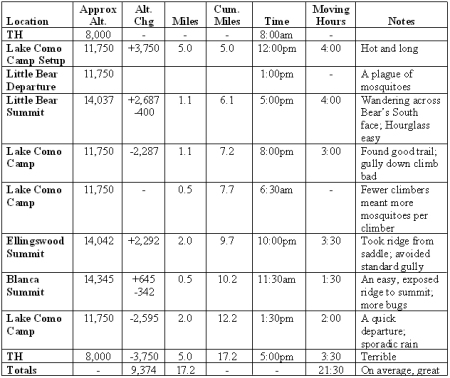
Lake Como Deathmarch

December 6, 2008

Story


Ten thousand toe-smashing steps over loose gravel and unstable boulders swatting at swarming mosquitoes and wondering again and again how much farther, it still was not until 4 miles into a 5 miles crawl down the Lake Como access road that my mind flirted with regret.  Such was the magnificence of Lake Como and the surrounding Little Bear, Blanca, and Ellingswood peaks.  It was a great trip.

I left Boulder at 3:30am on 7/13/03 with a 3 day plan to bag Little Bear, Blanca, and Ellingswood, and headed toward Golden and C-470 that I took to I-25 toward Pueblo.  I exited on hwy 160 toward Fort Garland.  After passing beneath the Sierra Blanca Massif, I took hwy 150 to the unmarked road leading to the Lake Como trailhead.  It was a nice and short approach to the passenger car parking.

My plan was for 3 days with a option to bag Little Bear on day 1 (and save a day) if the weather held.  As I arrived, the weather was promising, and I was of two minds:  (1) I wanted to do Little Bear before dark, but, (2) I was worried about the harsh road and destroying my only ride home (Boulder is a long walk).  I decided that discretion is the better part of valour and parked at the initial trailhead.   Either the good weather would last long enough or I would do my 3-day plan.

I started hiking with my massive pack at 8am.

Almost immediately, I was sorry I had parked so low. I hate avoiding exercise for the sake of laziness, but I needed the extra time that parking at 10,000′  (instead of 8,000′) would have provided.  The road and availability of parking was good enough up to that elevation.

My five mile trek to Lake Como took a long time.  I was pushing as hard as I could to save daylight, and getting more and more frustrated with my parking mistake.  My attitude improved immediately when I came upon on of the most beautiful mountain lake settings I have ever seen.  Lake Como is spectacular.  The trees are thick and massive, even at 11,750; I suppose the protection of the Massif on three sides plus the constant availability of water must allow for unusual growth.

The second thing I noticed was the mosquitoes.

Oh why didn’t someone stop the insanity of the mosquitoes?  I am from Florida and I know mosquitoes.  These were bad mosquitoes and I didn’t have repellant.  Rather, my sweaty clothes acted as an attractant…like I sprayed a can of “On” all over myself.

A swarm of mosquitoes and I arrived at my creekside campsite at 12pm and the group of us (mosquitoes and I) took an hour to build my camp.  The long setup time was caused by the extra activities required to co-exist with thousands of mosquitoes while building a camp.  Take out the tent poles…. swat, spin, dance, take out the tent foot print, … swat, spin, dance, etc.

The weather still looked good at 1pm and I started up thinking I’d turnaround if the weather turned on me.   The approach gully (directly east of Lake Como) was a steep and loose scree and dirt slope that barely tolerated human presence.  I finally topped out of the gully at 2pm and then became a bit confused about the way to the Hourglass.

The proper course is to stay on the ridge following nice, easy trails to the top of point 12,980 (which lies in a direct line between the top of the gully and the summit of Little Bear).  I misunderstood the route directions to mean I should look for a trail lower and followed a friendly-looking false trail heading that way.

As I was wandering up and down the east side of Little Bear’s south ridge looking for the trail, I was thinking that I hate directions given in linear form, e.g., do 1, then 2, then 3; and that I much prefer a pyramid structure where by the entire picture is given briefly followed by more detail of the picture already described, e.g., the South ridge leads directly to the Little Bear summit, between the top of your ascent gully (12,500) and the Little Bear summit is Point 12,980.  Stay on the ridge to reach Point 12,980 and then drop down on an established trail below the ridge to reach the bottom of the Hourglass which you will ascend to the summit.

The route I wish I had taken

The route I wish I had taken

After an extra bit of time on the traverse (about 1 hour extra), I came to the bottom of the hourglass around 4pm.  Since I was alone on Little Bear I didn’t have to worry about the major worrisome aspect of this climb…rockfall.  The rock was dry and so after a short break, I scampered right up the middle without any problem.  I climbed past a rope that was hanging from a dubious anchor and I feared for those who trusted it blindly.  I continued upward to the summit that I reached at 5pm.

The weather was still great, but now I had to worry about getting down before dark.  I followed a trail down that took me to the far right edge (left side of the hourglass looking up) that seemed much easier than the path straight up the gully.  I angled back to the center of the hourglass at the level of the anchors (by the way, there is an excellent piton anchor a few feet higher than the poor anchor so no hardware is necessary if a rappel is needed).  I then walked down the center to the base of the Hourglass where I collected my stashed gear.

On the way back, I was following the excellent trail below the ridge heading toward Point 12,980 when the weather turned on me.  It happened fast.  The flash-bang separation was small enough not to count.  I was moving fast when I came to what I thought was the gully I used to climb to the ridge.  Since I had been too low on the approach, I didn’t have any memory of the terrain.

Anxious to get low, I started down.  Fortunately, I realized my mistake before descending past the point of no return and continued until I reached the proper gully above Lake Como.  At that point the sky cleared.  Still, working my way down the loose gully was the worst part of the climb.

Once I got close to the wooded area, I prepared for the mosquito onslaught by putting on all my clothes, e.g., long pants, rain jacket with hood up, hat pulled down low.  Back at camp at 8pm, I refilled my water bottles, collected a few bars from my food bag and dived into the tent.  I had just enough daylight to crush the life out of the few foolish mosquitoes that dared enter my tent with me.  I tried to drink a lot of water to fend off cramps, but I just could not do it and fell asleep to the sounds of a bubbling brook by 9pm.

About 5:50am I woke up feeling great.  It was one of my best nights sleep ever and I am a connoisseur of sleep.  I organized myself for the attempt on Blanca and Ellingswood via the ridge traverse and was on the trail by 6:30am.

The trail to the basin was excellent and I followed it all the way in without incident.  I could not decide which direction to do the ridge, i.e., Blanca to Ellingswood or Ellingswood to Blanca, so I kept moving forward and looking and thinking.  Eventually it seemed the easiest path would be to go straight to the ridge and then use the ridge in both directions.  Once I reached the ridge I could see the area very clearly….it was an impressive view of both the Massif, the Lake Como area and the Huerfano Valley area.  I could see the entire route I took on Mt. Lindsey the week before and I could see the Gash ridge route that looked so interesting from the trail to Mt. Lindsey and I could see my routes to Blanca and Ellingswood.  The ridge up to Blanca looked terrible (read: very steep) from my perspective so I decided to head over to Ellingswood first.

I stayed on the ridge for a while until I came to a big notch in the ridge that looked impossible to down climb, so I worked down from the ridge to where I could enter the gully.  I then scrambled up the gully to the notch and continued the rest of the way on the ridge to Ellingswood summit.   I reached the summit at 10am and tried to enjoy a break and a snack but the mosquitoes had followed me to the heavens.  And these were no angelic mosquitoes.  After a quick bite and killing a few dozen mosquitoes, I headed back down the ridge.  This time I was determined to stay on the ridge the entire way.

My ridge route, as seen from Little Bear

My ridge route, as seen from Little Bear

When I got back to the notch that defeated me earlier, I spied a short route on the far side of the notch that looked like it might go.  So I down climbed into the notch and took a line that started about 5 feet from the edge toward the Blanca basin and worked up and right at a 45 degree angle over a few loose blocks to climb out of the gully about 10-15 feet below the ridge line above the notch.  I moved back to the ridge and stayed on the ridge all the way to Blanca.  Apparently, my earlier views of Blanca were foreshortened; the angle was not bad and the climbing was mostly hands-free.

My view of Little Bear from Blanca

My view of Little Bear from Blanca

I reached the summit of Blanca at 11:30am and studied the traverse from Little Bear while swatting more bugs.  I was very tired at this point having climbed over 9,300 feet in the last 28 hours, so I thought I’d rest a bit before pounding back to camp.

While resting I began to think about my mosquito strategy.  In a flash of insight, it seemed strange to me that when I see a mosquito, I wait for it to land so I can smash it.  Nobody ever did this with a wasp or bee, so why a mosquito?  Oh sure, it feels great to kill a mosquito, but I’ve noticed that it never does any good in an open environment.  Now, if I kill the only mosquito in my tent, then I have no mosquitoes in my tent; this is a good thing.  But if I kill a mosquito outside, a million more take its place without any notice that I have killed a cousin.  I’d have to destroy the planet to get rid of enough mosquitoes to make a difference, so I decided to henceforth employ a “no land” strategy and do without the pleasure of killing the little bastards.

The scree field below Blanca reminded me of the Little Bear approach gully (not hourglass) and I wanted no part of it.  I decided to return down the ridge to just above the saddle where a trail intersects the ridge.  Leaving the summit at 12pm, I followed this trail down to camp, which I reached at 1:30pm.  Once again trying to pack and dance simultaneously, I gathered my belongings and took off down the trail to the car by around 2pm.  Within 30 minutes of my departure, the skies opened up and it poured a mixture of rain and snow for about 30 minutes in a strange localized burst just over the Sierra Blanca Massif.

I actually enjoyed the cooling rain (no lightning) and was quite pleased with my trip, but knew I had to get down to the car…something about counting chickens popped into my head.  After over 3 hours of blister-forming, ankle-turning, knee-wrecking hiking, I could finally see my car and knew it was nearly over, and then I felt great all over again.

Little Bear, Blanca, Ellingswood Climb SummaryAverage of 721 elevation feet gained per hour & 0.8 overall mph

Average of 721 elevation feet gained per hour & 0.8 overall mph

Complications

  • Climbing alone
  • Unfamiliar weather patterns
  • Insufficient route and driving information

Mistakes

How I Got Lucky

  • The weather stayed good during late summit push on Little Bear
  • Didn’t get hit by lightning when I was trapped on ridge descending from Little Bear
  • Didn’t get injured while climbing by myself

Visit Yield and Overcome blog

See 14er Project & 14er Trip Report Listing

Longs Peak: Keyhole Ridge

December 3, 2008

Story

With a long break coming up, Brian and I looked for a long, high-altitude climb to keep us sore for a few extra days.  We settled on Longs Peak Keyhole Ridge: a moderate ridge climb with spectacular views and a direct route to the summit.  I also had a private agenda; I was going to see if I could avoid dehydration rather than tolerate it.

The route included a 7.25 mile one-way hike with a 3,600 foot elevation gain (ranger station to false keyhole) plus 5 mostly adventurous pitches of 4th class to 5.5 climbing. We thought we’d start early despite a perfect Summer weather forecast.

keyholeridgeroute3

We arrived at the full parking lot just before 4am and started out under a clear sky and bright moon right at 4am. Brian and I are still fairly fast hikers, even with a pack full of metal and rope; we reached the first bridge (just before tree line) in 45 minutes, which is a good a speed as we’ve done. We reached the cut-off to Jim’s Grove around 5am and the Boulder Field corral after 2.5 hours. With no small amount of pleasure, we noted that 2.5 hours to the Boulder Field is as fast as we’ve ever done.

We took a short break to enjoy a snack, tank up on water, stash some gear, and be amazed by the crush of people milling around the center of the Boulder Field. Rested and me with a full belly (a bar and 1 ½ liters of water), we started hiking toward the Keyhole. Just before the Keyhole is a NW-facing ramp that leads to the False Keyhole further up the NW Ridge of Longs Peak. From the False Keyhole (between the 1st & 2nd towers along the NW Ridge), we were able to mount the ridge and begin climbing toward the peak with the following pitches / sections of climbing:

  1. 4th Class Scramble: to reach the initial climbing section, we scrambled up along the ridge line for about 50 feet.
  2. Ridge Tiptoe & Climb to Second Tower: a scary, exposed section of blocks create a 4th class scramble along a 3 foot wide staircase with hundred foot drops to either side; we roped up. This scramble leads to the foot of the 2nd tower. From the foot of the tower, we traversed left (5.2) to reach a steep ramp that leads to the top of the tower. The ramp (5.4) led up to a number of options to reach the top of the tower; we went left to a ledge and then up to the top of the tower (5.5).
  3. Downclimb and Ledge Traverse: From the top of the 2nd tower, we descended to the west side of the ridge, down climbing 10 feet to a ledge.
    Longs Peak Keyhole Ridge Tower

    Longs Peak Keyhole Ridge Tower

    The ledge led to a low point between the 2nd tower and the remaining NW Ridge.

  4. Scramble to top of ramp: From the saddle, we moved up a broad, low angle ramp to reach a cliff below the NW Ridge. At the end of this pitch, I had a beautiful sit-on-the-cliff-edge, feet dangling belay overlooking the Boulder Field.
  5. Face Climb to Ridge Top: Finally, we climbed the cliff to get back to the top of the ridge (5.5)
  6. Scramble & Hike to Summit: We unroped and climbed along the ridge crest. Near the end of the ridge, we dropped down 10 feet to the left to pass the last tower (3rd class). We then scrambled to the summit level. Once we reached the summit block, we had a 100 yard hike to the summit and the masses milling and lounging around like on Miami Beach.
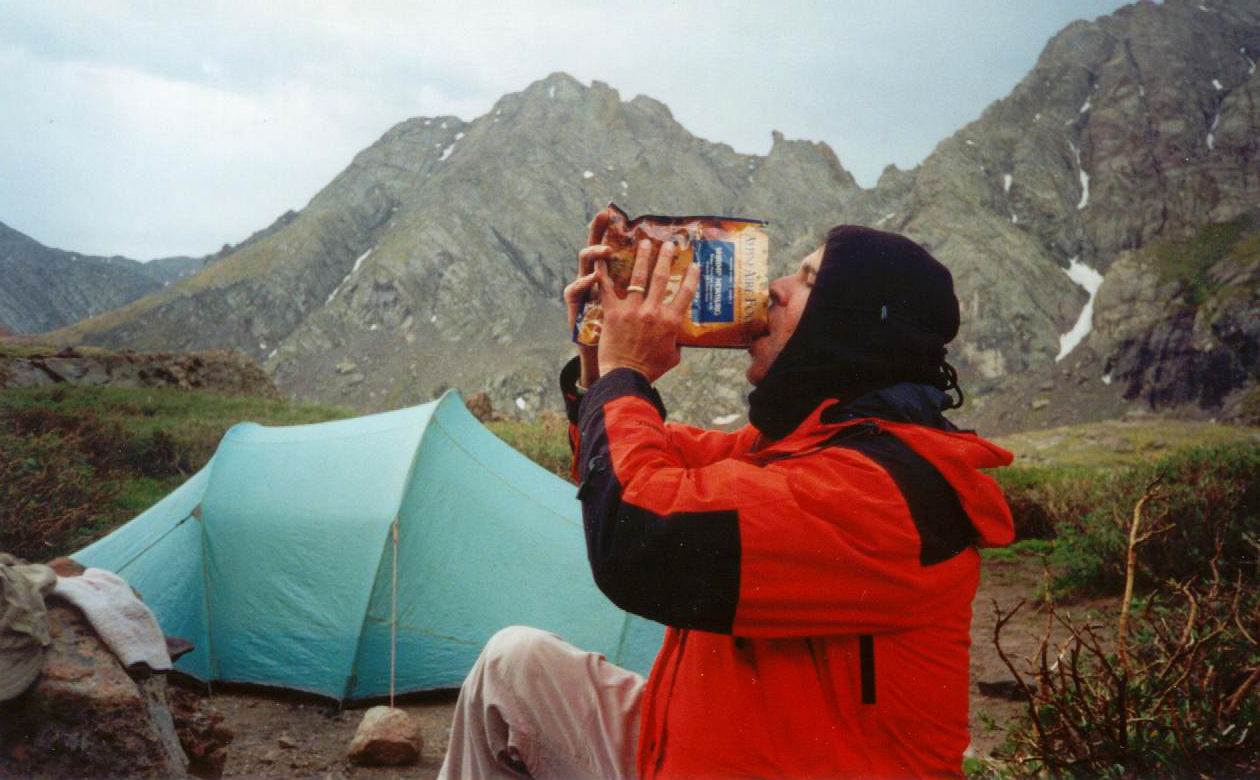
keyholeridgeroute

On the summit at noon was right on schedule. We rested and I ate a bite of lunch while finishing my 2nd liter of water since the Boulder Field.
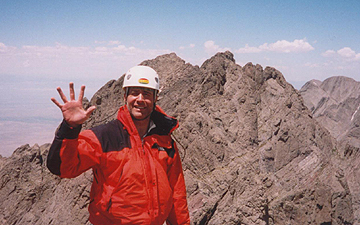
After our short break, we descended the Cables Route down the north face without incident.

keyholeridgeroute2
Once we reached the corral and our stash, we refilled bottles and bellies with water.

As we left the Boulder Field, my toes were already feeling the beginnings of “Fire Toes” syndrome, a very painful friction condition brought on by my newish Makalus. I’ve found that the newer style boots with rubber rands covering the toes will not break in; they insist on breaking in your feet.

The hike out of the Boulder Field and through Jim’s Grove was long and hot, but went without any ankle turns. We took a short break after the bridge that reconnects with the main trail, where I finished my 7th liter of water for the day.

Trudge, trudge, trudge. It is always the same death march back to the car after a Longs Peak summit. The only sign of aging I can discern is a strong preference for going uphill in the morning; the downhill return is always a dread. My toes felt horribly abused.

Still, the time passed relatively quickly due to our use of “Movie Quiz”: a game of guessing movie sources for quotes or naming movies that a particular actor was in. We reached the car at 4pm, where I was pleasantly surprised to find that, once again, the toes were still attached.

And, aside from boot tortures, I felt great, thanks to my water guzzling efforts.

Route Map: Yellow is standard Keyhole route. Our variations are in red.

14.5 miles, ~4,850 ft elevation gain, 12 hours; not bad for two old guys

14.5 miles, ~4,850 ft elevation gain, 12 hours; not bad for two old guys

Complications

  • None

Mistakes

  • None

How I Got Lucky

  • The weather was great all day
  • I was able to find a lot of water on the trail to avoid dehydration without carrying more than 2 liters at a time

Return to PeakMind blog