Archive for the ‘Trip Reports’ Category

No Love on Love Route

October 17, 2010

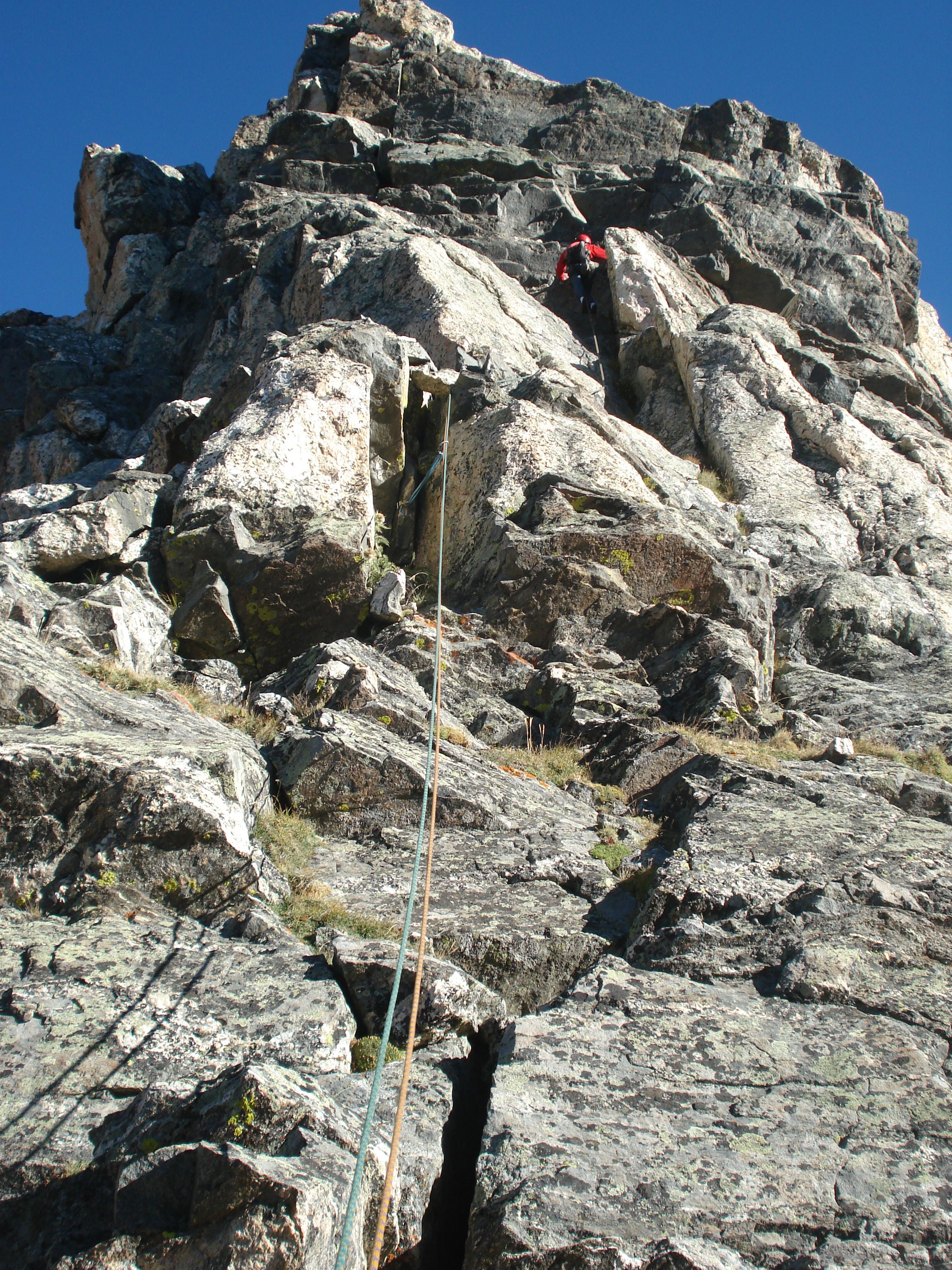
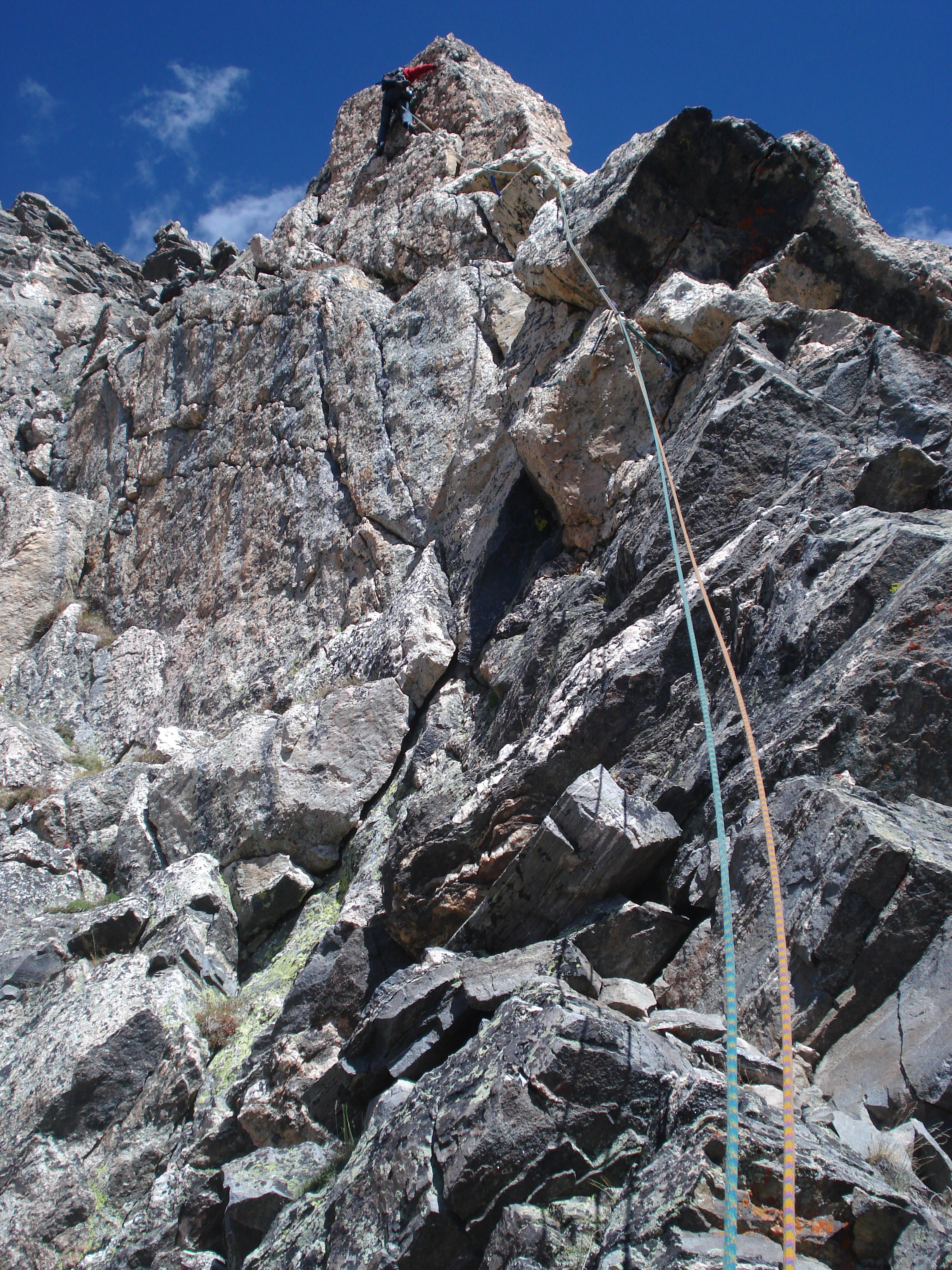
Brian and I were near the end of a run on the major Hallett Peak rock climbs.  The year before we had climbed Northcutt-Carter (5.7), Culp-Bossier (5.8), and this year we had already climbed Jackson-Johnson (5.9). Brian picked the Love Route (5.9) for what would turn out to be our last high peaks preparation for our upcoming attempt on the Casual Route (5.10), Longs Peak.

The weather wasn’t perfect, but we’d had great weather luck for many weeks in a row. I figured my luck would continue to hold.  I was wrong.

On August 1, 1998, we set off for Hallett Peak a little later than usual. The day before, in a flash of stupidity, I reasoned that if we could do Jackson-Johnson after starting at 8:30am (after a false start), we certainly could climb the Love Route with a 7:30am start (6am sunrise) in the face of poor weather.  This would allow for a 4:30am departure from Boulder instead of the normal 3am. One and one-half hours of sleep was the difference between 3.5 hours and 5 hours of sleep. Apparently, I was willing to gamble a lot to exchange a miserable night sleep for a mere bad one.

Brian wanted to be flexible, I suppose, and he didn’t argue the point. Perhaps he also looked forward to a few extra winks.

As planned, I felt much better than usual when Brian showed up for the drive to RMNP. And, after hiking to the base of Hallett in the dawn light instead of the pitch dark, the day was officially off to a grand start.

Pitch 1:

To the left of the Cup-Bossier start is the dihedral start to the climb.  Rossiter says, “Climb the pink wall 20′ right of the smaller dihedrals and 80′ left of the big dihedral”

A 160 foot 5.6 climb up the grassy, right-facing dihedral leads to the 4th class gully (the big dihedral) that leads to the top of the triangle buttress.  We started up the route at 7:15am.  I took the 1st pitch to allow us to switch off pitches (not counting the 50-foot ‘move the belay’ pitch) and leave the crux pitch to Brian.

Pitches 2 & 3:

The 2nd and 3rd pitches were only 4th class. The only interesting event on this section of the climb was Brian’s apparent attempt to drop his car keys to the bottom of the buttress.  The rock didn’t cooperate and snagged them only 50 feet below where Brian was able to collect them.

But the rock was very wet. It is quite common for have wet rock early in the day, but we’ve been able to rely on the wind to dry off the rock before long.  But not this time.  Not with overcast skies.

Pitch 4:

Brian led the 4th pitch up some wet, but good 5.6 rock through the white band for about 160 feet.

Pitch 5:

The 5th pitch was mine and was very bad…wet and runny. I started up, angling right. I was supposed to stay in a right leading crack for 90 feet then angle left and up. I was in water the entire time, and every time it looked like the route could go left, the path required friction moves over slime. No way.

According to Rossiter’s guidebook, there were no routes between Love Route and the Englishman’s Route, which was far to the right.  But the weakness in the rock and the only safe climbing went right. I had to try something.

I stayed right, picking my higher and higher. But every step was in mud, and every hand hold was in water. And I was unable to find any good pro for long stretches. At one point I was 15 feet over my last good pro before I found a good placement. It was a foregone conclusion that I was not going to get back to the route; I had passed up all changes to traverse back to the line. I was probably screwed. I just hoped I could find a safe belay before running out of rope.

It was turning ugly, but at least the weather had held despite threatening otherwise.

Looking up, I spied a potential belay and could see a line to get there. Thank God.

Just below the ledge, I had to pull up on and then step on two loose hand-sized rocks wedged into a shallow crack.

But I made it.  I had 5 feet of rope left.

The ledge turned out not to have much pro or space, but it was a satisfactory belay given that I was out of rope.

As I brought Brian up, he was whining about how far off route I was and how I should be more careful. Yeah, whatever. I was just glad to be alive. I told him we’d be back on route if he’d go up to the lower angle rock and then head left to get below the roof.  He said he’d try; what more could I ask.


The upper route topo. Red line is our route. Green line is the true Love Route. Blue line is the Better Than Love route, unknown to us at the time.


Pitch 6:

He made it.  The climbing was moderate, but the pro continued to be scarce. Still, it was another possible path to take when The Love Route was runny and slick. We were back on route.

It turns out that I wasn’t the only one to think so.

In the years since our climb of the Love Route, another route emerged into general knowledge between the Love Route and The Englishman’s Route.  It is called “Better Than Love” and follows the line we used except for continuing to the top while remaining to the right of the Love Route. See Gillett’s High Peaks guidebook 2001 version.  Apparently the climb was done many years ago; but since it wasn’t in my 1997 Rossiter guidebook, it might as well have been classified Top Secret by the US Govenment.


Brian approaching the top of the 3rd pitch


Pitch 7:

We took a moment to study the 7th and crux pitch.  And then it started to rain and hail. Shit.

It was bad. We’d never bailed before but this maelström did not look like the ‘take prisoners’ kind of storm. But Brian thought he could aid the crux, and since the top was a lot closer than the bottom, we agreed to push on.

It was so slippery. He had to aid the roof then then pulled off a couple unprotected traversing moves in a waterfall to make it. It was well done; one of his more heroic efforts of all time.

When it was my turn to step around the roof, I didn’t think I’d make it.  But I had a top rope, so I had to try. Sticky rubber is sticky even wet.

Pitch 8:

I took the last pitch, which was thankfully short and only 5.6. And by the time I reached the top, the rain had gone.

Our perfect record was still intact.

Lucky again.

See all trip reports

See all RMNP trip reports

Poor Teamwork on Mt Columbia

September 23, 2010

“The only way to have a friend is to be one.”

~~Ralph Waldo Emerson

When we play atop the high peak alone, we have only our own interests to consider.  It is a simple matter to set a goal and build a plan to accommodate our interests, skills, fitness and tolerance for risk.  When we are alone, we can enjoy the high peaks the way we want without any compromise.  But it is simply more fun to adventure with people we like and trust.  And as an added bonus for team-based adventuring, a collective effort can minimize the risks inherent to playing in a dangerous environment.

But a team is not a group of individuals acting in their own best interest.  Members of a “team” demonstrate cooperative and supportive behavior in a common effort to accomplish hard goals.  Good team members value a relationship built over time and expressed in mutual understanding, honesty, sympathy, empathy, and loyalty.  And, the knowledge of one-another within a team allows complementary abilities and coordinated efforts to generate synergy, which enables a “team” to be greater than the sum of the individuals.

A good team offers safety by being supportive and trustworthy.  A bad team doesn’t.

This trip report is about a bad team, of which some of the members successfully summited on Mt. Columbia on May 5, 2000.

Trip Report

On Saturday, May 5th, Brian, Susan (my girlfriend of 4 months and future wife), and I set off from the N. Cottonwood Creek trailhead to climb Mt. Columbia.

Brian (Climbing Partner) and Susan (girlfriend of 4 months) preparing for early start on Mt. Columbia (Colorado)

Brian and I had hiked past the full length of Columbia two years prior when we climbed Mt. Harvard via its South Ridge starting from the N. Cottonwood Creek trailhead; we felt we knew the area well enough to skip a full-on planning effort to climb Columbia’s West Flank and South Ridge. We were right to be confident that the two of us could figure out a way.

But we were wrong to remain confident once we added an inexperienced member to the group.

In the week before the attempt, Susan expressed an interest in joining me on one of my trips. Without thinking, I invited her to join us on the upcoming Mt. Columbia’s climb, and she accepted. If I thought anything, I suppose is was that any difficulties that surpassed her skill set would be at the end of the hike, and so would allow her to simply wait below for a short time if we could not protect her. When I told Brian of the addition to the team, he agreed it would be okay.

We were both wrong in assuming that adding Susan, an inexperienced 14er hiker, to the group would pose no significant problems.  But, I would stand alone in blame for the biggest leadership mistake of all.

We drove up Saturday night for a pre-climb car-camp. It would be a long day (Dawson estimate was 11 hours) so we needed a very early start from a trailhead a long way from home.  It was a beautiful night for sleeping under the stars, with clear skies and moderate temperatures. We enjoyed a couple hours of camaraderie before turning in for a short night’s sleep.

The next morning we hiked in the pitch dark and soft snow.  I had brought snowshoes for Susan, so she was fine; but I had skis, which I put on and took off multiple times as soft snow and exposed rocks competed for my attention. As the trail approached Columbia, snow started to fall and the wind picked up.  It was getting cold.  But going uphill kept the furnace burning hot, and we continued along following Brian who I assumed knew the way to go.

It was hard to see our destination through the trees, but eventually Brian said we should leave the trail. We turned toward Columbia and made our way closer to the West Flank that looked steeper that I expected. He stopped hiking on a pile of talus under a steep, icy gully and took off his pack. I asked if we were taking a break; Brian said this was it.

I couldn’t believe it! I stared at Brian in disbelieve that he would think this route would work for Susan, and then I looked at Susan.  She had a pleasant smile, and was expecting the best of a great day.  Oh shit!

I didn’t bring crampons for either of us, and I didn’t bring an ice axe for Susan; and she didn’t know how to use such equipment, anyway.

“What the heck, Brian? Isn’t there an easier way up?  Susan can’t climb that!” I communicated to Brian in another glance.

“I think this is it,” was all he said.

We stood there, freezing in the wind, for another moment.  Then I told Susan the bad news.  She couldn’t continue and it wouldn’t be smart to wait in a cold wind for 5 hours.  I told her that it would be best if she went back to the trailhead, where she could get protection from the wind (in my 4Runner), and even catchup on a little sleep.

Columbia from Yale: our route vs. standard

Susan was agreeable, as always, but she didn’t know the way back. I assured her that it would be easy to simply follow our tracks in the snow, and if she did get lost she could simply listen to find the river, and then she would keep it on her right and follow it back to the bridge crossing to find the trail. I pointed her in the right direction and she left.

Susan adds…

Joe was always going on some adventure or another on the weekends.  I thought I’d like to go along, and he said yes.  We started hiking so early it was dark, but I just followed behind.  We stopped hiking below a very steep snowfield, and Joe said he hadn’t known it was so steep.  I was a little upset that I couldn’t finish, but more so that I would have to hike back alone.  I was worried about getting lost because I hadn’t paid attention to the trail during the hike in.

Brian put on his crampons and disappeared up the steep, icy gully.  I followed by kicking creases in the ice & frozen snow where Brian had weakened it with his steps, and I hauled on trees wherever possible.

Progress up the slope was slow, for obvious reasons.

Once we reached the South Ridge, I hoped we were close so we’d be able to head back soon.  But no.  We still had a lengthy ridge traverse to reach the summit. And the wind became brutal.  With the skis acting as sails, we were tossed around like toys.  Brian even took a spill into some rocks after a big gust. But we made it.  And, although it was a bit late for snow safety, the cold wind gave us confidence.  We hurried back down the South Ridge past our ascent path to reach the a major gully, which probably would have been a better ascent path. (note: the standard ascent path would have been even better; see route photo.)

The ski descent was excellent. The snow was mostly in good shape, except for an unseen slushy spot that initiated a spectacular tumble by me.  And rocks were falling from above. But it was a wonderful period of joy that allowed no thoughts of what might have gone wrong for Susan on her retreat.

As we started back, I was surprised at the extent the trail had melted out.  It meant we could not ski out very well, and it meant the trail might have been hard to follow. I started wondering about Susan’s fate.

Columbia route map

We trudged on and steadily ate up the trail. Shortly after we crossed the creek, we saw Susan hiking toward us. She was delighted to see us as I was delighted to see that she had made it back.  I figured she had gotten bored and was coming to meet us.

But I was wrong.

Susan explained that she had not yet made it back to the trailhead.  She had been continuously hiking up and down the trails, looking for something that looked familiar. She was actually delighted to see us because finding us meant that she wouldn’t die that day.

Susan adds….

I tried following the tracks, and I nearly made it to the trailhead before getting confused and turning around.  I hiked back and forth on the trail for many hours until I found the Joe and Brian heading back.  I was so relieved that I wasn’t going to die that I wasn’t even too mad.  I had a long day of quality time with myself.

I was amazed that the situation had spun so far out of control.  And I was embarrassed. It was entirely my fault, and it forced me to think hard about the proper behaviors for teams with unequally experienced members.  Very clearly, I had made two serious errors

  1. I failed to understand and/or assume responsibility for Susan, who completely trusted me to keep her safe because she could not fully manage her own safety in that situation
  2. I failed to abandon my personal goal (bag summit of Columbia) when it became incompatible with my responsibility for Susan’s safety

It became clear to me that, for a good team, we need people we know, people we trust not to selfishly, foolishly or ignorantly put us in danger or fail to respond properly to an emergency.  And, finding a group of people is just the first step.  We then need to turn our “group” into a “team” by continually strengthening relationships and learning about each other in the context of shared adventures that we choose for suitability to the current level of trust and experience among the members.  And, most importantly, the experienced members of a team must assume responsibility for the inexperienced members whenever they adventure together, even when it means to give up on the summit to keep a team-member safe.

This must be the first rule of teamwork.

See essays:

And all credit to Susan for finding a happy ending to the story. She stuck with me, after all; our 10-year marriage anniversary is coming up in 2011.

See all 14er trip reports

See all trip reports

Found Money (Gambit)

September 19, 2010

I’ve been climbing in the Boulder Flatirons & Eldorado Canyon ever since I moved to Colorado in 1996. Over that time I’d managed to climb every moderate (5.8 or under), well-thought-of climb I’ve found. But last year I stumbled upon another highly regarded, moderate climb in Eldorado Canyon — Gambit.

I was amazed when I found it on Mountain Project.  It sounded too good to be true; all I had to do was give it a try to find out.

Brian was a go, naturally; the only prerequisite was to do some climbing to get our climbing skills back to a level that would allow for a 5-pitch 5.8 route.  We started with Spearhead’s North Ridge (5.6), and then, after a Solitude Lake Cirque diversion, we did Sharkstooth (5.6) in good form and then Zowie (5.8) in poor form, then we did  a variation of Blitzen Ridge that included a short pitch of 5.7+.  Finally, we did Long John Wall (5.8) with Brian leading the hardest parts without hitch. We were ready.

On September 18, 2010, on a foggy morning, we set out for Shirttail Peak to climb Gambit.  The temperature was nice and the forecast was for the fog to clear by midday.

It was a fairly short approach and an easy to follow trail.  True, it wasn’t as easy to get to as the Wind Ridge or the Bastille, but it was no harder than Yellow Spur or Long John Wall or the 1st Flatiron.

According to the beta available from Rossiter and Mountain Project, there were many different ways to breakup or combine pitches.  Brian and I agreed that we’d use the Mountain Project breakdown (5 short pitches) to avoid rope drag.

We got the gear organized and established the order of leading pitches.  Brian noticed that one of our TCU’s had a broken wire.  It somehow worked well enough to keep it on the rack, but the end was near.

Pitch 1

Brian took the first pitch that started just to the left of a tree growing around a bulge in the rock.  It was a nice warm up, rated 5.6, that was still rather steep for the grade.  It would turn out that every pitch was steep, with the hard ones being at least dead vertical.  The route was almost exactly 100 feet long and ended at a big ledge with a big tree.

Pitch 2

I took the 2nd pitch, which started directly behind the tree.  The pitch started with an unprotected overhanging section.  Not a nice way to start the day.  Still, it was only 5.7, so the holds had to be there.  And, they were.  It was a steep pitch with buckets.  Thankfully, it was only 75 feet long, as I was nearly out of gear at the end. The pitch ended at Pigeon Ledge, named, I suppose, for the leavings of our feathered friends.

It was a nasty, smelly place; so, I setup the anchor in the alcove above the traverse ledge.  This meant I had to hang on the anchor, but at least I could breathe and I could get out of Brian’s way when we was ready to traverse over to start the 3rd pitch.

Pitch 3

Brian took the perfect left-leaning dihedral pitch.  It was nearly vertical and capped by a broken roof.  I followed and found that I could stem across the dihedral to reach holds near the top of the roof.  I pulled over the top and found Brian on a big ledge, grinning like a Cheshire Cat.  It was a good lead on the crux of the route.

Pitch 4

We sat for a minute to study the beta.  The beta said to ‘climb the narrowing slot in front of us, and then to climb an overhanging handcrack…

This pitch packs more punch than may be implied by the 5.7 rating it garners…follow a right-angling, slightly overhanging hand crack over stupendous exposure with knockout jams.

~ Mountain Project

I had visions of Zowie’s 5.8 overhanging hand crack, that only 2 weeks earlier I had ‘fallen up’ after blowing out my arms 15 feet from the summit.  In a shameful display of cowardice, I offered to switch pitches with Brian (taking his 5.6 finishing pitch).

Naturally, he agreed; and, I was shamefully happy.

Brian took off, only stopping to comment on the fixed #4 Camalot.  When it was time to take down the anchor, I made some effort to lose another nut tool (lost a 1-year old one on Sharkstooth this summer).  Fortunately, I was saved by a sticky bush which caught the tool on its terminal bounce from the ledge.

This pitch created a lot of consternation for me and among the Mountain Project discussion board users.  With 20-20 hindsight, I can say it is unfounded; below are my thoughts by section:

Awkward Slot with Chockstone

Okay, it was ‘awkward‘ as in “not straightforward’ but not very hard.  A short layback mounts the slot, and is very well protected by a good pin.  No big gear is needed for the slot; the pin is good.

Overhanging Hand Crack

This was steep, but it was no ‘overhanging hand crack’.  Lots of hand and footholds made this portion of the climb only 5.6ish to me.  The protection opportunities seemed less prevalent, but I should have taken it.

Pitch 5

Okay.  Now was my chance to redeem myself.  Even if the climb was only 5.6, it was near vertical…and was not solid rock.

I was tempted to climb the top of the Tiger Balm Arete, which was recommended by a few Mountain Projet posters; but I decided I would use the ‘loose rock’ conditions to prove my mettle.

I started up, aiming to stay left to avoid the worst of the loose rock (as mentioned in Mountain Project).  I quickly found the ‘piles of wedged rocks’ that served as the source of many key holds.  But the situation was not too different from Alpine climbing where no piece of rock can be trusted; a process of testing and evaluating each hold slowed my progress but allowed me to make steady progress to the summit.

This route is not a good place to transition from the rock gym to real rock.

Summit

The summit of Shirttail Peak was nice, by which I only mean we had a nice flat area to sit and organize gear and ropes.  I cannot comment on the great views that were promised because we were still in a cloud; we couldn’t see anything further away than 100 feet.

No views for Brian and I, but we knew we’d be back.

The only remain question was how to get down.  The recommended path would take us into a wet mess; the cloud was blowing up the northwest side and deposited a lot of water on the rock. We decided to try to find a way to reach the rappel anchors below the climb that we’d seen earlier in the day.

Descent

We had to start by scrambling down the wet rock to reach the top of the gully.

With that done, we had to make an interesting downclimb to get into the gully.  It was only 4th class, but the exposure was rather serious; I wouldn’t recommend it for anyone not completely comfortable with 4th class downclimbing.

It turned out that we couldn’t get to the first anchor that looked to be set for coming down from the Potato Chip area.  We continued down to reach the next established anchor; this effort included an even harder down climb to descend the last 20 feet to the anchor.  Brian setup a belay on a tree with a poor anchor above the hard downclimb so we could do a belayed downclimb; Brian took the hard job of cleaning the gear on his way down.

The rappel anchor was good and a single rope (60m) rap got us to another ledge with a tree and an established anchor.  On this ledge, I found a newish cam that perfectly replaced the cam with the broken wire.  It added to the cache of gear we found on the day.

We reached the ground about 15 feet from our packs.  After a very short walk, we sat down for a few minutes to eat lunch and enjoy the moment.  Brian had to go early, so we left at 1:30pm to get Brian to his truck and me to my PC to record this trip report marking the check-off of another goal.

Finding a great route in my backyard felt like ‘Found Money’ without the generally feared consequences (“Law of Found Money”)

Gambit (5.8), Shirttail Peak, Eldorado Canyon State Park

See all trip reports

Blitzen Ridge, At Long Last

September 6, 2010

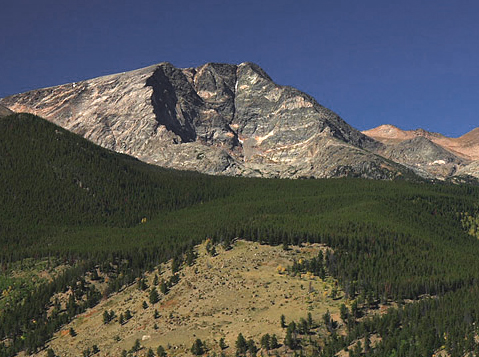
Mt Ypsilon and its Donner (left) and Blitzen (right) ridges

Blitzen Ridge.  It has officially been on my Climbing Goals list since 1/1/2000.

Unofficially, it was added the day I climbed Ypsilon Mountain from Chapin Pass (a walk-up) and marveled at the majesty of the entire area on July 11, 1999 (see Mummy Range Weekend trip report).

One of the key problems in accomplishing this goal is I never get to see it; I’m always driving to Estes Park in the pre-dawn dark, and I’m always climbing in the Longs Peak, Glacier Gorge or Loch Vale areas which are far to the south.  Out of sight, out of mind, I guess.

Still, every few years or so I’ve been reminded of it in some way.  Each time, I mentioned it to Brian for consideration and always get a similar negative answer, all of which boil down to: too much hiking for too little climbing. The fact that this statement is essentially true led me to never push very hard.

But in the year, 2010, I decided I would finish a number of my long-standing goals. I started my lobbying efforts early, and was unintentionally aided by the fact that our climbing skills have fallen far enough to severely limit our RMNP alpine rock climbing options.  Earlier in 2010, we’d done everything in RMNP we could think to do: Spearhead North Ridge, Notchtop Spiral Route, Hallet Great Chimney, Zowie Standard Route, Sharkstooth NE Arete, and we even bagged one of my long-standing goals, the Solitude Lake Cirque, a linkup of Arrowhead, McHenry, Powell and Thatchtop.  And, so, with a perfect weather forecast, Saturday, September 4, 2010, was the time to dedicate ourselves, finally, joyfully, to climb Blitzen Ridge.

Interesting story about the first ascent and naming of Blitzen Ridge

On about Sept 1958, a group of Yale students did the first ascent of the Blitzen Ridge. After a forced bivy on the summit, they walked down to Fall River Pass (where the RMNP Alpine Center is located) in the morning and hitch-hiked down. They named the two ridges “Donder” and “Blitzen” intending the names to mean ‘thunder’ and ‘lightening’.

~from a Charles Ehlert email published by Andy in the Rockies

Oddly, the ‘Donder’ ridge is now named ‘Donner’. It is impossible not to recognize the reindeer names, and a little research revealed to me that naming of Santa’s raindeers has changed over the years.  ‘Dunder and Blixem’ (Dutch) from the 1823 poem “A Visit from Saint Nicholas” (i.e., “twas the night before…”) by Henry Livingston, Jr. became ‘Donder and Blitzen’ in later versions by other authors, and eventually became ‘Donner and Blitzen’ in the 1923 song Rudolph the Red Nose Reindeer.  ‘Donner’ is the german word for ‘thunder’. Unfortunately, ‘Blitzen’ means ‘flash’ in german; it was used instead of ‘Blitz’ which is the german word for ‘lightning’ because of the need to rhyme with the name ‘Vixen’.  Still, it works for me.

The Plan

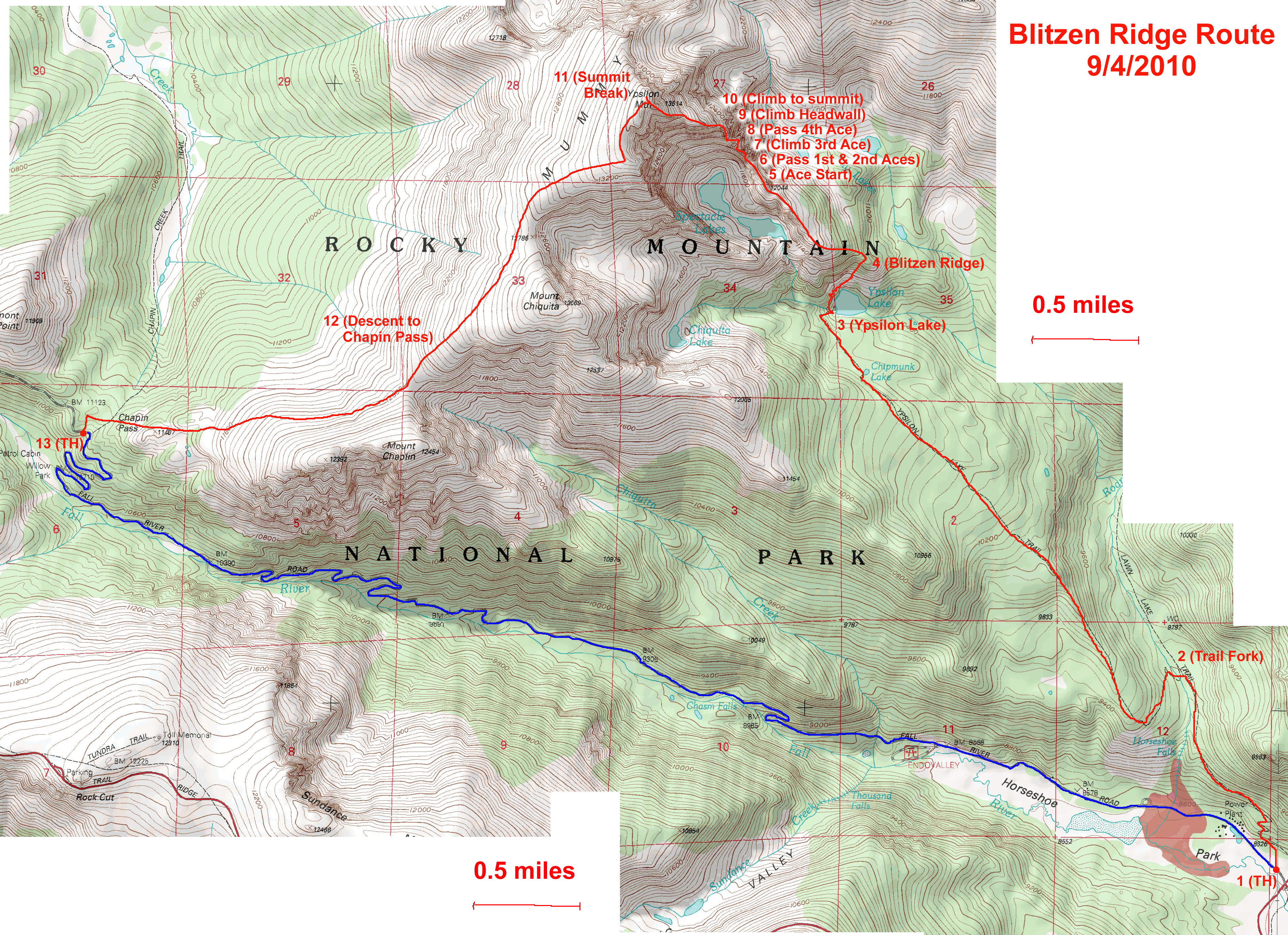
The plan was a simple one, and was designed to finish the ridge climb with the least amount of hiking possible.  It would also approximate the route used by the first ascent party in 1958, minus the hitchhiking.

The Blitzen Ridge route map

We would start from the Lawn Lake trailhead at the bottom of Old Fall River Road and hike to the bottom of Blitzen Ridge via the Ypsilon Lake trail spur.  We would climb the ridge and then descend from Ypsilon Mountain to Chapin Pass, where we would use a stashed vehicle to drive back to the starting point.  Yeah, driving would save ~4 miles of hiking and scrambling, but it would still be a hard day: 10+ miles of hiking & climbing from the Lawn Lake Trailhead (8540′) to the summit of Ypsilon Mountain via Ypsilon Lake and Blitzen Ridge to cover over 5000′ of elevation gain in 12 hours.

“Opened in 1920, Old Fall River Road earned the distinction of being the first auto route in Rocky Mountain National Park offering access to the park’s high country.”

~nps.gov (http://www.nps.gov/romo/planyourvisit/old_fall_river_road.htm)

I also hoped to check out the ‘Louis R. Leving Grave’ that is indicated on my GPS map as situated on the Blitzen Ridge.

On 2 August 1905, Louis Raymond Levings lost his life on the face of Ypsilon Peak…his body is buried there and a bronze tablet was erected where the body lies, to his memory.
 
~ Estes Park Archives

The Day

We met in Boulder @ 1am and drove up to RMNP in single file order. We drove past the Lawn Lake Trailhead at 2:10am on our way up Old Fall River Road to stash Brian’s truck at the Chapin Pass Trailhead.  The road was in good shape, but still narrow and winding in places and so slow (and explaining why it is a one-way road). It took a little over 30 minutes to drive the 9 miles; then we dropped Brian’s truck at what seemed to be a parking spot (next to the sign forbidding overnight parking).  We then continued up the one-way road in my 4Runner to the Alpine Center and then down the new Fall River Road to complete a 30 mile loop to reach, again, the bottom of Old Fall River Road and the Lawn Lake Trailhead.

And so it began.

Position 1

I was delighted to start on-time.  I figured some part of my start-up plan wouldn’t work and we’d start late; I was glad to have the extra time.  We actually arrived 20 minutes early.  But my estimate of 1 hour to position the cars was actually low by 15 minutes, and that was with no traffic at all.

When we pulled into the Lawn Lake trailhead, the lot had half-a-dozen cars already parked.  I couldn’t believe it; we wouldn’t be first on the rock. Brian suggested some of them might be headed toward Lawn Lake; I agreed it was good to have hope.

I had expected a cold, windy day, based on a forecast for Longs Peak on 14ers.com. But it was not cold, nor was it windy, except for the occasional gust. I packed away my extra clothes against the chance that the weather might change once we got above treeline.  And at the last minute, to save on weight, I decided to leave behind my extra water and only bring 1 liter of water and an extra (empty) bottle.  My plan was to drink a liter and refill both at Ypsilon Lake.  I figured 3 liters would be too little water for a 12 hour hike & climb, but still enough to get me home.

Position 2

In my preparation for the trip, trying to remember my previous 3 visits many years ago, I couldn’t recall a cutoff for Ypsilon Lake from the Lawn Lake trail. I was worried that the Ypsilon Lake trail would be hard to find, and worried that not finding it would be a quick end to a long plan. I decided to bring my GPS primarily for the purpose of finding the cut-0ff in the pitch dark.

We started up the excellent Lawn Lake trail making good time in the pitch dark. At about 1 1/4 miles in, I pulled out my GPS to guide us. But it was all unnecessary. At 1.5 miles along the Lawn Lake trail, we came upon a small sign indicating the turnoff.

So far so good.

Position 3

The Ypsilon Lake trail started as a fine trail but eventually reminded me of the Knobs Shortcut to the Glacier Gorge trail; it was rough and dark. Still, I only lost the trail once as we worked our way past Chipmunk Lake and, finally, Ypsilon Lake at approximately 5am.  In the dark, Chipmunk Lake looked like a swamp; Ypsilon Lake looked magnificent.

In my preparation research, I could not find any certain evidence of a ‘best’ way around Ypsilon Lake to reach Blitzen Ridge.  Roach wrote of heading north from the east end of the lake, while Rossiter indicated to hike up a grassy gully on north side of the lake.  I guessed ‘clockwise’ but wasn’t sure.

Once we arrived at the lake, I decided to take a couple minutes to see if a trail went counter-clockwise; it didn’t. And we did find a climbers trail to follow clockwise. The plan was still working.  But at this point, I forgot to do something important.

Position 4

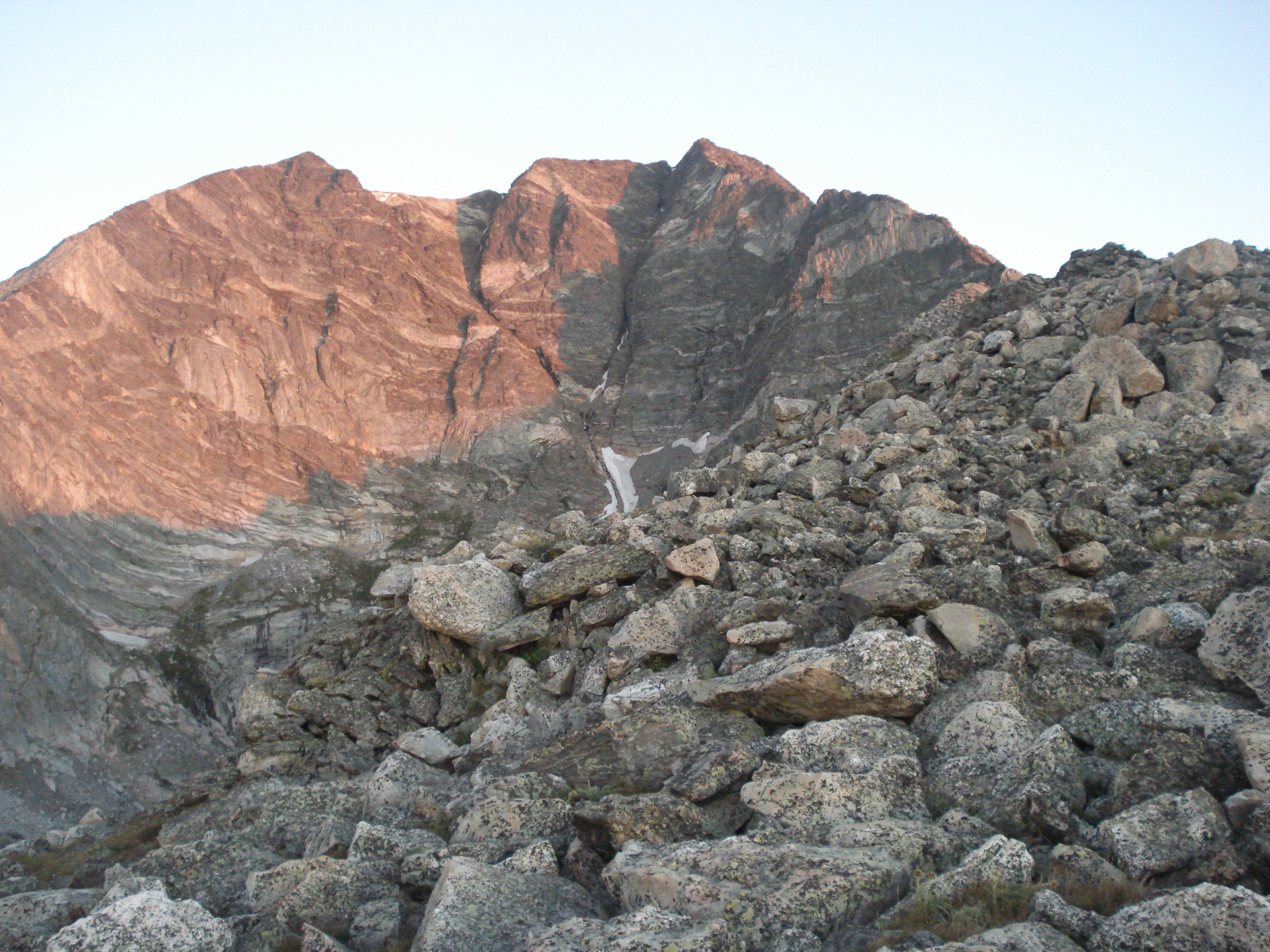
Our first view of Mt Ypsilon and the ‘Aces’ (see the shadows)

We followed the climber’s trail across a good bridge and for another 30 feet before completely losing all sign of a trail.  We continued hoping to find a trail, but willing to bushwack our way eastward, moving up or down depending on the obstacles. I was looking for a talus field that was supposed to mark Rossiter’s ‘grassy gully’ that led to the start of the ridge. In the dark, the talus field we found 1/2 way around looked more like landslide debris; but we took it.  It was very steep, but it went to the start of Blitzen Ridge, which we reached at 6am.  Still on plan.

But then I realized that I had forgotten to get water at the lake.  Shit.  One liter of water for 12 hours of high altitude exercise = bad day.  I started making an effort to breath through my nose instead of my mouth.

And, under the circumstances, I was glad to finally find the cooler temperatures and higher winds above treeline.

Position 5

It was still too dark to see any landmarks, but my GPS confirmed that we were on course.  The next step was to follow the ridge as it turns from a rounded hill to a sharp-edged ridge.  When we reached a point were we could see the Spectacle Lakes, the sun had come up enough to expose the scenery. Mt Ypsilon’s Y-Couloir and accompanying Donner and Blitzen Ridges are wildly spectacular; in my opinion, the area rivals Longs Peak, my favorite mountain in the world.
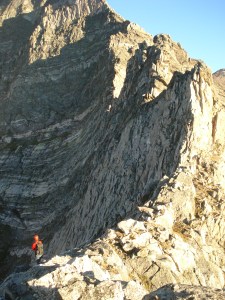
Brian examining the long way up Blitzen Ridge

The only odd thing was that we couldn’t see the Aces on the ridge.  Eventually, we saw the shadows of the Aces on the Donner Ridge wall, highlighted by the morning sun. By 7am, we arrived at the base of the 1st Ace; it was an impressive pinnacle.  To climb to the top of it would be a time-consuming undertaking.

Position 6

Our plan was to skirt the 1st two Aces. I took the 1st lead and did a descending traverse on 3rd and 4th class terrain to get below the 1st Ace and then continued with an ascending traverse over somewhat easier terrain to get by the 2nd Ace and to the base of the 3rd Ace.

Brian followed, arriving at 8am, and then prepared for his climb of the 3rd Ace.

Position 7

Brian’s lead of the 3rd Ace

The 3rd Ace was the one we had to climb, according to the route beta.  Brian, delighted for a chance at some real climbing, worked his way up the 3rd Ace, taking the hardest path when possible.

When I followed, the route felt a bit harder than 5.4, but that made sense.

When I arrived at the top, Brian indicated that he couldn’t find a rappel anchor. Now that was a bother, as we brought two ropes specifically for the 2-rope rappel off the 3rd Ace.

I climbed out to the ridge edge to see if I could find an anchor or a place to set one without leaving iron behind; I couldn’t. The going was easy enough that I shouted to Brian that I was going to down climb and place gear to protect his down climb. I admit it would have been better if I had taken the rack; I only had the 5-6 pieces I cleaned from Brian’s lead.

I continued down until running out of rope, but I could see it was going to work. Brian followed and then we scrambled the rest of the way to the saddle between the 3rd and 4th Ace.

Position 8

The plan for the 4th Ace was to pass it on the right.  I had read that the best path comes of climbing up for a bit before turning right.  Looking at the 4th Ace from high on the 3rd Ace, I couldn’t make sense of this advice; and worse, the rock looked hard to climb. But once up close, the obvious weakness in the rock started up and right, right off the ground. It was my lead so I started up, following the slight ramp to see where it would lead.

The climbing was easy but the protection was scarce. I worked far enough right to see a probable path around the corner about 50 feet away.  And then Brian yelled out that I only had 20 feet of rope left.  Shit.

I brought Brian over and then he finished the climb by turning the corner to find a nice walking and scrambling path to the foot of the Headwall. He brought me over and then we scrambled to the Headwall, which would be Brian’s lead.

And then I forgot to look for the brass plate marking Louis Raymond Leving’s grave.  Oh well, I guess it will wait for me.

The Blitzen Ridge ‘Headwall’

Position 9

Brian indicated that he’d read that climbing the white pillar was the best start to the Headwall.  I didn’t think he meant ‘easiest’…he didn’t.
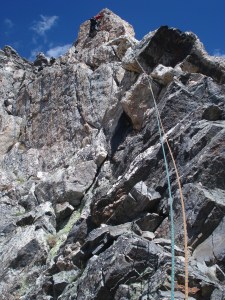
Brian’s lead up the Headwall 1st pitch

He started up the SE corner and found the hardest climbing of the day.  It was a balancey climb in a strong wind. I was surprised to be able to make it without a fall; I’m sure Brian was pleased with himself.

But we had another 125 feet of steep rock to reach the top of the Headwall.  I ran the rope out 75 feet up some 4th class rock and then led a 50-foot pitch to reach the top of the Headwall near a notch in the ridge. Brian came up and then we unroped, based on the advice we’d read (but absolutely not based on the look of the rock).

Position 10

The first 50 feet or so were wickedly exposed, but the rock was good.  The key was to get to the top of the ridge as quickly as possible. Once on the ridge, the difficulty was primarily past.  It was mostly 2nd & 3rd class movement; the hardest part was avoiding the overhanging rocks just out of sight that jumped out to bash my helmet at any moment of weakness.

The last 100 feet was the easiest terrain since before the Aces.

Position 11
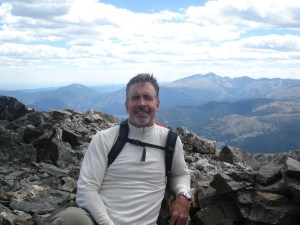
Ypsilon summit: enjoying our first break after 10 hours of hiking and climbing

I reached the summit at 1:30pm and sat down for my first official break of the day. I had saved 1/3 liter of water for my lunch. I was surprised that I didn’t feel dehydrated, but it had not been a hot day (so far, I should have realized).

I found Brian trying to use the sun to melt some found ice into his water bottle.  We sat and chatted about the day; I insisted that the Blitzen Ridge was a great idea.

Brian asked if we were behind schedule; he thought I had mentioned a plan to summit at noon. The weather had been so good all day that I didn’t pay any attention to the time.  I dug out my trip plan and found that our 7 hour climb was the high-end of my predicted range (5-7 hours).   We decided to stay awhile and enjoy the views.

I claimed that we could have gone faster if we hadn’t tried to make the technical climbing portions interesting. I was probably right, but it was all good. A good climb and a good plan.

After a 30 minute break, it was time to head down; but not before stopping to appreciate our path over the many obstacles on the Blitzen Ridge.

Position 12

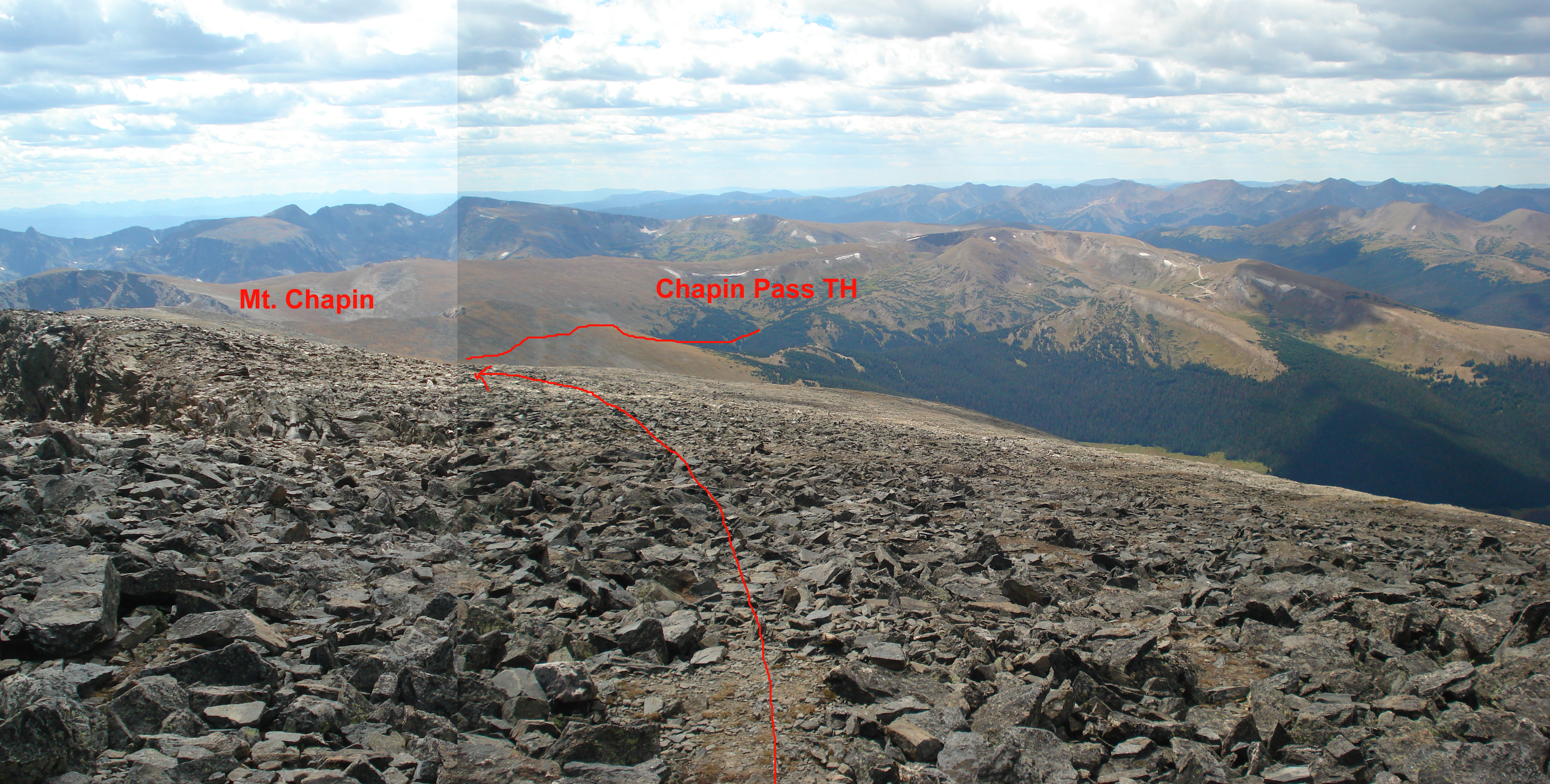
I had a mind to find the best compromise between shortest line between two points and avoiding losing any altitude that I’d have to re-climb. I followed a cairned path much of the way as I bypassed Chiquita and aimed for the saddle between Chiquita and Chapin, finding and losing the path at least a dozen times.

Brian had the energy to bag Chiquita on the way past.  I skipped it since I had already done these peaks on my Mummy Range Weekend adventure some years ago.

Once at the saddle, the trail became excellent and we made good time back to Chapin Pass, finally seeing other people for the first time in the day.  But it finally started getting hot, and I started feeling thirsty.  I wished I had stashed some water in Brian’s truck; now I’d have to wait for the long ride through RMNP.

As we approached the trailhead, the sight of Brian’s truck (13 hours after leaving it) was a sight for sore feet.

We made it.

Panorama of descent path to Chapin Pass trailhead

All that was left was the drive back to my 4Runner at the Lawn Lake trailhead.  Naturally, the traffic was horrific with all the tourists gawking at the aliens dressed as elk.  But, as a mere passenger, I was permitted to sleep and catchup on the lost sleep of the night before (I only got 2 hours of sleep: 10pm to midnight).

And once back at my vehicle, I started home immediately, and I drank 2 liter of water as I drove home.

Another great trip.
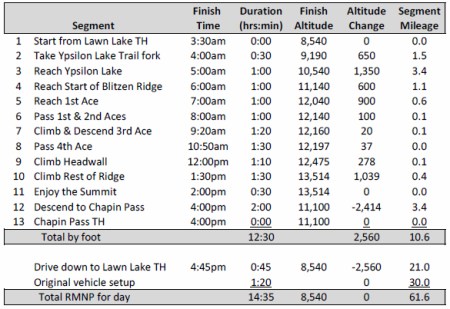
Trip data (click for more details)

See all trip reports

See RMNP trip reports

Scared to Death on Pear Buttress

September 1, 2010

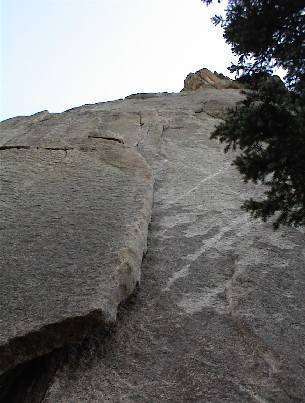
On July 5, 1992, I clawed my way up Pear Buttress in Lumpy Ridge, Estes Park, Colorado.  This was my first multi-pitch climb and was significant otherwise for two important aspects of my climbing style:  Ignorance and Fear.  And, it was nearly the last climb I ever did.

My first multi-pitch rock climb: Pear Buttress (5.8) on The Book

I’ll start with ignorance. I didn’t know anything about rock climbing.  I had bluffed my way into an ‘Intermediate’ level class because I was afraid of being bored in a ‘beginner’ course.  I was a fool; I started my climbing career with a 5.8 classic.

My ignorance accounted for the fact that I selected my street shoe size when asked what rock shoe size I wear.  What did I know about rock climbing shoes?  My feet swam in rock shoes built for Michael Jordan…and did not hurt me one bit.  In fact, I could not begin to understand the complaints from my fellow climbing students whenever we descended in our rock shoes later in the week-long course.  Also, it explained why I had no ability to stand on anything smaller than a sidewalk.  As a ‘Leg Hauler’, I did more pull-ups that day than I had done in my life to-date.

Still, I was able to do it, somehow. My ability to exceed my physical limitation was related to the second important aspect of my climbing style.  Fear.

For the 1st time in my life, I knew stark terror.  I discovered that I had a fear of heights. Living in flat Florida, I just didn’t know.

The start of Pear Buttress

On the first pitch, I followed Topher, my CMS guide up the standard start.  We went up the slab right of a giant flake and then quickly stepped left to get to the flake. It formed a perfect hand crack (5.7) that was good enough even for a climber without any technique.  Once at the top of the flake, I attempted to follow thin cracks (crux) up to a sloping ledge where Topher built a belay. The key was a little ‘crystal’ for my right foot that I needed to step up on to reach a hand crack.

I couldn’t do it; my foot kept slipping off.  After 5 or 6 unsuccessful attempts, I felt my first sensation of being “gripped’. I felt terrible about failing and about ruining the climb for everyone else.  My vision tunneled and my other senses began to shut down as my mind went into melt-down, just like Colossus when presented with an unsolvable problem (“what happens when an unstoppable object hits and immovable object?”).

A fly buzzing about my head seemed to be tormenting me in my life’s weakest moment.  It was the Devil.

I just wished it would all end so I could go home and say that I tried rock climbing but did not like it.  Topher only said, over and over, “try again”.

In a fit of anger, I managed to step up and reach into the crack.  Thank God.

The rest of the climb went pretty much the same:  I yelled out “falling” whenever I thought the possibility was high and tried to keep to myself any thoughts of how Pear Buttress would be the one and only rock climb of my LONG life.

But first I had to finish.

On the second pitch, we followed the ledge up and left to the edge of the face, then cut back right into a crack which we followed to a belay on a smaller ledge (5.4).

The third pitch followed a hand and finger crack above the belay for 100 feet (5.8).  By this time, my hands and fingers were just hamburger…I painted the route with my blood, and still have some of the scars.  The pitch finished with a traverse right under a small roof to a belay on another ledge.

The fourth pitch was easy going as we climbed toward a ‘cave’…but the face climbing to reach the awkward belay was nearly too much.

Finally, we traversed out of the cave to reach the greatest amount of exposure the world could present (I thought), but a short climb to the top got me out of harm’s way. When I pulled my body up and over the top and shook Topher’s hand, I had an overwhelming sense of satisfaction come over me that was unmatched until the birth of my 1st child nearly 10 years later.

Topher bringing up another of the students to the top of the Pear Buttress route.

I had just completed the most physically and emotionally demanding effort of my life … and I was going to live to tell about it.  I “knew” in my head that this climb would be my last; but my heart couldn’t forget that feeling…that overwhelming sense of satisfaction.

I still haven’t.

See First Alpine Adventure trip report (the climb done on Sharkstooth at the end of the week-long class.

See all trip reports

A Quick Zowie

September 1, 2010

For August 28, 2010, it was another bad weather forecast.  This time we chose Zowie for its short approach (1.5 hours) and short climb (6 short pitches) that, combined, would allow us to beat the 40% chance of rain after noon.

The only problem with Zowie was the 5.8+ finish on the easiest route to the summit. There was a time when that was no problem; but, we haven’t climbed anything harder than 5.7 in a long time. Brian remembered that we could bail from the bottom of the crux pitch, so we decided to go for it.

Approach to Zowie & Wham

We started hiking at 4:45am on a clear night from a nearly empty parking lot.  The trail went faster than the week before, and so the sun didn’t come up until just before we left the trees.  Heading toward Zowie, we left the trail soon after leaving the trees; we turned left to cross the Andrews Glacier drainage creek, and then hiked uphill to the base of the climb.

I’d done Zowie at least three times before.  The first climb of Zowie (7.27.1997) was up the left side of the South Face with a true south face finish. I don’t know the route name; I just climbed where Mark indicated.  The second climb of Zowie (9.21.2001) was the standard South Face route (that ends on the East face), or, at least Brian and I thought so at the time. The third climb was in August 2003 when Brian and I redid the standard South Face route except for a variation on the last pitch where we traversed back to the south face to climb to the summit.

This time we’d repeat the standard South Face route although, this time we’d find a better path, that stayed on the south face until the final pitch.

We stopped at the base of the climb to eat a bit of breakfast. Oddly, neither of us could remember the actual start to the climb.  The topo didn’t seem to match the rock; but since we could see the big chimney that we had to climb to reach the big ledge, it didn’t matter.

I took the first pitch so that Brian would lead the crux pitch.  I traversed along a seam in the rock to get below the big chimney, and then belayed on a nice ledge below the “V”. It was rated 5.5 but felt harder in a few spots; I supposed I just wasn’t climbing well.

Brian then ran the rope up the chimney.  We took the lefthand part of the “V”.

Once on the big ledge, we moved the belay to below the dihedral/chimney. I used tricams to set the belay to I could have all the cams.  I had a feeling that I’d need all the cams on the climb.

The third pitch felt hard.  It was very steep with great holds, and since my hands were way out of shape, great holds on steep terrain eventually felt like bad holds on steep terrain.  At least the protection was good.

Once at the top of the dihedral, the ledge looked familiar. The topo showed the route continuing up the chimney, but it didn’t look familiar to me. I yelled down to Brian and he remembered traversing right. I thought I should follow the route this time and climbed up into the chimney to see if I could make it work. The only problem was my backpack and my big body (215 lbs) fitting into that tight space. But it went.

Brian wasn’t convinced that it was the real route, but if it wasn’t, it should be.

Brian took the 4th pitch.  He stayed on the south face, near the east edge; he climbed past one ledge and belayed on the second. The crux of his pitch was an excellent 20-foot off-width crack, where we found and cleaned a fixed nut.

I took the 5th pitch, my last of the day.  The topo said to traverse to the east side and then climb up cracks to the base of the ….  But when I traversed over to the edge and looked over, it didn’t look right. As I moved back toward the belay, I noticed a fixed nut near a giant flake about 10 feet above me, on the south face.  It struck me that I might be able to climb that flake and the rock above…and I could clean the nut.

It was a great pitch! The climbing was awkward, but otherwise easy (5.5ish). I stayed on the south face until reaching the bottom of the summit block; I climbed NE over some blocks to reach the normal belay below the crux.

Still, Brian had a big job to do.  He had to run the rope up to the summit, and that would take some doing for an old guy.

Remarkably, he did a great job.  He got all the way to the dead-vertical part, 10 feet from the top, before needing a rest.  After a short rest, he made it to the top. And, then it was my turn.

I started up the initial wall.  It looked hard, and was certainly harder than anything climbed on the day.  I made it up to the ledge below the hard crack, and then continued up past the pins and to Brian’s last piece of protection before succumbing to gravity.  My hands were gone.

I was surprised to feel the grip of panic as I hung from the ropes; out of practice, I suppose.  I was able to put it out of my mind and just focus on helping my hands recover. But they wouldn’t come back.

After a couple minutes, I decided I would just try to move up a a few feet.  I did this a couple times to reach the top. My hands were so bad I was worried I couldn’t hold the rope on rappel.

The weather, which had been good all day, finally turned ugly.  We rappelled into the backside without incident and then scrambled down to the final rappel with only the miserly of scrambling down loose scree.

We continued the scrambling down the gully to reach our packs, where we stayed to eat until a few drops of rain fell out of the sky.

The light drizzle continued for about 30 minutes as we made the 1.5 hour hike back to the trailhead.  We arrived at 3:30pm for an 11 hour round-trip.

See all trip reports

See all RMNP trip reports

Another Sharkstooth

September 1, 2010

It finally happened.  I finally did Sharkstooth’s NE Arete and actually felt like I knew the route.  It really felt more like a Boulder Flatiron than an RMNP Alpine route, although I’m sure the beautiful, sunny day helped with that perception. I thought I’d document this trip (8.24.2010) to have and to hold for future reference, after the details once again slip from my mind.

We left the Glacier Gorge parking lot around 4:30am in an attempt to finish before the 3pm forecast for rain (30% likelihood).  We hiked up the Knobs shortcut and then past Loch Vale before turning west for Andrews Tarn.

Brian was ahead of me for much of the approach.  After the turn toward Sharkstooth, he built up a big lead.  I just couldn’t motivate myself to go any faster; that is, until I saw the guys ahead of Brian.  I knew he’d push to get ahead; now I had to pick it up. I didn’t want to be the reason that we got stuck behind another team when the weather was threatening.

I lost sight of everyone for a while, but I pushed as hard as I could without vomiting. I was surprised to find how much I had gained on the other team; it made me think I had regained some of my old strength.  I neared them just below Sharkstooth; as I passed them, I could see they were older than me.  Oh well.

At least we got on the rock first.

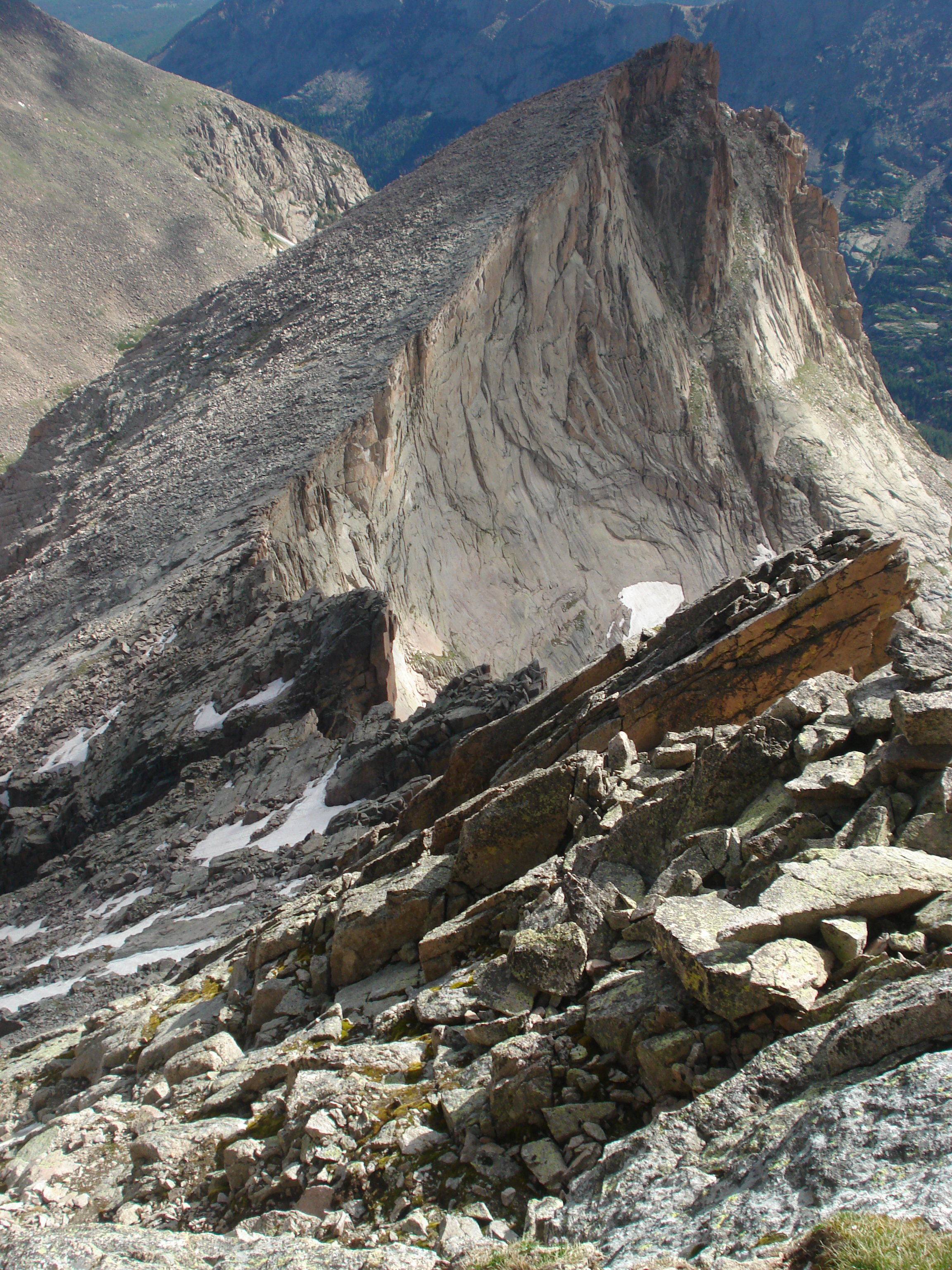
Sharkstooth seen from Zowie

Below is a summary of the pitches:

Pitch 1:
Brian took the right-most of the two obvious cracks and worked he way straight up to a large ledge.  When I arrived, he suggested I look to the left before setting off. He was right; the proper route was up the left crack.

Pitch 2:

I traversed left 10 feet to get into a slot which I climbed up (was crux for me).  I continued straight up until reaching a roof, which was at the bottom of a left facing detached flake.  I seemed to recall doing a layback up the flake, but the face to the left looked easy enough so I just walked up to the ledge atop the flake, where I setup the belay.

Pitch 3:

Brian continued up the steep but bucket-filled terrain to the big flat part of the NE Arete. Every variation of the NE Arete route must hit this ledge, as it is the first part of peak that actually forms a ridge.  The views are spectacular off both sides.

Pitch 4:

I climbed up the off-width crack and then moved left to climb the left side of the ridge.  I continued past the next big ledge and belayed at the end of the 200′ rope on a smaller ledge below the roof protecting the summit.

Pitch 5:

Brian finished it off by scrambling over the roof.

After a brief stop so I could drink the liter of water I hauled to the top, we started down the rappels.  The Sharkstooth rappels are always interesting for the ; we had to sacrifice a sling on each anchor to back up the aged cords.

We got back to the packs at 11:30am.  We ate our lunch before starting the long walk to the trailhead.

See all trip reports

See all RMNP trip reports

Angel’s Way

August 8, 2010

Sometimes, the adventure is found in just getting in and getting out; but as long as its in there somewhere, it is all good.

With an ankle under repair, I was limited to a short sort of adventure. Brian suggested Angel’s Way, a Flatiron’s route we’d found only a few months earlier and put on top of our Flatiron to-do list.

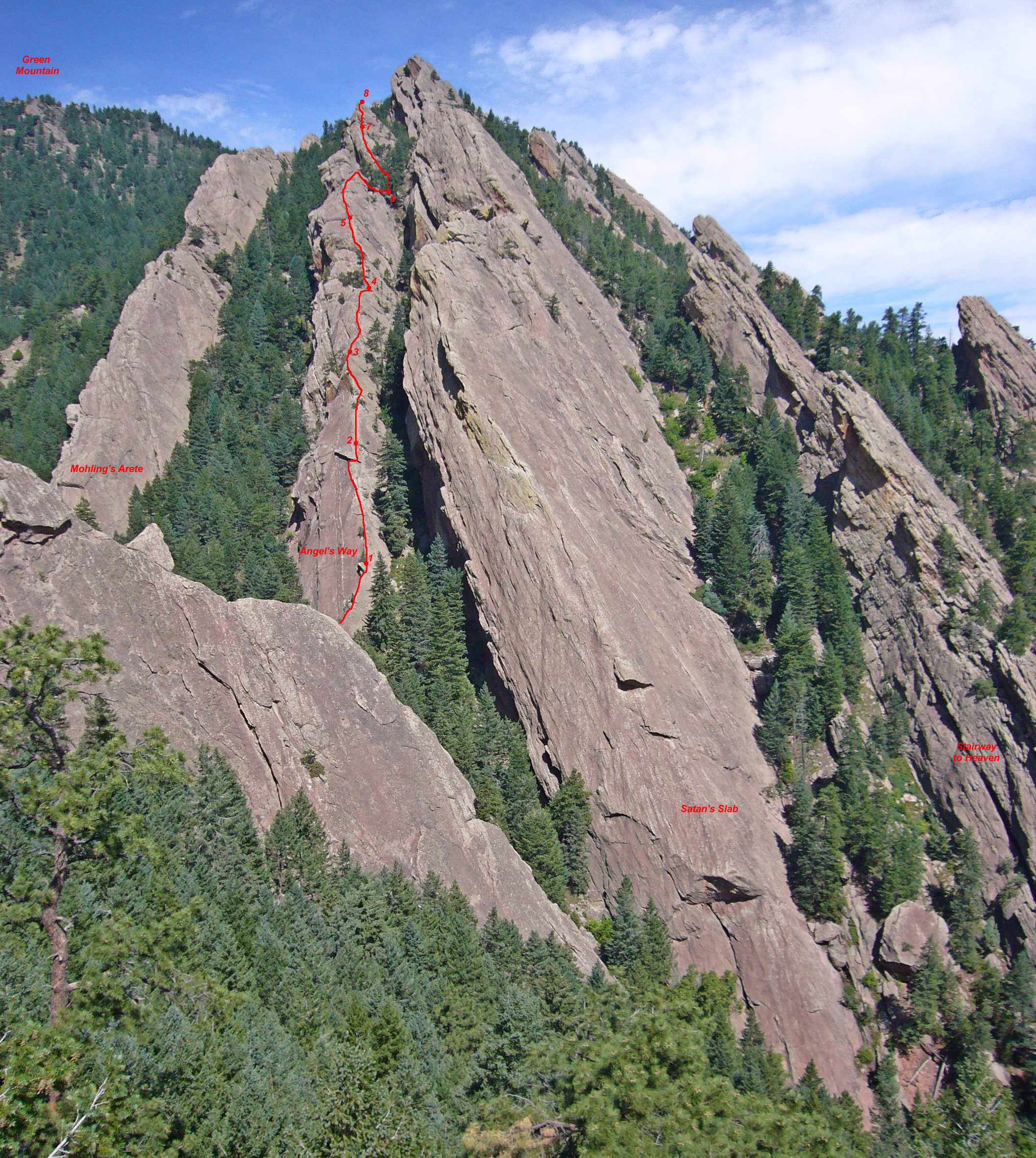
Angel's Way is the 3rd rib on the north side of Skunk Canyon, sandwiched between Satan's Slab and Mohling's Arete

August 7th, 2010, was going to be a hot one; the high temperature forecast was 96F. To beat the heat, we started from NCAR at 6:30am; but, it was already in the 70’s.

(Position #1 on map)

I had a vague memory of having to hike back down the main NCAR road to find the path leading to the water tank on top of the hill separating us from the Mesa Trail. Brian agreed and we found ourselves hiking through tall grass that made me think of Africa.  I kept wondering if I’d find a sleeping lion in the grass until my mind hit on a more likely scenario:  snakes.  Yikes!

Our Angel's Way map and reference points along the way

My pace was energized by my worrying about my route-finding mistake so early in the day.  Fortunately, we quickly came upon a super high quality trail/road. Heck, it looked brand new.

We then quickly worked our way over to the Water Tank (passing the correct trail junction along the way) and then down to the Mesa Trail.

(Position #2 on map)

We followed the Mesa Trail north for a couple hundred yards before exiting the trail at the end of a switchback, heading west toward Skunk Canyon on a climber’s trail.

Before leaving the Mesa trail, we had been quizzed about our wearing long pants on such a hot day; the sea of poison ivy on the climber’s trail justified the extra water loss. We were forewarned.  We were also warned about the shocking bushwack and route-finding needed to reach the base of Angel’s Way, but we were not prepared for the confusing directions provided to guide our efforts.

Here is where I’ll officially complain about the poor quality of information available to guide us to the base of the climb.  I don’t mean to say that all the information was incorrect; it was all correct.  The problem is that the people providing the information were not thinking about the uselessness of a description that while correct cannot be used to distinguish the right rock or path from many other wrong ones.  Much of it was so bad that it actually seemed to be contradictary, for example:

“It (the 3rd rib) is about 100 yards west of the [2nd] rib that forms Satan’s Slab”

vs.

“The Third Ridge is almost abutting the Second and the gully that separates them is very narrow”

Note: both of these statements turned out to be true, in one way or another

I know, I know.  All we had to do was count the ridges, right? The third ridge comes right after the second ridge which is preceded by the first ridge. And while there is no hiding from this fact, it is only useful if it is obvious what makes up a ridge when you are standing far below them, and for only as long as you knew in advance to avoid losing track of what you’ve already passed.

Neither of us managed to succeed with either requirement. Fortunately, Brian did bring along his brain which proved helpful in isolating the important data and using it to reason out the correct conclusion.

(Position #3 on map)

After considerable debate of the information and our observations (collected via hiking back and forth between the ridges in dispute), we finally found the start to Angel’s Way at 8:30am, with a route-finding cost of about an hour.
To summarize, follow the creek bed and keep careful count of the ribs of rock to the right.
  1. The first rib is Stairway to Heaven; the ridge starts with an overhang.  There is no directly opposing rib of rock on the left side of the creek bed.
  2. The second rib is only 50-100 feet further west and is called Satan’s Slab; the ridge ends in a steep slab that slopes down to the very edge of the creek and meets another rib of rock coming down from the left side of the creek; the two ribs block the creek from easy passage.  Once past this obstacle, you are below the backside of Satan’s Slab.
  3. To find the third rib, leave the creek path and head North following a faint trail.  Continue up and west for 100 yards to find the unimpressive start to the 3rd rib, Angel’s Way. This rib does not reach down into the creek bed
  4. If you continue past Angel’s Way for another 100 yards, you will find Mohling’s Arete.
(Position #4 on map)

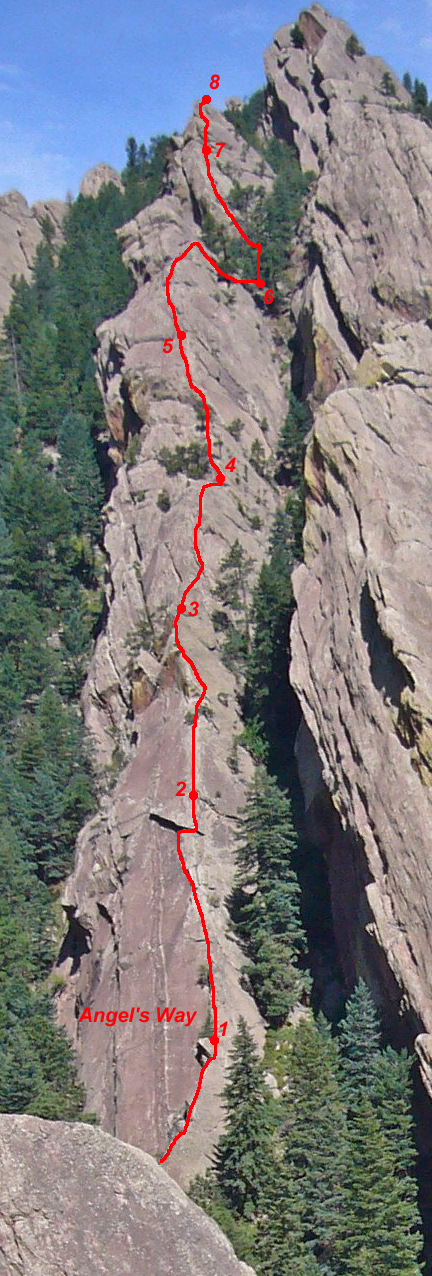
Angel's Way Route

After such a confusing start to the day, it was gratifying to finally start climbing and find the climbing to be very enjoyable.

We completed the climb in 8 pitches.
  1. Pitch 1: Brian insisted on starting from the bottom of the ridge for his personal sense of aesthetics, a 15′ exposed climb led to the ridge which he climbed along  for 200′ before belaying in a nice shady spot next to a tree
  2. Pitch 2: I climbed under the ridgeline in a low-angle dihedral to a roof, and then mounted the ridge top and climbed to an exposed belay after approximately 180′
  3. Pitch 3: Brian continued along the ridge for 30′ before stepping climbed near the ridgeline for another 180′.30 feet into Pitch 3 is where I stepped over a horizontal tree and avoided clipping it.  After that came one of the occasional steps in the ridge.
  4. Pitch 4: I climbed up a dihedral and then over some easy rock for 200′
  5. Pitch 5: Brain started up a very boring start, but after 30 feet came a hidden dip in the ridge had a short steep wall on its other side. He then traversed over some dark-colored rock to regain the ridge, and then belayed in the middle of dull-looking spot after 180′.
  6. Pitch 6: I continued up the ridge for about 50′ to find another notch in the ridge.  This notch created a relatively hard required move (I thought of it as the crux), after which the pitch turned into another easy traverse, but this time below the ridge crest which cliffed-out at the end of a big notch in the ridge after 150′.  I climbed down the ground to set up the belay.
  7. Pitch 7: Brian moved the belay up the slope a bit, and then he climbed a steep wall under a tree to reach the ridge
  8. Pitch 8: I led the short climb to the summit, which had better pro than we’d been led to believe

(Position #5 on map)

We did a belayed down climb from the summit and then north to reach a likely down climb.  I should say Brian thought it looked likely, but when I moved the belay to the official ‘rappel tree’ I surely didn’t like the look of it.  Brian allowed me to go first and take the belayed down climb while placing gear to protect Brian’s descent.  I couldn’t figure it out until Brian lowered me past the crux where I found the necessary footholds that Brian shortly used to join me at the bottom.

We then scrambled down the next section before packing away our gear and switching into hiking boots.  We contemplated returning to the start of the climb, but since we had brought our packs along to avoid having to go back down the ridge, we were loath to crawl back into the poison ivy pit of death.

Instead, we started hiking east.  We figured we’d find a way to get to the Mesa Trail and we used Brian’s research into booze to pass the time.

It turns out that Gin, Whiskey & Vodka are all very similar forms of liquor.  Back in the day, the problem with Whiskey was its harshness out of the still.  The only way to make what was essentially Vodka, palettable, to “anyone other than a Russian”, was to put it in wood casks and let it sit for a few years.   That is, until some enterprising Belgian doctor discovered that if you put Juniper berries in the un-aged whiskey and distilled it again, you got something tolerable.  It is called Gin.

If this is incorrect, talk to Brian

(Position #6 on map)

After a considerable amount of bushwacking down and across a moderately steep forest of small pine trees, we broke out onto a talus field.  At this point, we could see that we had been heading a bit NE instead of E, but it was going to work.  We reached an old road cut into the talus which we followed NE for a 100 yards to its end, and then we scrambled further down the talus to reach the current Mesa Trail.  We turned south and hiked toward NCAR.

(Position #7 on map)

It had been a hot day, but really it was not so long compared to others we’ve done recently.  We powered back up to the water tank and then took the proper trail toward NCAR.  A few hundred feet of hiking got us back to the car at 2pm.

My first thought was that now I get to cross off one more flatiron from my endless list of flatirons not yet climbed. I haven’t done much of that in the last few years; if I don’t pickup the pace, I may never finish that list.

See all trip reports

See Boulder Flatiron list

A Notchtop “Bad Variation”

August 3, 2010

It was going to be our 4th weekend in a row in RMNP, but the weather report was uncooperative.

A 40% chance of rain, mainly after noon.

Rats.  Rain at noon, or earlier, and long approaches didn’t leave a lot of time for climbing. We discussed our options for shorter approaches, including going to Lumpy Ridge and climbing on Hallett Peak.  We both wanted to continue climbing in RMNP, so Hallett was the better of the two.  But the only route on Hallett that would not be a reach at our current level of climbing would be the Great Dihedral (5.7); however, it was sure to be wet after all the recent rain.

We decided to take a chance and do the Spiral Route on Notchtop Mountain, which is what we’ve been thinking about for a few weeks any way.  The trick would be to start early and go fast, as always.  And, finding a bit a weather luck wouldn’t hurt.

We started from the Bear Lake parking lot this time (just before 4am), and started up toward Notchtop in a very dark night (the moon was just a sliver). The trail was good up to Joe Mills Mountain, and then the climbers trail to the base of Notchtop was pretty good too. It felt like a walk in the park compared to our adventure on the Solitude Lake Cirque.

From the bottom of Notchtop, the next step was to reach the top of the big platform that made up the bottom 3rd of the pinnacle. We took an obvious path up the gully next to Notchtop to find the right leaning ramp we’d used twice before to reach the top of the platform that marks the start of the climbing.

Reaching the platform, we stopped to get organized and to put on more clothes…I mean, all the rest of our clothes.  We were freezing to death on July 9th. The sun had been up for a short while, but it was not putting off much heat; and the wind was ferocious. There is something about Notchtop that leads to strong winds; we’ve had strong wind on all 3 visits over the past 13 years. Unfortunately, I didn’t have enough clothes, so I shivered as Brian started up.

When it was my turn, I climbed in my gloves and hiking boots; I was still too cold to do otherwise. When I found the climbing very easy going, I was sorry I hadn’t taken the 1st lead. I was doubly sorry when the 2nd pitch turned out to be hard, at least the path I chose was hard. By the time I reached the grassy ledge that we’d take to the East Meadow, I had warmed up very well.

Brian then led us over toward the East Meadow.  He stopped at the slight ridge which pokes out about 2/3rds of the way there with an idea for a new route to the notch. When I arrived, we decided to continue on to the East Meadow and use the Relief Train route (I think) to climb towards the notch.

It was a nice route, rated around 5.7; I enjoyed climbing it in my hiking boots  since I had a top rope.  Brian’s lead reached to just below the Notch.

When I arrived, Brian suggested we take a new path, on the north end of the ledge.  It looked like a bouquet of fins leading up and left toward the summit.

Roach’s RMNP Classic Hikes and Climbs:  “There are three places in the minicirque where it is easy and tempting (and wrong) to head farther north.”

Brian and I found a fourth.

It actually started off well, but once we got high enough to see down into the normal ascent gully (on the other side of the notch), the climbing became steep over crumbly rock.  It probably could have been protected, mostly, but we had put away the ropes and gear.

Once we reached the Notchtop summit, I was relieved to finally have the unprotected climbing behind me.

Oh, how wrong I was.

It is surprising how little I remembered about the two previous downclimbs of Notchtop.  I suppose I put it out of my mind. Every section just kept getting worse. I’d agree it was only 4th class, but downclimbing is always harder due to a lack of vision at the feet level.

A surprisingly quick scramble down with a few rain-drops reminded us of the primary issue of the day.  We hurried up to our packs (and water!); and we enjoyed a few minutes of rest.

I once again did my, ‘guess the time’ game.  This was the only time I can remember winning.  Brian guessed 12:30pm while I guessed 11:30am.  It was only 11am.

Brian’s water bottle made a mad-dash escape attempt, bouncing all the way down the gully toward the South  face bottom.  Brian pursued while I returned via the ascent route and met up with Brian at the bottom.  Brian was bottleless, but heavy one torn, faded down jacket that was spewing feathers; it wasn’t a good trade.

Another long hike on tired legs and sore feet back to the Bear Lake parking lot ended another RMNP adventure. And when we got back down to Boulder, we found it had rained cats and dogs. At least the weather luck is holding up, even if the legs aren’t.

See all trip reports

See all RMNP trip reports

Solitude Lake Cirque

July 6, 2010

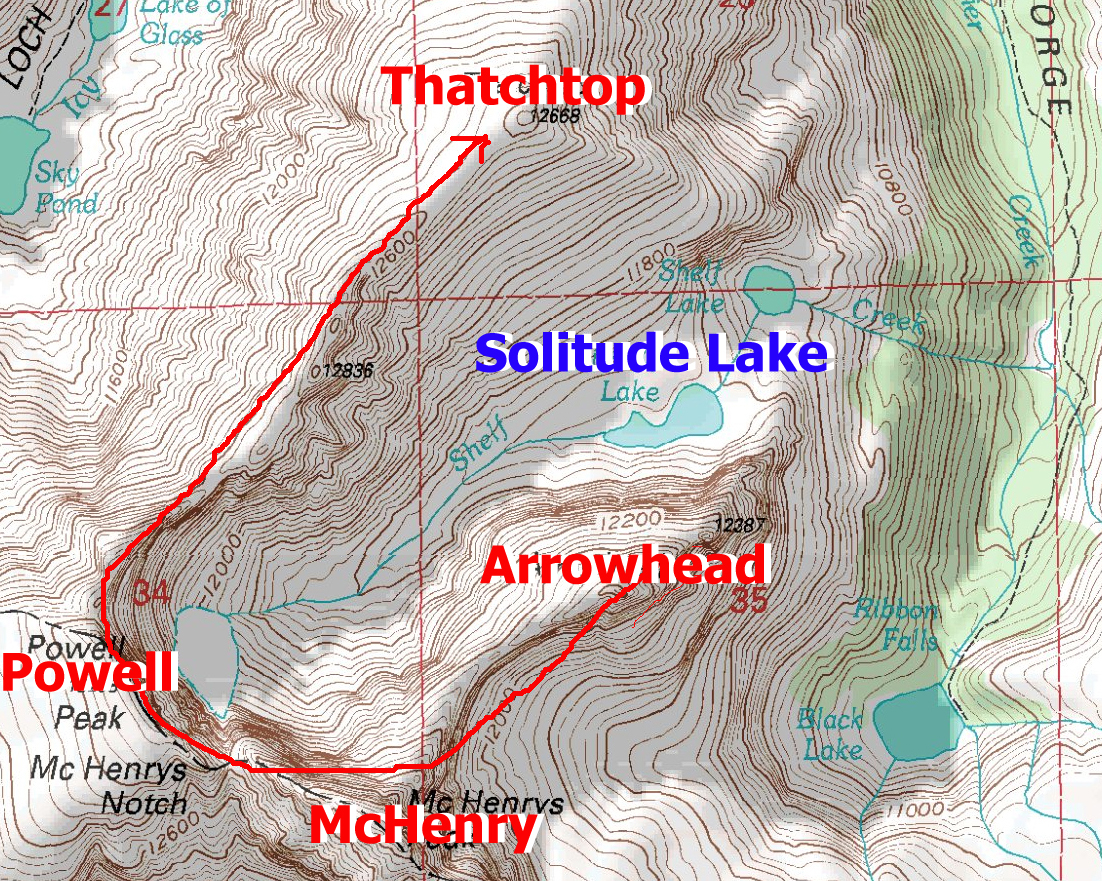
A low altitude illustration of the 'off-trail' ascending and descending required to complete the 'Solitude Lake Cirque'.

It was finally time to do it. After many years of thinking about the various connected pieces, it was time to attempt the entire Solitude Lake Cirque: a climb of Arrowhead (3rd or 4th class) from Solitude Lake, then traversing to and climbing McHenrys’ NE Arete (4th Class) to the summit, then traversing McHenrys’ Notch (5th class downclimb and 2nd class scramble) to reach the summit of Mt Powell, and then traversing and downclimbing Mt Powell’s entire NE Ridge (4th class) to the summit of Thatchtop.

We knew it would be a long day.  Even if everything worked out perfectly, it would be a grueling, body-breaking day: over 13 hours, 11.5 miles, and 5140′ of elevation gain & loss, with much of it being off trail. For illustration purposes, the planned effort is similar to scrambling up and down the 3rd Flatiron five times in a row with a mouth-full of water (to simulate high altitude oxygen availability).  Fun, right?

The Solitude Lake Cirque objective and plan evolved over the last 13 years:

  1. The ‘McHenrys Notch’ piece: I learned of ‘The Notch’ when sitting on top of Flattop during the summer of 1997 and wondering out loud about hiking the Continental Divide to Chiefs Head. Brian notified me that ‘The Notch‘ was a challenging obstacle. I was intrigued.
  2. The ‘NE Arete of McHenrys’ piece:  I still vividly remember looking up the NE Arete of McHenrys while sitting on the summit of Arrowhead in 1999 and thinking that it was the most spectacular sight I’d ever seen; I also thought it looked way too scary to to climb unroped (only 4th class).
  3. The ‘NE Ridge of Powell’ piece: I climbed this ridge almost exactly 11 years earlier in a solo effort; it was a near disastrous day as a late start and rainy weather nearly ended my climbing days (and every other kind as well). While my ability to do it while wet was confidence inspiring, the experience was psychologically traumatic.  Brian and I attempted to repeat it in late 2005 but were turned back by heavy snowfall.
  4. The ‘Do Them All Together’ Goal:  in early 2010, I informed Brian that the ‘Solitude Lake Cirque‘ was a goal for the 2010 summer.
  5. The Plan:  during the last week of June, I decided that we’d do the climb clockwise.  Even though The Notch is easier to climb than descend, I worried that a descent of McHenrys NE Arete would be too hard (since I didn’t know the terrain at all); and I thought we’d could rappel ‘The Notch’ if necessary.  And, I didn’t think a down climb of Powell’s NE Ridge would be much harder than an ascent since the elevation change was small. I was very wrong about this last point.

The 'Solitude Lake Cirque' -- illustrative route

And, throwing a monkey wrench into the works, the weather report was not perfect.  A “20% chance of rain after 1pm” was very worrying since it meant the rain would come while we were on Powell’s NE Ridge.  Given my history with that chunk of rock, I was justifiably worried. In addition, the weekend before a forecast of only 10% chance of rain after 1pm came 100% true on a climb of Spearhead in RMNP; I just couldn’t ignore the threat. However, Brian and I worked it out that we could summit Thatchtop by 1pm, if we started @ 4am and moved at a quick pace. That was somewhat reassuring, but I wondered how long we could keep up such a pace.

For better or worse, the ‘Solitude Lake Cirque‘ was a go!

On the morning of July 3rd, 2010, Brian and I left Boulder@ 2:30am for the Glacier Gorge trailhead in Rocky Mountain National Park. Unlike the previous week, the sky was mostly clear; it was a good sign on a day when good weather might be required to survive.

Ascending toward Solitude Lake with Arrowhead in background

I was driving, so we arrived at the trailhead a bit earlier than planned.  We started hiking at 3:45am.

Looking back down the steep hike up toward Shelf & Solitude Lakes

We took the ‘Knobs‘ shortcut to save 1/2 mile, and then took the Black Lake fork off the Loch Vale trail.

Position 1 (see references on map)

About 3.5 miles in, we reached the avalanche gully which marked the cutoff for Solitude Lake.  We turned toward Glacier Creek, gingerly walked along fallen logs to avoid sloshing through the marshy terrain.  A quick hop across the creek and then we scrambled up the steep slope to reach the Shelf Lake area, swatting mosquitoes all the way up.  On one of the longest days of the year (daylight-wise), it was light enough that we could have started hiking 30 minutes earlier.

It was Brian’s turn to dunk a boot, this time working across the Shelf Lake outlet.  But Brian was smart enough to wax his boots, so no wet foot for Brian (unlike my experience on Spearhead the week before).

Nearing Arrowhead, our 1st objective

Position 2

We reached the edge of Solitude Lake at 6:15am; I was delighted with our quick pace.  I thought we would be close to my goal of a 7am Arrowhead summit.  But clearly I had forgotten about the long talus-hop needed to reach the base of the Arrowhead climb.

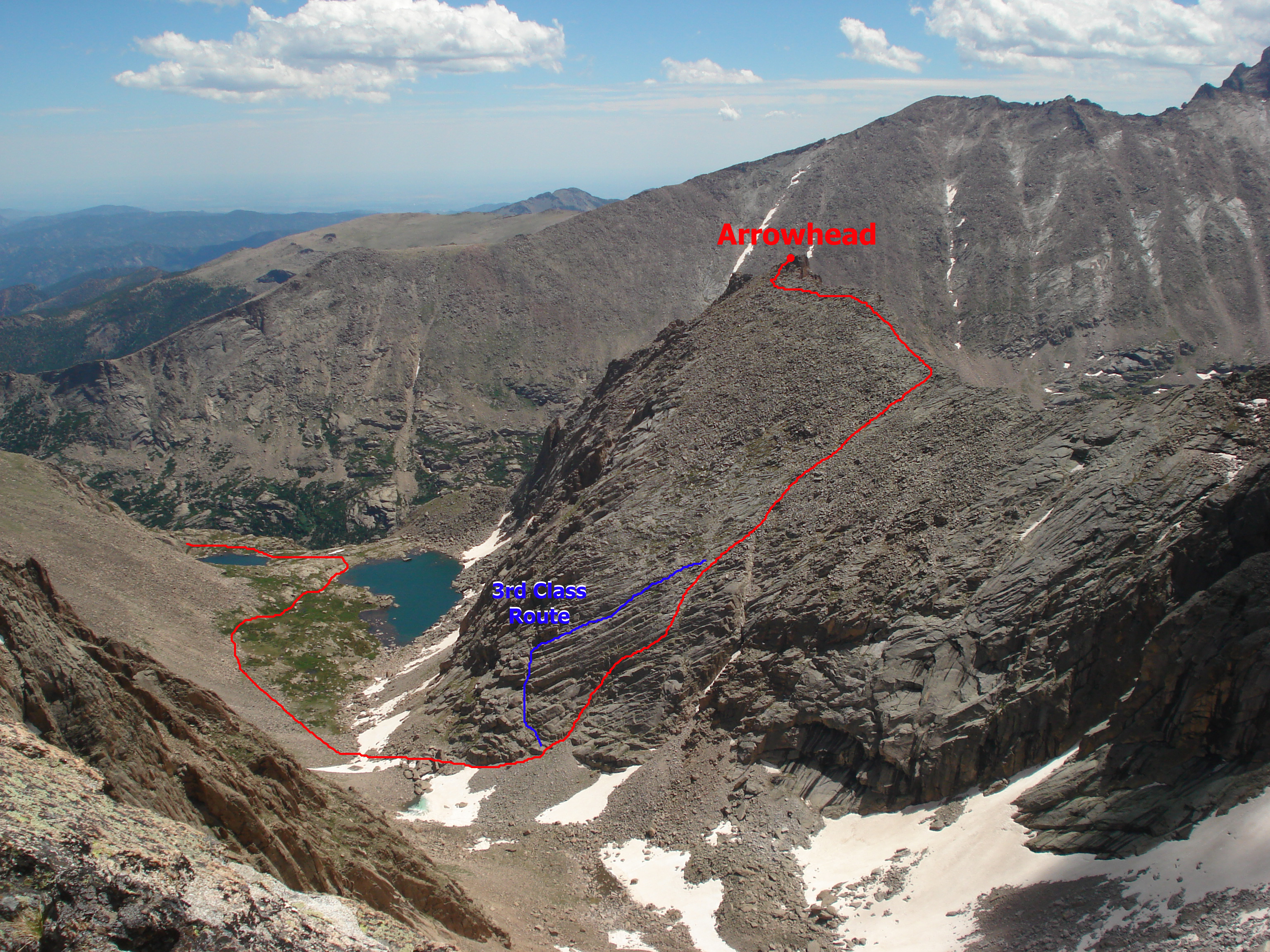
Our route up Arrowhead

It took us another 45 minutes to reach the base of the climb.

Position 3

We started up a 4th class path Brian picked out; he didn’t want to use the 3rd class route we’d used before. I figured it would be a good warm up for climbing to come later in the day.  Rather than angle directly for the Arrowhead summit, I decided to climb to the ridgeline first.  I was rewarded with spectacular views of Glacier Gorge through the clear, early morning air.

Position 4

Joe (me) on Arrowhead summit with McHenrys NE Arete in background

I then joined Brian on the summit of Arrowhead at 8am.  We were already one hour behind schedule. It was time to start going faster, somehow.

The weather looked good, but we could see the winds above McHenry were moving very quickly.

Looking back down the NE Arete toward Arrowhead

We started back down the ridge toward the saddle, and then up the NE Arete. The climbing was not very difficult; there were a few spots of harder climbing below the Gendarmes on the ridge.  I was pleasantly surprised to find that the climbing was nearly all 3rd class, with only a spot or two of 4th class. Accordingly, our time was pretty good, even though I was slowing down a bit after over 4300′ of elevation gain in the last 5+ hours.

The finish was remarkably easy and led to within a few yards of the summit.  A great route.

Position 5

Joe (me) on McHenrys summit with Longs and Chiefs Head in the distance.

We reached McHenrys summit at 9:30am; still one hour behind schedule, but at least no further time was lost. And the wind was cold and strong.

After a short break, we started toward The Notch.

Brian hiking toward 'The Notch' with Powell in background

Progress was easy for a while, but then became confusing. It was unclear which ledge was the correct ledge to take to the downclimb.  We decided to stay on the ridge crest as long as possible, which forced us to make an exposed move or two to reach the end.  From that position, we could see that the ledge below us had been the correct ledge; we downclimbed to it and then traversed over to the gully that led directly to the top of ‘The Notch‘.

Brian put on his rock shoes (removing Makalus); this says it all.  It was steep.  Plus, the freezing wind rushing up the gully was enough to unnerve anyone.

Brian descending the last few feet of the gully toward 'The Notch'

At first, the downclimb felt very hard; but that was just me getting used to the awkward nature of downclimbing steep terrain. The holds were good and we made good time for a bit. After about 100 feet, Brian found a rappel anchor and thought we should do a belayed downclimb. I was thinking we were past the hard part, but I rarely argue for less protection.  Brian was right. The next 150 feet was harder.

A view of the ascent path out of 'The Notch' to reach the summit of Mt Powell

We had brought a small rack, so it took some doing to put in gear for Brian’s protection.  And we were both freezing in the wind.

Position 6

I reached the bottom of the gully at 10:45am and worked my way into the sunshine before stopping to give Brian a belay. He came down quickly and joined me in the sunshine to warm up. The downclimbing was good due to the solid hand holds; it was a luxury we would miss later in the day while downclimbing slabs.

A view of the spectacular Mt Alice seen from 'The Notch'

We wandered over to the edge of The Notch to have a look and also gathered in some great views of Powell Lake and Mt Alice.

We also marveled at the great looking rock marking the Powell edge of The Notch; still, we were happy to have an alternative to escape The Notch.

Brian led the way down The Notch to reach the gully we could ascend to reach the top of Mt Powell.

Brian taking the final few steps to Mt Powell's summit

On the way up, I was delighted to find a trickle of snow-melt running over a rock that I could use to refill my empty water bottle.  I was very worried about not having more water for the rest of the day; it was only 11am. I silently wished for 2 bottles to fill.

Brian moved ahead and I followed as soon as my full bottle was put away. The gully was a bit loose, but not too bad; a mere 2nd class scramble.

Position 7

Looking back at McHenry from the summit of Powell, with Longs and Chiefs Head in the background.

We reached the summit of Mt Powell at 11:30am; we had picked up 30 minutes against our schedule and were now only 30 minutes behind schedule.  And 3 peaks down; only 1 more to go!

I realized that I had never been on the summit before.  The time I thought I had summited, on my trip up the NE Ridge from Thatchtop in the rain, I must have stopped at the false summit some yards to the north.  Well, better late than never.

And, now I was feeling very confident.  While the weather was getting worse, it looked like it would hold out until 1pm….just a few dark clouds so far. We didn’t even have to discuss our plan B of descending Andrews Glacier. I was thinking, ‘how long could it take to complete the NE Ridge’?  The reports of the ridge taking 4 hours seemed ridiculous.

Position 8

A view of the Cathedral Peaks and Sky Pond

We hiked toward Mt Taylor for about 200 feet and found a keyhole to slide through to get onto Powell’s NE Ridge. We then had to navigate a few feet of snow to reach the climbing, but that was the only snow we had to contend with all day.

Position 9

Finally, the only real hurdle remaining was the crux section of the NE Ridge; the section that I struggled so terribly with all those years ago. If we got past that section of the ridge, we would certainly make it. If the rain came before, we’d have to rope up if not turn back for Andrews Glacier. But the remaining hour before 1pm would surely be enough, wouldn’t it?

Brian working down the steep slabs on Powell's NE Ridge

I had budgeted 2 hours to do the entire NE Ridge; it took us 2 hours to just to finish the hard section.

Brian working past the crux

I was utterly wrong about how long it would take to complete the ridge. Descending 4th class slabs is much harder than ascending them.  Much harder….even when the altitude loss is minor. My mistake was due to my lack of understanding or appreciation of 2 factors:

  1. Descending 4th class slabs is complicated by the complexity of route-finding as holds are obscured when viewed from above
  2. Descending 4th class slabs is much harder at the end of a long day than seems possible at the beginning of the day

Brian nearing the end of the hard part of Powell's NE Ridge

Fortunately, the weather stayed dry.  The wind was unnerving as it tossed us around while we smeared our way across and down the slabs, but at least the rock was good for sticky rubber.

Position 10

Once past the hard section, I told Brian that I had followed the ridgeline all those years ago (which is also Roach’s instructions; I checked).  Brian said he liked the look of  the talus below the ridgeline. I wondered if there was a reason for Roach’s advice and so I angled up to the ridge near Point 12836 to see if the ridgeline was a better path.  Instead, I found the ridge was much harder than the talus below, so I descend to match Brian’s path.

A tired Brian sitting below the summit of Thatchtop

At a little before 2pm (and the weather still holding), I found Brian resting below the summit of Thatchtop. In his green jacket, I couldn’t see him until I was within rock throwing distance. He looked so comfortable, I couldn’t resist the temptation, and so I stretched out on a grassy patch.  It turned out that he wasn’t comfortable so much as sleepy.

Resting my feet on Powell's NE Ridge while enjoying the flowers

I finished my water and ate a snack, and I remarked to Brian that I would be willing to pay a lot to have the truck close-by.  The thought of descending thousands of feet and multiple miles just shriveled my morale.

All I had left to comfort me were my own words of advice: the greater the suffering, the greater the feeling of accomplishment.

Misery Axiom: never turn back because of mental misery.  More mental suffering (e.g., boredom, frustration, irritation) leads to more personal rewards, which can only be harvested through perseverance (corollary to Reward Rule).

Reward Rule: personal rewards are maximized by seeking an aggressive goal that matches the most optimistic assessment of your willingness to suffer; the right goal allows both success and satisfaction

Position 11

But we had many miles to go, as it has been said before.  We trudged up to the summit of Thatchtop, and I stopped for a photo of our day’s route.

The 'Solitude Lake Cirque' route overview

Brian hadn’t stopped, so I hurried after him, working my way down the endless talus field.  It was another mile of talus hoping to reach the bottom of Thatchtop. And at the end of such a long day, it was an endless misery.

Brian later pointed out:

Thatchtop’s name is appropriate from a long distance, but becomes supremely aggravating when one is actually on it and trying to hike over the ‘thatch’.

So true, Brian.

Brian heading down Thatchtop

And that wasn’t the end.  We still had to find the descent gully, which somehow eluded us.  After wandering through the peculiar stunted forested area at the end of the ridge, we finally stumbled upon the gully.  The gully turned out to be far more loose than I recalled; we slipped and slid down and around the corner before finally escaping.

And that wasn’t the end either.  We still had to work our way down the mixed forest/talus field to reach the creek flowing from Loch Vale.

Statistics for the 'Solitude Lake Cirque'

It was a level of effort I was not prepared to expend.  I was really beat.

I don’t think I’ve ever done so much off-trail descending.  To get down, we had to descend over 4000′ down talus and technical rock.  Try hiking down Longs Peak without using any trails..

And still we had to hike another 30 minutes to reach the car.

What a day!  I’m glad we did it. I’m glad it’s over.

Our route on the 'Solitude Lake Cirque'

See all trip reports

See all RMNP trip reports

Interesting info regarding ‘Cirque de la Solitude’ on the ‘toughest long distance trail in Europe’