Archive for the ‘Trip Reports’ Category

Boulder 4 Banger

September 3, 2009

I’ve been playing in the Boulder foothills for as long as I’ve lived my fun city. If fact, my very first “adventure” upon moving to Colorado was to discover a way up the forested hill behind the Flatirons.  I drove as close as I could and started hiking with the expectation of bushwacking the entire way.

As I discovered that day so many years ago, hiking up Green Mountain is not much of an adventure.  There is nothing that can be found that has not been found and forgotten many times over the past 100 years.  But I did find a love for that beautiful lump of dirt and trees, and those nearby, that would eventually lead to my Boulder 4 Banger adventure 10 years later.

It all started with Green Mountain, which I made time to stand on top of at least 50 times (about 10,000 short of a record) using 10 different paths (most with varations) in the 10 years since moving to Boulder.

My routes up Green Mountain over the years

My routes up Green Mountain over the years (note: I believe the NW Ridge trail now requires a "permit", whatever that means)

Photo of routes 5, 6, 7 & 8

Photo of routes 5, 6, 7, 8 & 9

And, I had climbed Bear Peak and South Boulder Peak many times starting from multiple starting points including Eldorado Canyon, Shadow Canyon and Bear Canyon.  And, on several occasions over that period of time, I had completed a multiple laps of the Green-Bear combo and the Green-Bear-South Boulder Peak Triple Banger.  So, let’s just say I had reason to think I knew the area pretty well.

But, as of 11/12/2005, I had never attempted the Flagstaff, Green, Bear, South Boulder combo (the “Boulder 4 Banger”). Heck, I’d never even been to the Flagstaff summit; I suppose it just seemed too easy.  The notion of a Boulder 4 Banger percolated in my subconcious until one day my climbing buddy, Brian, and I were looking for something short on a busy weekend.  Brian is usually game for something different and he didn’t disappoint.

Operation Boulder 4 Banger was a go.

The Plan

The last time I did the Green/Bear/South Boulder triple it only took 5.5 hours to do the loop by foot.  We only had about 5 hours for this effort, so we planned for a car shuttle to allow us to finish hiking before the 4:47pm sunset. And with the Fall weather upon us, we could count on perfect weather for the afternoon.

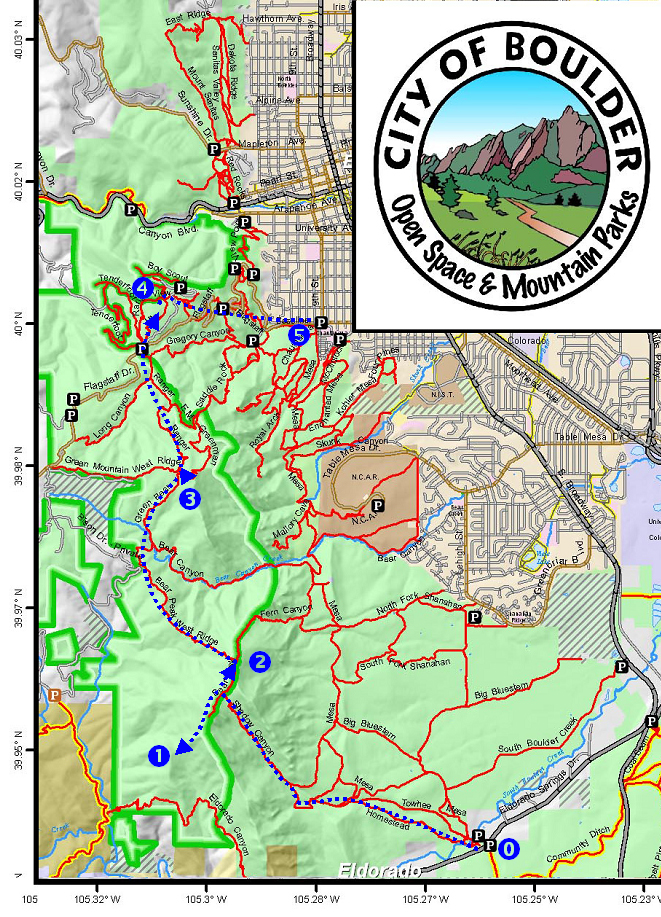
The Plan was to meet at Chautauqua Park in Boulder @ 11:30am, where Brian would leave his truck; then we would drive in my 4Runner to the Mesa trailhead (point 0) near Eldorado Canyon State Park.

Our route would take the Homestead trail to the Shadow Canyon trail which we’d follow to bag South Boulder Peak (point 1) and then Bear Peak (point 2). From Bear Peak, we’d descend the Bear Peak West Ridge trail toward Bear Canyon and connect with the Green Bear trail.

We would then ascend to Green Mountain’s West Ridge, and then turn east to hike to the summit (point 3). From the summit of Green Mountain, we’d retrace our steps down the West Ridge and then take the Ranger Trail all the way to Flagstaff Road (a bit past the Gregory Canyon turnoff) where we’d connect with the Ute trail on Flagstaff to reach the Flagstaff summit (point 4).

And then, finally, we’d follow the signs to Chautauqua Park to reclaim Brian’s truck (point 5).

Easy enough.  What could go wrong?

And it would have worked, too, except for two problems:  (1) we didn’t set time-based milestones to track our progress against time or bring a watch to monitor the time; and the early sunset fooled our instincts about remaining daylight and (2) we didn’t aniticipate how inexplicably hard it would be to find the Flatstaff summit.  Oh yeah, and we should have brought headlamps.  Okay, 3 problems.

Our planned route

Our planned route

In the end, our poor planning and insufficient situational awareness would lead to modest suffering, but not to any serious regrets.

The Execution

Late morning on November 12, 2005, I drove to Chautauqua Park and found a common perfect weather weekend, mid-day scene:  throngs of people and an ocean of parked vehicles.  I had to drive around a bit to find Brian parked further up Baseline Road.  He loaded his stuff in the back and jumped in.

Aerial photo of starting point (Eldorado Canyon Mesa Trailhead)

Overhead image of starting point (Eldorado Canyon Mesa Trailhead)

Alread behind schedule, we drove the 8 miles to Eldorado Canyon as fast as the law allows (right, Officer?), which is about 25 minutes.

We turned off CO-93 onto CO-170 toward Edorado Canyon.  A couple miles down the road we turned right into the Mesa Trailhead parking lot.  We had to wait a bit to snag a parking spot from someone who had already, responsibly completed the day’s adventure (point zero on map).

We started hiking closer to 1pm than seemed reasonable (about 12:35pm) and tried  to make up for it with a fast pace.  Our route took a quick left just past the Doudy-Debacker-Dunn House to connect to the Homestead Trail.  The Towhee Trail would have worked just as well, but we know and like the Homestead better.

We hiked by the wide creek for a short distance and then climbed over a sparsley wooded hill.  At the bottom of the hill, we stepped over a tiny creek and reconnected with the Towhee trail.  We continued past the gingerbread house in a grove of plum trees and headed directly toward and then along the foothills.  Along the way we passed beneath The Maiden (the scene of several nice climbing memories) and by the abandoned tin roofed hut before finally reaching the turnoff for Shadow Canyon.

Shadow Canyon is arguably the prettiest hike in the area with old growth trees and high rock cliffs and interesting obstacles along the way.  We followed this trail underneath and left of additional famous rock climbing, including Jam Crack Spire, The Maiden, The Flying Arch, and The Devil’s Thumb (yes, that thumb-like pinnacle far left of the Flatirons you can see from just about anywhere near Boulder).

After a bit more than 3 miles and 2700 feet of elevation gain, we reached the top of the canyon and the summit ridge for both South Boulder Peak  (SBP) and Bear Canyon.  The trail becomes Bear Peak Trail and goes left for SBP or right for Bear Peak.  We went left and after 1/3 mile and almost 400 feet of elevation gained reached the SBP summit at approx. 2:15pm (point 1 on map).

The views were great and difficult to ignore; we spent a few extra minutes admiring the world before heading off toward Bear Peak just under 1 mile away.  As we approached Bear Peak, Brian thought it would be fun to scale the cliff beneath the summit.  We poked around looking for a nice chimney and eventually found a 3rd class scramble leading directly to the summit.  We arrived on the summit for additional spectacular views at approx. 3pm (point 2 on map).

We were vaguely aware that we didn’t have all day to finish, so we left the summit of Bear Mountain nearly as soon as arriving.  We crused down the Bear Peak West Ridge Trail to the junction with the Green Bear Trail in Bear Canyon.  We then ascended Green Bear to the west ridge of Green Mountain. Then we headed east up the ridge and reached the summit of Green Mountain at approx. 3:45pm (point 3 on map).

As always, we enjoyed using the summit marker to identify the many peaks we’ve climbed and those yet to be reached.  The Green Mountain summit is a favorite place. But by this time, it started to look like the daylight wouldn’t last forever.  We weren’t certain of the time but didn’t want to finish in the dark, so we upped the pace a bit as we retraced our steps down the West Ridge and then down the Ranger Trail to reach the Gregory Canyon trail.  Instead of turning east and heading down Gregory Canyon, we continued north up the service road until we reached Flagstaff Road and the Ute Trailhead.

We guessed it was about 4:30pm, and that we had about 30 minutes of daylight. Yet, all we had to do was run up the trail to the summit and then descend in a cloud of dust to avoid too much night hiking over loose terrain.  So we double-timed it up the Ute trail.  But we could see that the trail was not taking us closer to the high point which was off to our left. We kept going and going, hoping that the trail would lead us to the summit.  Why wouldn’t the trail go to the summit?

But no.

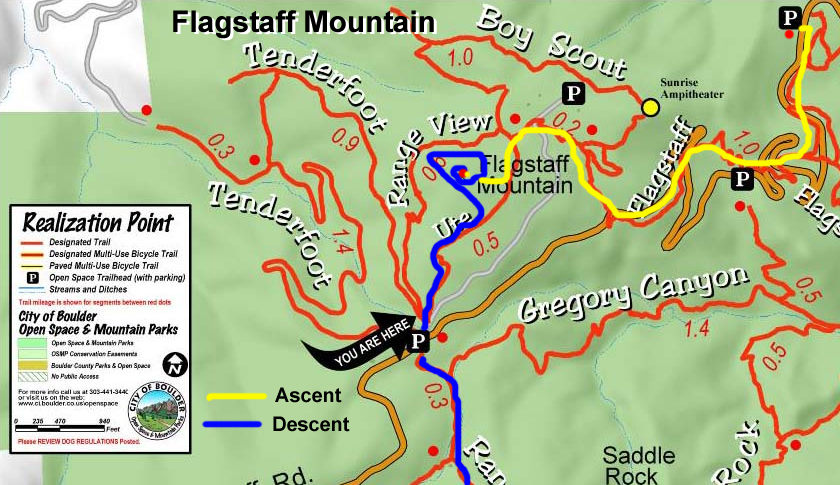
Our wandering route to touch the elusive top of Flagstaff Mountain.

Our wandering route to touch the elusive top of Flagstaff Mountain.

Eventually we gave up and backtracked until we were across from the approximate high point, and then we bushwacked across.  But the “high point” was elusive.  We ended up cutting across to the Range View trail, and then heading back and forth in a spiraling fashion until we found a “high point” that we could live with (point 4 on map).

But by that time it was past sunset and into twilight.  It was going to be a ankle-twisting, wrong-turning adventure back to Chataqua. Dang.

And to make matter worse, we didn’t really know how to get down.  The plan was to follow the signs to reach the Flagstaff trail and follow it down to Gregory Canyon or Baseline Road.  Now our best chance was to just go downhill while staying on whatever trail we could find.  So we headed back to the Ute trail and then started downhill.  Of course Brian wouldn’t hear of simply walking down Flagstaff Road.

It took about an hour to pick our way down, but we made it with only a few minor injuries (not counting the serious roadrash on my ego). We arrived at Brian’s truck at approx. 6pm (point 5 on map).  And after another round of driving, we were finished.

All in all, it was a nice afternoon (and a bit) on my favorite mountains in the world.

Summary (approximate distance and elevation gains):

  1. Eldo Mesa Trailhead to South Boulder Peak (3.4 miles; 3080′)
  2. South Boulder Peak to Bear Peak (0.7 miles; 300′)
  3. Bear Peak to Green Mountain (2.6 miles; 950′)
  4. Green Mountain to Flagstaff Mountain (2.2 miles; 200′)
  5. Flagstaff Mountain to Brian’s truck (1.8 miles)

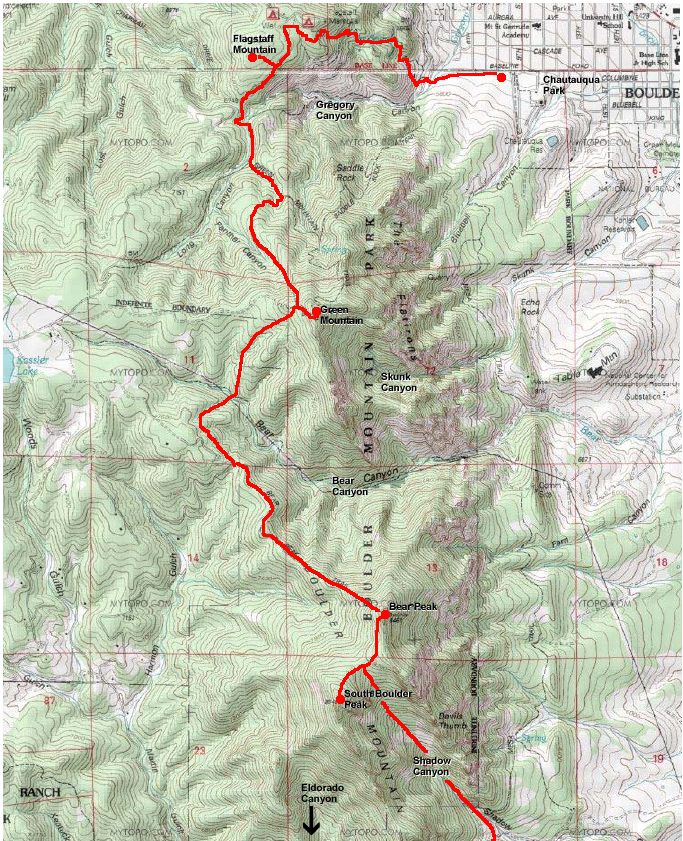
Boulder 4 Banger totals:  10.7 miles; 4530′

Topo map showing Boulder 4 Banger route

Topo map showing Boulder 4 Banger route

See all trip reports

Swimming Atlantic & Pacific Peaks

August 3, 2009

I had 14ers on the brain, but the unchecked peaks were too far for a day trip, and Brian couldn’t get away for an overnighter. Brian suggested we do “Atlantic” as it is nearby (near Copper Mountain) and would provide a good ski descent.  We could also add in Pacific if we made good time. I agreed.

Our plan for April 13, 2002 had 4 easy steps:

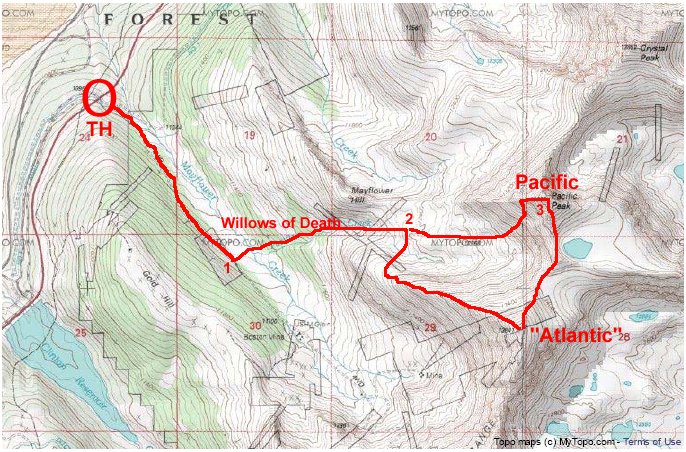
  1. Follow the mining road until we could cross the streambed to pass between Mayflower Hill and “Atlantic Peak”
  2. Ascend the West (summit) Ridge to “Atlantic” and proceed east to the summit of “Atlantic”
  3. Traverse to Pacific Peak, if time, conditions, and fitness permit
  4. Descend back to the trailhead and reach home alive
Our route from the Mayflower Gulch TH to Atlantic and Pacific Peaks

Our route from the Mayflower Gulch TH to Atlantic and Pacific Peaks

And everything started off so well….

We left the Mayflower TH parking lot around 7am and made good time along an old mining road.  After about 1 mile we turned to head NE up a stream bed headed between “Atlantic” and Mayflower Hill toward Pacific Mt.  Before leaving the road, I put on my snowshoes for floatation, which I brought instead of skis to give my aching knees a rest.  My optimism was not well founded, but at least I could blame this one on Brian.

Fletcher (right) and Atlantic (left) on the way to the Atlantic & Pacific peaks

Oh, the soft snow misery!  If only I was postholing…but I was drowning.  I needed snowshoes the size of freight trains.  The snow was at least 5 feet deep and soft as far down as I dared during my tank-less deep dives.  I had fallen into a giant bowl of sugar and had move through it to find an escape.  It took us 1.5 hours to travel ½ mile.  It sucked, big time.

Finally, we reached the Atlantic-Pacific cirque and mounted the Atlantic West Ridge.  I was ready for better conditions, but I wouldn’t find it.  The ascent required a steep climb up a wall of loose rocks covered by thin layer of fresh snow.  It was a slog.  But at least the ridge proper was much easier, with a lower angle and exposed rocks for footing.  We reached the Atlantic summit around 1pm.

The wind was stiff and cold, but I needed a rest as well as some water and food.  I sat on the eastern slope and ate my lunch despite a rather uncomfortable sitting position.  We decided to keep going to descend into the valley below from Pacific’s summit ridge.

The ¾ mile traverse (and 400 foot altitude gain/loss) went quickly.  The Pacific summit rose to a point, 2 feet by 2 feet…just as a summit should.  Without a pause, we immediately turned down the west ridge toward a tongue of snow which would lead us to the foot of the mountain.

Pacific is a twin-peak with no easy way to get down the west ridge.  As we skirted the west (lower) town, I had to down climb a loose rock chimney. I stepped into the chimney putting my left foot on a questionable foothold.  I proceeded only because I had good holds for both hands, although, my left hand also held my collapsed trekking poles.  My right hand held a jug on a large detached block. As I lowered myself to the next foothold, my only foothold failed…the rock broke off!  As my weight suddenly shifted to my hands, my right hand hold failed.  The detached block shifted and pulled out of its slot.  My mind raced for options and a quick glance revealed no other holds.  To buy a few milliseconds, I continued holding the detached block as it toppeled out and down toward my head.  As I twisted to avoid the rock, I shifted my right hand from the falling rock up to the ledge where the detached block once rested.  In the meantime (all 1.2 seconds of it), I traded a wrenched left shoulder and chest muscle for my life.

As I explained to Brian afterward, “it was a good trade.”

Fairly quickly we reached the tongue of snow that reached to the valley below.  The snow was a bit soft, but still allowed for a fun descent.  I had a fantastic glissade off the summit ridge.

Naturally, once we got down to the streambed, it was worse than before.  The snow was hell.  I tried to stay in my old tracks to find any purchase, but the snow had turned into quicksand.  The snowshoes provided no floatation, but instead became anchors that would hook under any vegetation beneath the snow.  I ended up taking off the snowshoes and just crawling back to the road….I didn’t know if I’d drown or go crazy first.  When I finally reached the road, I just rolled onto it out of the snow…and then let loose a blue streak of curses until my remaining energy was exhausted. It was the worst experience of my life.

But once I got back to the truck, it had turned into a great day!  And after all these years, I finally started to get an inkling of what that Dickens fellow had been talking about.

The Great Bolivian Adventure

July 21, 2009

It had been a long time since I had gone on a big expedition….long enough to only remember the good things.  I was ready to hit the big mountains again when my friend, Joe, started talking about a trip to Bolivia to climb  Huayna Potosi (19,974 ft) and Illimani (21,122 ft).

The Cordillera Real, or Royal Range, of the Bolivian Andes is a very popular area for mountaineers due to easy approaches, high altitudes, and only moderate difficulty. To succeed, we would need to overcome the obvious technical, acclimatization and logistical challenges in addition to gastro-intestinal illnesses, serious sleep deprivation, and the constant threat of having our possessions stolen.  And, of course, we’d have to cough up a considerable amount of money.  We really had to want it.

It all started in January, 1999, while watching the Denver Broncos on their way to repeating as Super Bowl Champions (right, a long time ago).  Joe mentioned that he was going to sign on for a guided trip to climb mountains in Bolivia.  He asked me to join him and I agreed. Unfortunately, it turned out that Joe’s intention was not yet certain.

During the following 2.5 months, we played an email game of “I’m not sending my deposit in until you do” and “something’s come up at work, I might not be able to go.”  It really was quite a lesson in communication – I frequently misinterpreted Joe’s email messages.  Below are some examples to illustrate my errors:

Email Message

What I Thought Joe Meant

What Joe Really Meant

“I am going to sign up this week”

I’m committed and will make it official by the weekend

It sure sounds good, but I like to keep my options open until the last minute

7 days later when I followed up…

“I just got approval from work – I’ll send in the application and check ASAP”

Finally, the last hurdle has been cleared.  I’m making it official tonight, or tomorrow at the latest

Now that I know I can go, I just have to be sure that I want to go.  I’ll start thinking about it real soon.

5 days later when I followed up…

“Actually, I will call the guide service today with a credit card number”

I will make it official before the end of today

I’ll send the guide service an email telling them that I really want a spot

1 day later when I followed up…

“I’m in and deposited as of this afternoon”

? (I didn’t dare guess)

It’s official

In the end, we committed.

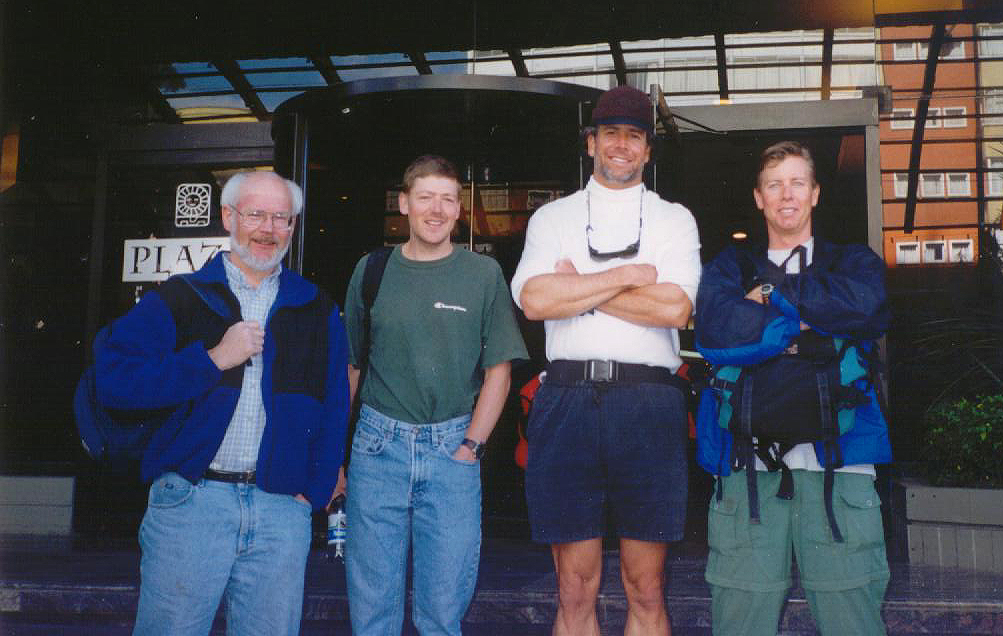
The trip lasted 16 days, during which we climbed two mountains: Huayna Potosi (19,974 ft) and Illimani (21,122 ft).  We spent six nights in La Paz, otherwise in tents near our mountain objectives.  On the trip we had three US guides: Jethro, Cate, and Brian; one Bolivian guide, Eduardo; and nine other climbers: The two Joe’s (me and my friend), Terri and Ralph (a couple from Canada), Steve (the CEO), John (“Harvard”), Rob (the Air Traffic Controller), Brad (the Brain Surgeon), and Mark (“Sharpshooter”).

Day One
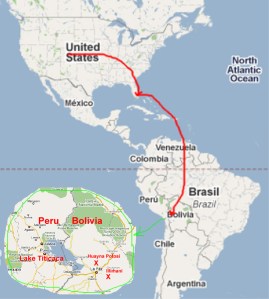
Overmap of flight to Bolivia and location of key destinations

Overmap of flight to Bolivia and location of key destinations

We landed in La Paz, the highest altitude capital city in the world (12,000’), on the morning of May 10 after a day of travelling.  The adventure had begun!

The flight was uneventful, but also a bit unfair.  Joe and I used Frequent Flyer Miles to upgrade to first class and began our vacation a bit early.  The thought of sitting all mashed-up in a tiny seat for 11 hours of flight time just shriveled me.  Joe tried to level the experience a bit by sharing a serving of mixed nuts with our unfortunate Comrades in low class.  I mean in Coach.  It didn’t work.

It was still a long flight, but my excitement over the adventure erased the unpleasant memories from my mind.

The airport is at 13,300’ elevation.  Lugging my gear around at that altitude definitely felt unusual.  We loaded our coach and drove down into La Paz; we came to understand that La Paz sits in a bowl surrounded by a high plain (called the Altiplano). The bottom of the bowl is protected from the high altitude weather and has very pleasant weather for a city at 12,000’.  Our first order of business was to drive to our hotel in central La Paz and then keep ourselves busy to avoid the temptation of taking a nap (we didn’t get much sleep on the flight).  Jetlag is a bitch even without drastic timezone changes.
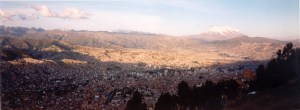
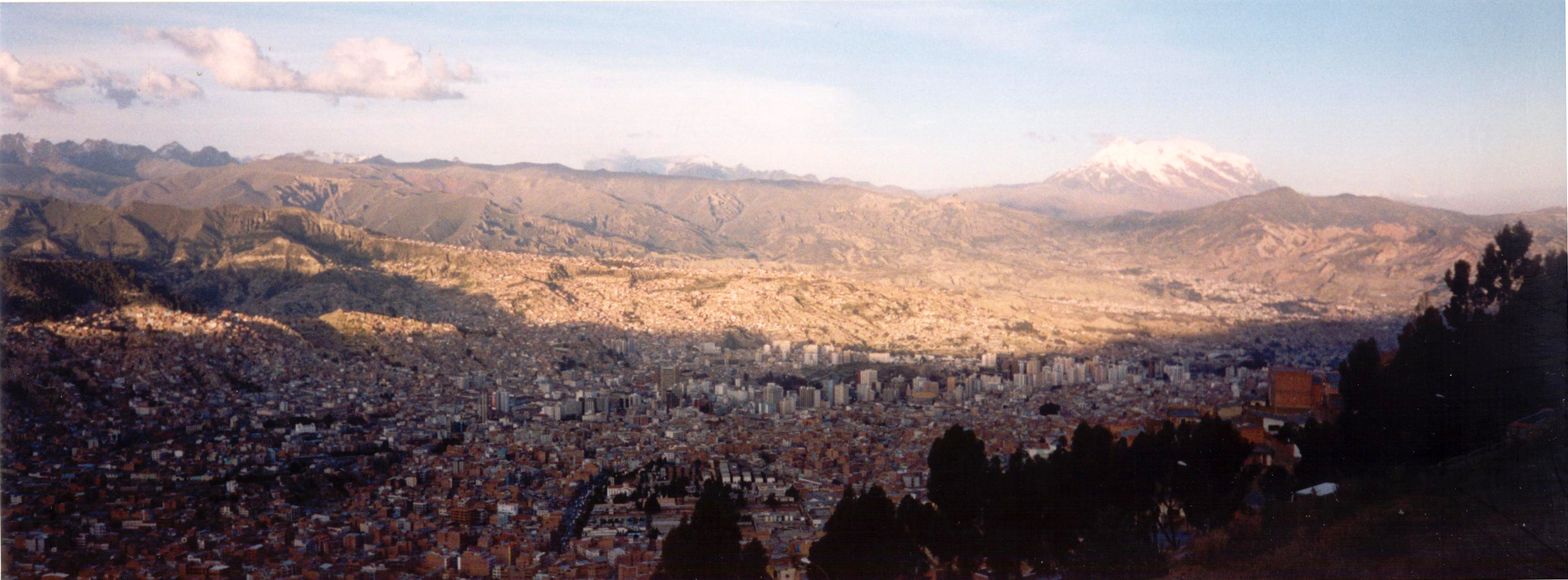
Looking down into La Paz with Illimani off in the distance

Looking down into La Paz with Illimani off in the distance

Our first project was lunch, which resulted in Rob’s fanny pack, wallet, camera, etc. being stolen from under our noses in the Wall Street Café – a painful lesson that caused us all to be justifiably paranoid.  Hell, we couldn’t even trust the water.  We spent a great deal of effort acquiring “safe” water, but to no avail.  Everyone was sick at some point and I was first.  I spent the first night in the bathroom as my internal organs were liquefying and vaporizing as a result of being set on fire.

On the flight down, I had read up on what not to catch while in Bolivia.  When you catch Giardia, the book instructed, you get huge amounts of intestinal gas, which comes out any way it can.  In particular, I recalled that the virus is characterized by “farting out of your mouth.”  I was sure I had it.  But, instead, it passed (pardon me) and I felt well for the rest of the trip.

Day Two

The second day we traveled by coach to the highest navigable lake in the world – Lake Titicaca.  I never did quite understand the full meaning of the word “navigable.”

nav·i·ga·ble (adj.)

Sufficiently deep or wide to provide passage for vessels: navigable waters; a navigable river.

Source:  The American Heritage® Dictionary

I think the key word here is “…passage…”  The lake must be good for moving between distant places, as opposed to a mountain lake in which you could use an inflatable raft to make your way around the shoreline.  In any case, we sat on a few run-down 20-foot boats and “navigated” over to an island famous all over the world for building reed boats. I forget the name. Just kidding, it was called Suriqui. I understand the local Amayra Indians helped Thor Heyerdahl build the famous reed boats Ra II and Tigress for his exploratory expeditions.

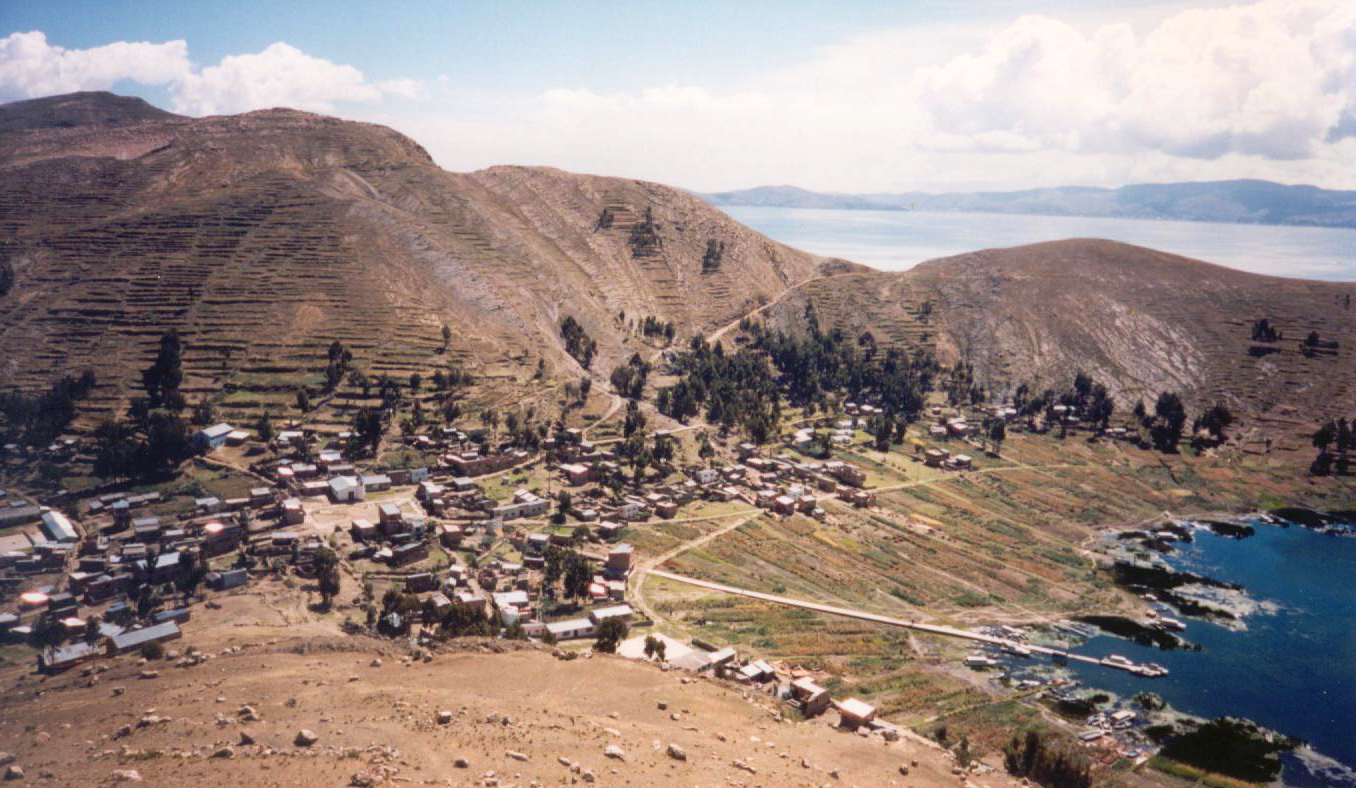
The island of ssss....the reed boat builders

The island of Suriqui....the reed boat builders

My primary mission for the day was to avoid the dry heaves (empty guts from night before).  The island had visible remnants of ancient Inca agricultural production (the horizontal lines cut into the hills), but I especially enjoyed the views of the two peaks we’d be climbing, which were visible off in the distance.

Day Three

On the third day, three Jeeps arrived at the hotel to drive us up a dirt and rock road of death to reach the highest elevation ski resort in the world.  Apparently, La Paz also has the highest golf course, football stadium, velodrome, and landing strip.  And Burger King, too, I’ll bet.
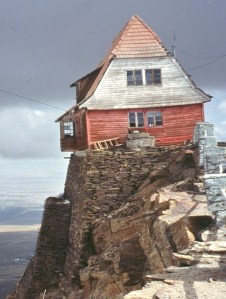
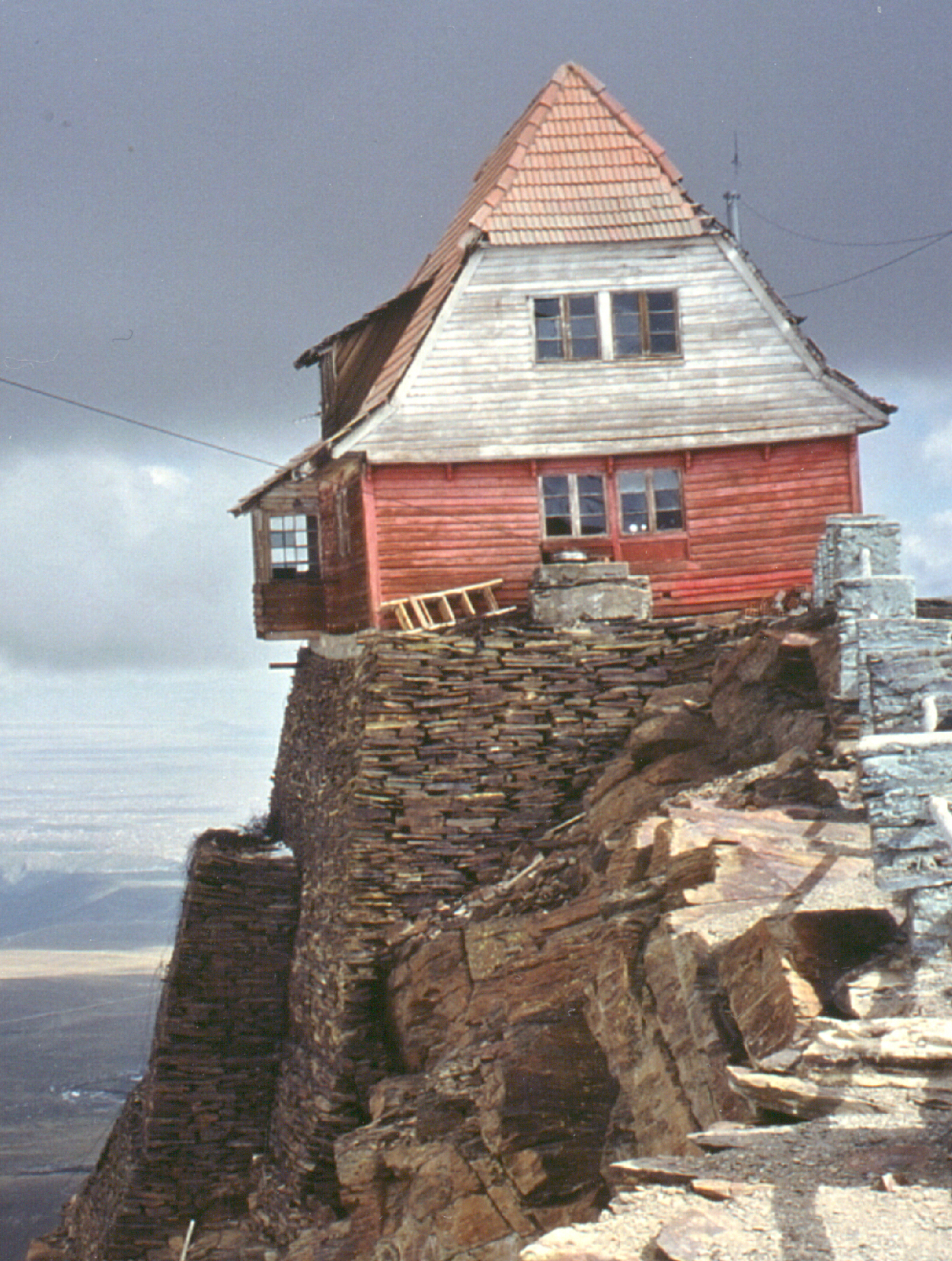
The "resort" hut

The "resort" hut

The so called ski “resort” had one ski run and a non-functioning towrope, but if you didn’t mind hiking you could ski.  I suppose it was better than flying to Colorado for the day.  At 16,000 feet, the idea was to help us to acclimate to higher altitudes while we practiced some basic snow travel techniques.  We hiked a bit and then practiced our self-arrest technique.

The coolest part was the old hut that sat upon a pile of rocks.  I only went inside because I didn’t notice the foundation until I came out again.  It was a scary sight.

Day Four

On the fourth day, our effort on Huayna Potosi began.  To climb Huayna Potosi, we would, on consecutive days:

  1. drive to Base Camp (15,500)
  2. train on the glacier below the mountain
  3. move to High Camp (17,700)
  4. climb to the summit (19,800)
  5. move back to Base Camp
  6. return to La Paz


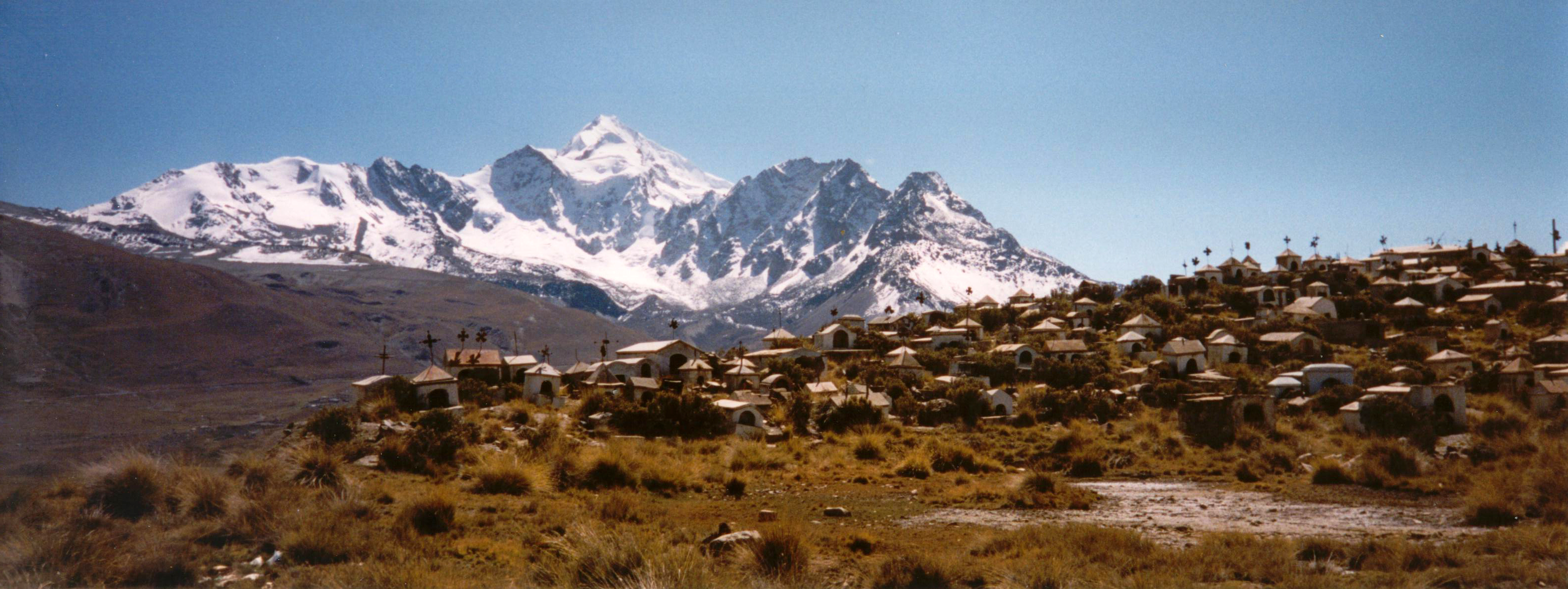
A view of Huayna Potosi on the drive to base camp.  In the foreground was a old graveyard for miners.

A view of Huayna Potosi on the drive to base camp. In the foreground was a old graveyard for miners (I thought they said "climbers")

To our relief, it was a coach instead of a jeep that arrived at the hotel to drive us to the Huayna Potosi Base Camp.  This drive was fun by comparison to the death road up to the ski resort.  We had learned that whenever jeeps show up for transportation, we were in trouble

Huayna Potosi Basecamp

Huayna Potosi Basecamp

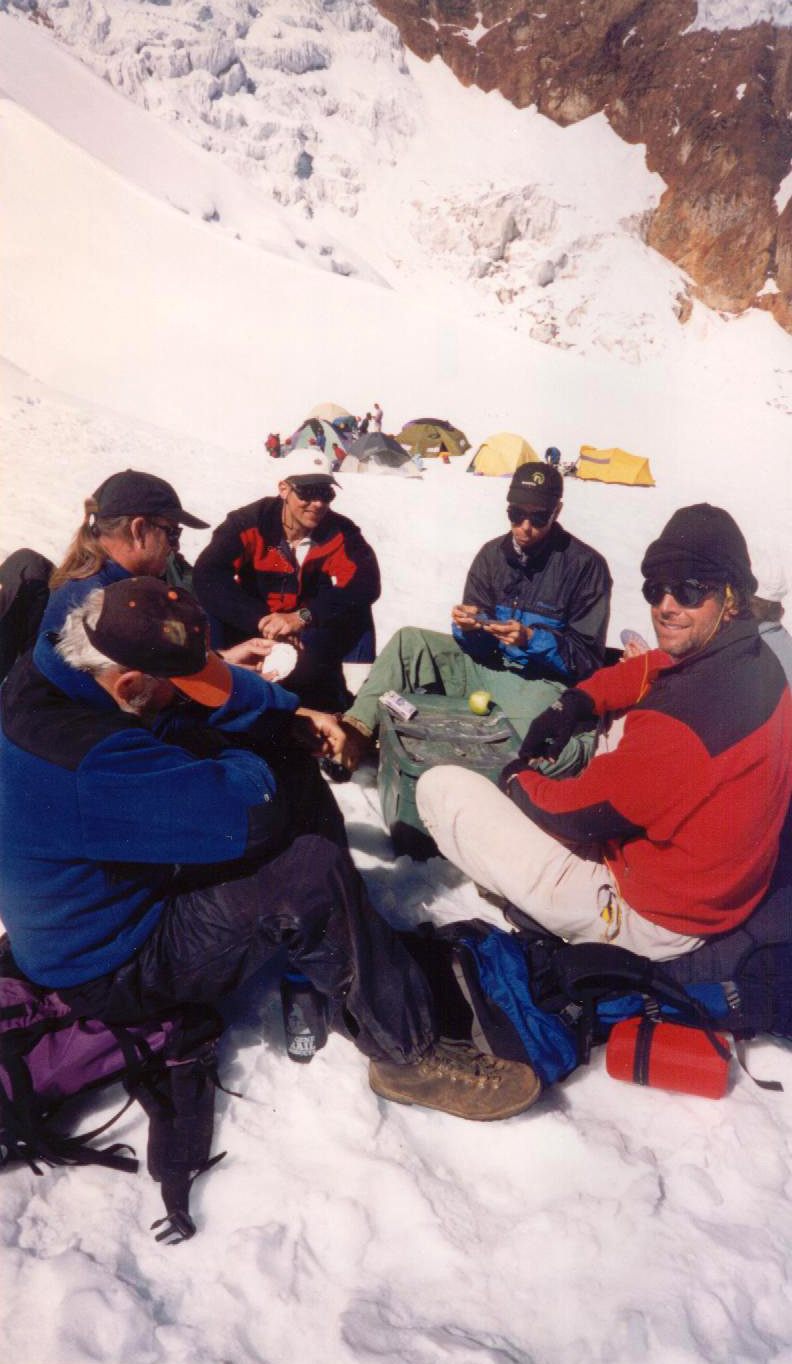
In Base Camp, we had a few chores before taking our acclimatization hike.  First we set up the tents and then the latrine.  The guides gathered the group together to explain that they would build a toilet out of rocks and place a plastic bag next to it for the used paper.  After the hike, we settled in for our first of many games of Hearts. It was interesting to (re)discover how little I could do in a day at high altitude and be completely fulfilled as long as the day ended with a meal and an hour of playing Hearts.

During this time, Mark had decided to be the latrine’s first customer.  A short while later while still within the walled area (ruins of a building) containing the latrine, Mark yells out, “where’s the plastic bag?”  One of the guides, Brian, yells back, “it is right next to the toilet.”  Mark responds, “there is no bag here, except the one you poop in.”  Oops, Mr. Sharpshooter strikes.  Apparently, on his last trip, Mark’s group was required to use a bag.  We laughed unreasonably hard (…’til we cried, and then some); apparently there is nothing like high altitude combined with stress to make everything seem hysterically funny.

A view of Huayna Potosi from Basecamp.

A view of Huayna Potosi from Basecamp.

Day Five

The fifth day was used to further our training and acclimatization.  We hiked up to the glacier at the base of Huayna Potosi and practiced our cramponing and axe techniques.  The training was very good as we used these skills continually during the summiting of Illimani without a single mishap.  To reach the summit of Huayna Potosi we would not need much technical skill, just a lot of patience to endure the slow pace.

Day Six

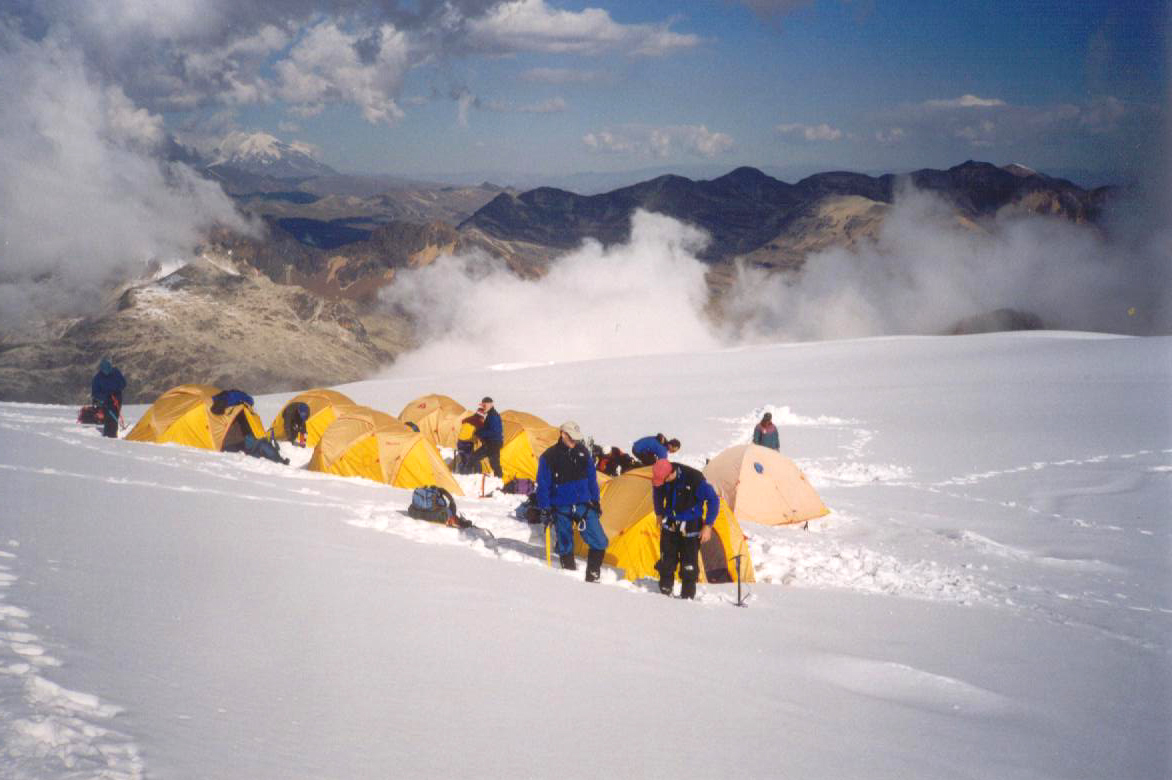
The sixth day we moved up to High Camp at 17,000 feet.

When I was preparing for the trip back in Boulder, I read the trip brochure’s promise of using porters and pack animals “as much as possible” as a weak promise.  So, my entire strategy in packing for the Bolivian trip was to bring a little as possible to reduce my pack weight to its minimum.  I have suffered with heavy packs too many times to let that mistake eat away at my summit chances on a trip I paid so much to join.

The porters carried everything (e.g., sleeping bag, axe, crampons, helmet, food).  I was amazed.  I could not confirm that it happened, but I wouldn’t be surprised if one or more of the smaller clients hid away in the porters’ bags.  So instead of feeling smart about a light pack, I had to dread how badly I would freeze high on the mountain and stink after 6 days in the same underwear!
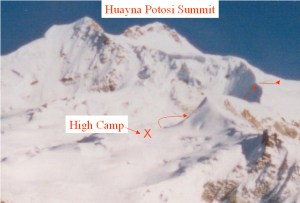
From High Camp, we ascende the headwall and moved to the far side of the summit to find the summit ridge

From High Camp, we ascende the headwall and moved to the far side of the summit to find the summit ridge

At High Camp, everyone was feeling a bit ill.  My heart was pounding at around 90 beats per minute no matter what I did to relax.

The latrine at Base Camp was a luxury throne by comparison to the shit pit in High Camp.  And, you had to watch out for pooping on your boot while you squatted over the hole dug in the snow.

Once the sun set, the only thing that mattered was getting in the sleeping bag.  It got cold in a hurry.
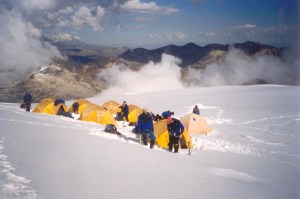
 

boliviahphighcamp

Huayna Potosi High Camp

My light and highly compressible sleeping bag rated only to 5F instead of the recommended –20F.  To compensate for the light insulation, I slept fully clothed.

This turned out to be a good idea, since I had to get out of bed every hour to pee anyway.  I should have slept with my boots on to be even more efficient.  I would later decide that a pee bottle is a great idea, after all these years of distain.

Day Seven

My heart stopped racing about midnight, and I managed to fall asleep about an hour before the guides woke us up on the seventh day to get ready for the summit push.  When the alarm went out, I was so pumped I didn’t even feel tired.  That would come later.  When I stepped out of the tent, I could tell it was going to be a very cold morning. Wearing every bit of clothing I brought and still shivering – the only thing I could hope for was vigorous exercise.

From High Camp, we had to hike up the mountain in a somewhat spiral fashion to reach the summit.  First, we had to climb toward the summit (north) for a short distance, then turn right (east) to mount a headwall, then back north past the summit to reach a ridge which we would take south (back toward High Camp) to the summit.

About 4am (yes, we were very slow; it was a big group and it was our first climbing day), we started hiking toward the Headwall. The Headwall was about 300 feet tall at a 50-60 degree angle.  The snow was soft enough for us to gain purchase, so the angle didn’t matter as much.  Of course, it was still cold, and at that point we were moving very slowly.  We had a bit of trouble as the first few climbers tried to Jumar up the team rope (the rope we were tied into).  They found out it is rather hard to pull yourself up a rope that is tied to the guy in front of you, but quickly corrected the mistake.  Once we topped the Headwall, the sunrise was not far away.
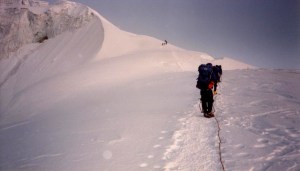
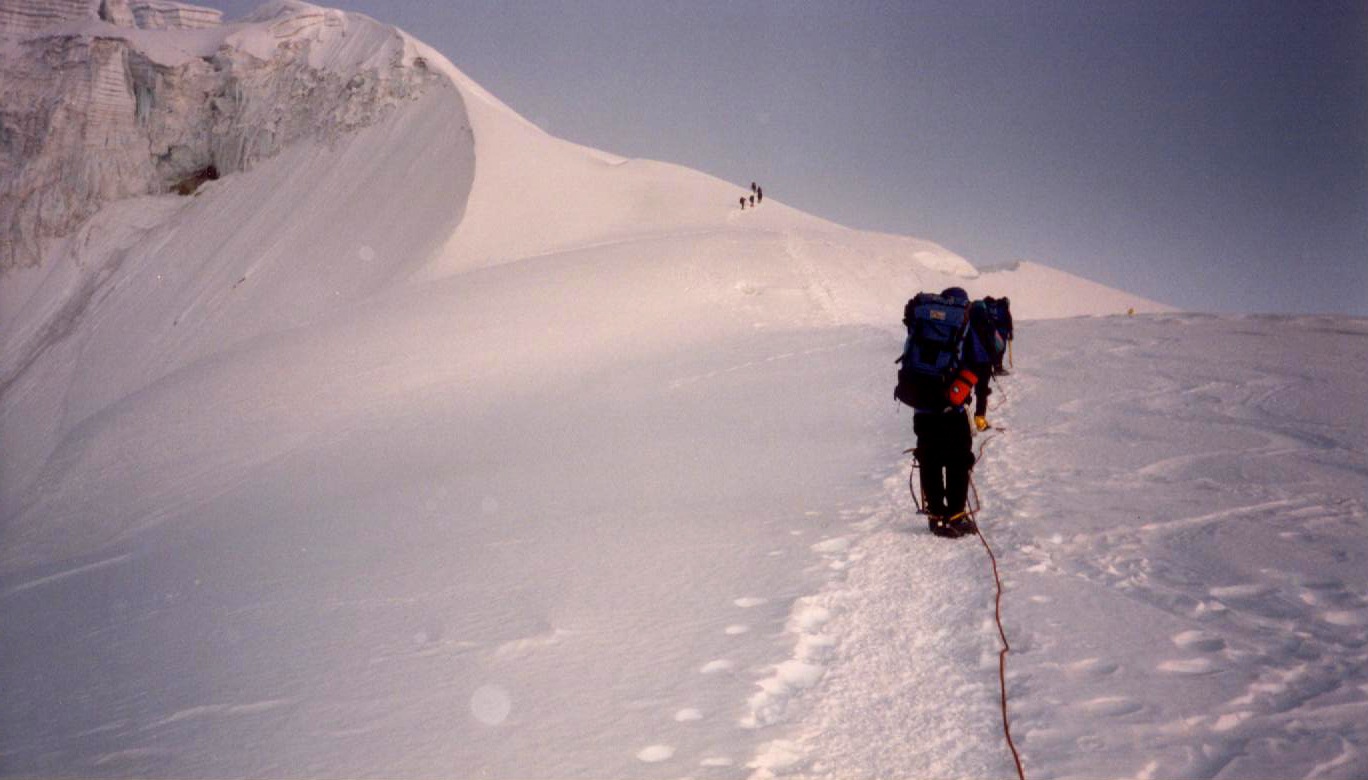
Above the headwall and just after sunrise.  The first team can be seen in the distance.

Above the headwall and just after sunrise. The first team can be seen in the distance.

At sunrise, the temperature rose so quickly that I started sweating before we could take another break to shed some clothes. From the headwall, we climbed a rather flat section around to the backside of the mountain where we eventually crawled up a flat shoulder to the summit ridge.  From there, we traversed 200 yards of knife-edged, wind blown snow to reach the summit.

The ridge traverse was quite stimulating.  To the right, the snow angled at 85 degrees, falling away several thousand feet.  To the left, the snow angled at 60 degrees initially and then 80 degrees, falling away 500 feet back to the shoulder we ascended.  The snow on the ridge was a bit soft and tended to slide out from under your feet.  The fixed line was a pleasure, to be sure.
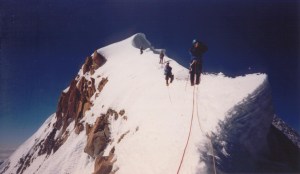
The summit ridge.  A slip to the left would cost you 500 feet; a slip to the right would take you all the way back to La Paz.

The summit ridge. A slip to the left would cost you 500 feet; a slip to the right would take you all the way back to La Paz.

Due to the exposure, not all of the team would attempt the traverse.  Mark had become too hypoxic to continue.  During the ascent of the shoulder, he had been trying to name each step he took, but became frustrated when he couldn’t keep up the pace . . . Mary, John, uh . . Kim, uh . . . uh . . . Brian, uh . . oh damn!  The team leader thought it would be best if Mark waited below the summit ridge as we pushed for the summit.

The summit itself was an angled hunk of snow atop a rock pinnacle.  As the summit was so small and our group so big, there wasn’t enough room for all of us.  As soon as the last man (me) reached the summit (and got off the ridge), the first team began to descend.  While we waited for our turn, Joe and I took pictures with Cate and Edwardo, two of our guides, and looked off in the distance at Illimani, our next challenge.

The Joe's and Kat on the summit of Huayna Potosi with much of Bolivia in the background.

The Joe's and Cate on the summit of Huayna Potosi with much of Bolivia in the background.

When our turn came, I took the lead for our rope team and followed the first team back down the ridge.  Descending turned out to be a lot easier, as always.  Our rope team made good time, and quickly caught up to the first team.  They seemed stuck for some reason, an opportunity for photos that Joe and I didn’t miss.  It turned out that Brad (the Brain Surgeon) had tripped and tumbled over the edge into the abyss.  Fixed lines to the rescue!  Soon Brad was back on the ridge and we all were moving again.  Reaching the shoulder and Mark, we stopped for lunch and a rest.
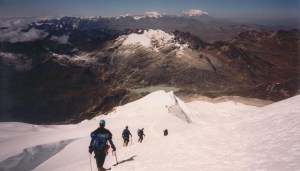
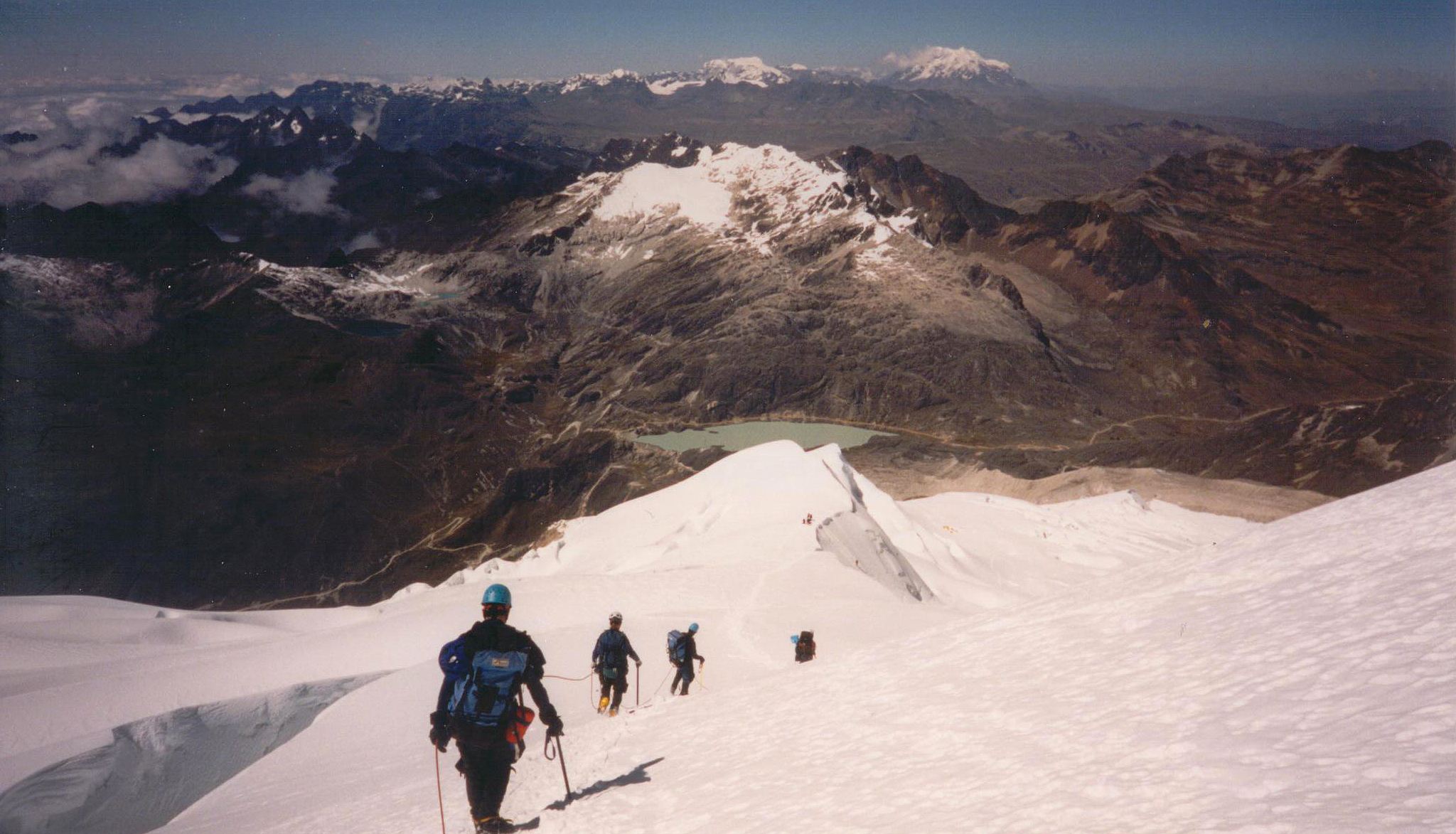
The descent to High Camp with Basecamp in the distance on the far side of the lake.

The descent to High Camp with Basecamp in the distance on the far side of the lake. The first rope team can be seen standing above the Headwall.

The descent went slowly.  The headwall provided some excitement, but mainly served to slow down my acquisition of additional water.  I was very dehydrated by the time the team returned to High Camp.  Once at High Camp, the Guides told us we were going to move to Base Camp.  So, we packed up our gear and continued down the mountain.  The hike out is always a death march, and this descent proved not to be an exception.

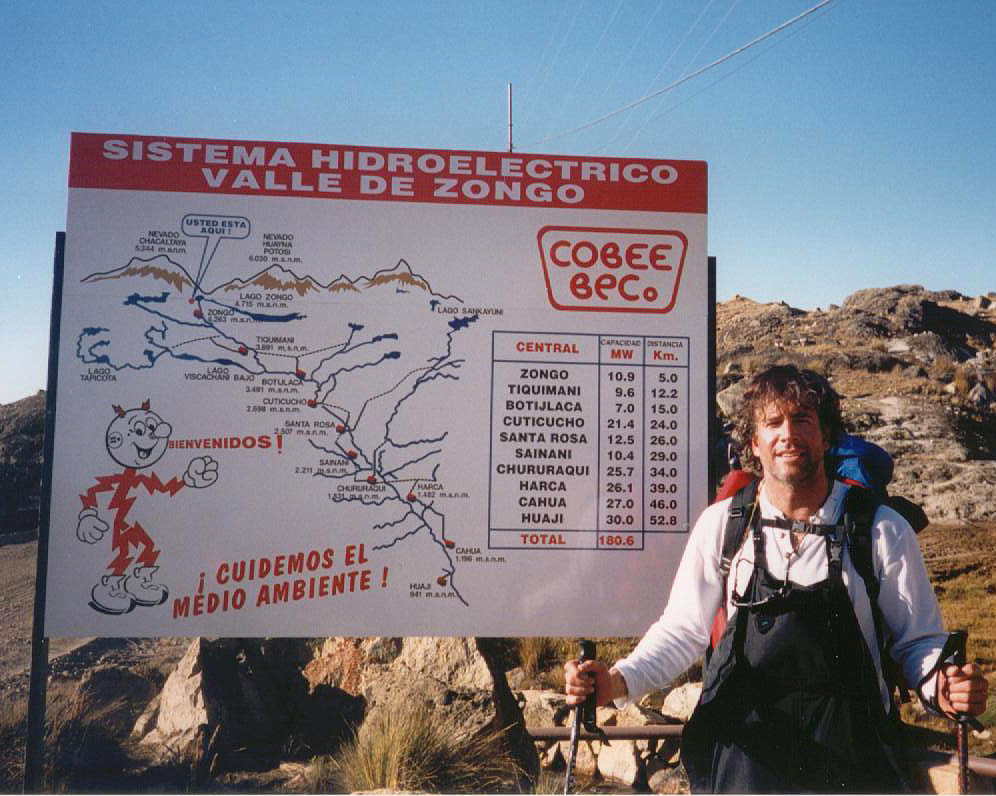
Me at Basecamp looking bad, but feeling pretty good.  The sign referred to the electrical system powered by the dammed lake next to Basecamp.

Me at Basecamp looking bad, but feeling pretty good. The sign referred to the electrical system powered by the dammed lake next to Basecamp.

At Base Camp, John (“Did I mention I went to Harvard”) and I collected water for the group and then helped set up camp before settling in to play Hearts.  That night we went to bed early – I slept from 7pm to 7am, without getting up to pee once.  It was a pleasure and a sure sign that I was dehydrated.  And, Boy, did I need a shower!

Day Eight

On the eighth day, the coach eventually arrived to take us back to La Paz.  While we waited, we sat in the sun and marveled at how much easier it was to breathe.  My resting heart rate had fallen to 46 beats per minute, down from 90 during that first night at High Camp.

The drive to La Paz went quickly as we were entertained by a Bolivian soap opera on the onboard TV.  Back at La Paz, we enjoyed showers and fresh clothes, the hotel steam room and pool, as well as some more of the local sites.  I managed to wash some of the stink out of my clothes in the tub of my hotel room.  As a side note, swimming underwater at 12,000 feet is a strangely panic-ridden experience….the oxygen in a breath of air just doesn’t last as long as it should.
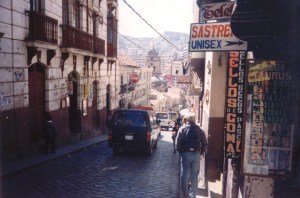
 

The Witches Market

The Witches Market

Day Nine

On the ninth day, we lost Mark.  He said he had to go to Maui to meet his wife.  It must be hard to be Mark.

Otherwise, it was an uneventful day during which we shopped in the Witches’ Market (Mercado de Hechiceria) and rested up for the next leg of our adventure.

Day Ten

On the tenth day, our effort on Illimani began.
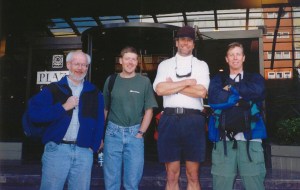
Waitn' for the bus (or Jeeps in this case)

Waitn' for the bus (or Jeeps in this case). From left to right was Steve, Brad, me & John

The mountain has four main peaks; the highest is the south summit, Nevado Illimani, which was our goal. To climb Illimani we would, on consecutive days, drive to Unna, below the massif of Illimani, and hike to Base Camp (14,000), move to the Mid camp site (16,000), hike to High Camp and return, move to the High Camp site (18,000), climb to the summit (21,122) and move camp back down to Base Camp, and finally hike back to Unna for transport to La Paz.
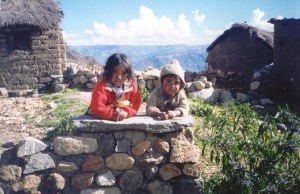
We hiked past a little village outside of Unna.  The kids sure liked the candy one of our group was thoughful enough to bring.

We hiked past a little village outside of Unna. The kids sure liked the candy one of our group was thoughful enough to bring.

When three Jeeps arrived to take us to the town of Unna, we knew we were in for a wild ride.  The 4-hour drive dealt with paying special undocumented fees (some combination of bribes for police and extra pay for drivers) for using the roads, driving around washed out bridges, and getting past runaway bulls blocking the road, but we made it.  Once in Unna, we left our gear to be carried up by the porters and pack mules, and we started hiking toward Illimani carrying only our fanny packs, with an objective of reaching Base Camp before dark.

Later, as we stopped for lunch, we watched the pack animals and porters go by us.  The porters included a few older women, including one who was carrying my full pack and another full pack strapped to her back by a piece of cloth.  I didn’t know how to feel.  I was grateful, but also a little embarrassed. Those people are really strong and they really ‘work’ for a living; it was sharp reminder of how easy life is in the USA.

Base Camp was at 14,000 feet in a Llama field.  It turned out to be the most comfortable campsite of the trip.  The ground was soft turf, so our aching bones rested much easier.  But it was also wet, so the air was exceptionally cold-feeling when the sun set.  We learned it was best not to spend a lot of time outside in the dark, but we did try that first night.  A late dinner that night included grilled cheese sandwiches, which turned out to be a favorite choice for all.  The production rate was 4 sandwiches every 5 minutes, and we had 12 people who wanted at least 2 for dinner and could eat a sandwich in 1 minute.  The math wasn’t pleasant; and jockeying for position at the grill was almost enough to distract our minds from the cold temperature.

Day Eleven

Day eleven was our ascent to mid-camp.  Another 2,000 feet up a rocky road, then loose trail to reach the rock ridge leading to the High Camp.  Somehow, this seemed to be the worst of our hikes.  The combination of loose rock, hot weather and long approach combined to make it seem interminable.  But, yes, we made it time for another round of Hearts.
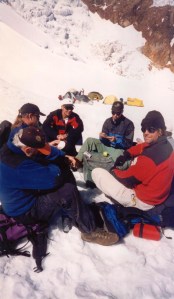
Another round of Hearts on low oxygen.

Another round of Hearts, this time without oxygen

Day Twelve

The guides had talked us into using our extra (and unneeded, at that point) ‘weather’ day on day twelve to further our acclimatization.  So, we woke up at first light and hiked 2000 feet up to High Camp to spend the day.  This hike was more interesting than most ‘acclimatization hikes’ due to the exposure.  High Camp turned out to be a crowded, little, flat bit of snow just to the side of the ridge leading to the summit.  There was a French glacier scientific team of about 20 who seemed to be doing little measurement.  There were also some British Columbia Canadians who were having a good time, eh.  Of course, we spent the day playing Hearts and taking photos.

Back down to mid-camp, we enjoyed some free time.  I wandered over to the latrine, which overlooked a valley to the side of the mountain.  Since it was a hot afternoon, I had my shirt off already.  Now I was sitting on this rock throne with my pants off too.  It was one of the most freeing moments of my life to be buck naked with so much of the world visible to me.  It was an experience that I will never forget.  Then we played cards.

Day Thirteen
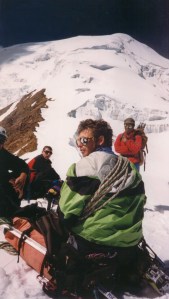
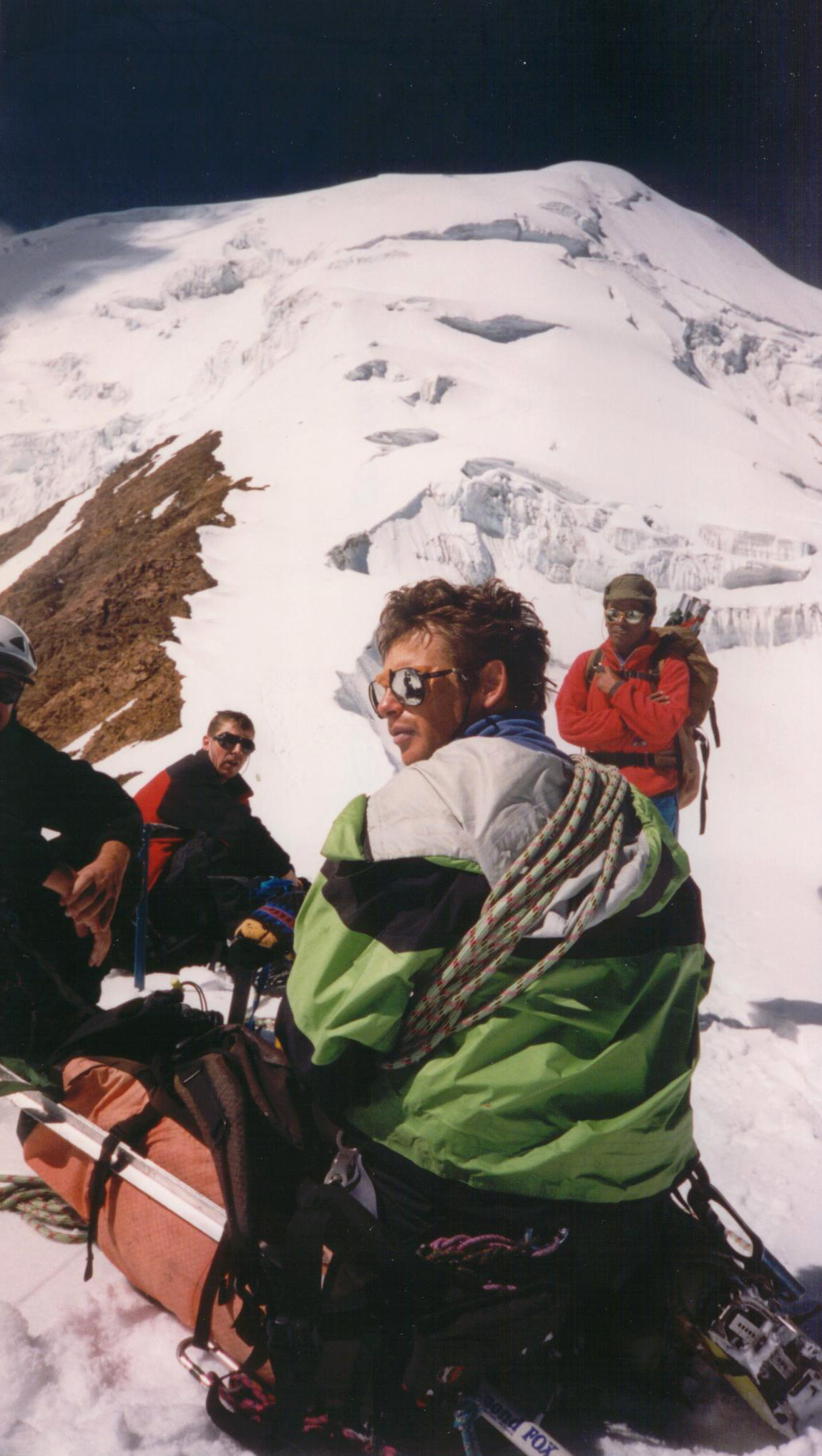
Jethro sittling below our climbing route on Illimani

Jethro sittling below our climbing route on Illimani

On day thirteen, all we had to do was move to High Camp. We got a late start, but still made High Camp before any tent sites freed up. A large group was leaving soon, so we waited. During this time, we noticed that one of the members of that group was a beautiful woman . . . a beautiful, mountain climbing woman. A “mountain peanut,” as some of our group would say. Needless to say, we didn’t mind waiting as our minds were left to wander. Soon they left, and we were sad.

We set up camp quickly and enjoyed some Raman noodles for dinner.  We went to bed early again, but this time I was careful to bring a pee bottle, and thank God I did.  I pissed 3 quarts of liquid during a 7-hour period and I am still waiting for a letter from the people at the Guinness Book of World Records.

Day Fourteen

I slept much better this time as my heart stopped pounding earlier.  When we were awakened, on day fourteen, the temperature was actually mild.  I had to take off most of my fleece before starting the climb.

Our route on Illimani was to ascend the west ridge, while avoiding several crevasses and crossing a large berschund blocked the ridge.  Most of the climb was high angle and in the dark until late morning.

The 3,300-foot climb started up a knife-edged ridge.  In the dark, it is hard to see how far you might fall, but occasional glimpses added to the drama of the morning. Fairly early into the climb additional climbers abandoned, and the rest of the group (4 clients & 2 guides) reformed into a single rope team.  We completed the ascent of the knife-edged ridge and then moved to the right to avoid open crevasses.  We ascended a large, steep snowfield on the face of the mountain, and eventually moved back left to reach the easiest section of a Bergschrund.  We reached the bergschrund at 10am and learned that this was somewhat above the ½ waypoint.
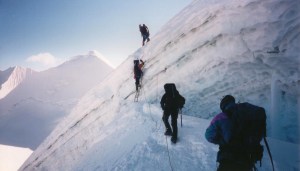
Crossing the burchrund....and reaching for sunshine

Crossing the bergschrund....and reaching for sunshine

The bergschrund was crossed via a naturally occurring ladder (it looked so old that it might have been from before the iron age) that Edwardo had hidden in the crevasse (he is the local guide).  The ladder was kept from plunging off the mountain by a cord anchored to an ice screw.  Still the ladder was unstable and climbing a ladder in crampons is not a natural act – it went slowly.

As last in line, I remained in the freezing cold shadows waiting my turn. While jumping and stomping my feet to stay warm, I could see the sunshine on the climbers as they reached the upper slope. I was looking forward to getting warm, and to easier climbing.  Eventually, it was my turn and as I reached the pleasure of the sunshine, I looked up in horror to see that the climb got even harder.  It looked dead vertical; I estimated the snow slope above me at 70 degrees (but you know how those estimate go).  To lower the risk of a catastrophic fall, we used fixed lines until we reached the summit ridge, up and left from the top of the bergschrund crossing.

The summit ridge was technically easy, but nothing is really easy when you are hypoxic.  I was not getting enough oxygen despite breathing as fast as I could (I foolishly refused to employ “pressure breathing”). Along the way, Edwardo pointed out the wreckage of a commercial airplane from a few years ago.
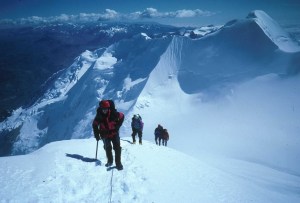
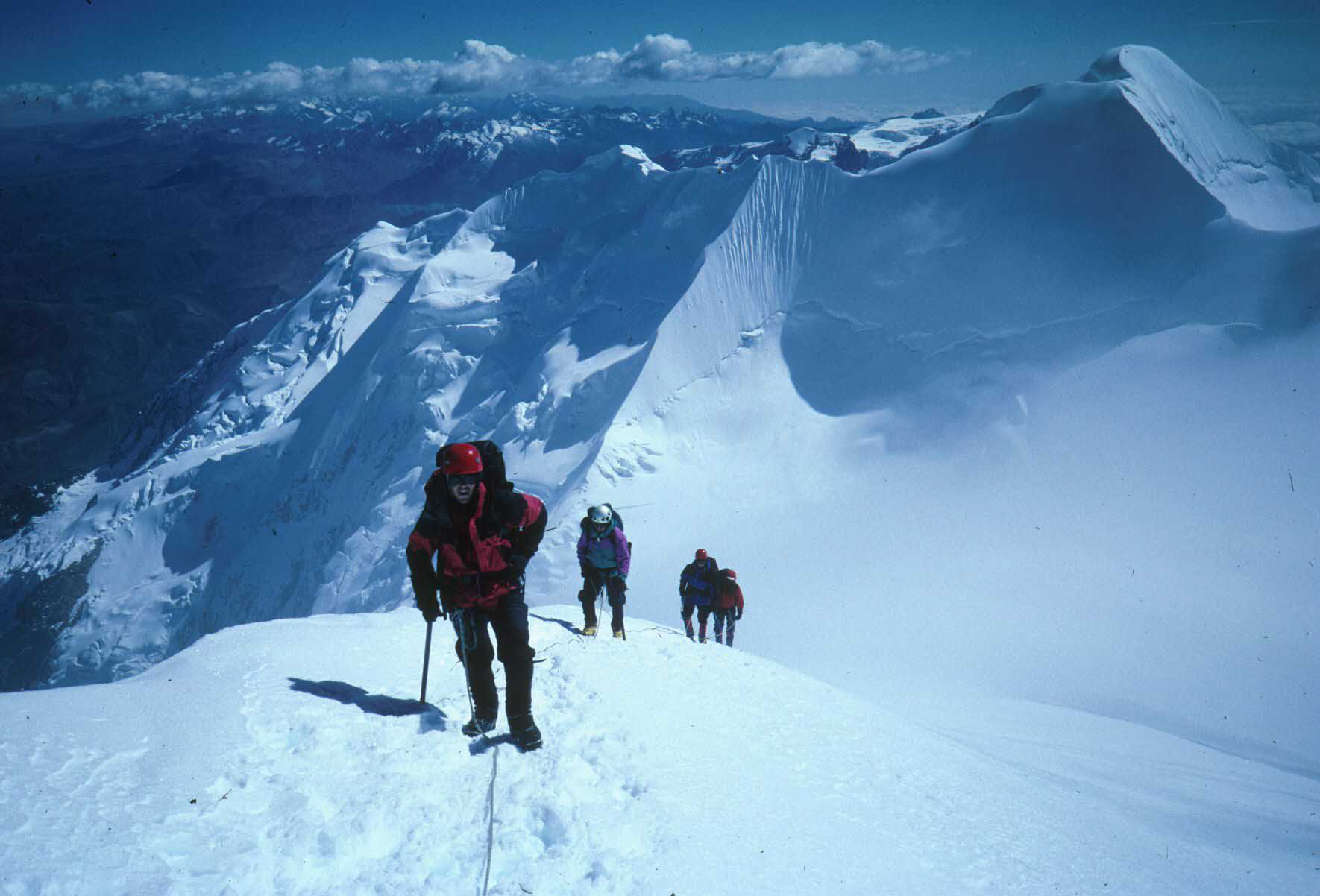
The Illimani summit ridge....just a few more steps!

The Illimani summit ridge....just a few more steps! In the photo from left to right are Brad, Rob, John and then me.

The summit was glorious.  We had made it in 7 hours – 500 feet an hour.  Brad, John, Rob and I had summited on with Jethro and Edwardo.  We all agreed that it was a significant achievement, despite Jethro’s warning that women would not be impressed.
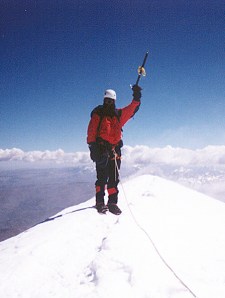
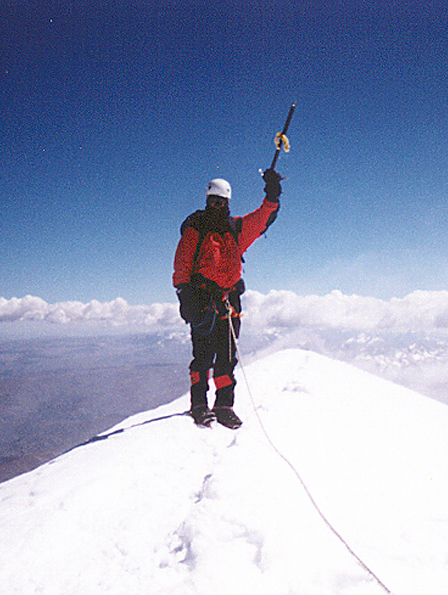
Me on the Illimani summit (21,122') 6/23/99

Me on the Illimani summit (21,122') 5/23/99

The descent was quick by comparison, and much less scary; we reached High Camp in 2 hours.  Back at High Camp, we were feeling pretty good for a 9-hour round trip at high altitude.

Unfortunately, the day’s work was not done.  We still had to move to Base Camp.  So, we packed up as much of the heavy gear as possible for the porters, and then began the 4,000-foot hike down the loose rock trail to Base Camp.  On top of a 3,300′ ascent and descent, another 4,000 of descent made for a long day.

That night, I fell asleep early and slept through the night without interruption.  On the soft Llama turf, it was the best sleep of the trip, if not my life.

Day Fifteen

On day fifteen, we had to hike back to Unna for transport back to La Paz.  Base Camp was a cold place, but I didn’t want to be in warm clothes once the sun was shining.  I dressed in shorts and began hiking quickly to stay warm.  The combination of cold temperature and dehydration from the previous day conspired to keep me cold.  I hiked as fast as I could to stay warm and reach the edge of the mountain’s shadow. My Sony Walkman (relax, IPods didn’t exist yet) kept me company until the sun got above the Illimani massif.

As we hiked, we could see that the porters/pack animals were not close behind us.  Trying not to get to town too early (to avoid being mobbed by handout seekers), we took our time to reminisce and imagine new inventions that would be useful for climbers.  Joe thought that a pill that would increase appetite would be good.  Everyone agreed.  (we all lost significant weight on the trip).
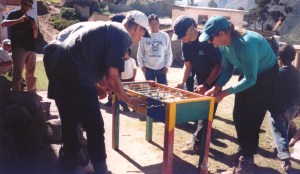
A wicked game of foosball distracted us from our delayed departure.

A wicked game of foosball distracted us from our delayed departure.

Finally back at Unna, we continued to wait for the behind-schedule porters.  To pass the time, several of our group played on a foosball table at a cost of about 1-penny per game.  In addition, Jethro tried to teach the local marble sharks a lesson, but lost his recently purchased marbles in the effort.  Eventually, the equipment showed up and we left for La Paz and the Burger King we saw on the way out.  I do believe that they make Whoppers out of filet mignon in Bolivia.  The Burger King in La Paz seems to be the best in the world.
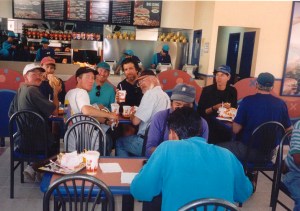
The #1 rated Burger King in the world, at least in my book.

The #1 rated Burger King in the world, at least in my book.

To wrap up our fabulous trip, the guiding service took us out to dinner.  It was a high end place that provided the sort of food we were used to eating back home; it had been a long trip filled with food bars & rehydrated food.  It was a nice way to begin the transition back to the U.S.

Day Sixteen
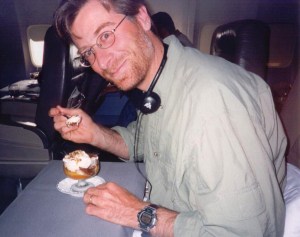
My buddy, Joe, take a break from the beating in cards I gave him all the way home to enjoy some yummy ice cream.

My buddy, Joe, takes a break from the beating in cards I gave him all the way home to enjoy some yummy ice cream.

Leaving La Paz was difficult.

Oh, sure, we wanted to leave.  What I mean is the airport was ridiculously inefficient.  First we had to wait in line forever to check in, then we had to wait in line to buy an ‘exit tax stamp’, then we had to get searched (read: felted up) by security for the stated purpose of ensuring we didn’t carry drugs, then we had to wait for the plane to board.

Well, the flight was good – first class again (see photo of ice cream sunday served).  But it was a long travel day.  We got up in La Paz at 3am (1am Denver time) to be ready for a 7am flight.  We arrived in Denver at 11pm and got home after midnight – a 23-hour travel day.

It was a great trip, but I was glad to be home.  All that was left was to shave off my scraggly beard and wash my seriously nasty clothes and gear.

See all trip reports

Brian’s Fork: Attempt on Yale

July 13, 2009

We were pushing it hard.  I was trying to get my body ready for a trip to Bolivia (to do Illimani & Huayna Potosi) while Brian was happy just to suffer at altitude.  Following the end of ski season in March (we always end resort skiing at the beginning of April to start the snow climbing season), we had done Mummy Mountain (13,425’), Mt. Silverheels (13,829’), Huron Peak (14,003’), and Missouri Mountain (14,067’).  The last peak on my prep list for Bolivia was Mt. Columbia (14,077’).  We scheduled Friday, May 1, 1999 for this ascent.

Unfortunately, the weatherman wasn’t cooperating.  In the 3 days prior to the climb, it snowed 24 inches.  We didn’t know what to expect, but we were just dumb enough to just go for it.

Friday after work, we drove south toward Buena Vista and found the access road to Columbia covered in soft snow up to the fenders.  I managed to get my 4Runner about 0.5 mile up the road before we decided that the chance for disaster was too high; then I got to enjoy backing up in the dark for a 0.5 mile.

Using a flashlight, Brian quickly rifled through the guidebook to find an alternative; we couldn’t let the weekend go to waste.  He found that Avalanche Gulch trailhead (9300’) for Mt. Yale was only 10 miles away via paved roads.  In a rush to get going, we settled on it quickly and started driving.  Looking back and considering the conditions, I can say the route selection was foolish; between the 2 winter accessible routes on Mt Yale  (Avalanche Gulch and Denny Creek), we picked the longer and more technical path.

Brian’s Fork:  if there are two ways to go and one of them is much harder and more dangerous, somebody will want to go that way (corollary to Murphy’s Law, and named in honor of my climbing partner, Brian, who is always looking to make life interesting).

As we drove down US 24, it started snowing again.  We drove through a white, ghostly Buena Vista before finding the turnoff and, eventually, the large parking lot at the trailhead.  We setup camp in front of the truck just after midnight and settled in to collect 4 hours of sleep.

Morning came quickly and we awoke to an ocean of snow.  It was only 5 miles to the summit, but 5 miles is a long way to swim and crawl while navigating via compass and dead reckoning.  The one good thing about the route selected was simple navigation…we just needed to head north until we could see the summit ridge to our left (west); and hope that the visibility would be good.

We took down the camp and set off @ 5:30am into the white hell.  And then it started snowing. The visibility during the climb was generally about 100 feet, with occasional ½ mile views.

Brian ponders the use of a map in a whiteout

Brian ponders the use of a map in a whiteout

The snow was very soft and our path was a bit meandering to overcome the terrain; the result was our progress was very slow.  It took 6 hours to travel 3 miles and ascend 2600’ to reach the 11,900’ saddle linking our route to the summit ridge.  And then it took us another 2 hours to reach approx. 13,000’.  We could barely make out that we were below a steep section of the ridge (how we gauged altitude) before fog rolled in and limited visibility to 10 feet.  We stopped at 2pm for lunch and to assess the situation.  It would be 2:30pm before we started again…5.5 hours of daylight left.  If we took 2 more hours to reach the summit, we’d only have 3.5 hours to find our way out before dark.  And we’d probably already lost our tracks to snowfall.  It was a bad bet; it was time to bail.

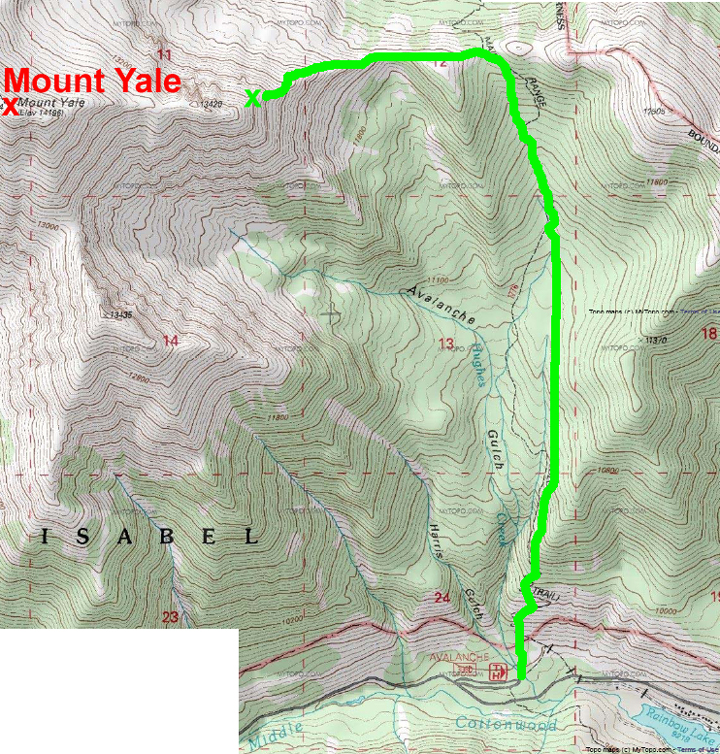
Our route up Mt. Yale's Avalaunche Gulch route

Our route up Mt. Yale's Avalanche Gulch route

I turned to retrace my steps and found that I couldn’t see the ground.  I could see my boots, but not the ground I was standing on.  The ground, the sky, the skyline…everything was white…I was floating in white air.  It was very disorienting to my sense of balance and direction to not be able to see anything for reference to my body.  And the real problem was that I was standing on a cornice.

On the ascent of the summit ridge, we were not able to stay on the ridge proper due to a cornice.  We skirted the ridge along the north side before mounting the cornice just below the steep portion of the ridge where I turned around.  And I couldn’t venture more than a foot to the south side as the angle steeped quickly and the hard-packed snow very slippery even with crampons on.   So now I had to walk along the edge of the cornice with my eyes closed!

I tried to stay toward the south side to avoid stepping too close and falling over the edge of the cornice on the north side.  But the only way I could tell if I was too far to the south side was by slipping down and self arresting.  So I tried to shift my balance carefully to avoid stepping on naught but thin air.  Twice I stepped through the cornice edge and barely caught myself with my axe.  After recovering from the initial fall, I just stood there and marveled at the absurdity of the situation.

It was a long retreat.  We couldn’t find our tracks due to the additional snowfall, but we recognized the terrain well enough to find our way back before dark.   We had taken 13 hours to climb and descend 7 miles (RT) & 3700 feet of elevation.  Some might call it pigheadedness, but we called it good exercise.

Joe catching a rest in the soft snow

Joe catching a rest in the soft snow

It was our first retreat on a 14er first attempt; I was sorry to see our record go by the boards.  But it would also be the only failure to summit on an intial 14er attempt…57 out of 58 ain’t bad.

See all trip reports
A Rainy Capitol

July 13, 2009

Capitol Peak had been highlighted on my list for some time.  I dreaded the “knife edge” but yet craved the chance to face my fears.  When my friend, Mark was coming back from Chicago for more high-altitude abuse, we decided on Capitol Peak outside of Aspen, CO to make it interesting (hard) and meaningful (tick off another 14er).  Our plan was to:

  1. Drive up Friday afternoon from Denver International Airport and make camp at Capital Lake,
  2. Get an early climbing start to beat potential weather for a Saturday summit,
  3. Spend a care-free night overlooking the Capitol Lake and Peak area, and
  4. Make an early march out to Mark’s plane for Chicago on Sunday afternoon.

What we didn’t plan on was the incredible stormy weather.

Story

On July 25, 2003, I left Boulder at 9:45am to pick up Mark at DIA.  Maneuvering through unusually heavy traffic, I managed to pickup Mark at 10:45am and we set off toward Snowmass immediately. The drive went quickly as we caught up on recent events, and we hit the Snowmass turnoff of CO-82 at approx. 2:45pm.  The road to the Capitol TH was direct, short and of good quality; and after a bit of packing we were hiking at 3:30pm.

Early in our approach...Mark posing in front of Capitol Peak

Early in our approach...Mark posing in front of Capitol Peak

We selected the longer, gentler cow path starting at the far end of the parking area , and reached Capitol Lake at 6pm.  Along the way, we had to hide from a moderate rainfall occurring between 4 and 5pm.  It was a sign of things to come.

The campsite on the knoll nearest to Capitol Lake looked the best and we set up camp on a mid-level spot overlooking the valley north of Capitol Lake.  In selecting a specific site, I couldn’t find an idea location.  I had to choose between a site with bad exposure to wind and lightning but good drainage, or a site with better shelter but a strong likelihood of pooling of water in the tent area. In a decision to be debated over the years, I elected to risk the pooling water vs. the lightning and wind.  To compensate, I spent an hour collecting and placing rocks to use as a vestibule platform and to keep the edges of the waterproof flooring off the ground.  With my enhancements, I figured I could survive a puddle as deep as 2 inches.

Our first close-up view of Capitol, as seen from near our campsite

Our first close-up view of Capitol, as seen from near our campsite

We had plenty of daylight for water bottle filling, dinner preparation and card playing before turning in for an attempt at sleep.  It was one of those silent nights where every rubbing of nylon over nylon roared in the ears. We spent most of the night listening to each other’s noises, with rare, unknown moments of unconsciousness.  But time is relentless, and the alarm went off as planned at 5am.  We rose and made ready for our climb.  Another bottle filling exercise and other duties later, we were hiking up the Daley Pass at 6am.

Our ascent route for Capitol Peak

Our ascent route for Capitol Peak

The general plan was to follow the obvious north-south (as the compass reads) ridgeline of Capitol Peak that you see from the Capitol Lake in four phases (some details added based on my own experience):

  1. Hike up the grassy slope directly east of Capitol Lake, turn right, and within a 100 yards descend a rocky gully to reach the low angle terrain below the cliffs on Capitol Peaks ridgeline on the east side of Capitol Peak
  2. Make a right turn and take a direct line south-ish toward a notch in an east-west ridge connecting Clark’s Peak and K2 … aim generally for the right side of the notch and the snowfield below it.  When K2 comes into view on the right (if you are not sure, keep going…when you see K2 you will be sure of it), head directly towards it.  Summit K2 either by circling left just below the summit and then climbing up or by going directly up to the summit.
  3. Take care but move quickly through the knife-edge area.  The rock is excellent on the hardest looking sections; simply straddle the rock to eliminate any chance of falling.  Use the good footholds.  Take care in the easier-looking sections, as obvious rock holds are often loose.  Trust nothing; test all holds before weighting them.  Follow the cairns to the east below the ridgeline.
  4. Work up and generally left through the grit-covered ledges.  Step carefully and do not push off with your toes when climbing through the loose rocks as it will cause rocks to fall on climbers below you.  When possible, get to the rocky edge (left side of face) of the east face below the main ridgeline and climb the bulging rocks (test every one you use).  This ridge will curve back toward the main ridge; once at the main ridge of Capitol Peak, head left (south) for 100 feet to the summit area.
  5. The descent back to the knife-edge is the hardest part; take care to test all holds and step on solid ground.  Return the ascent path; look for cairns lower than you may remember to stay on the correct path.
Capitol Peak elements

Capitol Peak elements

The route was fairly clear, from the plan gathered from multiple sources.  From the top of Daley Pass, we followed cairns and footprints in the snowfields down toward the valley floor.  We stopped descending at about 100 feet of elevation above the valley floor, and headed south toward the obvious notch at the backend of the valley.  There was more snow than expected, but the conditions were excellent for foot travel; the snow was soft enough for secure steps, but firm enough to support our weight.  Once we could see K2, we made a hard right and began a gradual ascent toward it.  We summitted K2 by angling to the left (as you approach K2) and then ascending to the summit from that side; the route was obvious, but loose.  I believe climbing straight on to the summit would be the easiest and safest.

A view from K2...my route noted in red

A view from K2...my route noted in red

We took a break on the summit of K2 and took in Capitol’s features; the view of the ridge to the summit was very impressive.  It was also intimidating;  Mark felt it was too difficult for a Flatlander and announced his intention to wait on K2 while I completed our plan.

Respecting his wishes, I continued, working my way down from the K2 summit via the only way I could find:  a hard class 4 move down the North face.  This difficult move turned out to be unnecessary, as I later found a much easier route via a ridge a bit further toward the right edge of the north face.  The knife-edge was a unique and pleasing climbing experience, but did not have the exposure I had expected.  I had “knife-edge” on the brain.  Still, it was exposed enough that I used a straddling position with my weight on my hands to move quickly through this section.

The next section was the worst.  I’ve heard it called “ledge madness” and “loose, awful climbing” and it is all of that and more.  Rocks falling from other climbers, loose rocks, and pebbles on small ledges made for many minutes of intense concentration.  I found that working up and left and then staying left as long as possible made the ascent the least dreadful.  When it was necessary, I moved right back toward the Capitol ridgeline.  Once at the ridge, I moved south (left) approximately 100 feet to the summit.

I reached the summit at 10am.

A view of Snowmass from Capitol

A view of Snowmass from Capitol

From the Capitol Peak summit, the view of Snowmass was spectacular.  I noted the melt-out of the massive snowfield I had glissaded a few years before.  I also took note of the cool view of our campsite…this is an incredible place.

I signed the register after a quick snack and headed back down to meet Mark on K2.

Our campsite seen from Capitol summit

Our campsite seen from Capitol summit

The descent through ledge madness and loose, awful rocks was worse on the way down.  Controlling rock fall and avoiding a personal fall on this loose junk was taxing on my mental stamina.  Getting to the knife-edge was a relief; I was tired of the stress.

Mark and I returned via our approach route and reached camp at 2pm.  Due to the worsening weather, we briefly discussed changing our plan to hike out immediately.  I successfully argued that a night spent outdoors would be far better than any other alternative.  We filled our water bottles and crawled in the tent for a quick nap.

I awoke from my post summit nap at 6ish to find it storming; Mark told me it started at 3pm.  The lightning was amazing and we were glad to have a sheltered campsite.  The tent and ground were holding up well to the rainfall so far, but we hoped the flow would stop soon.  About 8pm, the storm abated and we were able to exit the tent to make some dinner.  The sky did not look good, so we hurriedly finished and repacked the food and gear so we could eat undercover if it became necessary.  It did.  The rain and lightning resumed and lasted until 10:30pm.

Mark getting a headstart on his nap at camp

Mark getting a headstart on his nap at camp

Me and my big mouth; we should have gone home.  Or, if I had been warned by God, I would have built an ark. Approximately 7 hours of rain had overwhelmed the soil and created a wading pool upon which our tent sat.  My tent and my preparations were overwhelmed, and we floated the last few hours before rising at 4am to pack up.   On the good side, the continuing noisy weather drowned out Mark’s noises and I slept well for a soggy 5 hours.

We moved slowly and carefully around our mud hole campsite, and took an hour to get ready.  The miserable long hike out was punctuated by the massive trail damage and fecal matter from the herd of black cattle roaming Capitol Creek.  We reached the car, changed clothes and repacked in time to meet our deadline of  “driving by 8am.”

Several hours later, I dropped Mark off at DIA for his long stinky flight home.  I arrived at my home at 2pm to enjoy a few final hours of weekend that started with laying out all my gear in the sun to dry out.

It was a great trip.

See all Trip Reports

Flying Blind: Wetterhorn & Uncompahgre

April 25, 2009
Me and Isabella @ 4 years old

Me and Isabella @ 4 years old

I was going to be a dad.

My wife and I were going to have our first child, a girl whom we would name Isabella.   It was going to be the most exciting day of our lives.  But the big event was 5 days away; surely I had time to bag some Colorado 14ers beforehand.

Yet, having time and having consensus for such an adventure were two very different things.  I carefully worked out and then very carefully delivered my thinking to my wife.  I argued that it would be far, far better that I go adventuring right before rather than right after our first child is born. Right?  The Assumptive Close (changing the question about going from whether to when) was a long shot, but it was all I had.

She agreed! My wife is a very understanding and generous person. I always take credit for picking her.

With a family consensus in hand,  I made plans to leave for Lake City on July 26, 2002 to collect Wetterhorn and Uncompahgre, and possibly also San Luis.  These were three of the few unclimbed 14ers on my list of 58 Colorado peaks over fourteen thousand feet. And with the rest of the world having better things to do than climb 14ers on the far side of the state, I would go alone.

By the morning of, I had everything ready except my navigational planning.  I still didn’t have confirmation on the current information for the drive to the trailhead or the approach hike from the Matterhorn Creek trailhead.  And in the few remaining hours prior to departure, I stupidly wasted my time on unimportant and unrelated tasks, forcing me to leave unprepared and behind schedule.  Reduced to relying on the guidebooks printed years ago, I grabbed my Dawson and my Roach books and headed out into rush hour traffic; my punishment would be the trauma of  being “lost and flying blind” in the Heart of Darkness.

“Flying Blind” is an aviation term that describes a navigation scenario where the pilot/navigator cannot see the ground and must navigate by instrument alone to find a place to land before the fuel runs out (and the aircraft crashes into the ground).   When through error or mishap the aviator becomes “lost and flying blind,” he rides a ticking time-bomb while desperately gathering information to save himself.

As expected, I arrived in Lake City after dark:  no one to ask for directions and nothing to see but roadsigns.  Heck, I didn’t even have a map, just the guidebook directions that were printed years before. And yet, it might have even worked, but I was in too much of a hurry to stop for 5 minutes and read the dang directions carefully.

My simul-drive-read concluded with a simple set of instructions for me to follow:  drive into Lake City via CO-149 and turn right at the sign for Engineer Pass that I’d find near the middle of town, and then take that road to a junction near Capital City to find a sign for Matterhorn Creek.  It wouldn’t be hard, but flying blind, without any normal visual clues or basic spatial orientation, I could not afford to lose my way.  I might not find it again in time.

I had been to Lake City before, so that wasn’t hard.  Then I found the sign for Engineer Pass and made that turn; so far so good.  After 2 blocks the road ended in a T-junction with a sign that said, “Alpine Loop — 18 miles.”  Crap.  I looked down the road each way, but couldn’t see anything in the pitch dark.  I turned around and went back to the main drag to see if I could find additional clues.  Nothing. I was screwed; 5.5 hours invested (and just as much to get home) and my narrow time window quickly closing.  I couldn’t believe I had let myself get into this situation.  So stupid.

Full of dread, I went back to the T-junction and guessed left.  I followed the Alpine Loop that I feared would take me on a tour of the utterly dark mountains and deposit me back in Lake City after an hour of anxious self-loathing, and leave me with nothing to do but go home empty handed.

Now I was lost and flying blind.

It is a battle between confidence and fear.  Confidence of success desperately hangs on while pulled down by the weight of the rapidly growing fear of failure.  The driver, lost and flying blind must go on and on as long as possible, afraid to turn around because the goal might be just ahead, but afraid of being wrong and losing irreplaceable time. Desperately seeking a clear confirming clue, the driver continues until exhausting his reservoir of hope.  With his confidence broken, the driver turns around without knowing if he is actually lost. And, in the worst case, the driver returns to search for additional information, only to find that he was almost at his destination, and now does not have enough time.

A mistake of this magnitude could ruin the trip (if not a life!), and such a terrible conclusion is worthy of great fear.

Desperate to figure out where I was in the pitch dark, my solution was to go faster.  Driving at top speed with my nose in the guidebooks; I looked up periodically to stay on the road while trying to find some information in the books about the “Alpine Loop” or some clue that would confirm I was on the right road.  Heck, I’d have been delighted with indisputable evidence that I was on the wrong road.  The uncertainty was killing me.

Eventually I read that the Nellie Creek trailhead was found off the road I hoped I was on. It was only supposed to be 5 miles up the road, but when I didn’t find it (started looking too late) or any other indication of where I was, I lost hope.  I turned around.  I figured I should get back to Lake City before I forgot how.

When I got back to Lake City, I looked again for any road signs that I missed in the darkness; but found nothing.  It was time to go home; but before spending another 5.5 hours on that long, lonely drive, I thought I’d invest 5 minutes in careful, non-driving study of the directions.  I pulled over and started reading carefully; it took only one minute to find my mistake.  I was on the right road the whole time and must have been within minutes of finding the sign to Matterhorn Creek.

So, I went back up the road to Capitol City (noticing the Nellie Creek trailhead along the way), and then turned right onto North Henson Creek Road to head up to Matterhorn Creek trailhead. The road roughened significantly at this point, but still wasn’t too bad for a 4×4. After a couple miles, I entered a full parking area for the trailhead at 10,400 feet. I continued up the “four wheel drive road” for another 300 feet to reach the high parking lot below the Forest Service Gate at 10,720 feet. I continued up, taking the right fork at the end of the camping area, to an empty parking lot next to the trailhead register. I made it. It was 11pm; the drive to Lake City was 280 miles long and had taken 5.5 hours (51 miles per hour), while the drive from Lake City to the trailhead was an additional 12 miles in 2 hours.  I was so happy to still be in the game that I wasn’t even mad.

I set up camp quickly and spent the early morning studying the guidebooks. The weather had been rainy lately and was forecast to thunder in the afternoon; I would need to move quickly and without additional mistakes.  And to minimize the chance of weather interruption, I planned to start hiking at 5am.  Starting even earlier was a problem because I needed to be able to see well enough to find a switchback leaving the main trail less than 1 miles into the hike.

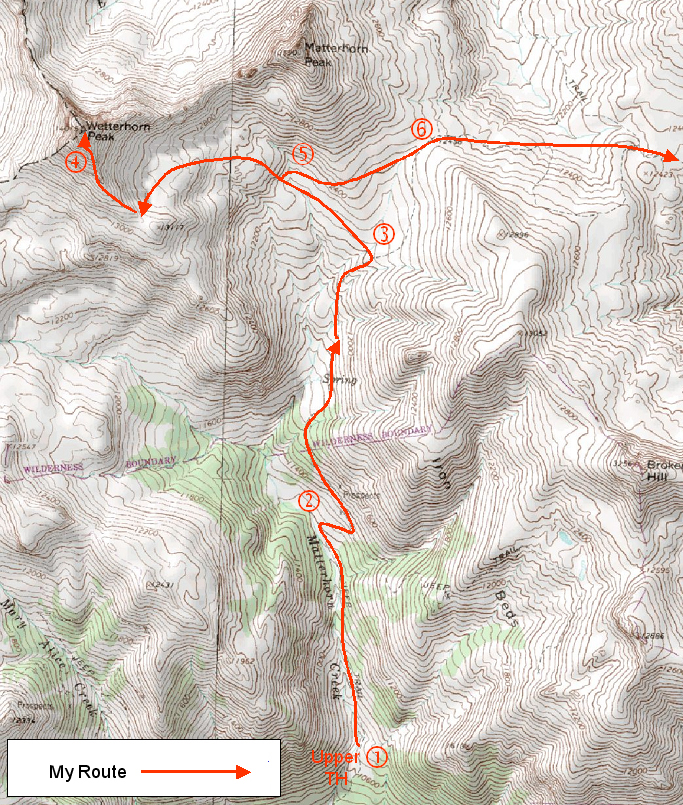
My route from the Matterhorn Creek trailhead to Wetterhorn Peak

My route from the Matterhorn Creek trailhead to Wetterhorn Peak

My guidebook study resulted in a plan what would start with five sections:

  1. Wake up and leave camp
  2. Find the place to leave the main trail and switchback up to a higher trail
  3. Find the cut-off point to leave the main trail and head toward Wetterhorn’s southeast ridge
  4. Ascend the tricky steep finish to reach the Wetterhorn summit; decide if a traverse to the Matterhorn summit was a good idea (it wasn’t)
  5. Return to the main trail heading toward Uncompahgre
  6. With a close up view of the peak, decide which route to take to the summit of Uncompahgre

The alarm went off at 4:30am. I packed my gear, my copy of Roach’s 14er book, and put on my trusty old Makalus that I had resoled after several futile attempts to break in my new Eigers. I had not seen any tents the night before and was worried that somehow I was camping in an illegal spot, so I decided to pack up the tent before leaving. This and other distractions cost me an extra 30 minutes.  I began hiking at 5:30am; yet, I was the first on the trail, somehow.  And with a near full moon, I could see the sky was already threatening.

About the time I started worrying about having missed the “switchback” I found it. Basically, the main trail is blocked off.  The only way to proceed is to follow the switchback. I continued up the trail, slowly gaining ground on the mountains until I could see the Matterhorn Peak in the early light; oh, what a misuse of a great name.

I was tempted to follow Roaches advice regarding the Wetterhorn / Uncompahgre combination, and do Uncompahgre first. But since the weather was threatening, and the most difficult climbing was on Wetterhorn, I decided to reverse that order.

Roach says to “leave the main trail at 12,040 feet”…a rather precise instruction to use with an altimeter that is never more reliable than +/- 200 feet (a variance of approximately 1/2 mile along this hiking trail). Without some sort of landmark. I tried to get my bearings by looking to the Wetterhorn Peak and its Southeast Ridge but couldn’t see much from beneath the ridge. I decided to  mimic the route drawn on the map by veering 45 degrees left (northwest) toward the saddle between Matterhorn and Wetterhorn peaks once the main trail turned toward Uncompahgre.  Of course, knowing when the trail makes a permanent turn in direction vs. just a temporary one isn’t easy.  But it was a plan.

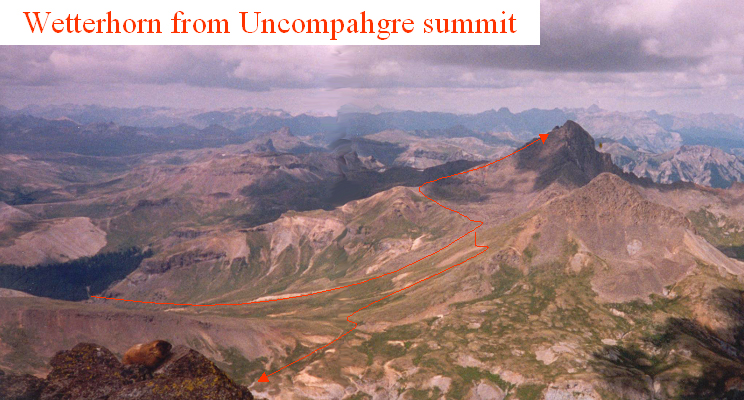
A view of Wetterhorn and my early-day route, seen from the summit of Uncompahgre

A view of Wetterhorn and my early-day route, seen from the summit of Uncompahgre. The marmot in the lower left is waiting for me to leave my food unattended.

I had a moderate amount of altitude loss and wandering.  After proceeding northeast approx. 0.25 miles, I found a well-beaten trail which I would follow up to the southeast ridge.  Looking down, I noticed a single set of fresh footprints in the mud.  I was surprised because I hadn’t seen or heard anyone on the trail. I wondered if the climber was from the bivy site I passed on a grassy slope below. I looked up toward the ridge to look for him/her when movement on the summit caught my eye – a climber! This person had summited before 7am; that’s commitment.

I had made good time (1,500 feet per hour) so far and wanted to manage my energy level. In my life-long battle to bring-enough-but-not-too-much-water, I had decided to bring four liters (I can hear Brian groaning at this admission). I just didn’t know for certain that I’d be able to find any and I had a long day of hiking. To avoid dragging nearly 10 lbs of water up Wetterhorn, I decided I would stash two liters down low.  All I had to do was remember to reclaim it.

The Middle Notch

The Middle Notch

I continued up to the saddle between Point 13,117 and Wetterhorn and then up the southeast ridge. The hiking included a significant amount of scrambling, but all easily within 2nd class difficulty. Numerous cairns revealed numerous paths; I took the path closest to the ridge and passed underneath and left of the initial towers and eventually reached a flat area to the right and beneath the peak of the “Ships Prow” tower.

From this point I could see 3 notches, which didn’t match the descriptions of my guidebooks (they mentioned either one or two notches). Fortunately, the middle notch (see photo) had a big cairn near it, so I climbed it first and found the impressive finish to the climb.

The last 100 foot stretch was very impressive:  steep and airy. In slippery conditions, I could see it would be troublesome.

And the sky looked like rain.

The final stretch beneath low clouds

The final stretch beneath low clouds

I traversed the down angle ledge to the east for 15 feet to reach the bottom of the finish. I paused to test holds a couple times, but the handholds were good enough to catch my weight if a foothold broke. I reached the tiny summit at 8am.

I looked down the ridge toward Matterhorn to see if I might bag it as well, but the ridge looked loose and steep. After a moment, I retreated back to the summit having silently agreed to leave the Matterhorn for another day. As I looked for a comfy rock to sit on, a cloud rolled over the summit obscuring my vision.

I wanted to see the footholds as I down climbed; so I descended as soon as visibility returned. Naturally, the down climb was harder than the climb up; but I only needed a few  “face-the-rock” moves to make it back to the ledge, and then the Middle Notch.

After a quick break below the “Ships Prow”, I was ready to start back down the southeast ridge. That is when I realized that I hadn’t again seen the person whom I had spied on the summit at 7am…hmmmmm. Where did he/she go? Perhaps I should name my trip report, “The Ghost of Wetterhorn”?

The descent went quickly. Once reaching the saddle with Point 13,117 on the southeast ridge, I turned left (north) off the ridge and headed toward Matterhorn. I backtracked my original route and discovered that the trail I had used earlier in the morning was a good traversing route between Wetterhorn and Uncompahgre; I didn’t lose any altitude and was able to take a nearly straight shot west to the saddle between the two 14ers at 12,380 feet. Oh, and I collected my stashed water.

Once I connected with the main trail, I followed it over to where I could see Uncompahgre where I began to consider how to climb it.

My early morning study revealed three basic options:

  1. Go the long way around to the using the Southwest Slopes route which connects with the East Slope route taking approximately 2 extra miles than the shortest route
  2. Take the shortest path, 2000 feet directly up the West Face (steep scree slope) to join the East Slope route near the summit
  3. Take a compromise path that Roach calls V1 of the Southwest slopes route, which takes a mile off the long approach and only goes up 1,000 feet of rock to the ridge line.
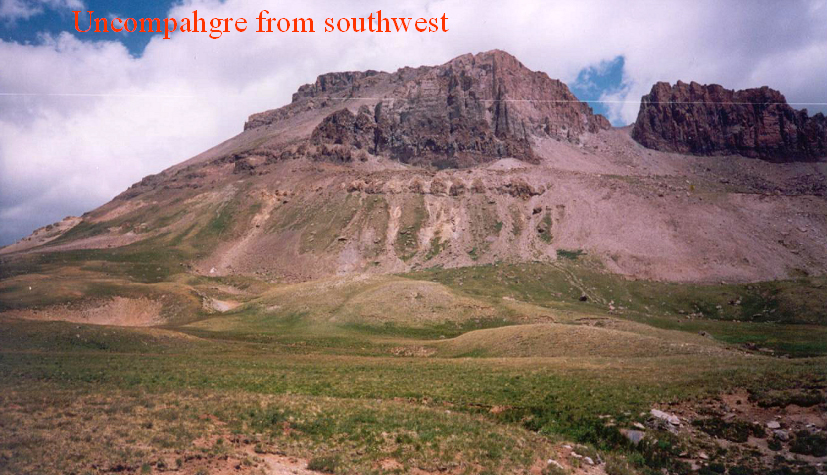
A view of Uncompahgre from the south, while hiking around to the east

A view of Uncompahgre from the south, while hiking around to the east

I was in a hurry to beat the weather, but I wasn’t willing to churn up the scree and cause significant erosion; I took the third option.

I left the main trail and did a bit wandering to find the start of the V1 route. It looked a bit looser than I expected, but only the first 400 feet were very steep and loose.  The rest of the route was straightforward, and I reached the ridgeline (13,260 ft) at 10:45.

The view from the ridge was impressive (see photo). A massive cliff band stood before me guarding the large, flat summit area.

My initial reaction was…”wow!…do I get to climb that cliff?”

The forbidding cliffband protecting the Uncompahgre summit

The forbidding cliffband protecting the Uncompahgre summit

But it wasn’t to be so.  The trail angled up to the south corner of the broad summit where it turned the corner and reached the south face. The trail switch backed and scrambled to the summit area, then traversed north and, finally, headed to the western edge. I reached the summit at 11:30am.

The wind was hard and cold; I was only able to remain on the summit at all by wearing my jacket, balaclava, and gloves. I enjoyed most of the rest of my dwindling water supply and a couple Balance Bars while examining my route up Wetterhorn.  I also enjoyed the views of Sunlight, Redcloud, and Handies which I had climbed a few weeks earlier (see trip report).

After a fast, enjoyable 20 minutes on top, it was time to get down.

I had climbed 5800′ and was running out of steam.  I was sorely tempted to go down the West Face route to shave some effort.  But with the weather cooperating, I still couldn’t justify the trail erosion.

I resolved to return using the trail I had ascended.

Once back down to the Matterhorn Creek trail, I took a short break near a creek to clear my boots of gravel and replenish my water supply.  I also needed another rest.

The weather was still holding; but to be prudent, I kept up a good downhill pace to reach treeline. I reached camp by 2:30pm despite another brief rest below treeline.

I was tempted to stay another day to collect San Luis Peak since I was so close to it, but I felt anxious to get home. Better late than never, my wife was probably thinking when I explained my early return.

It would take me 4 years to return to collect San Luis.

Despite a rough start, I got my 14ers:  approximately 15 miles and 5,800 feet of elevation gain in 8 hours.

My route map for summiting Wetterhorn and Uncompahgre

My route map for summiting Wetterhorn and Uncompahgre

The day included 10 sections:

  1. Wake up and leave camp
  2. Find the place to leave the main trail and switchback up to a higher trail
  3. Find the cut-off point to leave the main trail and head toward Wetterhorn’s southeast ridge
  4. Ascend the tricky steep finish to reach the Wetterhorn summit; decide if a traverse to the Matterhorn summit was a good idea (it wasn’t)
  5. Return to the main trail heading toward Uncompahgre
  6. With a close up view of the peak, decide which route to take to the summit of Uncompahgre
  7. Find the start to the V1 route to join the East Slopes finish on Uncompahgre
  8. Complete the ascent of Uncompahgre
  9. Enjoy the summit of the 6th highest mountain in Colorado and the  highest on Colorado’s Western Slope
  10. Go home and be a good husband and father
My observation of mountain name appropriateness

My observation of mountain name appropriateness

Six and one-half hours and three liters of Diet Coke (for caffeine) later, I was home. It was a great trip designed to scratch my 14er itch, but it didn’t work; two weeks later I used my in-laws visit to excuse another trip to collect Castle and Conundrum.  But, don’t worry; I would get my “just desserts.”

The Castle-Conundrum trip would be my last for a while as another “lost and flying blind” scenario conspired with errors in judgment to give me an injury.  It was time to start being a better husband, and to get serious about this father thing.

See all trip reports
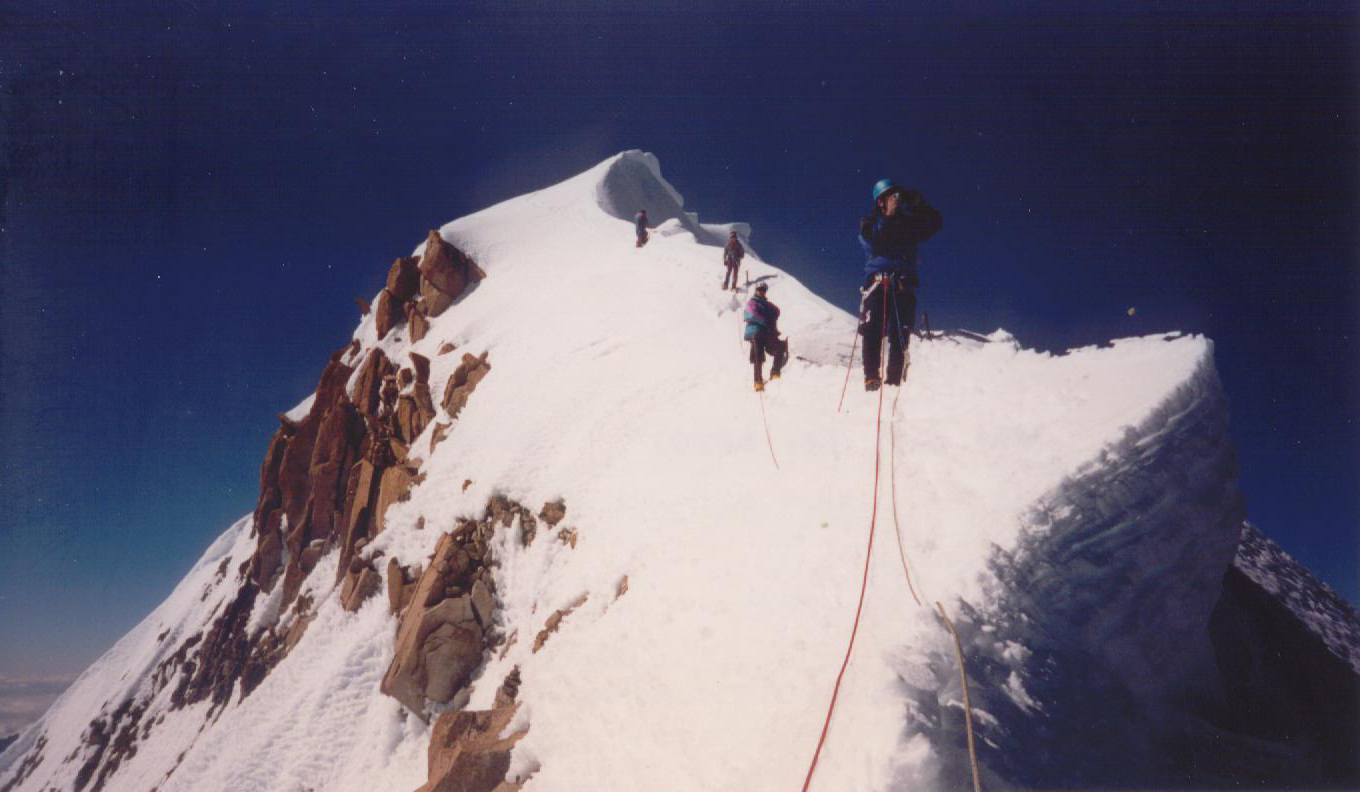
See blog introduction, rules, laws, etc.

The “Casual” Route?

March 31, 2009

The Diamond.

The East Face of Rocky Mountain National Park’s Longs Peak is the greatest alpine climbing wall in the Universe.   Sure, it’s just my opinion, but read on and judge for yourself.


The Diamond of Longs Peak

The Diamond of Longs Peak (photo taken 7/1/94)


When I started rock climbing some years ago, the Diamond was a place of legend:  only the climbing Greats dared challenge the gods with an attempt on the Diamond.

It requires nearly 1,000 feet of high-altitude technical rock climbing in a lightning-filled environment over wet, cold, vertical rock that cannot even begin until completing an approach of nearly 7 miles and well over 3,000′ of elevation gain.   And the easiest route up the face requires the skill and stamina to complete two pitches of 5.9-5.10a, three pitches of 5.8, and three pitches of 5.5-5.7 at nearly 14,000′ elevation.

Adding insult to this impossible dream, the easiest route is called, “The Casual Route, ” in honor of Charlie Fowler’s description of his free solo (no rope, no protection) climb of the route in 1978…he said it was “casual” in the sense of…

…not difficult, child’s play, a cinch, easily done, effortless, inconsiderable, no problem, no sweat, no trouble, nothing to it, a picnic, a piece of cake, straightforward, and undemanding.

Uh huh.  Thanks for your opinion, Mr. Fowler.  I guess that’s one for and one against, as far as voting goes.

Back in the old days, my Midwest climbing friends and I didn’t dare admit having such ambitions; we would only talk about how amazing and crazy some climbers were, and we’d keep our true feelings of envy and aspiration to ourselves. But, over the years, as I grew into a better climber and a mountaineer, I dared imagine that I, too, could climb the Diamond. Someday.

This trip report is about the effort my buddy, Brian, and I made in an effort to climb The Diamond.

Story

Having brought ourselves to thinking that we could really do it, Brian and I decided that we’d use the Spring & Summer of 1998 to prepare our skills,  fitness and confidence for a late Summer attempt.  During the 4 month preparation, we completed the following alpine snow & rock climbs to ready ourselves physically, intellectually, & emotionally:

  1. Squaretop Mountain; snowclimb (4/98)
  2. Mt Belford; snowclimb  (4/98)
  3. Mt. Princeton; snowclimb  (5/98)
  4. Mt. Harvard; snowclimb  (5/98)
  5. Mt. Tauberguache; snowclimb  (5/98)
  6. Mt. of the Holy Cross; snowclimb  (6/98)
  7. Longs Peak via Kieners; snow and rock scramble (7/98)
  8. The Saber in RMNP; 11 pitches up to 5.9 (7/98)
  9. Jackson-Johnson on Hallets Peak; 9 pitches up to 5.9 (7/98)
  10. The Love Route on Hallets Peak; 8 pitches up to 5.9 (8/98)

We had prepared very hard and felt ready to proceed.  When the weatherman predicted good weather, we set the date:  August 8, 1998.

The overall plan was:

  1. Hike in the day before to save energy for the climbing day
  2. Camp in the Boulderfield (to avoid a free solo of the 4th class plus, 320′ plus North Chimney)
  3. Descend to Broadway Ledge via the Chasm View rappels (3 150′ rappels in the pitch black darkness)
  4. Traverse the snowy ledge to the Casual Route start, skirting the opening of the North Chimney
  5. Climb the Casual Route (7 pitches plus traversing finish)
  6. If unsuccessful, escape via many rappels down the Diamond’s face, and then ascend the Camel Route to reach our campsite
  7. If successful, traverse the Table Ledge to finish the climb via Kiener’s Route
  8. Traverse to the North Face Cable Route and rappel back to Chasm View
  9. Hike back to the Boulderfield to pack up and head home

Before it was over, we’d be sleep-deprived, starved, dehydrated, exhausted, rained and hailed on, surprised, horrified, and delighted.


Brian next to his tent in the Longs Peak Boulderfield

Brian enjoying a moment of rest in the Longs Peak Boulderfield


The Hike into Camp

We started hiking in toward the Boulderfield at 9am.  We had all day to cover the distance, so we took our time.  We arrived at the Boulderfield and setup camp; and we still had hours to kill.

We wandered up to Chasm View to take in the sights, snap a few photos, and prepare ourselves to find the rappel anchors in the dark a few hours hence. All was proceeding well until we noticed the clouds building.


Joe posing with the Diamond looming in the background

Joe posing with the Diamond looming in the background


The weatherman was wrong.

One of the key problems in climbing the Diamond is the weather.  It is east facing, so any approaching weather cannot be seen until it is overhead; and with escape only possible via multiple rappels requiring one or more hours to perform, we’d have to move very fast to have any chance.  And we’d have to be lucky.

The Approach to the Climb

We arose in the dark and started for Chasm View at 4:15am.  Using headlamps, we wandered among the refrigerator-sized boulders, orienting ourselves using the faint outline of Longs against the dark sky.

Reaching the Chasm View area, our previous day efforts paid off with the quick acquisition of the Chasm View rappel anchors.  We unpacked the harnesses and the rope and made ready for a descent into a pit of darkness.

I took the first rappel.  The light from my headlamp illuminated the canyon walls, but couldn’t reach to the bottom. It was a creepy feeling to rappel into an abyss, but my lack of sleep muted any strong emotional response.


A view of the Chasm View rappel area from the start of the Casual Route; 3 150 foot rappels to descend to Broadway Ledge.

A view of the Chasm View rappel area from the start of the Casual Route; three 150 foot rappels to descend to Broadway Ledge.


My only job besides not dying was to find the next set of rappel anchors.  I only had one chance to find them as we couldn’t go back up without losing the day.

But the day started well; I found the anchor. I clipped into the bolts and then unclipped from the rope. I called out for Brian to come on down by yelling, “Off rappel!”  Brian stepped over the edge carrying our gear pack, rappelled down and clipped in next to me.  After he unclipped from the rope, I started pulling the rope down from the initial rappel anchor while he threaded it through the 2nd anchor. As we neared the end of the process, his headlamp died.

I couldn’t believe it.  After 4 months of planning, he didn’t replace the 50 cent batteries. Fortunately, it wasn’t really a big deal.  I would just have to find the next two anchors.  Although, it was possible that we’d have to wait a few minutes at the bottom of the raps for the sky to brighten enough for Brian to accomplish the traverse to the start of the climb without falling off Broadway Ledge.

I finished getting ready for the next rappel while Brian put the dead headlamp away in our gear pack.  I heard him say, “Shit!”  With some reluctance, he explained that when he unzipped the backpack, one of his rock climbing shoes fell out and disappeared into the darkness.  Now that was a big deal.  No shoe, no climb.

If the shoe fell below Broadway Ledge, all the way down to Mills Glacier, it would take us too long to recover it even if we could find it.  We’d lose the day. Brian says, “Sorry.”  I replied, “Maybe we’ll get lucky; maybe it stopped at Broadway Ledge.”  In one part of my mind, I was mad; all this effort wasted.  In another part of my mind, I was relieved that we would be going home alive.

But we had to try to find it, so we continued down into the black pit.

At the bottom of the 2nd rappel, there it was.  Brian’s shoe had stopped on a small ledge. The climb was on.

We completed the 3rd rappel and then started the traverse immediately.  The daylight had begun, and we could see without the headlamps.  And we could see that the sky was already threatening.  Top of the North Chimney was a loose, snowy, narrow, sloping trap.  We decided to do a belay while skirting the rim of the North Chimney and then found “The Ramp” about 20 feet further.  At the top of that large sloping ledge, we started the climb with the knowledge that we had to go fast.

The Climb


Joe on top of the D1 pillar, about to start the 5.9 crack of Pitch 2

Joe on top of the D1 pillar, about to start the 5.9 crack of Pitch 2


Pitch 1: Brian gave me the pack and took the first lead up a left-facing corner, and then up and left to a ledge. I followed without incident. We were delighted to see that the weather was clearing. (5.5)

Pitch 2: I took the second lead up a short easy section to the top of a pillar, and then up a tough crack to a belay stance near the start of the traverse.  My primary concern was to find the correct traverse starting point.  The correct traverse is a protectable 5.7 while the improper one is poorly protected 5.10c.  I found it right at a spot with a nice stance. Brian followed quickly behind. (5.9)

Pitch 3: Brian took the traverse.  While technically not difficult, crawling sideways is always harder than climbing up. I found it hard to find the best route over the flakes and small ledges, negotiating past wet rock, and trying to keep the gear pack from pulling me off-balance.  We belayed beneath a squeeze chimney. (5.7)


A view straight up of Brian leading the 5th pitch

A view straight up of Brian leading the 5th pitch


Pitch 4: I led the fourth pitch up a short, challenging squeeze chimney, and then up and slightly left on easier terrain to the end of “The Ramp2.”  I made sure to continue past the initial piton to give Brian enough rope for a long 5th pitch. Brian followed without incident. The weather started worsening. (5.8)

Pitch 5: Brian then led up a long dihedral and belayed at a grassy ledge.  I followed in light rain & hail.  By the time I reached the belay, the rain & hail had stopped.  We didn’t even discuss bailing. (5.9)

Pitch 6: I took a short lead to the Yellow Wall Bivy Ledge, which was a magnificent ledge for such a vertical environment.  I could see how it would be possible to sleep on the ledge quite comfortably.  Once Brian arrived, it started to hail and rain again, but this time a bit harder.  And then it stopped again.  Still no lightning, so we didn’t speak of retreating.  We took a short break to give the wind some time to dry out the technical crux of the route.

Pitch 7: The crux pitch.  If we could get up this last pitch, we would make it. But failure was still within our grasp:  if the rock got too wet or if lightning started, we’d fail and bail.  Brian took this lead and moved very quickly.  After a short time, the slack in the rope started being pulled up.  After 3 quick rope tugs, it was my turn to make it past the several hardest moves of the climb. As I started climbing, the rain & hail started again.  I continued up through the wet, narrow inset, and then started up the squeeze chimney.  I struggled to get through the chimney with the pack on; when I finally got past it, I was completely exhausted.  I took off the pack and passed it up to Brian, then I steeled myself to move past the bulge blocking my path to Table Ledge. Then it was over.

We had made it.  I needed a short break, despite the threatening weather; but we couldn’t fail now.  We had finished the Casual Route, but we still needed to escape the face and the mountain.

The Escape


Joe sitting on the far end of Table Ledge, preparing to belay Brian to complete our escape from the East Face of Longs Peak

Joe sitting on the far end of Table Ledge, preparing to belay Brian to complete our escape from the East Face of Longs Peak


We were sitting on the Table Ledge which we needed to traverse left to link up with the Kieners Route.  But the ledge had a break in it, so we had to do a descending and then ascending traverse to find our escape.  I started by traversing left past a piton, and then down and left about 25 feet to another ledge called Almost Table Ledge.  A wet downclimb is challenging in any case, but at nearly 14000 feet and after hours of climbing, it was very unnerving.  I carefully traversed left until I could climb up to the Table Ledge again and belayed off some fixed gear backed up by two cams.  Brian followed quickly, and then we continued left, walking along the ledge until we could move above the Diamond onto the north face.

As we stepped above the Diamond, we were shaken by thunder.  To minimize our exposure to the elements, we traversed directly to the Cables Route.  We were rained and hailed upon, but no close lightning strikes.

After a short hike, we rappelled down to Chasm View, where we had started the day many hours earlier.


The Diamond, with key locations and pitches referenced.  Note:  the photo is from a different trip.

The Diamond, with key locations and pitches referenced. Note: the photo is from a different trip.


The Return Home

It seemed that the entire Boulderfield camp ground was out watching our return.  I wanted to believe that it was admiration for a job well done, but there is no doubt it was pity.  We felt like and must have looked like the walking dead, as we walked back into camp.   One wonderful fellow walked


Joe eating the greatest meal of all time...using a nut tool as a replacement spoon

Joe eating the greatest meal of all time...using a nut tool as a replacement spoon


over to our bivy site with a steaming hot dinner, which we gratefully accepted since we had no food left at all.  I had only eaten 1,000 calories during the day, and Brian even less.  That Hawaiian Chicken dinner tasted better than any meal I ever had before or since, and it got us home.

Thanks, neighbor!

It had taken us 2 days to hike 15 miles and 4,000 feet of elevation gain, while climbing nearly 1,000 feet of 5th class terrain and descending 600 feet on rappel.

It was and continues to be a great feeling to  accomplish such a long held goal.

So what’s your vote?

See all Trip Reports

See all Longs Peak Massif Trip Reports

Brian’s Lucky Day: Longs via Kieners

March 27, 2009

Neither Brian or I had ever successfully completed the classic “Kiener’s Route” on Longs Peak (I had failed on an earlier effort in June of 1996). Making this effort all the more unavoidable, this route is also called, “The Mountaineers Route.” Ensnared by the gravity of such inspiration, the limits of our so called “free will” were all too apparent.

And while this adventure shared many attributes with many other adventures, this one would be characterized by the lucky breaks Brian used to survive the day. For that reason, I call our ascent of Longs Peak via Kieners Route on July 3rd, 1998, “Brian’s Lucky Day.”

Start

We started at 4:20am and hiked up the trail toward Chasm Lake beneath the North Face of Longs Peak. It was a beautiful clear night with millions of stars filling the black sky. We took a left at the Y-Junction (right goes to Boulderfield) and arrived at Chasm Lake at 7:30am.

A preview of our plan to summit Longs Peak via the Kiener's Route

A preview of our plan to summit Longs Peak via the Kiener's Route

(1) Chasm Lake

As we approached the lake’s dam, we were hoping the lake would still be frozen over so we could hike over instead of around it. Going around is a significant bother as there is no “shore”; it requires a scramble over talus. And worse, the southern shore (the direct line to Lamb’s Slide) is blocked by cliffs, so we’d have to take a big detour to our right, around the northern side of the lake. But no; the ice was melted through in the center. We had to go around.

As I moved across the talus, I lost sight of Brian. I assumed he found a path lower down the talus, closer to the lake. Once I was about ½ way around the lake, I was surprised for a moment to see Brian walking on the ice about 20-30 feet from shore. But my surprise didn’t last as Brian frequently likes to push it when it comes to walking on lake ice.

Then I noticed he was shiny. He looked wet!

(2) Brian’s Self Rescue

Brian noticed me looking at him, and he motioned for me to approach. I moved down to the lake to join him, and found that the ice did not reach back to shore. Brian asked me to extend a hiking pole to pull him as he jumped the gap from the ice to the shore. He made it without adding significantly to his moisture level, so I asked how he came to be dripping wet. He explained that he had fallen through the ice, but had managed to escape a watery grave by crawling back onto it. I guess the ice was thin enough that when he went through, it broke up all around him into small floes: small enough to not trap him; big enough for him to get on.

He hadn’t yelled for help or even let me know he was on the ice. I would never have found him. He was lucky to be able to save himself.

(3) Complete the trek to Lamb’s Slide

After a short break to let Brian pour water out of his boots and wring out his socks, we continued around the lake and then up to the foot of Lamb’s Slide.

(4) Climb Lamb’s Slide

We reached the bottom of Lamb Slide and stopped to put on crampons and get out the ice axes. Then, we turned left to head up towards the Loft and Mt Meeker. We climbed about 800′ of elevation and exited at the first place it looked possible onto snowy ledges. We would traverse these ledges to the right until we reached the Broadway ledge proper. Along this thin ledge, we knew we would encounter snow & ice and at least one exposed technical section.

And, Brian needed to drain his boots again so we took another short break.

(5) Traverse Broadway Ledges to Horsby Direct Dihedral

The first corner we reached was covered in snow; I think it was the dihedral used by the Hornsby Direct finish to Stettner’s Ledges route. Brian headed across to check the conditions, to see if we needed a belay. He was planting his axe and kicking steps until about half-way across, he hit rocks just under the snow. Unable to gain secure footing on the main path, and with a large bulge of rock above him partially blocking his way, he moved lower to find solid footing on some exposed rocks below

I yelled out that the rocks looked unstable, and that we should setup a belay. Brian said he thought it would be okay. Just as he stepped down and put his full weight on a large boulder, it rolled over and fell out from under him.  It careened down onto Lamb’s Slide, hundreds of feet below. In that instant, I knew he was a goner. I stared blankly and screamed “rock” as a warning to anyone below.

By pure chance, Brian dropped straight down and landed squarely on another boulder only a foot or so lower that stopped his rapid descent into the afterlife. Brian looked back at me and offered up a profound, “whoa.” He then took the last step to reach the far ledge. We paused for a moment to listen for voices, but heard nothing but our own hearts pounding in our ears.

No one had been hurt, and we wanted to keep it that way.  Brian set up a belay anchor, and then I threw his end of the rope to him so I could get a belay past the airy bulge.

(6) Complete Broadway Traverse

We continued the traverse past several loose, snowy slopes to reach the far side of the notch couloir.  The route directions in Rossiter’s “High Peaks” guide book indicated a start within the Notch, but once again (as in 1996 see my Kieners’ …er, Notch Route trip report) I could not spot a likely start.  We decided to stop beneath a broken rock face leading up toward some fins of rocks. This looked to be a way to get into the Kiener’s Route.

We stopped for a snack and to change gear. Brian took his boots off and poured out a combined pint of fluid.  I didn’t think to see if it was just water, or if he’d peed himself a short while earlier.

Sitting squarely in the center of the “East Face” of Longs Peak, I felt that I was in the best spot on the greatest Colorado mountain. The combination of spectacular views, modest danger of dying at the moment, and the thrill of expected excitement to come felt unmatched.

(7) Climb Kiener’s Route to the Summit of Longs Peak

The upper portion of the Kiener's Route

The upper portion of the Kiener's Route

Brian took the first lead up the broken rock and over a chockstone; it was low 5th class climbing. I took the second lead up a narrowing chimney (about 3 feet across) to its end, and then up a waterfall to a big, grassy ledge. This pitch was 4th to low 5th class, and was the end of the technical portion of the route.

To speed things up without completely throwing caution to the wind, we simul-climbed up the broad ledges at the margin of the face (above the Diamond) for about 500′.  Once the terrain became gully-like with good hand and footholds, we unroped.  From this point on, the climbing difficulty was never harder than 3rd class.

At the end of this section, we stood in front of a massive cliff that separated us from the summit. It was very imposing and looked impossible to overcome.  I remember that my heart sank the first time I stood on that spot and looked at the impassable obstacle until I remembered the escape used by my guide to finish a climb on The Diamond.

Brian and I headed up and right, toward the Diamond face, and looked for large blocky rocks on the right. We climbed over the blocks and around the corner on a ledge to mount the north face of Longs.

From here, it was a 10-minute, 2nd class hike to the summit.  We reached the summit at 2pm; naturally the weather was deteriorating.  In addition, the summit was covered by flies and gnats, so we got ready to leave quickly.

(8) Descend the Cables Route

Just as we rose to head toward the Cable Route raps, a cloud rolled in and obscured visibility beyond 50 feet. Fortunately, we were able to feel our way down, having made the descent a couple times before. In a short time, we completed the second rappel and were looking over the impressive “Chasm View” to admire our path.

The hike down from the Boulderfield was a long one, as always. But, in the end, we had suffered and persevered 14.5 hours to ascend approximately 4800 feet and accomplish a classic mountaineering goal. And Brian had a very lucky day.

Our "lucky day" route up and down Longs Peak. The "X's" mark the spots of Brian's found luck.

Our "lucky day" route up and down Longs Peak. The "X's" mark the spots of Brian's found luck.

Our route had 8 major sections

  1. Hike to Chasm Lake
  2. Traverse around lake and Brian’s self rescue
  3. Completion of traverse to foot of Lamb’s Slide
  4. Ascent of Lamb’s Slide to Broadway Ledges
  5. Traverse to top of Hornsby Direct dihedral and Brian’s second lucky break
  6. Completion of traverse to start of Kiener’s Route
  7. Ascent of Kiener’s Route to Longs Peak summit
  8. Descent of Cables Route to Chasm View and back to car

See all Trip Reports

A Mummy Range Weekend

March 21, 2009

I had a free weekend on July 10-11, 1999 and decided I’d go after the seven 13ers in the Mummy Range.  

I had recently hiked to Mummy Mountain, and from the summit had seen how close and accessible were Fairchild and Hagues.  I decided then that I would return to get them all in a day.  Reading Roach’s 1988 RMNP book for planning information, I learned that the Mummy Range included Ypsilon, Chiquita and Chapin as well.  I figured I could get them all in 2 days:  

  1. Starting from the Lawn Lake trailhead (8530′), use the Lawn Lake trail to reach Lawn Lake (10900′), and then climb the cirque bagging in order, Fairchild (13502′), Hagues (13560′), Rowe Peak (13,400′), Rowe Mtn (13184′) & Mummy (13425′).
  2. Start further up Old Fall River Road at the Chapin Pass trailhead (11020′) and use Chapin Creek Trail to get access to the west side of the Mummy Range to bag in order, Chapin (12454′), Chiquita (13069′) & Ypsilon (13514′).

Day 1

It was going to be a long day.  I was going to hike 21 miles and 6,800 feet of elevation gain, if my body and the weather held out.  I decided to gamble a bit on the weather and water availability to reduce weight; I only packed a rain jacket, two 1-liter bottles of water, and iodine pills.  The  “plan” was for the rain and related cold wind to stay away, and for me to be able to find enough water to drink an estimated 6 liters (13.2 lbs) without having to carry more than 2 liters in my pack at any one time (4.4 lbs).  With such a small load, I figured I could do it. 

I started hiking at 6am along the Roaring River, and was amazed at the wild river bed that looked like it contained a wild amount of runoff in some years. Later, I found out that the dam on Lawn Lake had failed in 1982, and the water carved out the river bed as it roared into the town of Estes Park.

The trail was completely empty of humans.  Walking on an excellent trail didn’t exactly feel wild, but the sense of adventure was certainly heightened by my isolation.  My adrenaline was running high; I was feeling very good.

I broke out of the trees just after reaching Lawn Lake.  I could finally see the peaks I was attempting; I could see the entire cirque.  Based on my trip planning, I was thinking that I needed to cross over to the SE slope of Fairchild, but the route didn’t seem obvious.  I decided to head over to Crystal Lake and use “The Saddle” approach.  But first, I finished the last of my initial 2 liters and refilled both bottles.

A view of Cystal Lake with Fairchild Mtn beyond.  My route followed the right skyline to the summit.

A view of Cystal Lake with Fairchild Mtn beyond. My route followed the right skyline to the summit.

Unlike all other Colorado lakes I’ve seen, Crystal Lake has perfectly clear water.  I suppose that is where the name came from.  It reminded me of spring-fed lakes I had played in as a kid in Florida.  I was tempted to go swimming, but managed to stay focused on making progess; I had a long way to go.   I did make a mental note to return someday for a swim.

To get a good view of Crystal Lake, I had come in too close to take a direct route up the slope toward “The Saddle” (actual name on map).  Rather than take the detour to get around the cliffs surrounding the lake, I decided to climb up one of the steep gullies. As is almost always the case, I regretting my casual acceptance of unnecessary risk about half-way up the loose, steep rock.  But I made it, and then worked my way up along the rim to the summit of Fairchild where I took my first break.

slkdjfsd;lk

A view of Fairchild (and Ypsilon) from Mummy. I ascended the cliff band to the right of Crystal Lake and then to the summit. Then I traversed right to The Saddle and further right to Hagues Peak.

I didn’t know the Mummy Range well so I didn’t know that right behind me was Ypsilon, less than 2 miles away.  I thought it was an impressive looking peak and took a picture, but I had no idea about the possibility of linking all the peaks together.  

I started down to The Saddle after only a few minutes, and enjoyed the beautiful flowers.  It was the biggest collection of mountain flowers I had ever seen;  I made my second mental note of the day:  to return to this incredible spot with others to share it with them.

Beautiful flowers on "The Saddle".  My route ascended the slope to the left to Hagues, and then followed the skyline to Mummy on the right.

Beautiful flowers on The Saddle. My route ascended the slope to the left to Hagues, and then followed the skyline to Mummy on the right.

Approaching Hagues, the hiking turned into scambling and then to climbing. Near the summit level, the difficulty felt 4th class; but I was insisting on the direct path.

 As I was climbing up a crack leading to the summit level, a roaring sound from above got my attention.  As I heaved my bulk over the top, I quickly looked up to see a B1 bomber doing a low-altitude, tight turn; he looked like he was having some fun before heading off over the Continental Divide. It was a strange feeling. All alone deep in the mountains and watching an air show.  

At this point, I could feel the mileage of the day.  I was tired, and I was out of water.  As I looked over at Rowe Peak and beyond it to Rowe Mountain, I was thinking that I was moving too slowly (and getting slower), had a long way to go, and was far above treeline.  I thought I’d be taking too big of a chance by doing the 2 mile round trip over that tricky terrain.  I was disappointed to skip the Rowes, but I needed to start heading back down very soon.

I tagged the Hagues summit and took off for Mummy with an eye for water. On the Hagues side of the saddle between Hagues and Mummy, I found a mossy puddle.  It was nasty water with lots of floating and suspended matter.  Worried that I wouldn’t find anything better, I filled one of my empty bottles.  I reasoned that one liter of bad water might keep me alive, but that two liters of that nastiness would definitely kill me.    

Looking back at Hagues from the summit of Mummy.

Looking back at Hagues from the summit of Mummy.

I pushed my body to keep going with some speed.  I was tired, but I could make hard 20-30 step pushes followed by a bent over, hands on knees rest. And, the ascent to Mummy was mercifully short.  On the Mummy summit, I decided I needed to thin my blood with some of my water supply.  

To my mind, it was like drinking a liter of loogey, chewing to keep from choking.  

Loogey (lōō-gē)

  1. A chewy substance that is difficult to swallow. 
  2. An unidentifiable mass of goo of probably disgusting origins.
  3. A blob of snot. lung butter.

With a queazy stomach and somewhat less tired legs, I started down the south slope toward the Black Canyon trail.  The thunder in the distance encouraged me to take advantage of the downhill terrain.  I always feel stronger going downhill for some reason; it’s a mystery.

Near the bottom, I cut the corner to reduce the distance to the Black Canyon trail and get below treeline.  The Black Canyon trail quickly led to the Lawn Lake trail and the Roaring River.

The hike out along the Roaring River was an unending death march.  But water was nearby and I was below treeline.  I managed to get my 6 liters of water on the day, and I was very happy to reach the car and end my suffering.  I had hiked just over 19 miles and accumulated just over 6,500 feet of elevation gain in 12 hours.  That was enough; I figured I’d do the rest of the Mummy Range some other weekend.  

When I got home, I found a message from my friend, Joe.  He wanted to join me on my final day in the Mummy Range.  Now I had to continue with my Mummy Range weekend.   At least the suffering was so high that I knew I’d be proud of myself when it was all done.

My route through the Mummy Range

My route through the Mummy Range

Day Two

I picked up Joe and we drove to RMNP and up the Old Fall River Road to Chapin Pass trailhead.  

The first mile or so was through the trees, but it thinned out quickly as we approached Chapin.  As we broke above treeline, we saw two big bull elks giving us the eye.  They both had massive racks, and we had none. We gave them room by doing a rising traverse of the Chapin flank.

A view of our route taken on the drive out

A view of our route taken on the drive out. Ypsilon is further to the left of Chiquita.

We continued on to the northern most of the two Chapin summits. Once there, I admitted to Joe that I was tired.  He expressed some surprise at my slow pace.  I didn’t feel like explaining.

My tiredness was not going to be resolved or even aided by a break on the summit of Chapin, so we continued hiking, now heading to the Chapin-Chiquita saddle.  My morale was boosted by the impressive views down to Chiquita Creek.

We continued hiking, now heading up the long ascent to the Chiquita summit. When I could afford to take my attention from my footing, I enjoyed a spectacular view of the areas I had investigated in great detail the day before. Oddly, it still didn’t occur to me how those peaks could be linked to my current location.  From the Chiquita summit, Joe and I enjoyed the great view of Ypsilon’s Donner Ridge before heading down Chiquita’s northern slopes to the Chiquita-Ypsilon saddle. 

The climb up Ypsilon Mountain was another grind for my tired body.  Joe kept looking back at me, wishing I’d move faster as we hiked up boulder-filled terrain. Once we could see down into the basin, we were lost in wonder. The Spectacle Lakes basin is very impressively boxed in by the the Donner and Blitzen ridges. 

Sitting on the summit of Ypsilon, the pieces of the puzzle came together in a rush.  My eyes followed the line from Fairchild to Ypsilon, and I thought, that looks doable.  Suddenly, it hit me…I should have gone that way!  

Looking for excuses anywhere, I complained that Roach didn’t say anything about the possibility of linking all of these peaks together.  I wondered out loud if perhaps no one had done it before.  The prospect of being a trail blazer burned in my mind and powered my failing body as we hiked back to the Chapin Pass trailhead.  We managed to get lost for a short time and had to take a detour around a giant Porcupine, but we made it.  We had taken 7 hours to climb almost 7 miles and approximately 3,200 feet of elevation gain; the weekend total was nearly 26 miles and 9,800 feet in 19 hours.

When I got home, I quickly dug out Roach’s RMNP book to confirm my assertion that he makes no mention of the linkup.  Of course, I quickly found his “Mummy Mania” description and regretted not being more careful in my research.  Using this route would have saved me 11 miles and 3700 feet.

Mileage and elevation gain for my Mummy Range weekend

Mileage and elevation gain for my Mummy Range weekend

Wow, what a lesson!  Even though I wasn’t very smart, I still retained a measure of pride for the effort to reach 6 Mummy Range summits in a weekend.

See all trip reports
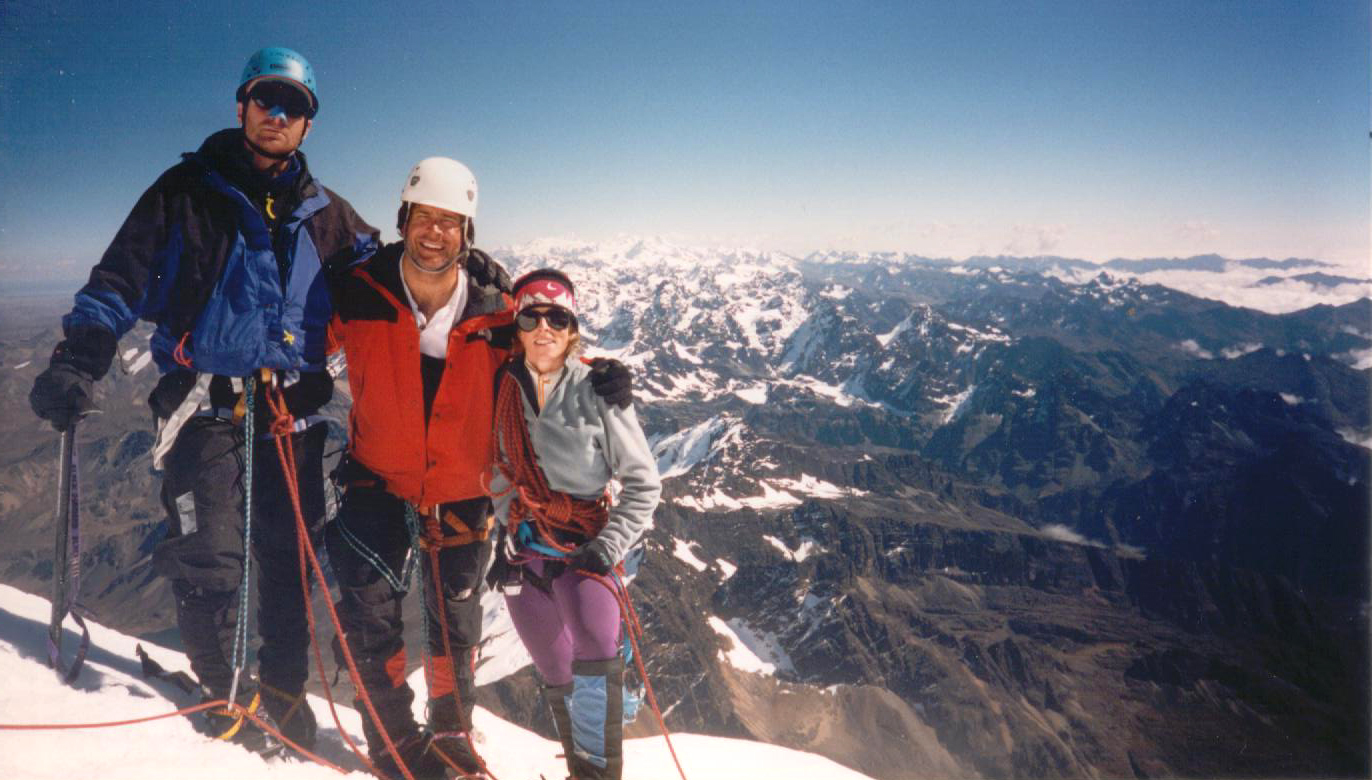
The Double Crown: Chiefs Head & Mt Alice

March 19, 2009

Time after time, I find that an ambitious goal combined with an equal willingness to suffer optimizes personal reward.  I’ll admit this statement doesn’t feel true during my adventures, but is clear afterwards.  Of course, larger goals lead to larger rewards; but, overly large goals, exceeding my willingness to suffer, lead to bitter disappointment.   And, naturally, small goals accomplished easily mean nothing.

To find situations where I must try as hard as I can to just barely succeed, I look to harmonize aggressive goals with an optimistic assessment of my willingness to suffer.  This mental model helps me to imprint two attributes on my adventure plans:

  1. My goals are probably attainable; high success rates
  2. I’ll have to suffer more than I wanted, but be rewarded more than I expected

My trip to RMNP to collect the summits of Chief Head (13,579′) and Mt Alice (13,310′) was aggressive for obvious and non-obvious reasons.  In success, I found tremendous satisfaction, even if some of the suffering was self induced.

Story

When the alarm went off at 4:30am I was reminded of the Cardinal Rule of sleep:

“It doesn’t matter how badly you’ve slept the night, the sleep you were getting when the alarm went off was great.”

Still, I managed to get ready to meet Brian and then drive to the Glacier Gorge trailhead before 6am.   As I tied into my new La Sportiva Eigers, which just replaced my old Makalus, I silently hoped wearing them around the house for a couple days the previous week was enough to break them in.

It wasn’t.

We started hiking right at 6am and made good time until the battle between my feet and my new boots began to resolve itself into a win for the boots. By 8:45am I reached Black Lake where I performed my second boot/sock refit of the day.  Afterward, we left Black Lake for the shortcut to Stone Man Pass, aiming directly for Arrowhead.

We scrambled up the steep grass and cliffy slope, and reached the bench above Black Lake just in time for a boot pit stop.  In a blatant escalation of hostilities, I dug out the moleskin and athletic tape, and hoped for a stalemate.  We then turned south to head underneath McHenry and to Stone Man Pass.

Below McHenry, we stopped at a waterfall to refill our bottles.  This would be our last water source until returning to the spot hours hence.  Brian had his usual thimble-sized container, while I brought a surprisingly modest two 1-liter bottles.  To compensate for a dry future, I finished and refilled both liters before heading up the partially snow-clogged couloir to Stone Man Pass.

A view back down the ridge toward Stone Man Pass

A view back down the ridge toward Stone Man Pass. The route starts from the top of Stone Man Pass.

We reached Stone Man pass around 10:30am and examined the ridge leading up to Chief’s Head for clues about the route.  The available guidebooks were not very clear about the exact route to Chiefs Head.  I have found that this can mean the route is obvious or, alternatively, it could mean nothing at all.

We took another 2 minutes to study the Stone Man himself for possible future climbing; Brian assessed it a “five-easy” while I thought it looked hard to protect.  Brian is often right about these things and we made a mental note to give it a try another time.

Note:  a later trip confirmed the climbing is easy but awkward; however, a safe escape from the Stoneman’s head required the sacrifice of a long cordelette.

The Chiefs Head Keyhole

The Chiefs Head Keyhole

The route finding quickly became very interesting.  I spied a lonely cairn 90 degrees west (right) from where the route looked to go up a couloir to the ridgeline.  Brian went to investigate while I resorted my boots again.

I feared for torrents of blood pouring out of my boots each time I took them off.

We continued scrambling below the ridgeline on the west side along a ledge until we reached the end of the ledge.  Then we took a hard left through a “keyhole” of sorts, and climbed up to the summit ridge of Chief’s Head.  It was very good rock and a pleasant scramble (3rd class).  We reached the summit ridge at 11:15am and took another 30 minutes to ascend the remaining 700 feet of elevation to the Chiefs Head summit.

This last 700 feet consumed the last of my “still feel strong” status.  We stopped for lunch, during which I consumed ½ of the water that would have to sustain me until I return to the bottom of Stone Man Pass.  I was 1.75 hours into a 5-hour circuit and my water was ½ gone.   I also made another futile attempt to save my feet, and resolved to go barefoot if the pain got worse.

A view of Pagota, Keyboard of the Winds, Longs, and Meeker, taken from Chiefs Head summit

A view of Pagota, Keyboard of the Winds, Longs, and Meeker, taken from Chiefs Head summit

The views from Chief’s Head are worth the trip.  The line from Meeker to Longs to Pagoda to Chiefs Head is spectacular. The thought of doing the entire traverse appealed to my ego, but I concluded it would require too much suffering.

As I looked over toward McHenry, I joked that if we felt like it we could climb McHenry again to claim the Triple Crown (Gerry Roach’s title for bagging McHenry, Chief’s Head, and Mt. Alice in a day).  Brian just grumbled as he had done every other time I mentioned the possibility in the previous 24 hours.

Looking back toward McHenry and Stone Man Pass from Mt Alice

Looking back toward McHenry and Stone Man Pass from Mt Alice

Somewhat refreshed, we started down the talus boulders making very good time to reach the grassy field that lies between Chief’s Head and Mt. Alice.  We were approaching Mt. Alice when, looking back, we noticed a couple of people behind us about ½ way across the grassy field coming toward Mt. Alice as well.  We were surprised and wondered how they had gotten so close without us noticing. Looking back a few moments later, Brian noted they had gained a lot of distance on us.  I reasoned that they were traveling downhill while we where doing a bit of scrambling and climbing.  It seemed like a reasonable conclusion.

A view of Mt Alice from below the summit of Chiefs Head

A view of Mt Alice and the narrow ramp summit route from below the summit of Chiefs Head.

Over the next 30 minutes, these fellows proved that people are not all the same.

They must be young, I thought.  The first to pass me was a young fellow, but his partner right behind him looked like my father.   Brian strained to beat the old guy to the summit, marginally holding up the honor of the team.

When I arrived at 1:30pm, they were gone.  As I looked around, Brian indicated that they had gone on to grab more peaks before heading back to Wild Basin.  They had done Meeker, Longs, Pagoda, Chief’s Head, and Mt. Alice (so far) in shorts and sneakers.  The older guy had said he was tired, while the younger guy said he was running out of food because he didn’t have bread to make peanut butter and jelly sandwiches that morning.  Poor guy.

Our route map to (1) Black Lake, (2) Stone Man Pass, (3) Chiefs Head, and (4) Mt Alice

Our route map to: (1) Black Lake, (2) Stone Man Pass, (3) Chiefs Head, and (4) Mt Alice

After a short snack and another boot repair, I was out of water.  I was tired and 9 miles from the car, but at least I was turning around.

I managed to get back to the grassy field in decent time; downhill is always okay.  But climbing back up to the Chief’s Head ridge was murder.  And my body didn’t work that well anymore, forcing me to think carefully about moves that I did unconsciously a few hours earlier.  I really needed some water.

We reached Stone Man pass at around 4:30pm, which left us 4 hours of light to get down the snow/talus slope below Stone Man Pass, get over to and down the steep trail west and above Black lake, and then hike 4+ miles to get to the car.  We didn’t even talk about McHenry.

We descended the snowy Pass with a bit of heel plunging and a bit of scrambling to reach the bottom by 5pm.  I found a nice fountain of melted snow to refill my long-empty bottles; but I had to wait 30 minutes before drinking to allow the iodine to work its magic.  I was very tempted to throw caution to the wind and just drink it.
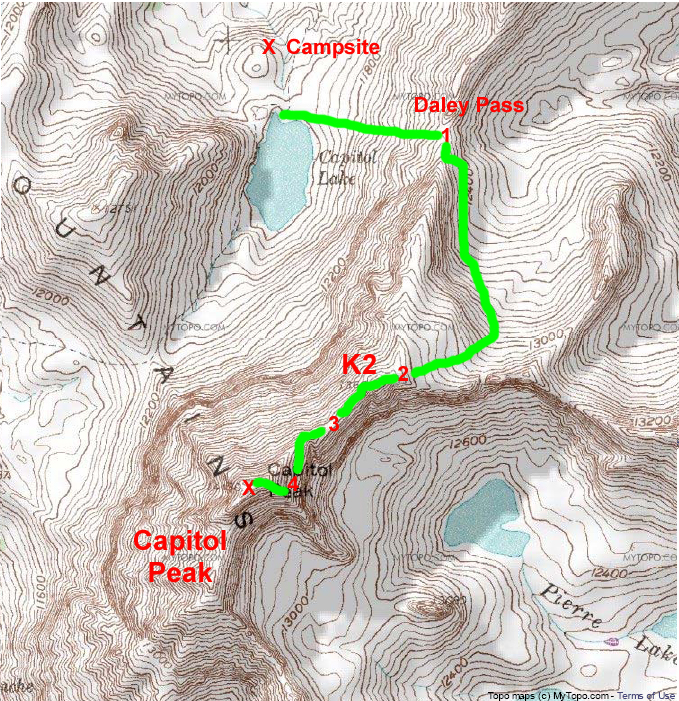
Thirty minutes later, I yelled to Brian to stop.  I was going to have that damned water right then.  As I was pulling my water out of the pack, I nearly trembled with fear as I lifted the 1st bottle up to the light . . . It was not dissolved.  The damned thing looked just like it did when I put it in there. As I was losing my composure, Brian reminded me that hiking equals shaking, in the world of iodine tablets.  I started hiking without taking a drink.

We scrambled down the steep slopes above Black lake with a bit of rock scrambling and steep grass maneuvering.  The plan was to stop at Black lake for a break, but once I was past the hard part of the descent, I just sat in the dirt and drank a liter of water.  That was good water; even the iodine tasted good.  I then joined Brian at Black lake where I finished off another liter and a bar, and then I refilled one of the bottles for the ride home.

I didn’t even bother with the boots any more.  I was just stumps below the ankles.

On flat terrain and using good trails, we took less than 1.5 hours to cover the 5 miles to the car, arriving at 8pm.  I finally was able to get those miserable boots off my feet.  I didn’t have the courage to examine the damaged tissues so I just put on my sneakers, drank my iodine water and started driving.

Driving home, it started to feel like a day well spent.  The pleasure of our successful 14 hour effort to hike 18 miles and climb 5,300 feet to reach the summits of two new 13ers spread throughout my body like a slow, warm wave.  My feet almost didn’t hurt anymore.  Almost.

Our trek to bag Chiefs Head and Mt. Alice in RMNP was another of those harder-than-expected- but-glorious-in-its-successful-completion efforts. It was perfect.

See all Trip Reports