Posts Tagged ‘Brian’

Another Sharkstooth

September 1, 2010

It finally happened.  I finally did Sharkstooth’s NE Arete and actually felt like I knew the route.  It really felt more like a Boulder Flatiron than an RMNP Alpine route, although I’m sure the beautiful, sunny day helped with that perception. I thought I’d document this trip (8.24.2010) to have and to hold for future reference, after the details once again slip from my mind.

We left the Glacier Gorge parking lot around 4:30am in an attempt to finish before the 3pm forecast for rain (30% likelihood).  We hiked up the Knobs shortcut and then past Loch Vale before turning west for Andrews Tarn.

Brian was ahead of me for much of the approach.  After the turn toward Sharkstooth, he built up a big lead.  I just couldn’t motivate myself to go any faster; that is, until I saw the guys ahead of Brian.  I knew he’d push to get ahead; now I had to pick it up. I didn’t want to be the reason that we got stuck behind another team when the weather was threatening.

I lost sight of everyone for a while, but I pushed as hard as I could without vomiting. I was surprised to find how much I had gained on the other team; it made me think I had regained some of my old strength.  I neared them just below Sharkstooth; as I passed them, I could see they were older than me.  Oh well.

At least we got on the rock first.

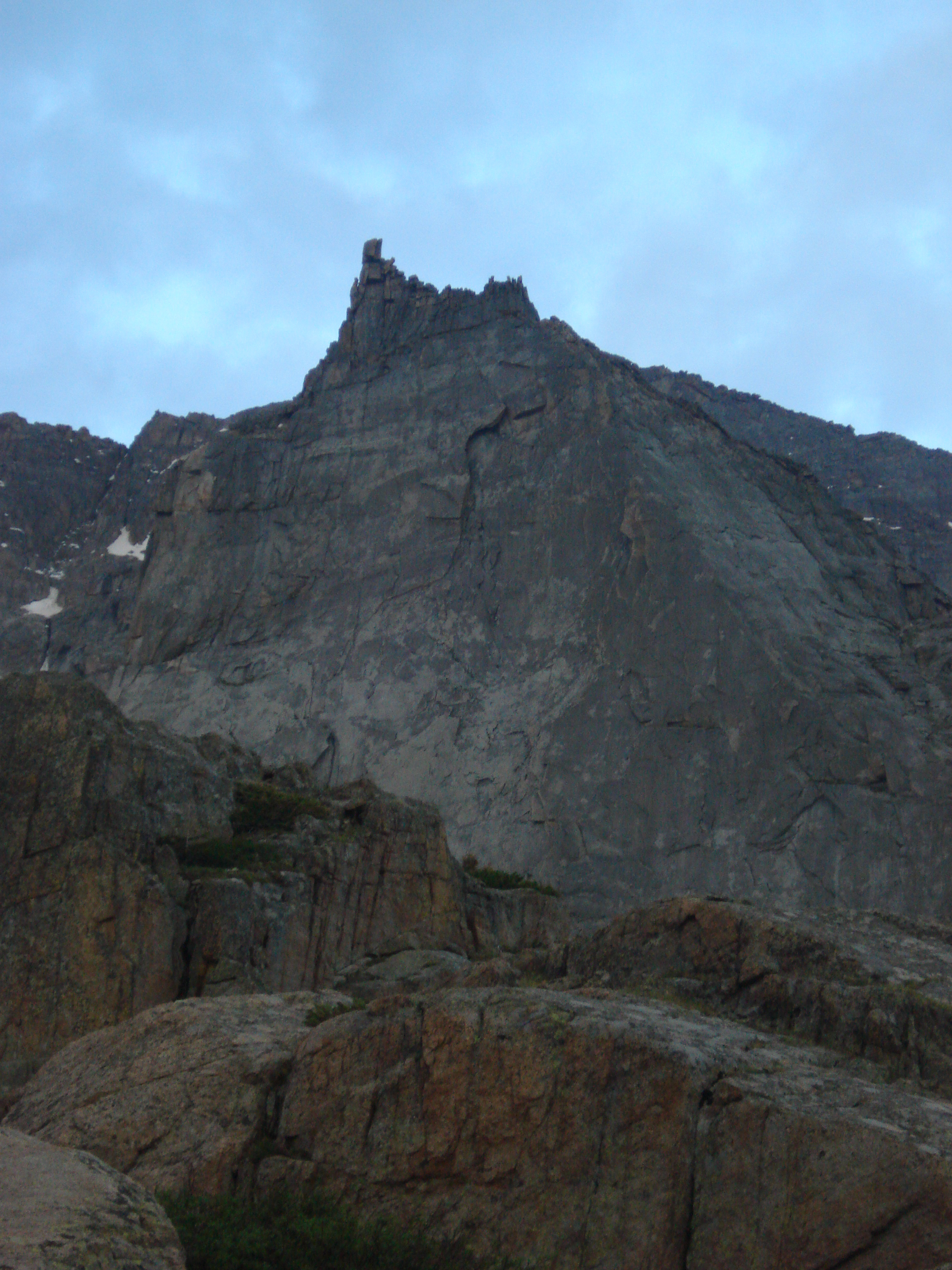
Sharkstooth seen from Zowie

Below is a summary of the pitches:

Pitch 1:

Brian took the right-most of the two obvious cracks and worked he way straight up to a large ledge.  When I arrived, he suggested I look to the left before setting off. He was right; the proper route was up the left crack.

Pitch 2:

I traversed left 10 feet to get into a slot which I climbed up (was crux for me).  I continued straight up until reaching a roof, which was at the bottom of a left facing detached flake.  I seemed to recall doing a layback up the flake, but the face to the left looked easy enough so I just walked up to the ledge atop the flake, where I setup the belay.

Pitch 3:

Brian continued up the steep but bucket-filled terrain to the big flat part of the NE Arete. Every variation of the NE Arete route must hit this ledge, as it is the first part of peak that actually forms a ridge.  The views are spectacular off both sides.

Pitch 4:

I climbed up the off-width crack and then moved left to climb the left side of the ridge.  I continued past the next big ledge and belayed at the end of the 200′ rope on a smaller ledge below the roof protecting the summit.

Pitch 5:

Brian finished it off by scrambling over the roof.

After a brief stop so I could drink the liter of water I hauled to the top, we started down the rappels.  The Sharkstooth rappels are always interesting for the ; we had to sacrifice a sling on each anchor to back up the aged cords.

We got back to the packs at 11:30am.  We ate our lunch before starting the long walk to the trailhead.

See all trip reports

See all RMNP trip reports

Angel’s Way

August 8, 2010

Sometimes, the adventure is found in just getting in and getting out; but as long as its in there somewhere, it is all good.

With an ankle under repair, I was limited to a short sort of adventure. Brian suggested Angel’s Way, a Flatiron’s route we’d found only a few months earlier and put on top of our Flatiron to-do list.

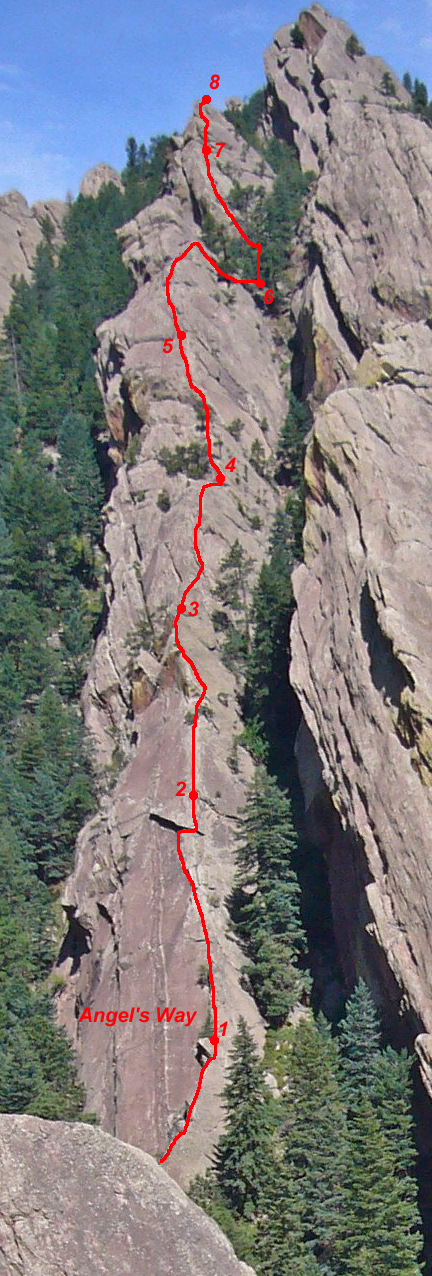
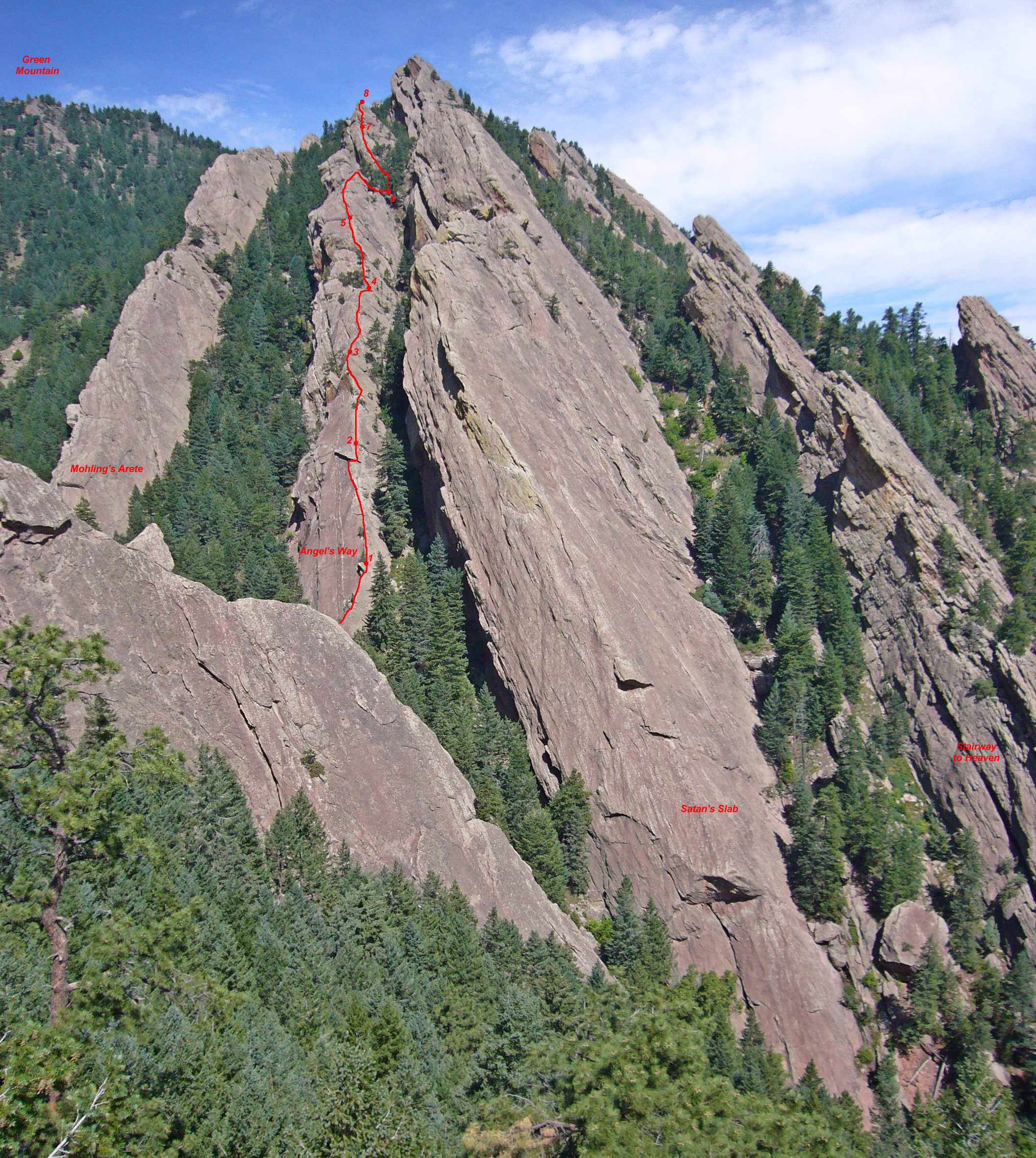
Angel's Way is the 3rd rib on the north side of Skunk Canyon, sandwiched between Satan's Slab and Mohling's Arete

August 7th, 2010, was going to be a hot one; the high temperature forecast was 96F. To beat the heat, we started from NCAR at 6:30am; but, it was already in the 70’s.

(Position #1 on map)

I had a vague memory of having to hike back down the main NCAR road to find the path leading to the water tank on top of the hill separating us from the Mesa Trail. Brian agreed and we found ourselves hiking through tall grass that made me think of Africa.  I kept wondering if I’d find a sleeping lion in the grass until my mind hit on a more likely scenario:  snakes.  Yikes!

Our Angel's Way map and reference points along the way

My pace was energized by my worrying about my route-finding mistake so early in the day.  Fortunately, we quickly came upon a super high quality trail/road. Heck, it looked brand new.

We then quickly worked our way over to the Water Tank (passing the correct trail junction along the way) and then down to the Mesa Trail.

(Position #2 on map)

We followed the Mesa Trail north for a couple hundred yards before exiting the trail at the end of a switchback, heading west toward Skunk Canyon on a climber’s trail.

Before leaving the Mesa trail, we had been quizzed about our wearing long pants on such a hot day; the sea of poison ivy on the climber’s trail justified the extra water loss. We were forewarned.  We were also warned about the shocking bushwack and route-finding needed to reach the base of Angel’s Way, but we were not prepared for the confusing directions provided to guide our efforts.

Here is where I’ll officially complain about the poor quality of information available to guide us to the base of the climb.  I don’t mean to say that all the information was incorrect; it was all correct.  The problem is that the people providing the information were not thinking about the uselessness of a description that while correct cannot be used to distinguish the right rock or path from many other wrong ones.  Much of it was so bad that it actually seemed to be contradictary, for example:

“It (the 3rd rib) is about 100 yards west of the [2nd] rib that forms Satan’s Slab”

vs.

“The Third Ridge is almost abutting the Second and the gully that separates them is very narrow”

Note: both of these statements turned out to be true, in one way or another

I know, I know.  All we had to do was count the ridges, right? The third ridge comes right after the second ridge which is preceded by the first ridge. And while there is no hiding from this fact, it is only useful if it is obvious what makes up a ridge when you are standing far below them, and for only as long as you knew in advance to avoid losing track of what you’ve already passed.

Neither of us managed to succeed with either requirement. Fortunately, Brian did bring along his brain which proved helpful in isolating the important data and using it to reason out the correct conclusion.

(Position #3 on map)

After considerable debate of the information and our observations (collected via hiking back and forth between the ridges in dispute), we finally found the start to Angel’s Way at 8:30am, with a route-finding cost of about an hour.
To summarize, follow the creek bed and keep careful count of the ribs of rock to the right.
  1. The first rib is Stairway to Heaven; the ridge starts with an overhang.  There is no directly opposing rib of rock on the left side of the creek bed.
  2. The second rib is only 50-100 feet further west and is called Satan’s Slab; the ridge ends in a steep slab that slopes down to the very edge of the creek and meets another rib of rock coming down from the left side of the creek; the two ribs block the creek from easy passage.  Once past this obstacle, you are below the backside of Satan’s Slab.
  3. To find the third rib, leave the creek path and head North following a faint trail.  Continue up and west for 100 yards to find the unimpressive start to the 3rd rib, Angel’s Way. This rib does not reach down into the creek bed
  4. If you continue past Angel’s Way for another 100 yards, you will find Mohling’s Arete.
(Position #4 on map)

Angel's Way Route

After such a confusing start to the day, it was gratifying to finally start climbing and find the climbing to be very enjoyable.

We completed the climb in 8 pitches.
  1. Pitch 1: Brian insisted on starting from the bottom of the ridge for his personal sense of aesthetics, a 15′ exposed climb led to the ridge which he climbed along  for 200′ before belaying in a nice shady spot next to a tree
  2. Pitch 2: I climbed under the ridgeline in a low-angle dihedral to a roof, and then mounted the ridge top and climbed to an exposed belay after approximately 180′
  3. Pitch 3: Brian continued along the ridge for 30′ before stepping climbed near the ridgeline for another 180′.30 feet into Pitch 3 is where I stepped over a horizontal tree and avoided clipping it.  After that came one of the occasional steps in the ridge.
  4. Pitch 4: I climbed up a dihedral and then over some easy rock for 200′
  5. Pitch 5: Brain started up a very boring start, but after 30 feet came a hidden dip in the ridge had a short steep wall on its other side. He then traversed over some dark-colored rock to regain the ridge, and then belayed in the middle of dull-looking spot after 180′.
  6. Pitch 6: I continued up the ridge for about 50′ to find another notch in the ridge.  This notch created a relatively hard required move (I thought of it as the crux), after which the pitch turned into another easy traverse, but this time below the ridge crest which cliffed-out at the end of a big notch in the ridge after 150′.  I climbed down the ground to set up the belay.
  7. Pitch 7: Brian moved the belay up the slope a bit, and then he climbed a steep wall under a tree to reach the ridge
  8. Pitch 8: I led the short climb to the summit, which had better pro than we’d been led to believe

(Position #5 on map)

We did a belayed down climb from the summit and then north to reach a likely down climb.  I should say Brian thought it looked likely, but when I moved the belay to the official ‘rappel tree’ I surely didn’t like the look of it.  Brian allowed me to go first and take the belayed down climb while placing gear to protect Brian’s descent.  I couldn’t figure it out until Brian lowered me past the crux where I found the necessary footholds that Brian shortly used to join me at the bottom.

We then scrambled down the next section before packing away our gear and switching into hiking boots.  We contemplated returning to the start of the climb, but since we had brought our packs along to avoid having to go back down the ridge, we were loath to crawl back into the poison ivy pit of death.

Instead, we started hiking east.  We figured we’d find a way to get to the Mesa Trail and we used Brian’s research into booze to pass the time.

It turns out that Gin, Whiskey & Vodka are all very similar forms of liquor.  Back in the day, the problem with Whiskey was its harshness out of the still.  The only way to make what was essentially Vodka, palettable, to “anyone other than a Russian”, was to put it in wood casks and let it sit for a few years.   That is, until some enterprising Belgian doctor discovered that if you put Juniper berries in the un-aged whiskey and distilled it again, you got something tolerable.  It is called Gin.

If this is incorrect, talk to Brian

(Position #6 on map)

After a considerable amount of bushwacking down and across a moderately steep forest of small pine trees, we broke out onto a talus field.  At this point, we could see that we had been heading a bit NE instead of E, but it was going to work.  We reached an old road cut into the talus which we followed NE for a 100 yards to its end, and then we scrambled further down the talus to reach the current Mesa Trail.  We turned south and hiked toward NCAR.

(Position #7 on map)

It had been a hot day, but really it was not so long compared to others we’ve done recently.  We powered back up to the water tank and then took the proper trail toward NCAR.  A few hundred feet of hiking got us back to the car at 2pm.

My first thought was that now I get to cross off one more flatiron from my endless list of flatirons not yet climbed. I haven’t done much of that in the last few years; if I don’t pickup the pace, I may never finish that list.

See all trip reports

See Boulder Flatiron list

A Notchtop “Bad Variation”

August 3, 2010

It was going to be our 4th weekend in a row in RMNP, but the weather report was uncooperative.

A 40% chance of rain, mainly after noon.

Rats.  Rain at noon, or earlier, and long approaches didn’t leave a lot of time for climbing. We discussed our options for shorter approaches, including going to Lumpy Ridge and climbing on Hallett Peak.  We both wanted to continue climbing in RMNP, so Hallett was the better of the two.  But the only route on Hallett that would not be a reach at our current level of climbing would be the Great Dihedral (5.7); however, it was sure to be wet after all the recent rain.

We decided to take a chance and do the Spiral Route on Notchtop Mountain, which is what we’ve been thinking about for a few weeks any way.  The trick would be to start early and go fast, as always.  And, finding a bit a weather luck wouldn’t hurt.

We started from the Bear Lake parking lot this time (just before 4am), and started up toward Notchtop in a very dark night (the moon was just a sliver). The trail was good up to Joe Mills Mountain, and then the climbers trail to the base of Notchtop was pretty good too. It felt like a walk in the park compared to our adventure on the Solitude Lake Cirque.

From the bottom of Notchtop, the next step was to reach the top of the big platform that made up the bottom 3rd of the pinnacle. We took an obvious path up the gully next to Notchtop to find the right leaning ramp we’d used twice before to reach the top of the platform that marks the start of the climbing.

Reaching the platform, we stopped to get organized and to put on more clothes…I mean, all the rest of our clothes.  We were freezing to death on July 9th. The sun had been up for a short while, but it was not putting off much heat; and the wind was ferocious. There is something about Notchtop that leads to strong winds; we’ve had strong wind on all 3 visits over the past 13 years. Unfortunately, I didn’t have enough clothes, so I shivered as Brian started up.

When it was my turn, I climbed in my gloves and hiking boots; I was still too cold to do otherwise. When I found the climbing very easy going, I was sorry I hadn’t taken the 1st lead. I was doubly sorry when the 2nd pitch turned out to be hard, at least the path I chose was hard. By the time I reached the grassy ledge that we’d take to the East Meadow, I had warmed up very well.

Brian then led us over toward the East Meadow.  He stopped at the slight ridge which pokes out about 2/3rds of the way there with an idea for a new route to the notch. When I arrived, we decided to continue on to the East Meadow and use the Relief Train route (I think) to climb towards the notch.

It was a nice route, rated around 5.7; I enjoyed climbing it in my hiking boots  since I had a top rope.  Brian’s lead reached to just below the Notch.

When I arrived, Brian suggested we take a new path, on the north end of the ledge.  It looked like a bouquet of fins leading up and left toward the summit.

Roach’s RMNP Classic Hikes and Climbs:  “There are three places in the minicirque where it is easy and tempting (and wrong) to head farther north.”

Brian and I found a fourth.

It actually started off well, but once we got high enough to see down into the normal ascent gully (on the other side of the notch), the climbing became steep over crumbly rock.  It probably could have been protected, mostly, but we had put away the ropes and gear.

Once we reached the Notchtop summit, I was relieved to finally have the unprotected climbing behind me.

Oh, how wrong I was.

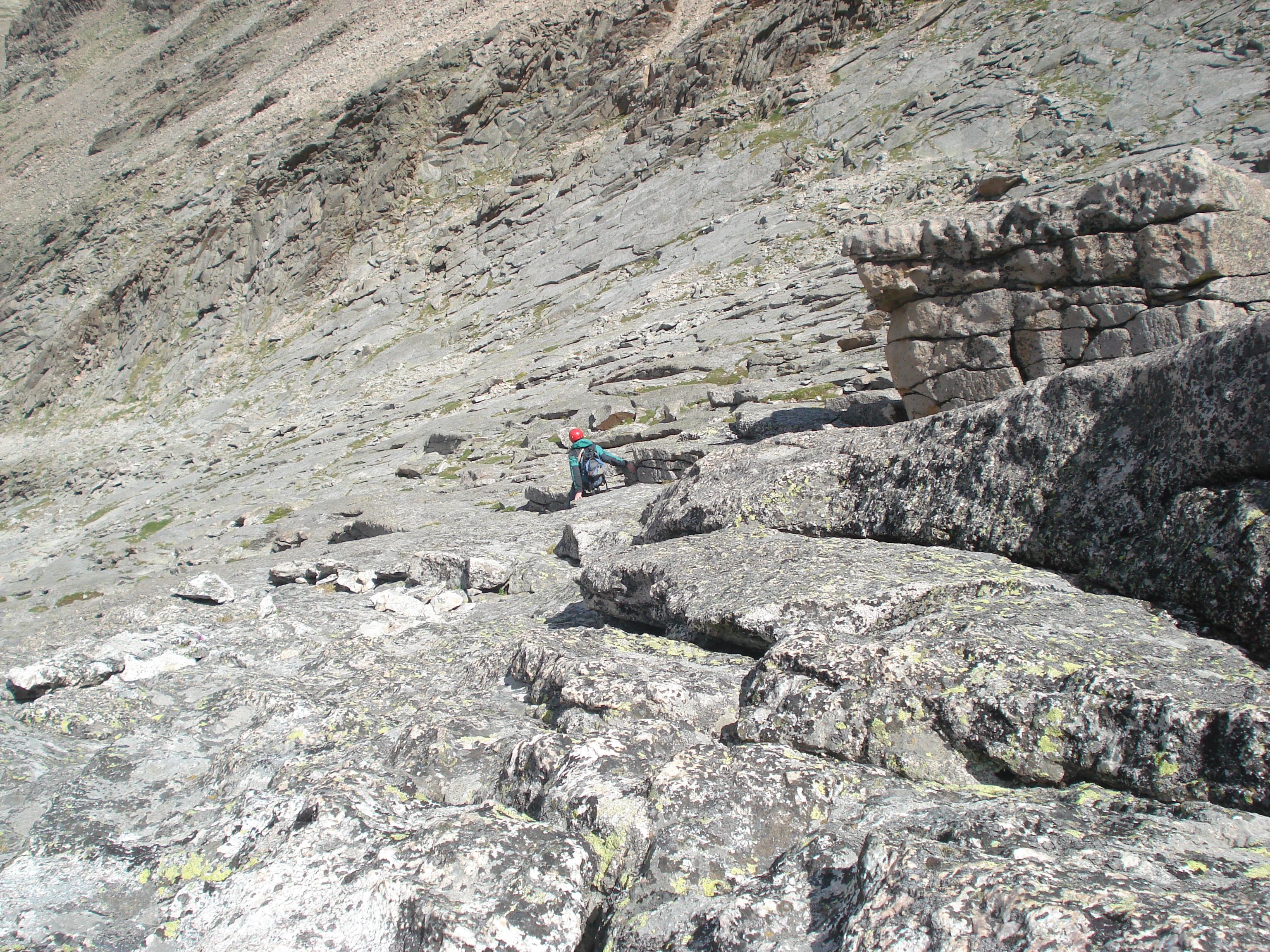
It is surprising how little I remembered about the two previous downclimbs of Notchtop.  I suppose I put it out of my mind. Every section just kept getting worse. I’d agree it was only 4th class, but downclimbing is always harder due to a lack of vision at the feet level.

A surprisingly quick scramble down with a few rain-drops reminded us of the primary issue of the day.  We hurried up to our packs (and water!); and we enjoyed a few minutes of rest.

I once again did my, ‘guess the time’ game.  This was the only time I can remember winning.  Brian guessed 12:30pm while I guessed 11:30am.  It was only 11am.

Brian’s water bottle made a mad-dash escape attempt, bouncing all the way down the gully toward the South  face bottom.  Brian pursued while I returned via the ascent route and met up with Brian at the bottom.  Brian was bottleless, but heavy one torn, faded down jacket that was spewing feathers; it wasn’t a good trade.

Another long hike on tired legs and sore feet back to the Bear Lake parking lot ended another RMNP adventure. And when we got back down to Boulder, we found it had rained cats and dogs. At least the weather luck is holding up, even if the legs aren’t.

See all trip reports

See all RMNP trip reports

Solitude Lake Cirque

July 6, 2010

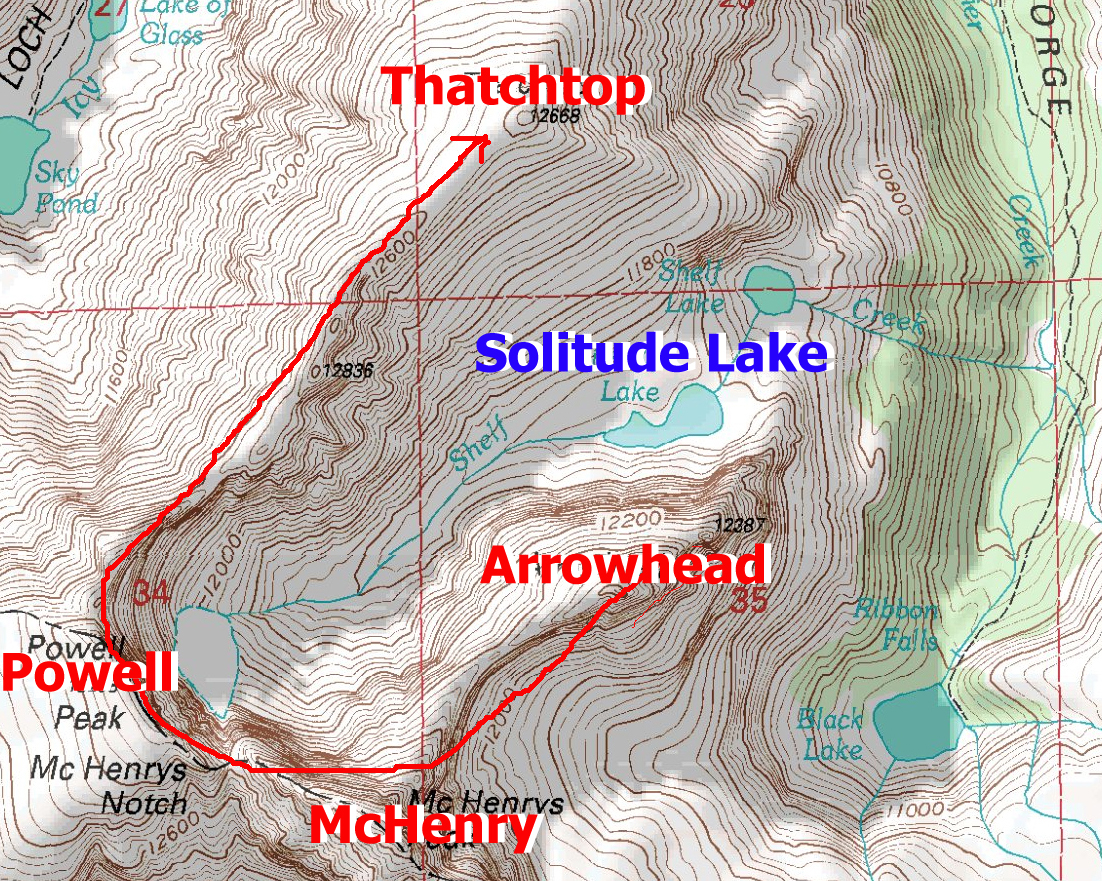
A low altitude illustration of the 'off-trail' ascending and descending required to complete the 'Solitude Lake Cirque'.

It was finally time to do it. After many years of thinking about the various connected pieces, it was time to attempt the entire Solitude Lake Cirque: a climb of Arrowhead (3rd or 4th class) from Solitude Lake, then traversing to and climbing McHenrys’ NE Arete (4th Class) to the summit, then traversing McHenrys’ Notch (5th class downclimb and 2nd class scramble) to reach the summit of Mt Powell, and then traversing and downclimbing Mt Powell’s entire NE Ridge (4th class) to the summit of Thatchtop.

We knew it would be a long day.  Even if everything worked out perfectly, it would be a grueling, body-breaking day: over 13 hours, 11.5 miles, and 5140′ of elevation gain & loss, with much of it being off trail. For illustration purposes, the planned effort is similar to scrambling up and down the 3rd Flatiron five times in a row with a mouth-full of water (to simulate high altitude oxygen availability).  Fun, right?

The Solitude Lake Cirque objective and plan evolved over the last 13 years:

  1. The ‘McHenrys Notch’ piece: I learned of ‘The Notch’ when sitting on top of Flattop during the summer of 1997 and wondering out loud about hiking the Continental Divide to Chiefs Head. Brian notified me that ‘The Notch‘ was a challenging obstacle. I was intrigued.
  2. The ‘NE Arete of McHenrys’ piece:  I still vividly remember looking up the NE Arete of McHenrys while sitting on the summit of Arrowhead in 1999 and thinking that it was the most spectacular sight I’d ever seen; I also thought it looked way too scary to to climb unroped (only 4th class).
  3. The ‘NE Ridge of Powell’ piece: I climbed this ridge almost exactly 11 years earlier in a solo effort; it was a near disastrous day as a late start and rainy weather nearly ended my climbing days (and every other kind as well). While my ability to do it while wet was confidence inspiring, the experience was psychologically traumatic.  Brian and I attempted to repeat it in late 2005 but were turned back by heavy snowfall.
  4. The ‘Do Them All Together’ Goal:  in early 2010, I informed Brian that the ‘Solitude Lake Cirque‘ was a goal for the 2010 summer.
  5. The Plan:  during the last week of June, I decided that we’d do the climb clockwise.  Even though The Notch is easier to climb than descend, I worried that a descent of McHenrys NE Arete would be too hard (since I didn’t know the terrain at all); and I thought we’d could rappel ‘The Notch’ if necessary.  And, I didn’t think a down climb of Powell’s NE Ridge would be much harder than an ascent since the elevation change was small. I was very wrong about this last point.

The 'Solitude Lake Cirque' -- illustrative route

And, throwing a monkey wrench into the works, the weather report was not perfect.  A “20% chance of rain after 1pm” was very worrying since it meant the rain would come while we were on Powell’s NE Ridge.  Given my history with that chunk of rock, I was justifiably worried. In addition, the weekend before a forecast of only 10% chance of rain after 1pm came 100% true on a climb of Spearhead in RMNP; I just couldn’t ignore the threat. However, Brian and I worked it out that we could summit Thatchtop by 1pm, if we started @ 4am and moved at a quick pace. That was somewhat reassuring, but I wondered how long we could keep up such a pace.

For better or worse, the ‘Solitude Lake Cirque‘ was a go!

On the morning of July 3rd, 2010, Brian and I left Boulder@ 2:30am for the Glacier Gorge trailhead in Rocky Mountain National Park. Unlike the previous week, the sky was mostly clear; it was a good sign on a day when good weather might be required to survive.
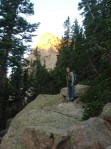
Ascending toward Solitude Lake with Arrowhead in background

I was driving, so we arrived at the trailhead a bit earlier than planned.  We started hiking at 3:45am.

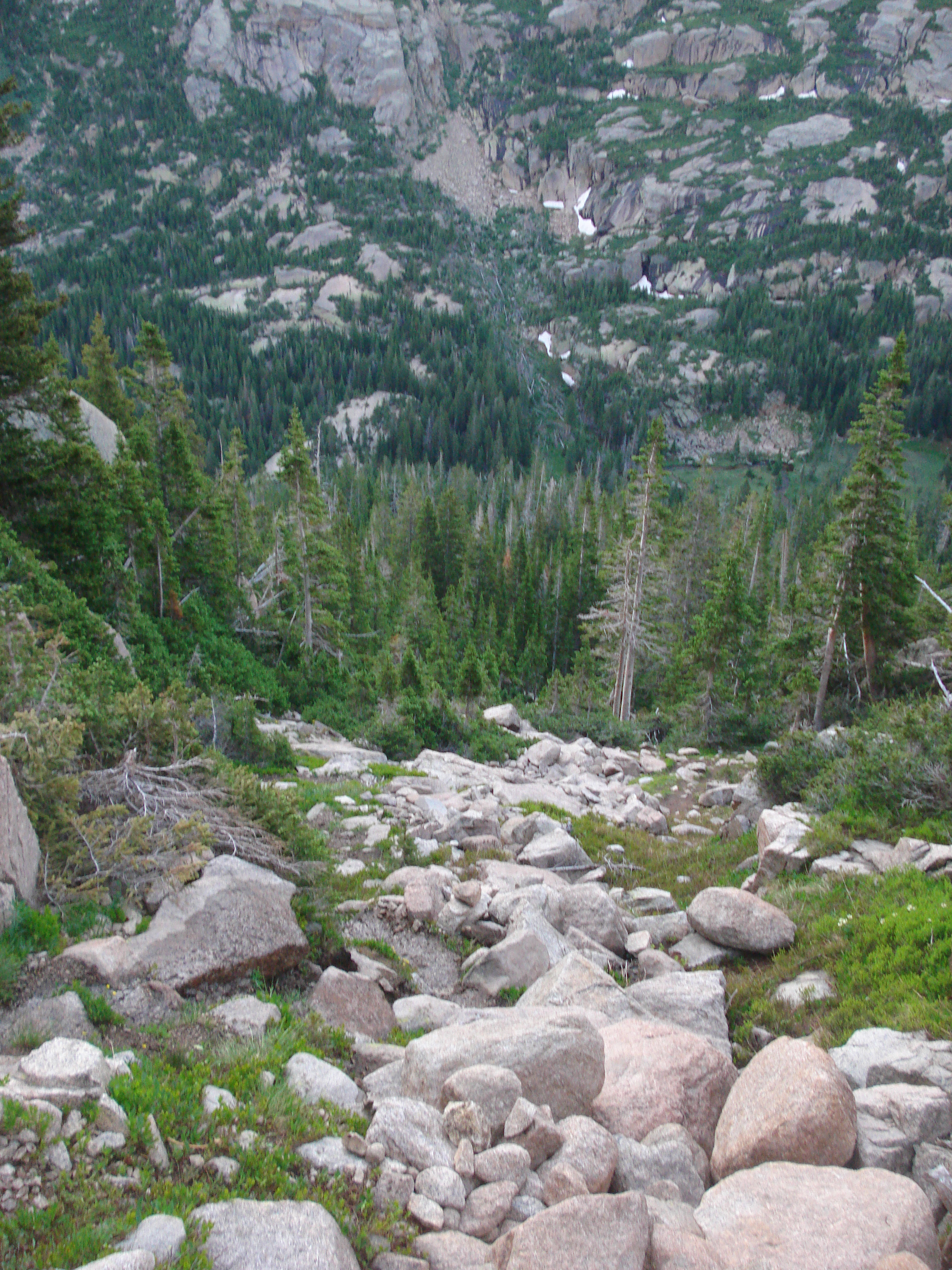
Looking back down the steep hike up toward Shelf & Solitude Lakes

We took the ‘Knobs‘ shortcut to save 1/2 mile, and then took the Black Lake fork off the Loch Vale trail.

Position 1 (see references on map)

About 3.5 miles in, we reached the avalanche gully which marked the cutoff for Solitude Lake.  We turned toward Glacier Creek, gingerly walked along fallen logs to avoid sloshing through the marshy terrain.  A quick hop across the creek and then we scrambled up the steep slope to reach the Shelf Lake area, swatting mosquitoes all the way up.  On one of the longest days of the year (daylight-wise), it was light enough that we could have started hiking 30 minutes earlier.

It was Brian’s turn to dunk a boot, this time working across the Shelf Lake outlet.  But Brian was smart enough to wax his boots, so no wet foot for Brian (unlike my experience on Spearhead the week before).
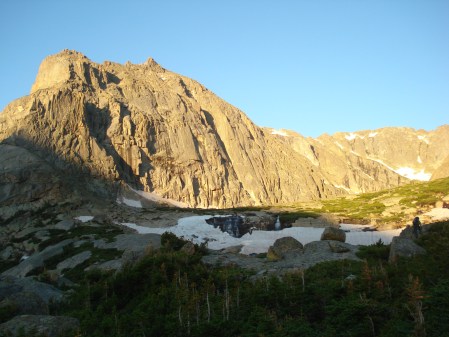
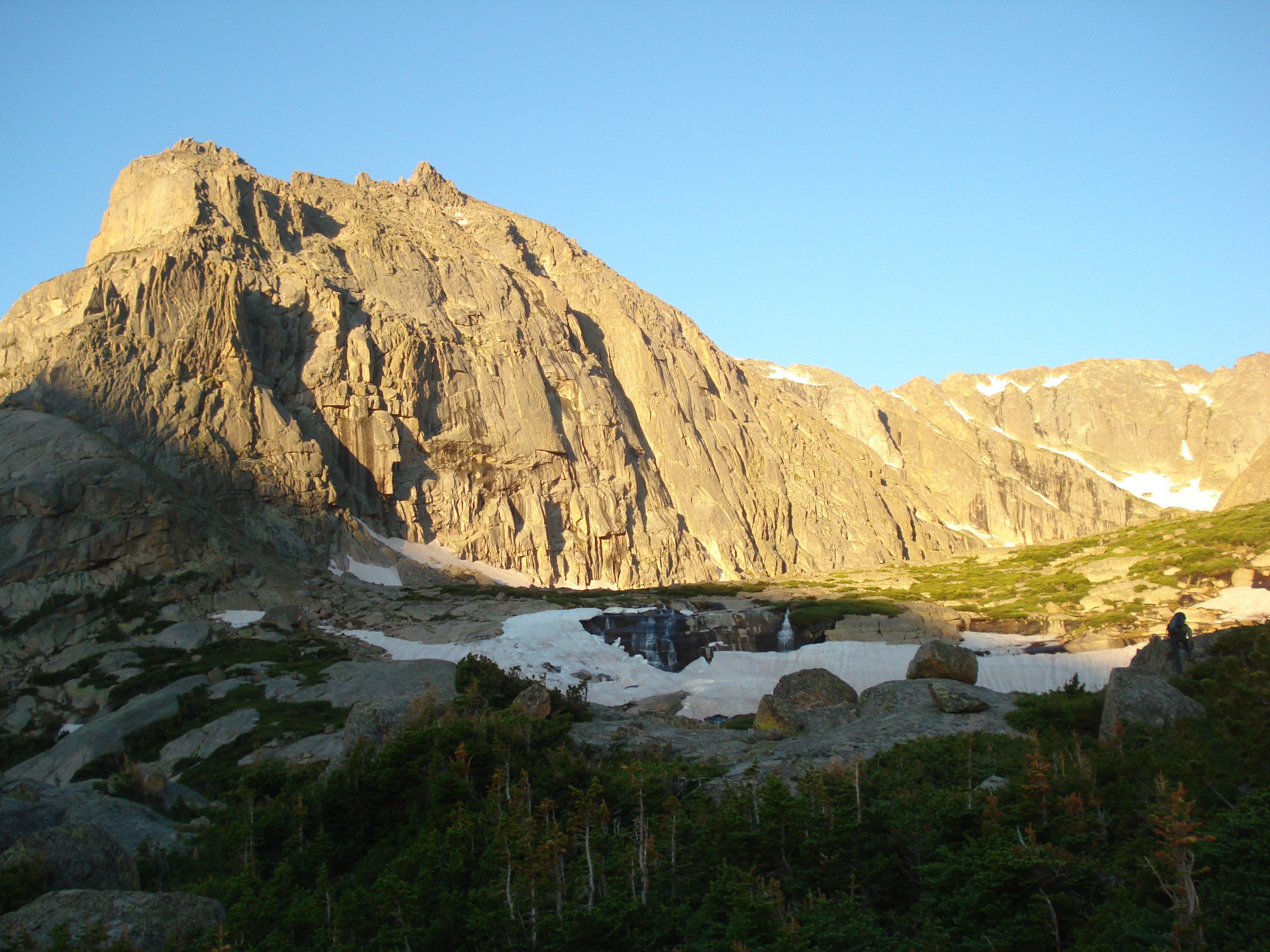
Nearing Arrowhead, our 1st objective

Position 2

We reached the edge of Solitude Lake at 6:15am; I was delighted with our quick pace.  I thought we would be close to my goal of a 7am Arrowhead summit.  But clearly I had forgotten about the long talus-hop needed to reach the base of the Arrowhead climb.

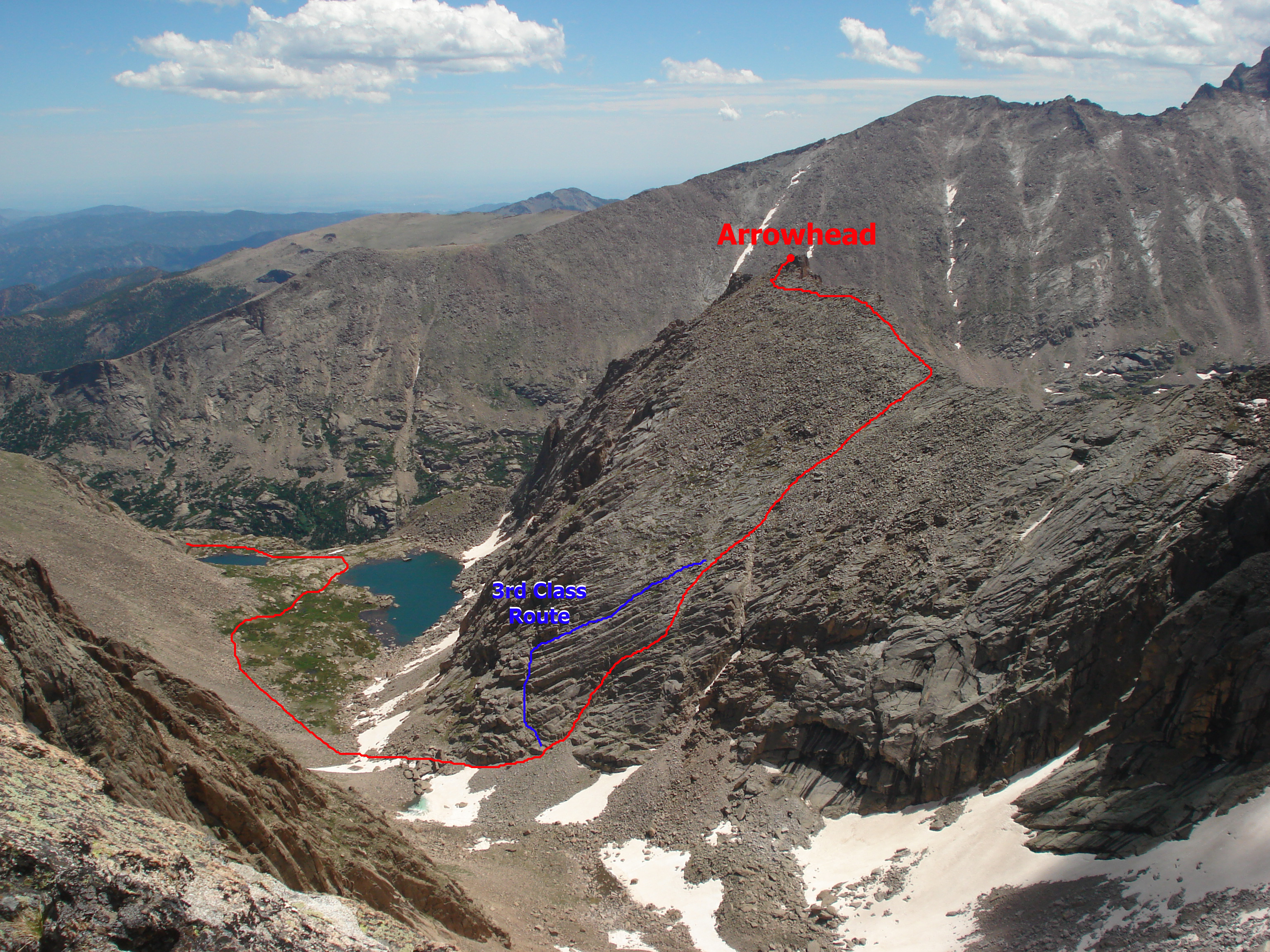
Our route up Arrowhead

It took us another 45 minutes to reach the base of the climb.

Position 3

We started up a 4th class path Brian picked out; he didn’t want to use the 3rd class route we’d used before. I figured it would be a good warm up for climbing to come later in the day.  Rather than angle directly for the Arrowhead summit, I decided to climb to the ridgeline first.  I was rewarded with spectacular views of Glacier Gorge through the clear, early morning air.

Position 4
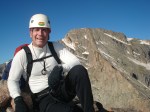
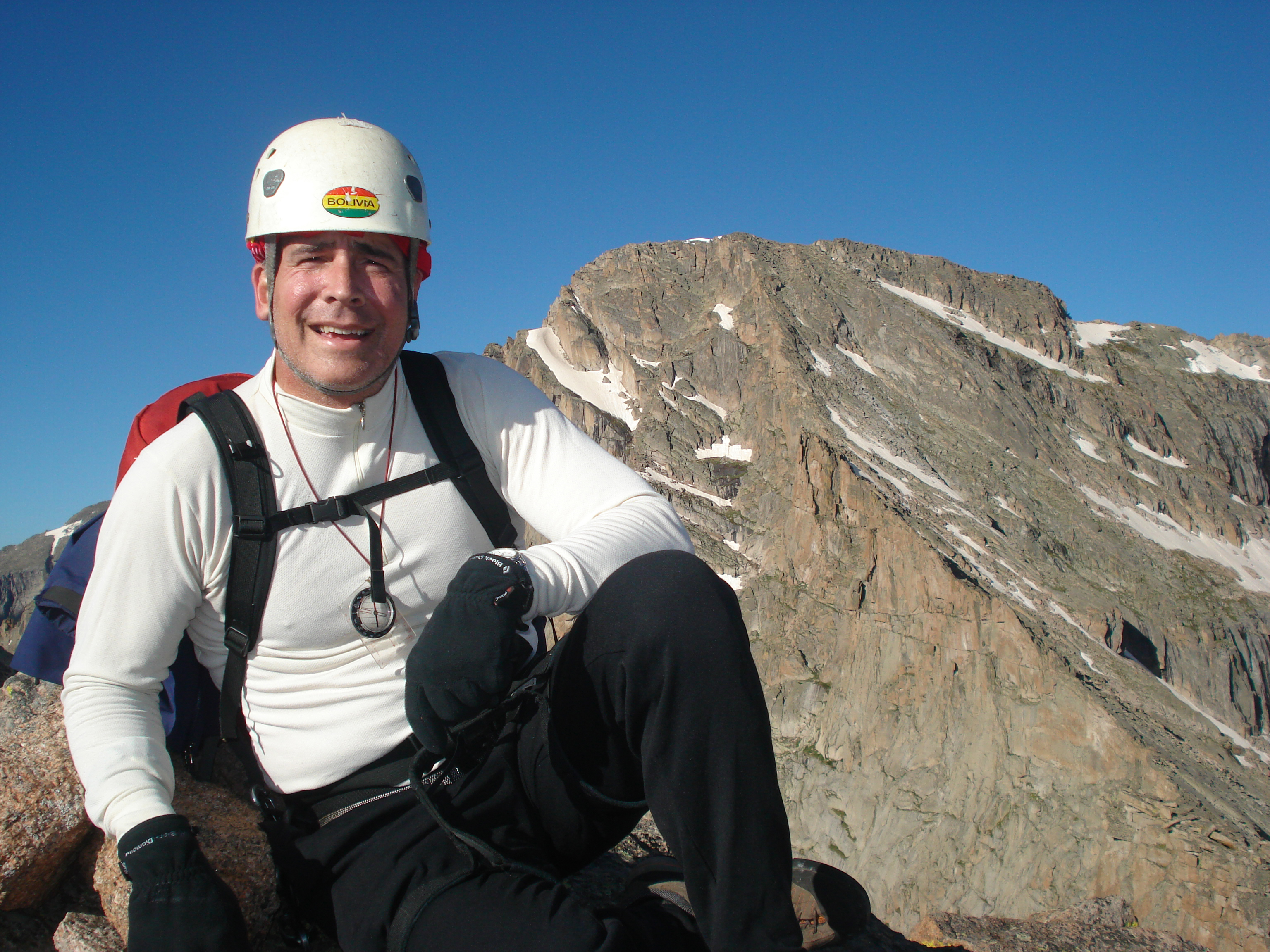
Joe (me) on Arrowhead summit with McHenrys NE Arete in background

I then joined Brian on the summit of Arrowhead at 8am.  We were already one hour behind schedule. It was time to start going faster, somehow.

The weather looked good, but we could see the winds above McHenry were moving very quickly.

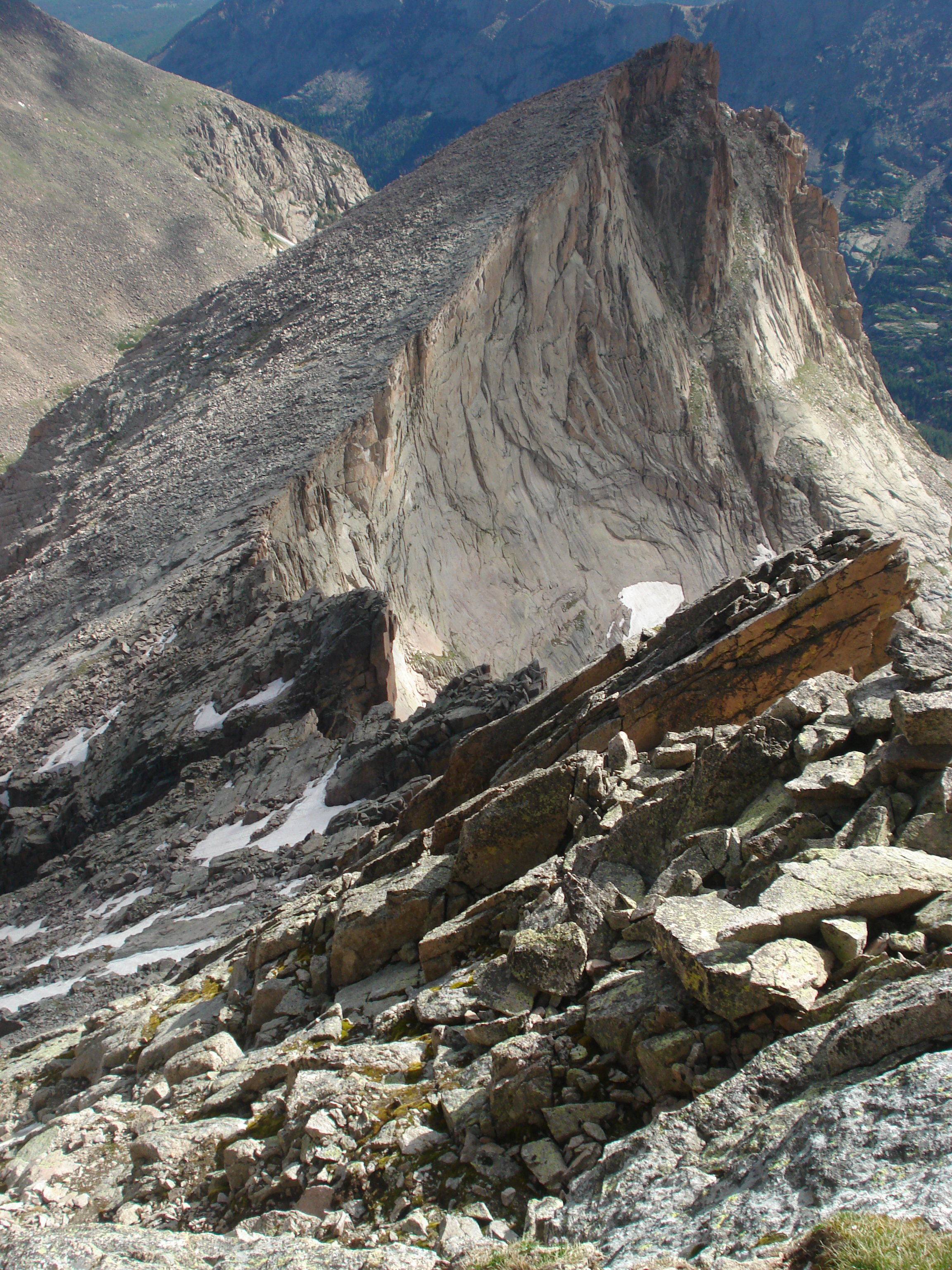
Looking back down the NE Arete toward Arrowhead

We started back down the ridge toward the saddle, and then up the NE Arete. The climbing was not very difficult; there were a few spots of harder climbing below the Gendarmes on the ridge.  I was pleasantly surprised to find that the climbing was nearly all 3rd class, with only a spot or two of 4th class. Accordingly, our time was pretty good, even though I was slowing down a bit after over 4300′ of elevation gain in the last 5+ hours.

The finish was remarkably easy and led to within a few yards of the summit.  A great route.

Position 5
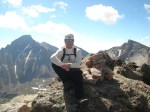
Joe (me) on McHenrys summit with Longs and Chiefs Head in the distance.

We reached McHenrys summit at 9:30am; still one hour behind schedule, but at least no further time was lost. And the wind was cold and strong.

After a short break, we started toward The Notch.
Brian hiking toward 'The Notch' with Powell in background

Progress was easy for a while, but then became confusing. It was unclear which ledge was the correct ledge to take to the downclimb.  We decided to stay on the ridge crest as long as possible, which forced us to make an exposed move or two to reach the end.  From that position, we could see that the ledge below us had been the correct ledge; we downclimbed to it and then traversed over to the gully that led directly to the top of ‘The Notch‘.

Brian put on his rock shoes (removing Makalus); this says it all.  It was steep.  Plus, the freezing wind rushing up the gully was enough to unnerve anyone.

Brian descending the last few feet of the gully toward 'The Notch'

At first, the downclimb felt very hard; but that was just me getting used to the awkward nature of downclimbing steep terrain. The holds were good and we made good time for a bit. After about 100 feet, Brian found a rappel anchor and thought we should do a belayed downclimb. I was thinking we were past the hard part, but I rarely argue for less protection.  Brian was right. The next 150 feet was harder.
A view of the ascent path out of 'The Notch' to reach the summit of Mt Powell

We had brought a small rack, so it took some doing to put in gear for Brian’s protection.  And we were both freezing in the wind.

Position 6

I reached the bottom of the gully at 10:45am and worked my way into the sunshine before stopping to give Brian a belay. He came down quickly and joined me in the sunshine to warm up. The downclimbing was good due to the solid hand holds; it was a luxury we would miss later in the day while downclimbing slabs.

A view of the spectacular Mt Alice seen from 'The Notch'

We wandered over to the edge of The Notch to have a look and also gathered in some great views of Powell Lake and Mt Alice.

We also marveled at the great looking rock marking the Powell edge of The Notch; still, we were happy to have an alternative to escape The Notch.

Brian led the way down The Notch to reach the gully we could ascend to reach the top of Mt Powell.

Brian taking the final few steps to Mt Powell's summit

On the way up, I was delighted to find a trickle of snow-melt running over a rock that I could use to refill my empty water bottle.  I was very worried about not having more water for the rest of the day; it was only 11am. I silently wished for 2 bottles to fill.

Brian moved ahead and I followed as soon as my full bottle was put away. The gully was a bit loose, but not too bad; a mere 2nd class scramble.

Position 7

Looking back at McHenry from the summit of Powell, with Longs and Chiefs Head in the background.

We reached the summit of Mt Powell at 11:30am; we had picked up 30 minutes against our schedule and were now only 30 minutes behind schedule.  And 3 peaks down; only 1 more to go!

I realized that I had never been on the summit before.  The time I thought I had summited, on my trip up the NE Ridge from Thatchtop in the rain, I must have stopped at the false summit some yards to the north.  Well, better late than never.

And, now I was feeling very confident.  While the weather was getting worse, it looked like it would hold out until 1pm….just a few dark clouds so far. We didn’t even have to discuss our plan B of descending Andrews Glacier. I was thinking, ‘how long could it take to complete the NE Ridge’?  The reports of the ridge taking 4 hours seemed ridiculous.

Position 8

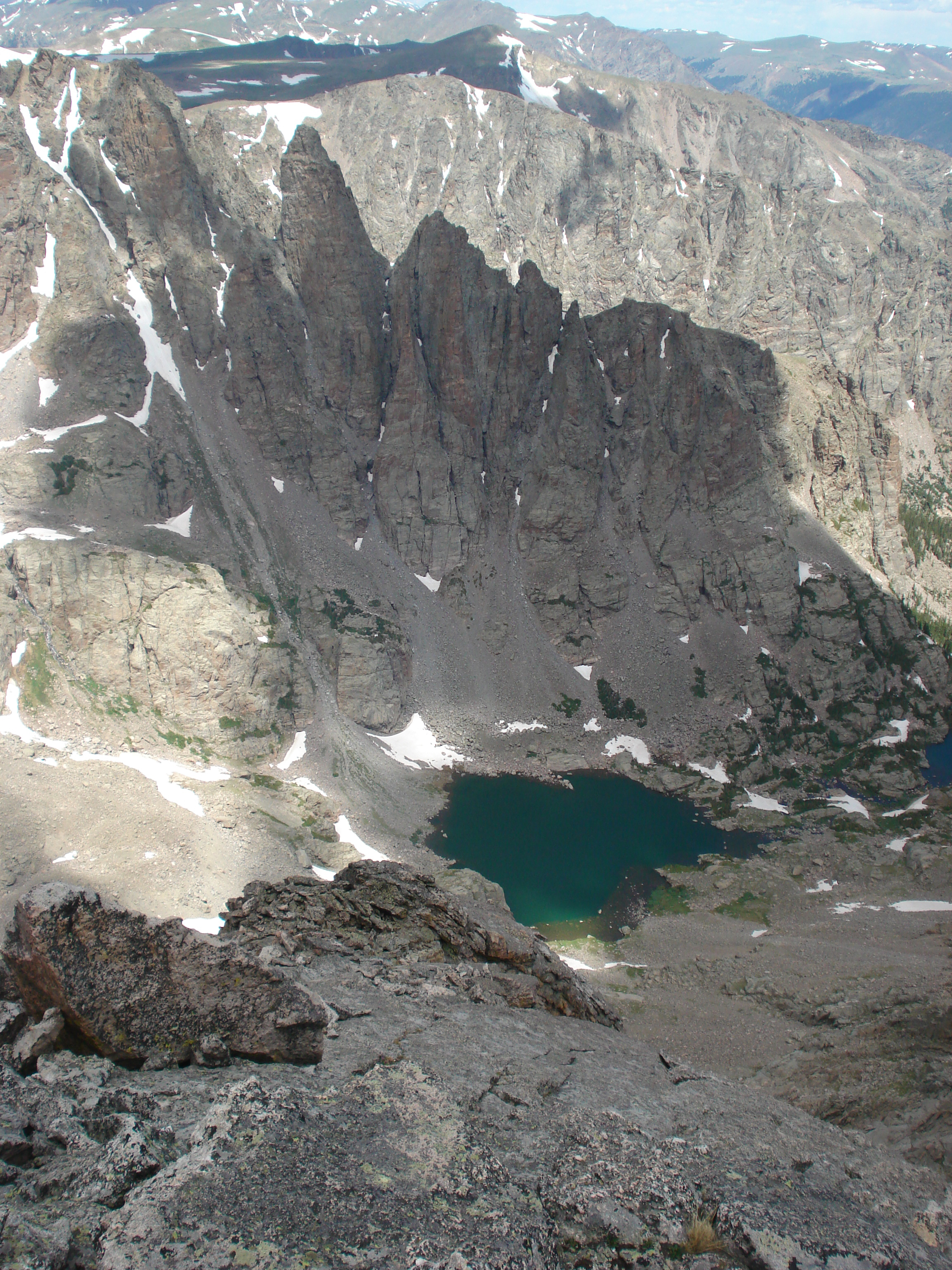
A view of the Cathedral Peaks and Sky Pond

We hiked toward Mt Taylor for about 200 feet and found a keyhole to slide through to get onto Powell’s NE Ridge. We then had to navigate a few feet of snow to reach the climbing, but that was the only snow we had to contend with all day.

Position 9

Finally, the only real hurdle remaining was the crux section of the NE Ridge; the section that I struggled so terribly with all those years ago. If we got past that section of the ridge, we would certainly make it. If the rain came before, we’d have to rope up if not turn back for Andrews Glacier. But the remaining hour before 1pm would surely be enough, wouldn’t it?
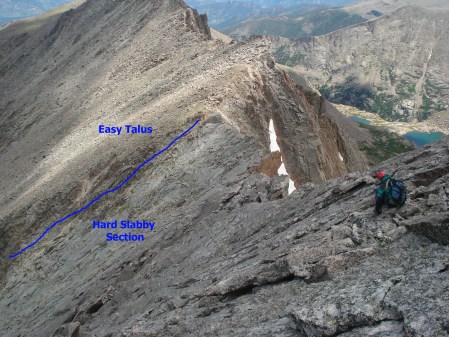
Brian working down the steep slabs on Powell's NE Ridge

I had budgeted 2 hours to do the entire NE Ridge; it took us 2 hours to just to finish the hard section.
Brian working past the crux

I was utterly wrong about how long it would take to complete the ridge. Descending 4th class slabs is much harder than ascending them.  Much harder….even when the altitude loss is minor. My mistake was due to my lack of understanding or appreciation of 2 factors:

  1. Descending 4th class slabs is complicated by the complexity of route-finding as holds are obscured when viewed from above
  2. Descending 4th class slabs is much harder at the end of a long day than seems possible at the beginning of the day

Brian nearing the end of the hard part of Powell's NE Ridge

Fortunately, the weather stayed dry.  The wind was unnerving as it tossed us around while we smeared our way across and down the slabs, but at least the rock was good for sticky rubber.

Position 10

Once past the hard section, I told Brian that I had followed the ridgeline all those years ago (which is also Roach’s instructions; I checked).  Brian said he liked the look of  the talus below the ridgeline. I wondered if there was a reason for Roach’s advice and so I angled up to the ridge near Point 12836 to see if the ridgeline was a better path.  Instead, I found the ridge was much harder than the talus below, so I descend to match Brian’s path.

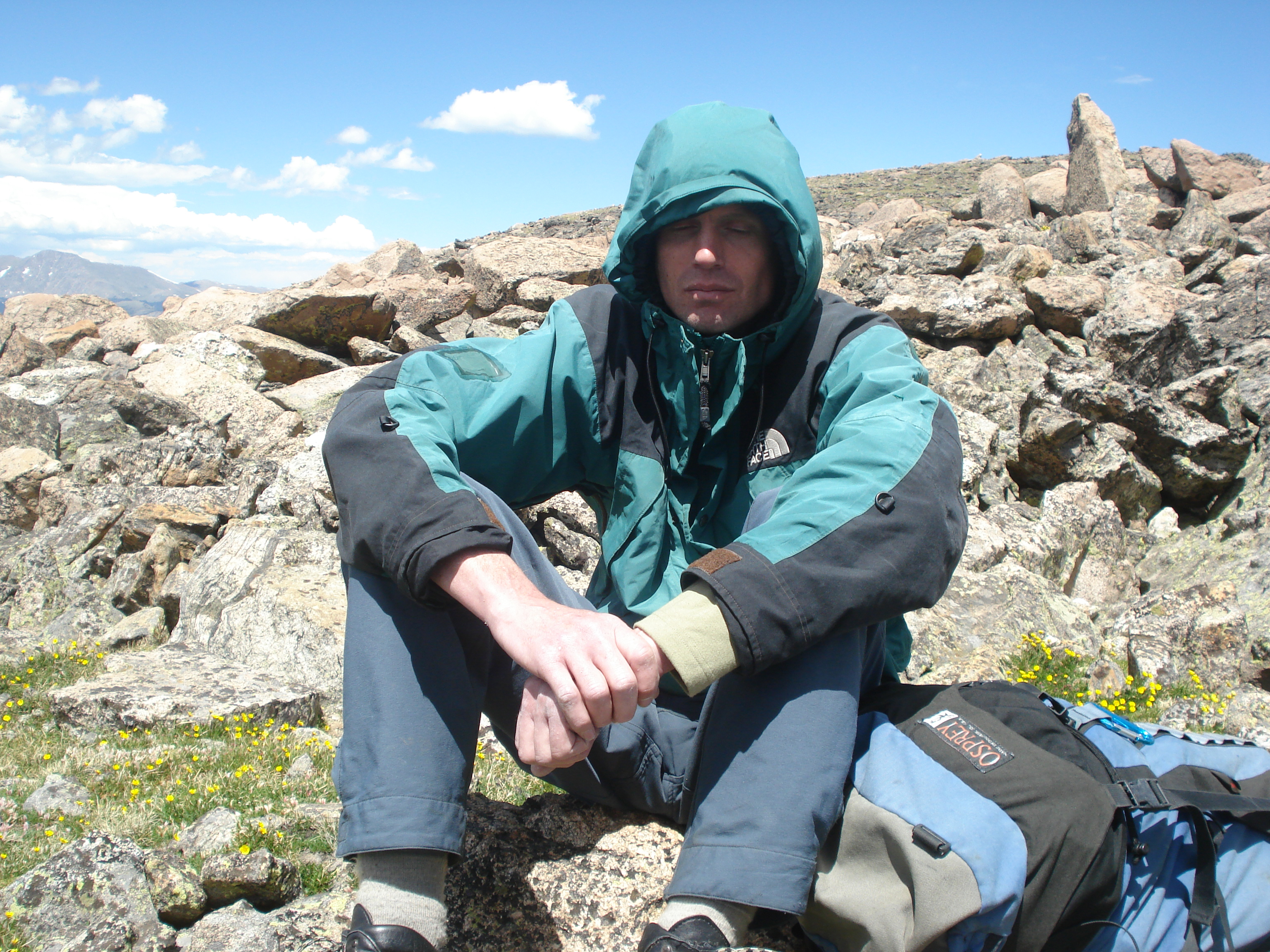
A tired Brian sitting below the summit of Thatchtop

At a little before 2pm (and the weather still holding), I found Brian resting below the summit of Thatchtop. In his green jacket, I couldn’t see him until I was within rock throwing distance. He looked so comfortable, I couldn’t resist the temptation, and so I stretched out on a grassy patch.  It turned out that he wasn’t comfortable so much as sleepy.
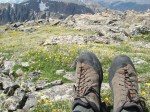
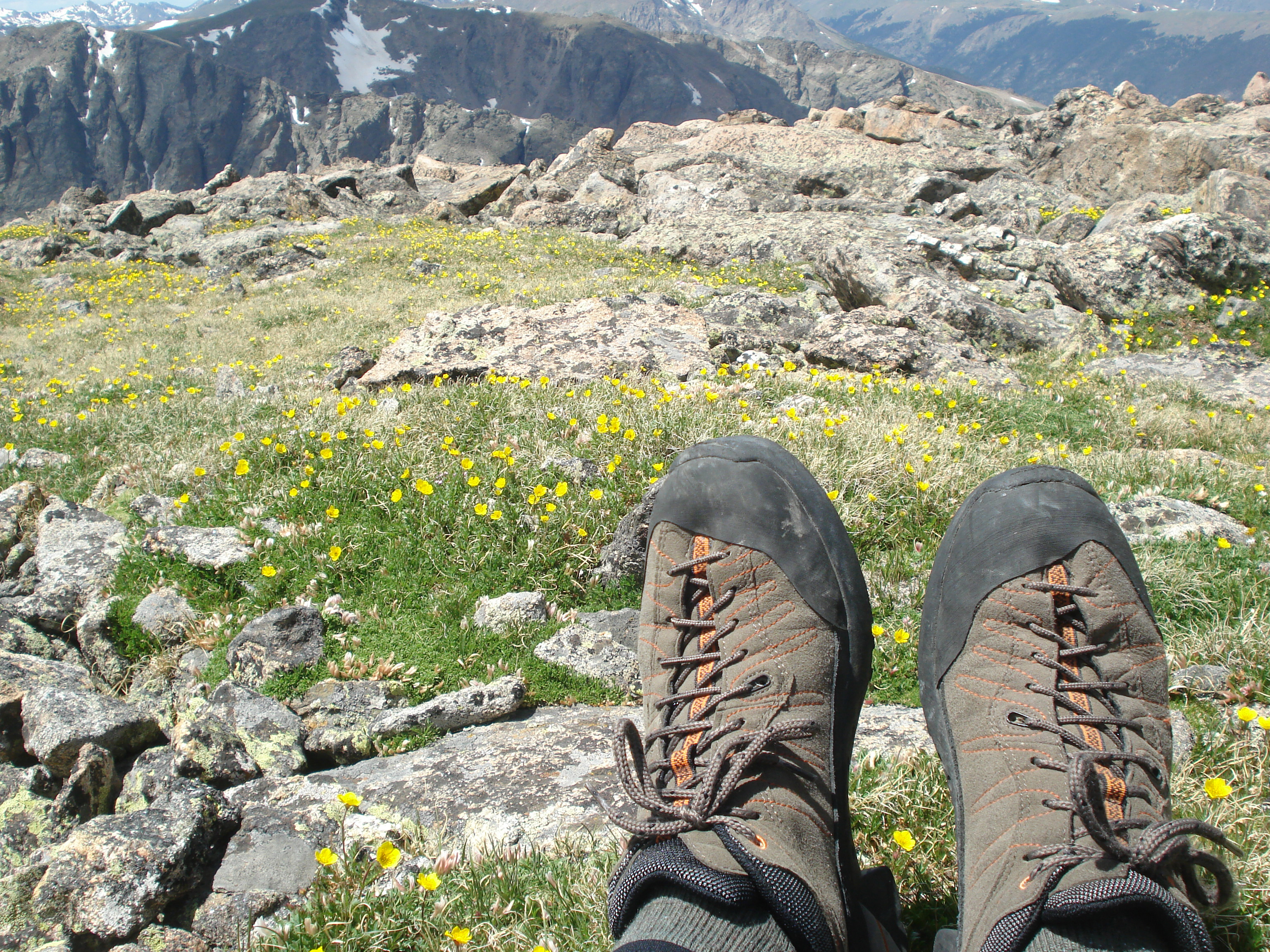
Resting my feet on Powell's NE Ridge while enjoying the flowers

I finished my water and ate a snack, and I remarked to Brian that I would be willing to pay a lot to have the truck close-by.  The thought of descending thousands of feet and multiple miles just shriveled my morale.

All I had left to comfort me were my own words of advice: the greater the suffering, the greater the feeling of accomplishment.

Misery Axiom: never turn back because of mental misery.  More mental suffering (e.g., boredom, frustration, irritation) leads to more personal rewards, which can only be harvested through perseverance (corollary to Reward Rule).

Reward Rule: personal rewards are maximized by seeking an aggressive goal that matches the most optimistic assessment of your willingness to suffer; the right goal allows both success and satisfaction

Position 11

But we had many miles to go, as it has been said before.  We trudged up to the summit of Thatchtop, and I stopped for a photo of our day’s route.

The 'Solitude Lake Cirque' route overview

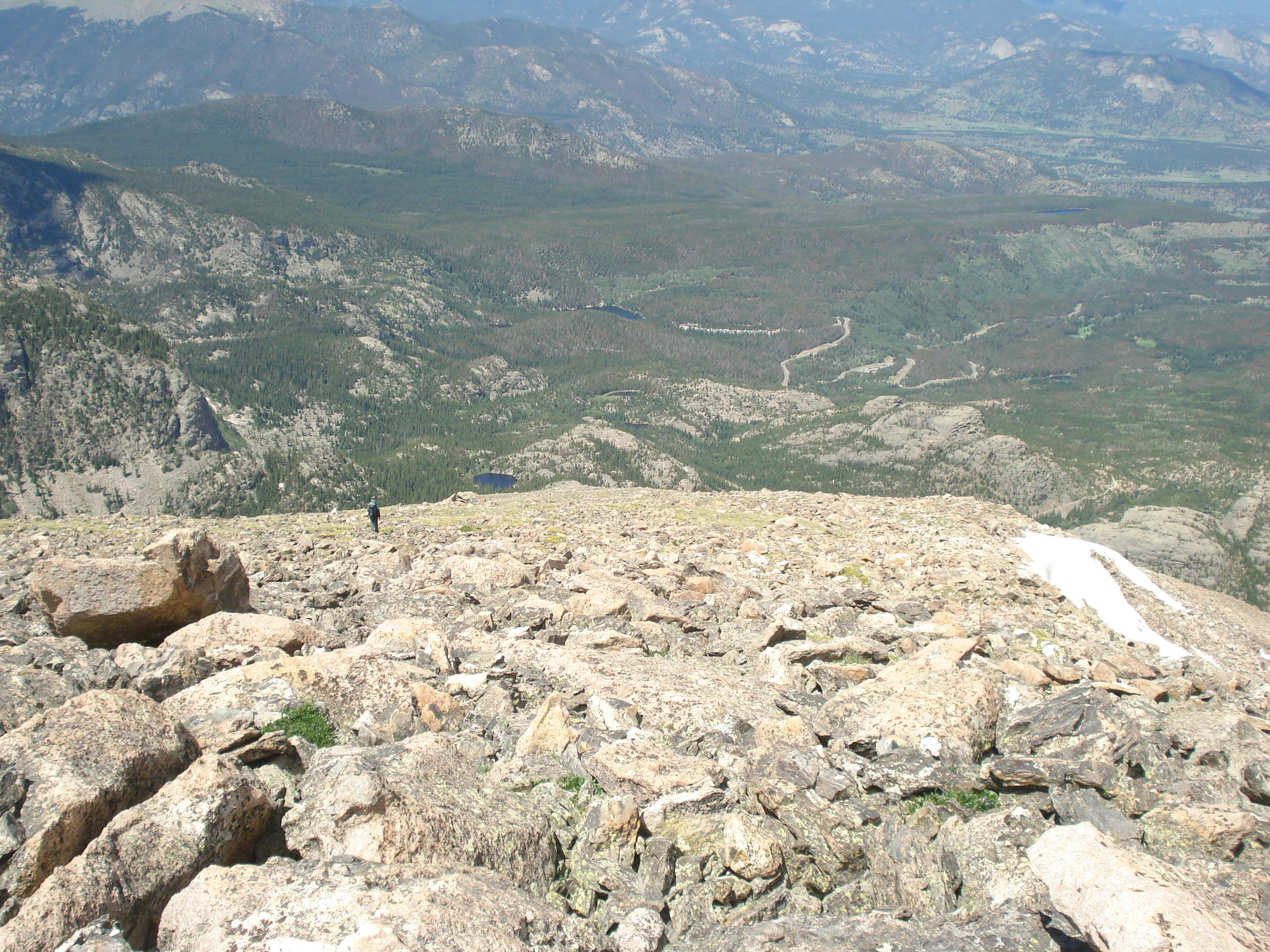
Brian hadn’t stopped, so I hurried after him, working my way down the endless talus field.  It was another mile of talus hoping to reach the bottom of Thatchtop. And at the end of such a long day, it was an endless misery.

Brian later pointed out:

Thatchtop’s name is appropriate from a long distance, but becomes supremely aggravating when one is actually on it and trying to hike over the ‘thatch’.

So true, Brian.

Brian heading down Thatchtop

And that wasn’t the end.  We still had to find the descent gully, which somehow eluded us.  After wandering through the peculiar stunted forested area at the end of the ridge, we finally stumbled upon the gully.  The gully turned out to be far more loose than I recalled; we slipped and slid down and around the corner before finally escaping.

And that wasn’t the end either.  We still had to work our way down the mixed forest/talus field to reach the creek flowing from Loch Vale.

Statistics for the 'Solitude Lake Cirque'

It was a level of effort I was not prepared to expend.  I was really beat.

I don’t think I’ve ever done so much off-trail descending.  To get down, we had to descend over 4000′ down talus and technical rock.  Try hiking down Longs Peak without using any trails..

And still we had to hike another 30 minutes to reach the car.

What a day!  I’m glad we did it. I’m glad it’s over.

Our route on the 'Solitude Lake Cirque'

See all trip reports

See all RMNP trip reports

Interesting info regarding ‘Cirque de la Solitude’ on the ‘toughest long distance trail in Europe’

Spearhead Bootcamp

June 29, 2010

A dark Spearhead in the distance

My high altitude climbing goals for the 2010 summer season meant I needed to get back into shape.

Brian had talked about redoing the Spiral Route on Notchtop; I had been talking about redoing the North Ridge on Spearhead.  We were worried about snow on the descent behind the Notch, so we agreed to do Spearhead.  A Spearhead Bootcamp, as it were.

I asked Brian what time he’d pick me up.  He responded that we used to start at 2:30am.  Now, I have to admit that 2:30am sounds too early.  I mean, why did we used to start at 2:30am?  So I started counting:  1.5 hours to drive from Boulder to the Glacier Gorge parking lot (4am) plus 2 hours to hike to Black Lake (6am), plus 45 minutes to hike to Spearhead (6:45am).  With sunrise at 5:30am, it would be light enough to climb by 6am; and with a forecast of possible thunderstorms at 1pm, starting at 2:30am seemed foolishly late.  The question was, could I live with getting up even earlier than 2am?

I agreed to be ready at 2:30am.  We’d just have to get down by 1pm.

The beautiful terrain of Glacier Gorge

When the alarm went off at 2am, I felt a wave of nostalgia wash over me.  I used to do this all the time, and I always hated it.  But this time, it just felt right. I jumped up and got ready.

We arrived at the Glacier Gorge parking lot at 4am and started up the dark, windy trail.  There were a few cars in the lot, but we had the trails to ourselves.

A snowy barrier below Black Lake

Upward and onward we hiked toward Loch Vale, taking the cutoff to Black Lake about 1.75 miles in (using the shortcut).  We could hear the full creeks roaring by, but could not see a thing outside the flashlight beams. It wasn’t until we were hiking below Arrowhead that the sky started to get light.  To that point, we’d walked on dirt and rocks; no snow any where near the trail.  But as we approached Black Lake, we found a lot of snow.  It was a delicate thing, walking across frozen snow in sneakers. But it only slowed us a bit, and we arrived at Black Lake at 5:45am.

I really should have brought better footwear. Sure my light hiking sneakers felt great while carrying them up the climb, but on the hike in and out they felt like slippers that permitted the roots and rocks to bash and mangle my feet. It is said that good fences make for good neighbors; I contend it is also true that good boots make for good terrain. I won’t make that mistake again anytime soon.

My first good view of Spearhead for the day. The North Ridge route ascends the right hand boundary of the broad face in the photo.

Sunrise may have been at 5:30am in Denver; but in Glacier Gorge, we could see little of that sunshine.

While I was starting to feel the weight of my pack (full of rock gear) and my lack of conditioning, I decided to push on to Spearhead without a rest.  Of course, Brian didn’t need one.

We were ahead of schedule and made good time up the drainage creek path to reach the Spearhead basin. All that was left was to figure out a path through the willows and streams.  Brian was ahead and took a wide detour to the left.  I thought I’d head straight on to save time.  After dunking a sneaker (made of meshy, spongy material), all I can say is my path was straighter.

At least by that time, the sky was fully lit, even though the sun would not be seen for another hour.

Spearhead is a spectacular chunk of rock.  The North Ridge route ascends the long ridge that forms the northeast face.

Brian catching a few winks at the bottom of Spearhead's North Ridge

I stopped at a small pond to fill my water bottles, take off my wet hiking sock, and give my right Achilles tendon a rest. It only took 5 minutes to complete my chores, and then I worked my way past some sleeping biviers to the start of the North Ridge route, where Brian was catching a few winks.

We started up at 7am.  Brian was shivering after his grass nap and so took the first pitch to warm up.

Pitch 1

Brian started up some easy rock and then moved left to cross a slab to get beneath the twin chimneys.  I followed and was amazed to struggle on the slab traverse.  I commented to Brian that perhaps he should have gone lower.  Perhaps, my declining skills and tolerance for altitude just made the low 5th class rock feel hard.

Brian leading the 1st pitch of Spearhead's North Ridge

I joined Brian beneath the left chimney and grabbed the gear.

Pitch 2

First on the agenda was to look at the rappel sling someone had left behind at the top of the chimney. I always like to find biners and usable rock gear to use for own my escapes.  But this was just a knotted sling stuck in a crack, and the water knot was tied with the tails so short that one has slid back into the knot.  That sling had some bad karma; I left it behind.

I continued up the crack to reach a flaring dihedral .

Then I reached a 2nd flaring dihedral, this one had a wide crack in the middle. I used the left face as it had all the holds.

Above the 2nd pitch

I continued up the ridge until I reached a ledge below a short crack. The rope was starting to feel heavy and my Achilles was demanding a sit-down rest.  I took it.

I started Brian’s belay with 3 tugs, and then I enjoyed the spectacular view of Glacier Gorge.  My eyes followed our approach path, winding up from below Bear Lake, past Mills Lake and continuing beneath Storm Peak, Thatchtop and Arrowhead to reach Black Lake, and then winding through the willows and drainage creeks to reach the foot of Spearhead.  It was breathtaking.

And we had the peak to ourselves.

Brian arrived after a short while; we re-racked and then he left, heading further up the ridge

Brian arrives at the end of the 2nd pitch

Pitch 3

Brian scrambled up the ridge line with all apparent intentions of going further than he had rope.  I gave him some rope tension to signal the impending ‘end of the line’.  He quickly found a solid belay and then I followed after struggling to extract my bomber nuts in the belay anchor.

I followed up the exposed ridge and enjoyed the excellent views of Sykes Sickle and the great rock above us.  The sun was finally beating down on us and my sweater and rain jacket started to feel like too much.

Joe (me) at the 3rd belay, about to start the 4th pitch.

I reached Brian and requested I get in one of the photos, and then I started up.

Pitch 4

Initially, I wandered left to take a new line, but the rock looked dirty and steep; I backed off.  I went up the obvious weakness in the otherwise slabby rock directly above the 3rd belay.  The climbing was rather easy and I was surprised when the rope ran out. I struggled to put in a good belay anchor, but was soon giving Brian a belay to my position.

He arrived quickly and then set off for the “big block” (Roach).

Pitch 5

Brian made short work of the rather easy rock leading up to the base of the big block, and I followed quickly.  As I approached, I recalled reading Roach describe that the standard route went right of the block to reach a ramp.  But I was certain that we’d always gone left for some challenging (as I recalled) climbing.

Above the 3rd pitch

It would be my pleasure to pick a line.

Pitch 6

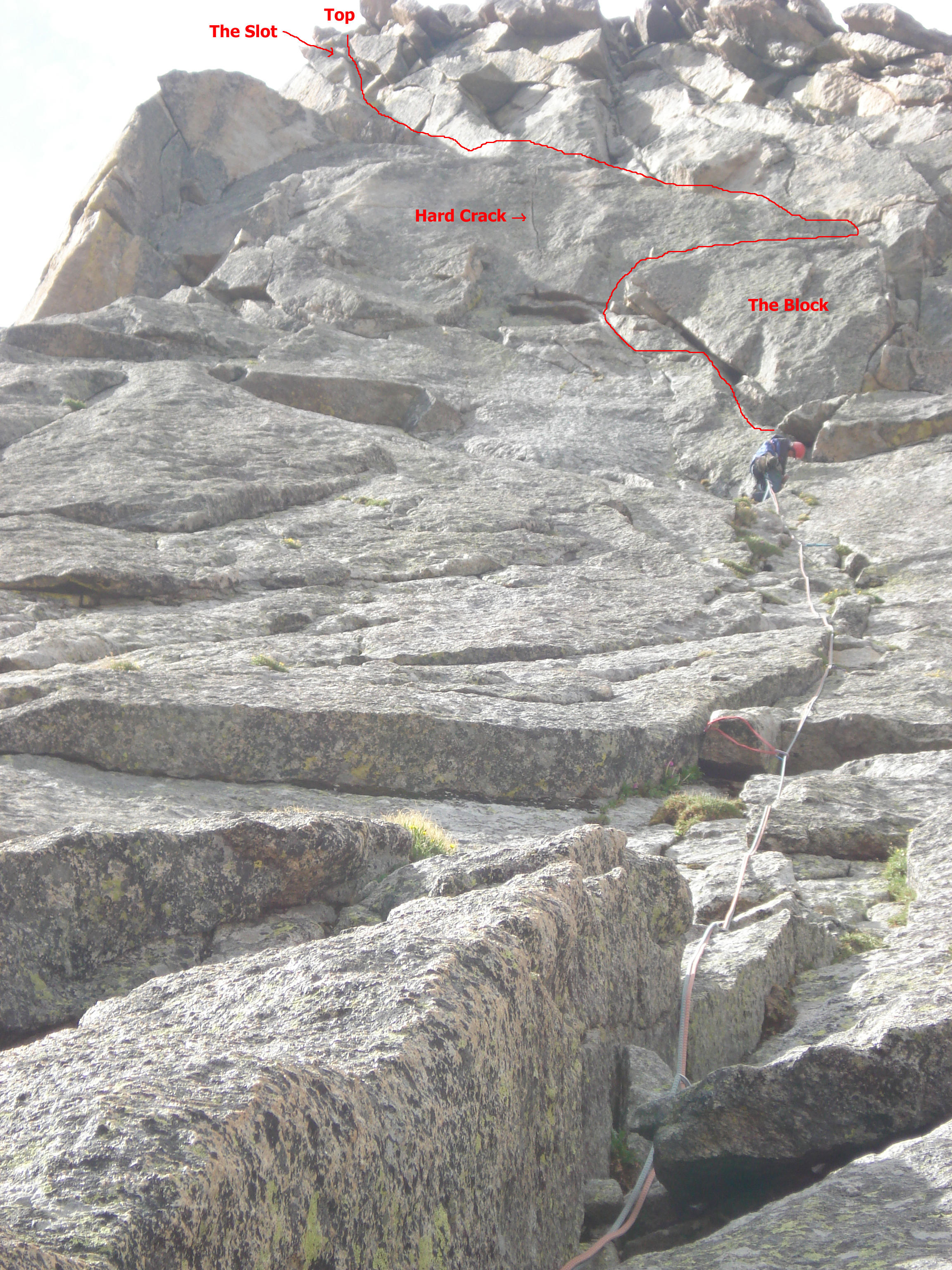
I asked Brian what he thought. Instead of left vs. right, he suggested a hard crack variation (further left) that we had done the last time we did the route. I had no memory of the crack variation at first, but once I saw it I remembered.  And I remembered it was hard.  Brian suggested that

I take the crack and belay near the top of the crack, for a 100 foot pitch; then he could take the last 100 feet to the summit, including the awesome step back to the ridge and ‘The Slot’ (Roach) leading to the top of the climb.  Hmmm.  Well, I did seem to recall that is the way he did it when he led it some years ago.

I worked up the left leaning crack underneath the roof.  I had to choose between traversing left beneath the hard crack or continuing to the top of the roof before traversing left using a nice looking hand ledge.  I picked the hand ledge.

The view above the 4th belay with Brian near the 5th belay and a route line drawn to indicate the 6th pitch

I continued up and stood on top of the roof; it was a nice rest for my Achilles.  Then I looked at the hand ledge and discovered it was not as ‘nice’ as I had perceived from below.  I was still within talking distance from Brian, so I asked him what he remembered from his last visit.  He seemed to recall putting in gear on the left; I’d missed the route. I felt I could make it, but I would have had to make a hardish, unprotected traverse to reach the bottom of the hard crack.  I bailed on the idea.

I wasn’t terribly disappointed. I had mixed feelings to start with. I wasn’t sure I wanted to do the hard crack anyway, and I was damn sure I didn’t want to give up my lead on the best part of the route. I called back down to Brian to tell him that I wouldn’t put in any more gear until I was above the hard crack so he could climb it, and that I would see how high I could get.

He nodded and sealed his fate.

The start of the 5th pitch, heading left of the block overhead

I continued right across the roof to reach the bottom of the left leaning ramp.  Then I worked my way back above the crack where I finally put in another piece of protection.  I asked Brian how much rope; he indicated more than half.

How could I stop?

I looked up at the set of dihedral leading to the top and couldn’t tell which one I was suppose to climb. But I did know that I was supposed to reach the ridge at the top of the dihedral, so that meant I needed to climb the furthest left one.  It started looking familiar, and I remembered climbing it easily in the past, but those days were gone (not forever I hope).  I struggled up, and desperately searched for places to rest my Achilles.  The only place I could find a rest was at the top of the corner with one foot on the either side of the ridge crest.

It had been my intention to belay below The Slot, but I couldn’t work out a good belay.  Plus, I could see that the route only had 20′ to go.  I decided to push on and explain later.

Brian nearing the top of the 6th pitch

I stepped up and wedged myself in the slot, and found the climbing to be easier than I remembered.  Before, I’d always had tremendous rope drag, like I was dragging a couple dudes behind me.  But this time it was smooth sailing. Later I figured out it was because I didn’t place any gear on the ramp (to the right of the belay); a great lesson for the future.

I dragged my oxygen deprived body over the top, grinning like a Cheshire Cat.  I set out to place an anchor but found the rack to be nearly empty of gear and slings; I guess I had been stressed a little bit. I managed to build a solid anchor out of a cam and a wedged ass, and then I pulled up the rope.  I had at least 20 feet of slack!

I brought Brian up and was thinking about how I’d explain not leaving anything for him to lead. I was ready with my excuse, but he caught me so off-guard by cursing me while he was still doing the crux that I could only say, “I still had rope so it was technically my pitch.”  I think I’m right about that.

Once at the top, I had intended to return to the summit, as we had done the first time we climbed Spearhead in 1997.  But the weather wasn’t looking great, so after a short visual tour of the area, we started back down.

Our view from near the top of Spearhead

Rarely is a mountain summit a literal point, like the tip of a spear; but Spearhead was one of the rare ones.  The top was so small, we had to take turns sitting on it (on our initial visit in 1997). And, to make it even more interesting, the top was shaped like a throne; it was a flat seat with a comfortable back and arm rests.  It is the best seat in my RMNP palace.  Feel free to use it if you stop by.

The descent was as bad as I recalled, but we made it down without incident.

Once at the bottom of the route where we’d left our packs, our first order of duty at Spearhead was to confirm that our lunch survived our absence. This is the only real difficulty with Spearhead….there are no trees and so no obvious way to secure the food.  On our first climb in 1997, Brian tried to hang his lunch from a steep part of a large boulder; a marmot ate the sandwich and most of the plastic bag.  This forced me to give up one of my food bars and Brian to gag it down.  On our third visit, crows got into my pack (they unzipped my top compartment) to get my food bars; I don’t remember what Brian shared with me to power me home.

This time Brian resorted to burying his lunch beneath a heavy rock while I carried my bars to the summit. And we each managed to eat the lunch we brought from home.

I also did my normal ‘what time do you think it is?’ contest.  Brian guessed 12:30pm; I thought it had to be later, so I guessed 1:30pm.  After digging my watch from my pack, I could see it was 12:23pm.  Brian has a very good internal clock.

We had now climbed the North Ridge route on Spearhead 4 times.  It is a classic.

The rain and hail did catch us on the hike out, but we survived it.  The last part of the hike out felt like a death march, and my joints were killing me.  My knees are old foes, and my ankles were in revolt as well.  And my feet were destroyed by stupidity.

Spearhead approach & hike out

We made it back at 3:30pm for a 11.5 hours round trip, only 30 minutes longer than our first effort 13 years earlier.  But I was hurting pretty badly; I forced Brian to stop on the drive out so I could soak my legs in the creek for a while.  ‘Awhile’ in running, freezing water turned out to be 3 minutes.  But it was good for what ailed me.

I may get into shape yet.

Maybe next week we’ll do the Spiral Route on Notchtop.

See all trip reports

See all RMNP trip reports

Lumpy Orange Julius

June 21, 2010

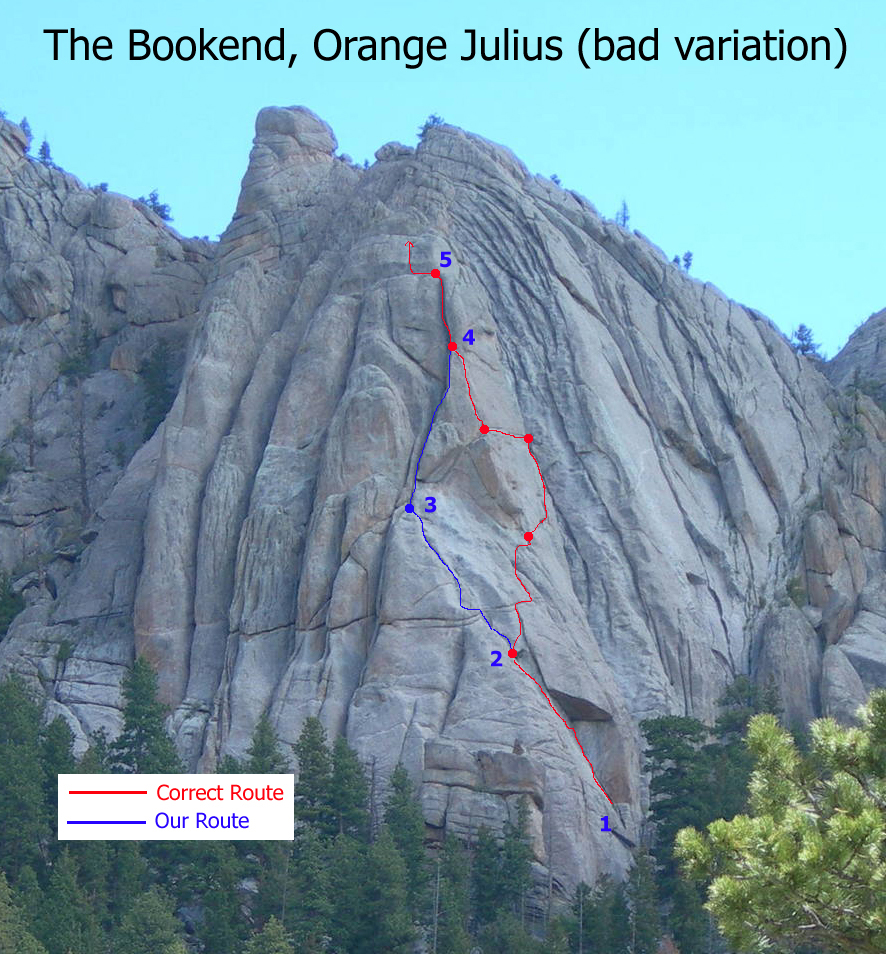
Okay, okay.  The title is a bit misleading, but I felt a little less than myself when trying to come up with a title.  I made do; I hope you’ll do the same.  This is a trip report about a misadventure on the Bookend crag at Lumpy Ridge climbing the classic rock climb, Orange Julius (5.10b).  It is a great climb, I hear; I can personally attest to the 1st and last pitch, which is all we did of the route.

The weekend before, we had successfully dodged trains and unsuccessfully dodged poison ivy in an unsuccessful attempt to climb on Mickey Mouse Wall near Eldorado Canyon.  After finding a “Raptor Closing” sign on the rock, we decided to make the best of what was available, some hard (5.10ish) face climbing on a few bolted routes we found nearby.  With that success, we felt confident to try something new (and hard) at Lumpy Ridge.  Brian picked Orange Julius.

On June 20, 1998, we hiked into Lumpy’s Bookend area and did a warmup climb on The Great Dihedral before starting up Orange Julius.

It was an epic.

Our unintended variation of Orange Julius

Pitch 1

Brian led the first pitch, which was the official crux of the climb, rated at 5.10b (very hard for normal people and one of the top 3 difficult routes I’ve ever done). Oddly, he struggled to get off the ground, but soon was cruising.  He ascended the dihedral and then used thin, wet face holds to traverse left out from under the roof.  The nice horizontal crack at the top of the face (under the roof) provided excellent placements for pro.  Once out from under the roof, he moved higher and found a nice belay behind a tree. I was impressed with how easily he moved past the crux; it gave me hope that the climbing was easier than the rating.

After a moment or two, Brian yells down to announce that the blue rope is stuck and he could only give me a belay on the green rope (we use a double rope system). Great.

I did a layback move to get past the ground level difficulties, and made good time up the dihedral to the roof. I then examined the rock under the roof to see what kind of hand I’d been dealt.  My high hopes for a moderate traverse were dashed immediately.

The holds were very thin and very wet.  I didn’t see any way my shoes could stick to that thin razor of an edge protruding from the rock face that I had to use, and my hand holds were worse. And everything was slick with water. I had to admire Brian for his grace, but then I realized that he had a top-rope!  The gear was above his head when he did the crux.  I had already removed the piece in the roof that protected these thin moves, and the next piece on the green rope (blue was stuck, remember) was 15 feet directly to my left; if I fell, I was going to swing a long way before smashing into the rock.

So, I had to do it.  The sequence was step out onto the wet, razors, and then step through to the next set of wet, razors, and then grabbing for a bucket.  Oh shit!

Okay, I’ve done stuff like this before, I can do it! (yeah, right; I’d done it once or twice, when dry, and not facing a big fall).

1-2-3, step, and step, and reach….made it!  How’d I do that?  Sticky rubber is truly a miracle.  I love sticky rubber!

I then cleaned up the rest of the gear, including the one that was all jammed up with the blue rope. I joined Brian at the belay and we exchanged some prideful notes on the crux pitch.  It was my turn to lead next; I was so pumped full of adrenaline that I didn’t bother to look at the topo in my pocket.  I just started climbing up the rock.

We wouldn’t see the Orange Julius route again for several hours.

Pitch 2

I went straight up the crack above me looking for a traverse right; what I should have done was quickly head right.  But I was just climbing along without thinking, and was happy as a lark.  That is, until, the good rock ran out.

I came to a mantle move that didn’t seem to lead anywhere. I didn’t want to have to reverse a mantle (and I hadn’t been able to place gear in a while), so I looked around for a better path; there wasn’t one.  So I took the mantle and then started feeling around the bulge to the left for holds; the rock above and to the right was blank.

I felt a crack, so I blindly stuck my foot around the corner and jammed my toe in the crack to balance my reach around to place some protection.  Delighted that I wouldn’t have to fall a long way, at least for a while, I made the move around the bulge and continued up.  The higher I got, the less protection I found and the dirtier (read: not climbed often) the rock became. My mind finally started working, and I started to realize that something was wrong.

I made another mantle…8 feet above my last protection…I put in a very bad TCU and then made a 5.9 crack move to a ledge…now 15 feet over my last good protection…and all the while thinking that my gratitude for chalk bordered on the religious. And looking up for some salvation, I could see bolts!  I’m saved!

My desire to live was high as I crept up a sloping slab of grit covered rock to reach the ledge with the bolts.

Brian followed quickly and offered me his highest possible compliment under the circumstances, “I bet that was scary!”  What I mean is he couldn’t rightly offer me a ‘nice lead’ complement when I really screwed the pooch.

Pitch 3

Brian then took off up some nasty off-width. He found the right path, but didn’t have enough big gear to stay in it; so, he stepped left and worked up some overhanging rock with good holds to reach a good ledge atop a pillar.

I followed quickly, but begged off taking the next lead. It was getting late and God only knew what rock was above us; we needed our best climber on lead, if we were going to have our best chance to make it out alive.

Pitch 4

As we were getting ready for Brian’s lead, the rope pile slipped off the ledge.  Brian asked if we should restack the rope; I looked over the ledge and saw that it was merely hanging straight down, not caught on anything.  I said ‘no’, it will be okay.  Brian accepted my judgment and started up the 4th pitch.  The Utter Fool!

As he was climbing, the rope was giving me more and more trouble.  It was getting friction on the rock below somehow; but I kept working on it enough to feed Brian the rope he needed….right up to the moment that the rope got fully stuck below me.

I yelled up to Brian to see if he could get off belay to let me fix the rope. I could barely make out what he was saying until I finally understood that he was saying ‘no’. I pulled like madman and managed to get enough slack to let Brian reach a belay.

But even with both hands available, I couldn’t work it out.  I managed to pull in enough slack on one rope to rappel over the edge to clear the jam.  It was overhanging, so it wasn’t easy to reach the problem.  I finally managed to work it out, but then I had to climb back to the belay station while giving myself a belay; I would climb a bit and then take in the slack and re-tie in.  The climbing involved some hard face climbing and a pendulum, but I made it.

And then I had to climb up to the next belay; well, at least this part was on a good belay.  The hardest part was a dead vertical section with thin holds.  Normally, the pro is placed before a hard section, but this time Brian had really wedged in a brown tricam right at the pitch crux.  I worked on it until my hands gave out; then I worked on it while hanging on the rope.  I still couldn’t get it out; I really hate it when Brian places tricams like nuts instead of cammed.

I was already in a foul mood from the stuck rope; I just left it.

When I reached the belay, I told Brian that I left that damn tricam behind because it was placed badly.  He grinned and said, ‘that was a hard section, huh?’  I agreed, and then he said, ‘that’s where I was when you asked if I could get off belay’. Touche.

Pitch 5

We figured we were back on route, finally.  All that was left was a 5.7 chimney that led to a bunch of easy but exposed scrambling.

It was a hell of a day. I really have to be more careful.

Someday I’d like to really climb Orange Julius; I hear it is a great climb.

See all trip reports

2nd Flatiron Waterfall Climb

June 16, 2010

Brian and I had scheduled a Lumpy climb for Saturday, June 12, 2010; but the weather didn’t cooperate.  After a month of hot, clear weather during which Brian skiied and I did therapy on my knee, the forecast for our rock climb was rain and cold.  Thanks.

But the forecast for Sunday looked better, so we agreed to push the plan back a day; and in addition, we agreed to move the climbing to lower elevation. We agreed to go to Eldo if the weather was good or Flatirons if the weather was bad.

We didn’t have a plan for very bad weather.

When the forecast turned to “rain all day”, we agreed at the last moment to do the 3rd Flatiron.  We’ve done the 3rd in snow and ice; we felt confident we could do it in a steady rain as well.

We started hiking from the Chautauqua Ranger Station parking lot around 8am, taking the old paved road to avoid the muddy trench that the main trail becomes when wet. It was steadily drizzling into the standing puddles that had accumulated over the past 2 days of rain. On the hike in we discussed Paul Graham’s essay on Why Nerds are Unpopular (in school).

At the turnoff the Royal Arch trail to the 2nd/3rd Flaitron approach, Brian stopped to look at the “Rock Climbing Closure” sign.  Shit.  We’d forgotten about that stupid raptor closure program that I’ve had to contend with since before I moved to Boulder many years ago.  The 3rd Flatiron was closed until the end of July.

There is no nonsense so arrant that it cannot be made the creed of the vast majority by adequate governmental action.

~Bertrand Russell (1872 – 1970)

Neither of us had a guidebook, so we resorted to mining our failing memory about past climbs and unclimbed objectives that might work under the current horrendous conditions.

My first comment was that the Tangen Tunnel route would be perfect except for the blanket of Poison Ivy living in that particular gully. I then offered the idea to finally climb the Royal Arch, but Brian rightly thought the climbing would be too steep for exceptionally slippery rock.  Brian then suggested the 1st Flatiron, but there was no way I was going up the steep East Face Direct in a steady rain.  I’ve done it wet by accident; I wasn’t going to do it intentionally.  Then I had the idea to do the 2nd Flatiron.  I remembered someone telling me about the “Highway”,  a 4th class route that went up the gully between the South Block and the main portion of the 2nd Flatiron that led to the Hanging Garden below the “Pullman Car” that capped the 2nd Flatiron.  Of course we’d skip the Pullman Car, I said.  The route had been described to me about 10 years ago, but it still felt fresh in my mind because I had thought about it every time I’d climbed the 2nd Flatiron. Brian agreed and we started for the base of the 2nd Flatiron.

Unfortunately, I was completely wrong.  The route was not “Highway” but “Freeway” and that route doesn’t go up the gully but rather up the face well to the right of the gully.  The route that does go up some of the gully is “Dodgeblock” but it starts differently and dodges the Pullman Car to the right; it does not go left of the Pullman Car and into the Hanging Belay.

In fact, no established route, 4th or 5th class, goes up the gully all the way to the Hanging Belay. I misunderstood what I was told about “Freeway” all those years ago and I never bothered to check it out. My foolishness would be the catalyst for an interesting day in the rain.


The 'Waterfall' route and our other regular routes up the 2nd Flatiron


On the way there, the weather actually worsened.  It was raining hard by the time we started up the vegetated gully.

Position #1

About 100 feet above the hiking trail, we stood beneath a house sized boulder choking the gully.  It looked like we might be able to work up and around to the right, but Brian wanted to try to climb the left side up a low angled dihedral. We got our harnesses on and then he started up in his hiking boots. He refused a belay.

Under the current conditions, I surely did not want to be standing beneath him when he came sliding back down the slip-n-slide.  It would have been a bad tumble back down the rocky, tree-filled gully.  I stood off to the side and encouraged him to request a belay. He explained that the rope might let him avoid getting so wet and dirty (he was laying on the rock for full body friction), but ‘no thanks’. Apparently, he was working on his mental toughness.  Fortunately, he made it to a small ledge with injury only to his clothing.

I took a belay and managed to avoid the mud wallow Brian endured, but it was very sippery. I was very glad to have the belay. I continued up the next obstacle and setup a belay behind a large tree another 50 feet above.  It was a wet, gooey, slippery experience, not significantly different from how I would imagine the experience of climbing a waterfall with mossy vegetation beneath the water.

Position #2


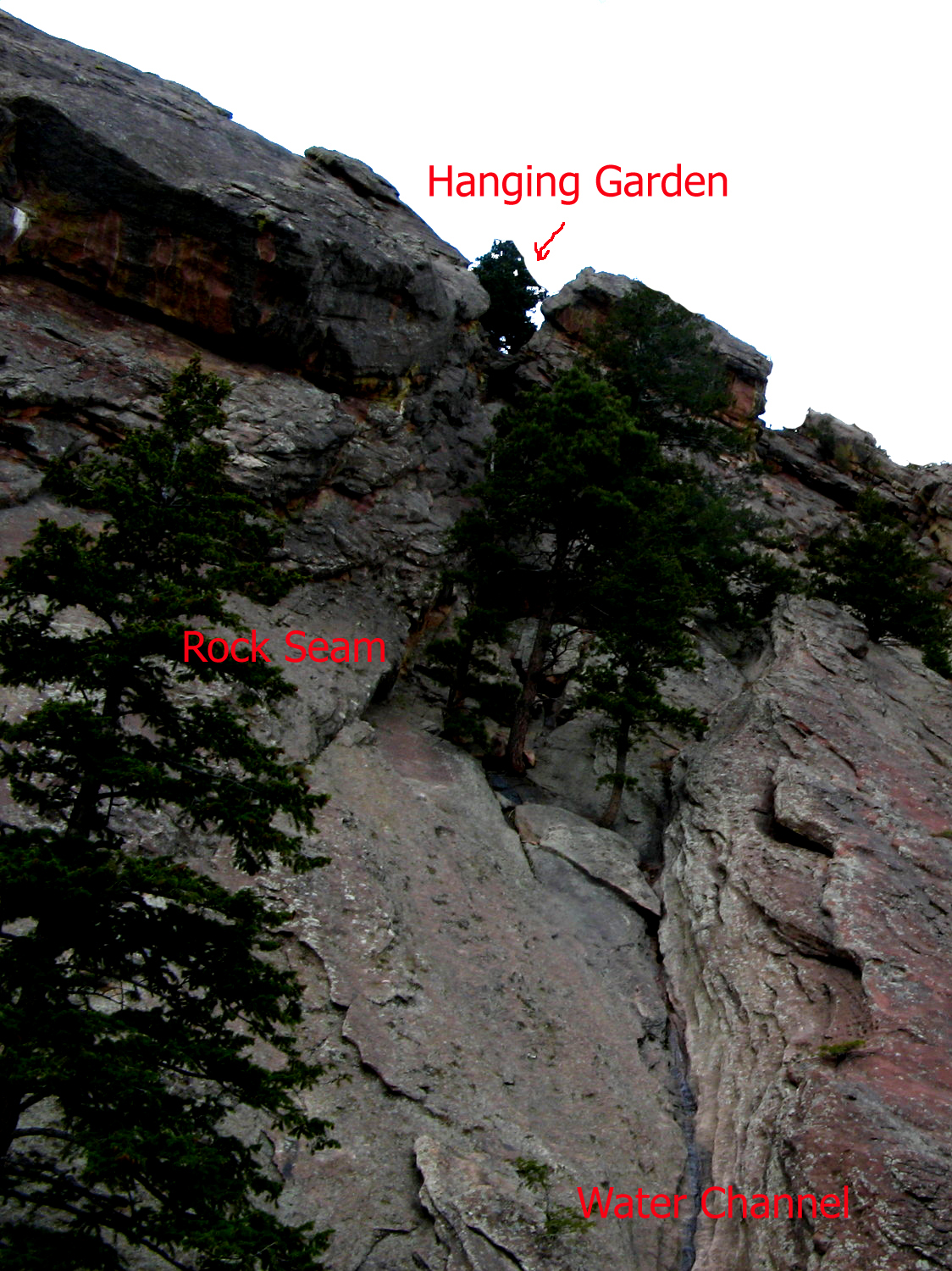
Our route followed the rock seam and then the tree lined gully toward the 'Hanging Garden'. Photo not from rainy day (imagine torrents of water pouring down the gully)


We then scrambled up another 100 feet to reach the bottom of a true waterfall. The water was cascading down a broad slab of smooth rock with a channel cut just below a rib of rock; the channel looked to be cut into the rock by thousands of years of running water. The slab of rock blocked easy access to the tree-filled gully 100 feet above. Uh oh.

With most of our views obscured by trees and by the heavily falling rain & mist in the air, I wasn’t sure where we were.  At first I (wishfully) thought we were underneath the Pullman Car, but it was just the overhang on the South Block.  I noticed another gully to the right (north) and thought I had found the way up; we traversed north 50 feet and then scrambled up 50 feet to were I could see well enough to know where I was.  We here standing at the bottom of the gully that we use to reach the bottom of the Pullman Car on our normal 2nd Flatiron route (which is similar to Free For All).  I remembered that this water-smoothed gully is steep with delicate climbing when dry and in rock shoes, and that the only escape I knew was the 5.6 traversing crux underneath the Pullman Car.  No way we were going to do that in these conditions. Shit.

That was when I knew that I had screwed up.  We weren’t going to make it. If we were going to push ahead, we’d have to commit to a risky effort. Turning around was a solid option, in my mind.

Position #3

We returned to the waterfall and Brian said he wanted to try it. I tried to talk him out of it as I thought the protection would run out after 20 feet. My point was we were in a good place to bail from, while 50 feet up with no way to secure a rappel would not be a good place to decide to go home. But Brian was feeling adventurous, I suppose; and he started up the waterfall. At least, this time he took a belay.

But, the rock was too slippery for hiking boots, and we figured rock shoes would be worse.  He slid back to the ground before putting in a single piece of protection, and gave up on the waterfall.

Position #4

I looked around and then pointed to a seam and a potential ramp in the rock above us and to the left, just below the South Block.  I wondered out loud if that would allow us to work our way above the waterfall area. Brian jumped to it, apparently determined not to go home just yet.

He led a scrambling pitch to a saddle between the waterfall gully and the South Block of the 2nd Flatiron.  From that platform, we could see the diving board flake that is the crux of the Southeast Ridge route on the South Block; it’s a 2-move route, but it is awesome set of moves. We could also see that our best bet was the seam in the rock face that led toward the tree-filled gully.

Brian again took the sharp end and oh-so-gingerly worked his way across the slick rock using the rock seam.  The seam provided just enough protection and friction to make it possible to cross this amazingly slippery rock in hiking boots while dragging a 20 lbs rope (soaked with water).  Brian yelled that the slabby bit at the end (after the seam ended) wasn’t as bad as it looked from afar.  When it was my turn to cross it, I complained that it was exactly as bad as it looked.  Yet, we both made it without a slip.

Position #5

And once we were past the waterfall area, I felt sure we would make it.  Despite all evidence to the contrary, I still clung to a certainty in my mind for the climb-ability of the gully beneath the Hanging Garden that I had casually glanced at on a number of occasions over the years. It surely was a day for being very wrong.

A 20 foot scramble led to another waterfall, and this time the water fell over an overhanging lip of rock; we wouldn’t be climbing directly up it. We found a path to the right that required a significant reach to utilize a hold big enough to pull our bodies out of the falling water. As I pulled my gore-tex protected bulk out of the water, I could feel the difference between a good rain jacket and a dry suit; I could only wish for the latter.

Position #6


The 'Waterfall' route crux


Another 20 feet of scrambling led to another waterfall, and this was a big one. It was directly below the Hanging Garden between the summit of the South Block and the Pullman Car atop the 2nd Flatiron. And, it was another overhanging rock formation that we would not be able to climb.  But while we could climb around it, I could finally see the gully beneath the Hanging Garden; and I could see how it was steep and featureless, and I could see how so very wrong I had been all day long.

I got that sinking feeling, the one that says “I’m screwed!”

Brian rightly insisted on solving one problem at a time, and we climbed up and right to get past the waterfall and reach the bottom of the technical climbing directly beneath the Pullman Car formation.  From there, we’d have to traverse left back into the gully, and then climb straight up into the Hanging Garden.

This was it.  The crux.  If we couldn’t slither our way past this last section of rock, we’d have to rappel all the way back down the gully.  I dreaded it with all my heart.

And, it looked hard.  Just looking at the smooth rock, I wasn’t confident we could even get around the corner to get back into the gully below the Hanging Garden.  The rock was slick and it lacked the normal flatiron features we’d been using to get this high.  Once again, Brian started up.  I told him to aid it, if he could.

The only thing going our way was the weather.  At last the rain had stopped.

Position #7

He put in a yellow camalot and then the grey one in the overhanging lip on the corner.  He managed to pendelum out into the gully and then climb up a few feet, but soon slipped back down.  It was too slippery. It wasn’t going to work.

In desperation, I suggested he try his rock climbing shoes.  I was just thinking that we should try all the possible variations; I really didn’t think the treadless rock shoes would hold any better. Brian returned to the belay to change shoes.

It was still agonizingly slow, but Brian managed to work back out to the gully and then upward about 1/2 way to the Hanging Garden before bringing me up. I took my own advice and put on my rock shoes; they stuck to the wet, slabbly rock very well.  We should have known. I quickly made my way up to Brian with the gear he’d need to complete the rest of the climb.

He started up again, slowly making progress toward the Hanging Garden. Near the top, he made an awkward flopping move to mount a block that he then used to step up to the belay ledge.  He made it!  We didn’t have to rappel all the way back down the gully!

I followed, using a batman rope climbing move to quickly overcome a particularly thin and slippery section. I was amazed at the volume of poison ivy that I had to trod upon to escape.  But I did escape.

We had to overcome another tricky move to reach the last layer of the Hanging Garden, but from there I knew how to escape the Hanging Garden and led Brian to the downclimb that led to the backside of the 2nd Flatiron.

We made it! I think we actually put up a new route in the process.  I think I’ll call it the “Waterfall” route. I cannot say I recommend it.

We stopped for quick, late lunch and to put away the gear. It was approximately 1:30pm.

After the short break, we started hiking up slope behind the 2nd Flatiron to reach the descent trail between the 1st and 2nd Flatirons, which we took all the way back to the parking lot.

On the hike out we discussed on plans for the year.  We decided to next do the Spiral Route on Notchtop and then the traverse from Thatchtop to Powell as preparation for a fun scrambling climb around the Solitude Lake Cirque, climbing up Arrowhead to McHenry to Powell to Thatchtop.

And, yes, the lower part of the main trail was a miserable, slippery muddy mess (that is still stuck to my boots).  But at least I didn’t slip this time, unlike 6 months ago when I slipped on the same trail, icy instead of muddy, and spoiled my 2010 ski season.

We always find a way to find adventure, and so far, we always get home to tell tall tales.  And we share credit this time: Brian gets all the credit for the positive outcome, while I get all the credit for getting us into a jam.

See all trip reports

Unnamed (and Mt Antero)

June 10, 2010

May 27, 2000

With Memorial holiday giving us an extra day I was hoping for a bigger than normal adventure…but Brian couldn’t pull off two nights out. We had to make do with a single day with an early start.

Brian suggested Antero, with the idea that we could get a good ski descent. Since Antero was one of the few unclimbed Northern Colorado 14ers on my list, I loved the idea.

The drive up, which started late due to my tardy arrival, was interrupted by a missed highway turnoff and an accident that closed the highway for an hour. To make use of the time and avoid eating dinner after midnight, we got out the stove and made dinner on the side of the road. And, it still might have turned out okay, except the approach road was very long and slow going. We made it to 11,300′ before stopping to setup camp; we settled in for sleep at 1am. With a 5am wakeup call forthcoming, it would be a short night.

Brian on final approach to Mt Antero summit

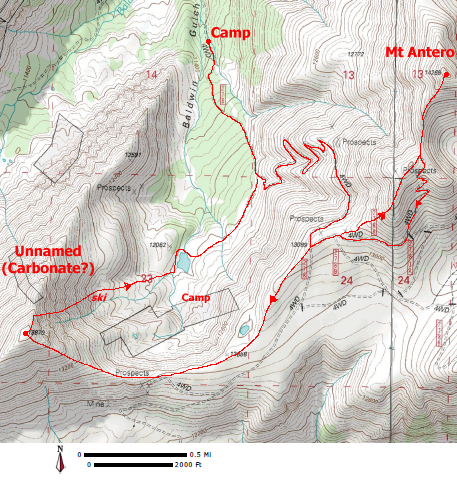
We started moving at 5:30am and took 3 hours to ascend from camp at 11,300′ to the Mt Antero summit at 14,269′. We followed the winding road up, but didn’t trust where it led after passing the summit ridge; we followed the ridge to the summit. Unfortunately, we also discovered that there wasn’t any snow left on Antero except for a thin strip about 50 feet wide and 500 feet tall on the southern ridge leading to the summit.

We enjoyed the summit for a short time and discussed our options for the day.

My rapture on the summit of Mt Antero

Since we couldn’t get our ski descent, we decided we’d head over to a tall peak across Baldwin Gulch that had a very nice snow covered eastern slope. But we had to hurry since the snow had been in the sun since dawn.

We descended Antero following the old mining road which turned out to lead to the final stretch of the summit ridge.  Once at the start of the switchbacks, we left the mining road and headed around the cirque toward the unnamed peak.

Where's the snow? On the way to some snow on 'Ol Unnamed (North Carbonate?) from Mt Antero (in background).

The progress was good until we got to the exposed scree & talus on the SE ridge of the unnamed peak.  It was murder for tired legs.

We found the summit to be protected by a weird cornice that required crawling over to get to the top of the peak. I needed a rest, but with the sun burning on the snow, we stopped only momentarily before setting off for the steep descent slope.

As we feared, the snow was soft, and possibly dangerous. After a short pow-wow, we decided we’d proceed…with the extra precaution of staying on opposite sides of the face and only skiing one at a time. The snow turned out to be great, and we had a great time descending 1800′ in only a few minutes.

Our route from Baldwin Gulch to Mt Antero and North Carbonate(?)

The hike out was mercifully short; we made it back to camp at 1:30pm for an 8 hour, 8 mile, and 4000′  day.

And sometimes, one day is enough.

In the years afterward, I came to believe that the peak had an unofficial name, “North Carbonate”.  And, just recently, I discovered that the officially unnamed peak got an official name in 2005…it is now called Cronin Peak.

Formerly known as “North Carbonate”, this mountain now has an official name, approved by the Department of Interior in May 2005. Cronin Peak is named in honor of Mary Cronin (1893-1982) who in 1921 became the first woman to climb all the fourteen-thousand foot peaks in Colorado.  ~summitpost

See all trip report

See all 14er trip reports

The Stone Man Project

June 5, 2010

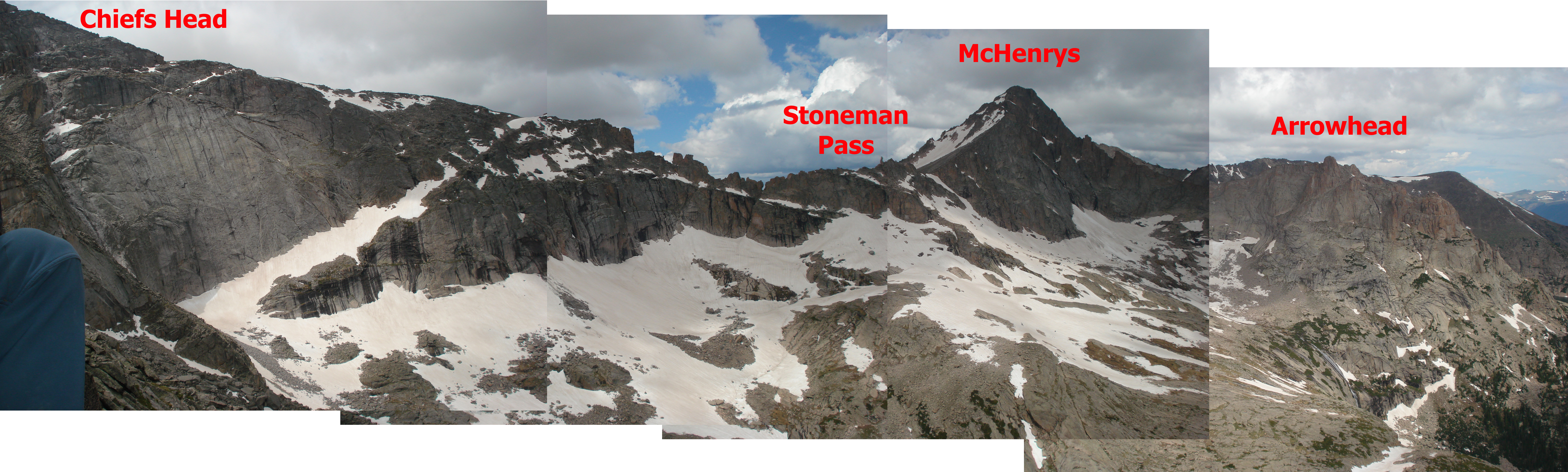
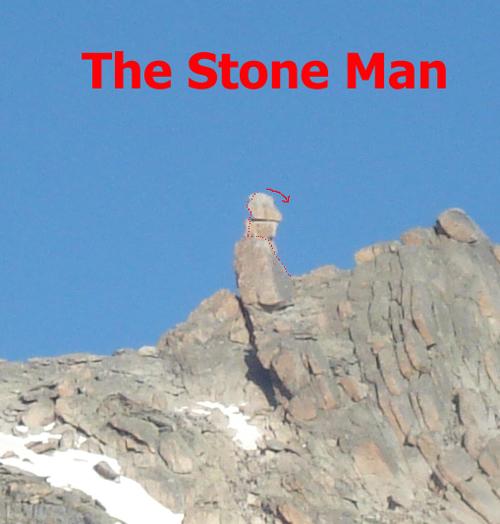
Three years before, in the Summer of 2002, Brian and I used the Stone Man Pass to scramble out of Glacier Gorge in RMNP on our way to the Double Crown of Chiefs Head and Mount Alice. While hiking past the famous Stone Man, Brian, out of the blue, speculated on the difficulty of climbing the Stone Man pinnacle.

The Stone Man from low on McHenry

While perhaps admitting to a lack of imagination, the question caught me off-guard to the extent that would musing over what marmots think about when not raiding unattended backpacks.  I mean, who in their right mind would hike 6 miles each way and ascend 3,200 feet of elevation gain in order to do a 40-foot rock climb?

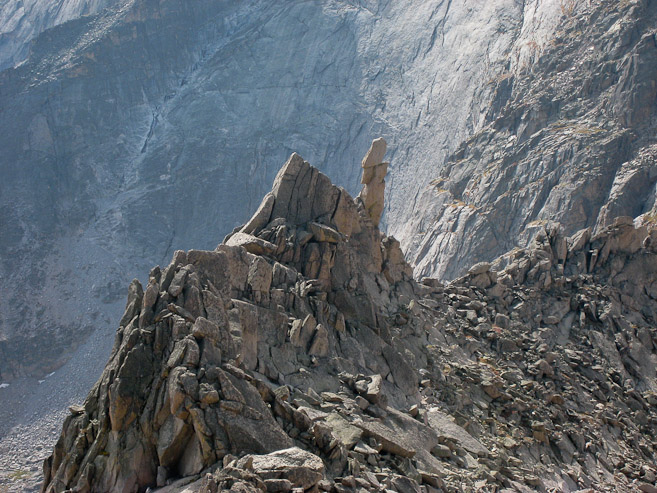
View from Spearhead

Still, I did take a quick look.  My judgment was it looked upper 5th class if it went, and it might not go; and no guarantees about getting down, either.  Brian figured it was easy. Whatever.

I put the notion out of my mind in the years since; Brian did not.

In August of 2005, as Brian and I were going through our weekly “what are we going to do this weekend” exercise, Brian suggested we finally go see about climbing the Stone Man.  The implication was that it’s been next on his/our list for some time.  In some situations, this call would require an official/judicial ruling.  But, our adventuring partnership is based on a choose-and-let-choose philosophy, meaning that when one of us really wants to do something, the other will generally agree. And since I didn’t have a better idea, Project Stone Man was a go.

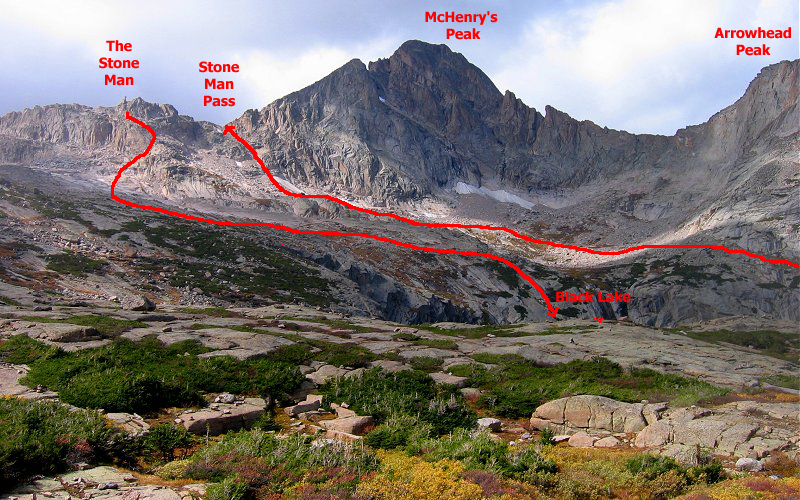
The plan was to hike 5 miles to reach Black Lake, scramble 1800 feet from Black Lake to reach the top of Stone Man pass, and then figure out a way to climb 40 feet of technical rock climbing to stand atop the Stone Man.  Whoo Hoo! Well, it would at least be a good hike into beautiful terrain; no doubt a better day than that of 99% of the population.

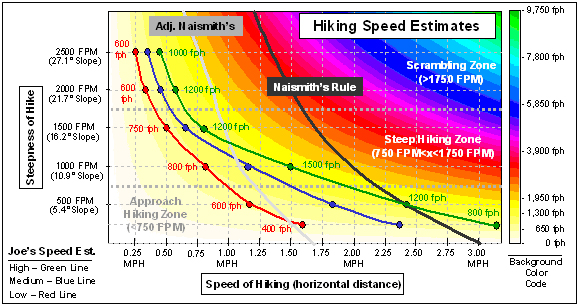
We started hiking right at 6am and made okay time reaching Black Lake at 8:00am; 2.5 mph at 288 feet per mile is 720 feet of altitude gain per hour while covering 5 miles — good enough while carrying rock gear.  (See hiking pace discussion).

My hiking speed chart

After a short water break, we left Black Lake for the shortcut to Stone Man Pass heading west beneath Arrowhead.  After a lengthy scramble up the steep grass and cliffy slope, we reached the bench above Black Lake; we then turned south to head underneath McHenry toward Stone Man Pass. We reached the top of Stone Man pass around 10:00am.

After a short break, we began our exploration of the base of the Stone Man, looking for a probable line of attack.

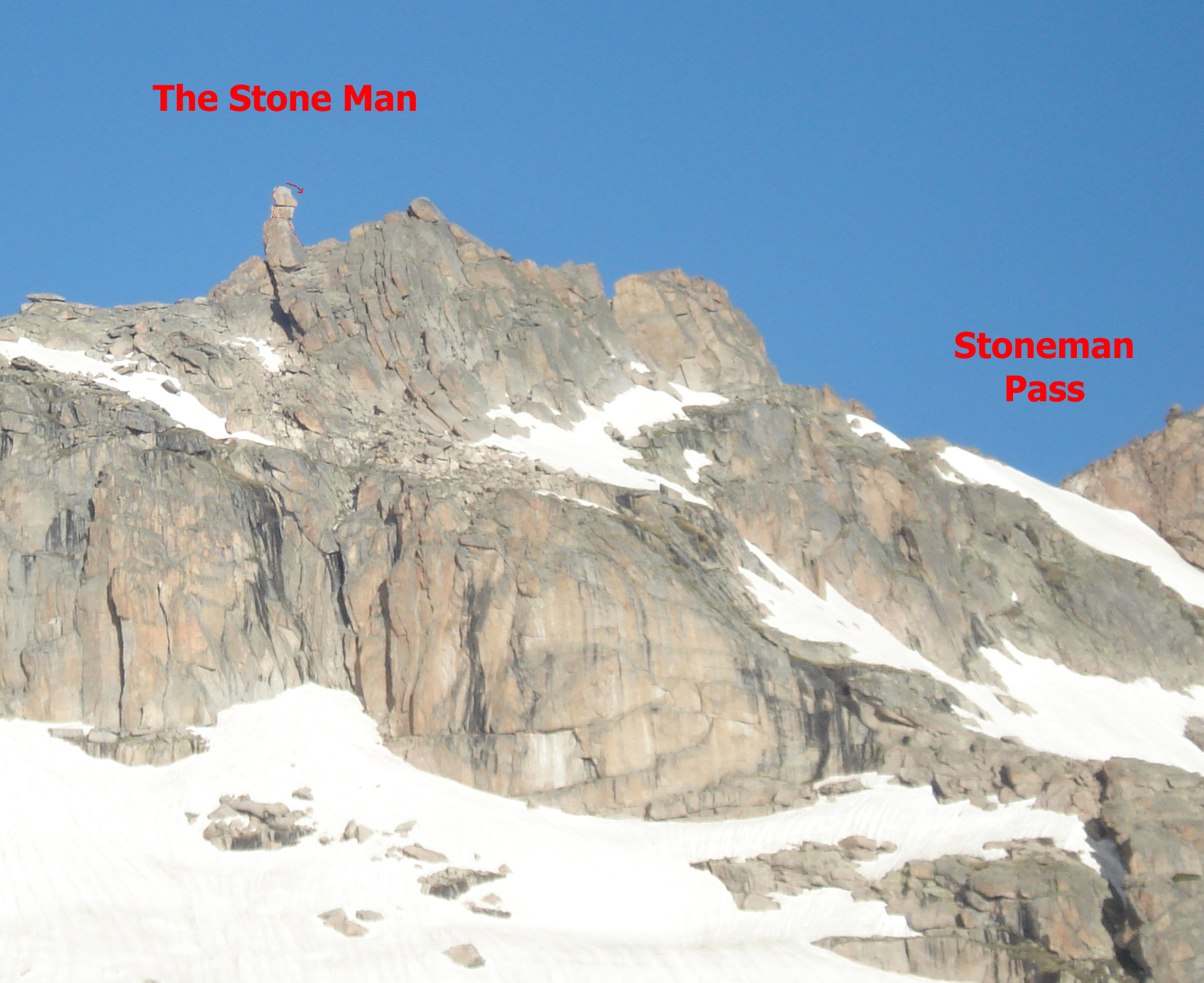
We started on the ridgeline and started going around the Stone Man counter-clockwise. In my eyes, it still looked hard. Once we made it around the the north face, we found a probable line…at least a line that would go to within 5 feet of the top.  Brian said he’d do it; he grabbed the rack and started up.

Our climbing route to the summit of the Stone Man (the dashed line indicates the route view is obstructed)

It turned out to be only a 20-foot climb, so I didn’t bother to get comfortable. After 10 minutes, Brian yelled back down that it went. He said there was a single tricky, hard to protect move; then he went for it.  And he was on top.

He yelled down that it would take a bit of time to set up a belay. I didn’t know what to make of that but did what I could do; I waited.

I watched from below as Brian flipped the cordellette a few times to get it all the way around the Stone Man’s head.  Then he yelled out that I was on belay.

I followed his route, admiring the quality of the few moves it required. And then I was standing below the summit and studying the exposed move that Brian had made to accomplish his (our) goal. I repeated it, and then I was on the summit as well. It was an admirably exposed summit, but not a good place to spend the rest of your life.

View of Stone Man route from Spearhead

When I looked around, I noticed that the cordellette was the only anchor. Brian informed me that it was the only thing he could find for protection, and asked me if it was okay that we sacrificed it (the cordellette was mine). Well, I did want to go home eventually, so I complied.

We rappelled back to the base and started back down. We started following cairns down the east slope (toward Spearhead & Longs), simply curious to see if the path would lead us back to the basin below McHenrys. It was a winding route, but far superior to the nasty Stoneman Pass route.  It worked! Since we were in an adventurous mood, I suggested we try the waterfall descent route Brian had mentioned as a possibility some years earlier.

Brian was game, and we angled directly for Black Lake and the top of its major waterfall.

The ascent and descent routes from the Stone Man, seen from Blue Lake area

The descent was a bit more dramatic than I expected. The climb down into the waterfall notch was easy enough; but once into the notch, the passage got thin and steep.  It was worth doing, but not superior to the scramble up to or down from the bench above and west of Black Lake.

A view from summit of Arrowhead of alternate descent to Black Lake

A short scramble led us back to Black Lake and another short rest, and then 5 miles back to the car for the 1 hour drive back to Boulder.

Brian insisted on replacing my cordelette and so we drove to Neptunes to buy 30 feet of 6mm cord.

Despite my early lack of enthusiasm, The Stone Man Project turned out to be a worthy adventure.  My only regret is our having to leave a cord where it can be seen. I hope the sun and weather beat that cord down quickly.

See all trip reports

See all RMNP trip reports

Mt Evans Extreme

June 2, 2010

It was the end of May, 1999, and I had just returned from my Great Bolivian Adventure. I didn’t have time for a full day of mountain fun, and, naturally, Brian wanted to ski; we picked Mt Evans as a good, close-by solution, with the thought of seeking the route less travelled to spice things up. And, I was anxious to see how much better my performance would be with my Bolivian, high-altitude acclimatization.

A view of Mt Evans and the rocky ridge separating Mt Evans from Mt Spalding

We drove up early to get good snow conditions and parked in the parking lot beside Summit Lake. We started working our way forward, postholing our way to the top of the bowl rim so we could get a good view of the options. We decided to angle right toward the rocky face dividing Mt Evans from Mt Spalding, aiming for the snow slope that reached nearly to the top of the ridge.

Brian nearing the exposed rock portion of the climb. The hard snow climbing occurred just before this spot.

Brian picked it, and I went along; I thought it looked interesting and possibly climbable. I forgot that we didn’t bring a rope; read: no belay.

The climb started like any other moderate snow climb, but about 2/3rds of the way up it got hard; the route became steep over mixed terrain.  And I was huffing and puffing with poorly functioning lungs. I whined to Brian that my allergies were acting up and trying to suffocate me.

The last 50 feet was thinly covered rocks; very little for the crampons and nothing for the axe to grab onto. On two separate occasions I had to commit to moves that I expected to fail, when failure meant some very bad outcomes. My alternative was to stay there for the rest of my life. The worst was at the very top, which turned into a moderate rock climb with crampons and ice axe making every effort to kill me.

I didn’t get a belay, but I recall Brian was generous with his words of encouragement.

But we made it to the top of the rim.  Thanks, Pal!

Then we hiked to the summit and enjoyed the well earned views. My breathing was so labored that I swore to Brian that if Colorado made my allergies this bad again, I was moving!  The skies had quickly changed from beautiful blue to looking like rain or snow soon, but we didn’t start down for the North Face until the axes started singing their dreaded electrical song.

We got down well enough. My glissade wasn’t very good due to operator error; I guess I just forget how to do it, having been skiing instead for the last year. Some additional huffing and puffing while postholing had me really annoyed with my physical performance. I had looked forward to kicking Brian’s butt for a change, but my 20,000′ plus acclimatization just didn’t pay off the way I expected.

Brian about to descend the North Face to escape the electrical field around us.

Twenty-four hours later, I knew why:  I had the flu. Isn’t air travel just lovely? At least I could continue living in Colorado with a clean health conscience.

It was my 3rd summit of Mt Evans, and the most interesting so far.

See all trip reports

See all 14er trip reports