Posts Tagged ‘Brian’

Huron, Bloody Huron

May 28, 2010

Our drive, hike & climb to Huron Peak summit

One more time. Brian and I thought we’d back to the Clear Creek Reservoir Road, this time to collect Mt Huron. We knew going in that it would be a 10+ mile hike in the snow with a 4000′ elevation gain due to the winter road closure, but we were on a roll and Huron was next on the list. The only problem would be the inevitable snow storm; the previous week it snowed all the night before. And, it did so again.

It was Brian’s turn to drive; we left his place in Golden @ 7:45pm on Friday (April, 23, 1999) heading toward Leadville.  The Bronco is a slow beast, but it works wonders on poor backcountry roads. Along the way, we were pleasantly surprised to find the roads in better shape than the previous week (when we did Missouri Mountain) despite the heavy new snow in the front range. We figured we’d gotten lucky on the snow distribution.

Brian picked the East Slopes route. At the time I figured it was the worst thing he could find, but in hindsight I suppose it might have been because Dawson wrote that the East Slopes generally have more snow. Well, we did have plenty of snow.

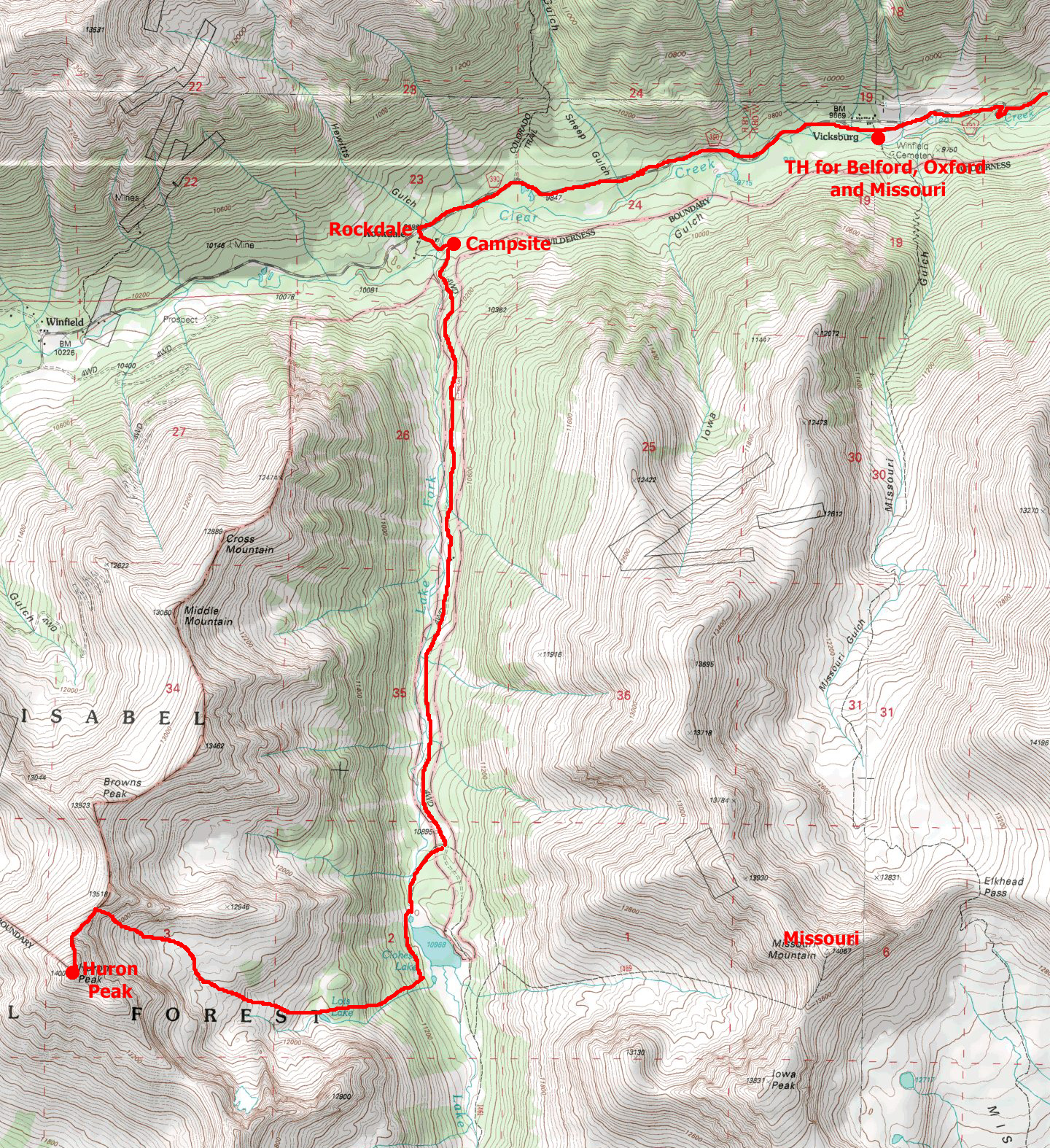
Aiming for the Clohesy Lake trailhead, we pulled off US Highway 24 onto Clear Creek Reservoir (dirt) Road. We immediately knew we had been mistaken about getting lucky with the snow; the accumulation was much worse than the previous week.  We drove past our previous camp at Vicksburg and to the Rockdale townsite where we turned onto the 4×4 road heading toward Clohesy Lake trailhead, but only managed to get 1/3 mile up the 3-mile road before the snow was too deep to drive even for the Bronco.  And, believe me, that means something. A determined Brian forced his way cross Clear Creek before giving up on the drive; that crossing was much more interesting than I like at 11:30pm.

We setup camp as quickly as frozen fingers allowed. And then sleep came quickly, and so did 5am.

The first thing we noticed was the temperature.  It was way too warm.  Crap, it was going to be a hellish, soft snow day.

The initial hiking over the 2.7 miles remaining of the 4×4 road was rather flat; we started at 10,000′ and took 1.5 hours to gain 800′ of elevation. I hoped in vain that it would be a nice downhill glide 10 hours hence. Still, it was an easy start, for me anyway. Brian broke trail; and for a change, he actually made a trail I could use instead of gliding across the surface like a modern day Legolas. It was odd to hear him grumble.

Once we cleared the treeline, we could see heavy snow covering the ridges descending from Huron.  It was still early and already a slide had occurred, nearly reaching our ascent path.  We kept our distance from the snowy slopes as best we could, and we tried to hurry to minimize our exposure.  But it was a long curving path to reach the couloir ascent to the summit ridge.

Detail on the final stretch to the summit

The final couloir was very steep and icy. So, we didn’t have to fear an avalanche, but the skins were only marginally up to the task of ascending such a steep, slick surface. We slowly worked our way up until about 3/4ths of the way up we had to exit into the rocks on the right to make the saddle.  The climb certainly would have been better with crampons and an axe.

The weather had looked bad all day and continued to do so.  We tried to hurry to the summit, but the snow on the ridge was too soft. I literally had to swim across the sections without rocks to step on. This misery was compounded by my agreeing to bring the skis to the summit, where we sat for only as long as it took to eat a quick snack.

I carried the skis up to the summit and then carried them back down to just above the saddle.  When I dared put them back on, the snow stuck to the base like tar.

Fortunately, by the time we reached the top of the couloir, the skiing returned to a normal state for the day…merely terrible. A few turns into the descent, I hit a rough, icy section and lost it. I hit face first and cartwheeled down the slope, bashing my brains in on every flip. My self-arrest ski poles allowed me to stop after a few flips, but not before mutilating my nose. And this only 2 weeks since making a pact with God to take better care of my nose after allowing me to keep most of it after some frostbite on a cold, windy day on Mt Silverheels.

I bled continually and fell frequently as I attempted to escape Huron with my life and the remainder of my health (and nose).

Once we made it past the lake and reached the 4×4 parking area, the snow had softened enough to become impossible. In the last 3 miles, I fell through the snow 6 times. One time I could not get back up; it was a sort of quicksnow. I finally had to resort to rolling to escape the pit I dug for myself.

We made it back to camp at 6pm for an 11.5 hour day covering 4000′ of elevation gain and 10+ miles of soft snow slogging.  And, I was a bloody mess.

Some trips it is hard to remember that I do this because I love it; but it is important that I remember it.
See all trip reports

See all 14er trip reports

Wham!

May 20, 2010

Hike to Wham

Rocky Mountain National Park is my favorite playground.  And, I am not alone in feeling that way.  The secret to finding great alpine adventure unspoiled by throngs of people in RMNP is to start early and to seek out the rock less climbed. This trip report is about reaching a bit too far, a bit too casually to climb Wham, the ugly twin of the Zowie pinnacle on Otis Peak.

Anyone climbing Sharkstooth or Andrews Glacier has seen the fantastic pinnacles hanging off the south side of Otis Peak. Most people just keep on going, but I and a few others have had the pleasure of climbing Zowie. It is a smaller version of the Petit Grepon with the same exposure and great climbing, but with far fewer people competing for a place in line (generally, none) and a good deal less rock to climb to reach the top. I’ve climbed it three times whereas I’ve only climbed the superior Petit twice due to justifiable fear of crowds.

And to avoid lawsuits for lack of disclosure, I’ll mention that there is something terrible about Andrews Creek below Zowie that facilitates the birthing of massive clouds of mosquitoes. One trip in particular represented the worst mosquito event in my life, and I grew up in South Florida. I still blame that day for my serious bout of West Nile Virus in 2003.  Consider yourself warned.

Approach to Zowie & Wham

On our last visit to Zowie in the summer of 2003, Brian and I gazed over at Wham, Zowie’s next door neighbor, and agreed that we should do it before returning for another ascent of Zowie. Brian broached the subject in September of that year, but I was afraid it was a loose mess and didn’t want to waste a day.  Nearly a year later, Brian’s persistence paid off and we selected Wham for the Saturday, August 7, 2004.

The only worry was that Wham would be too short and easy (5.7) to fill the day; the plan was to bag Wham and then re-climb Zowie (5.8+).

August 6, 2004
Joe:
How about Wham tomorrow?  It’s fairly short.  If we’re feeling fast maybe we could redo Zowie afterwards.
Brian

For better or worse, Wham turned out to be more than an appetizer.

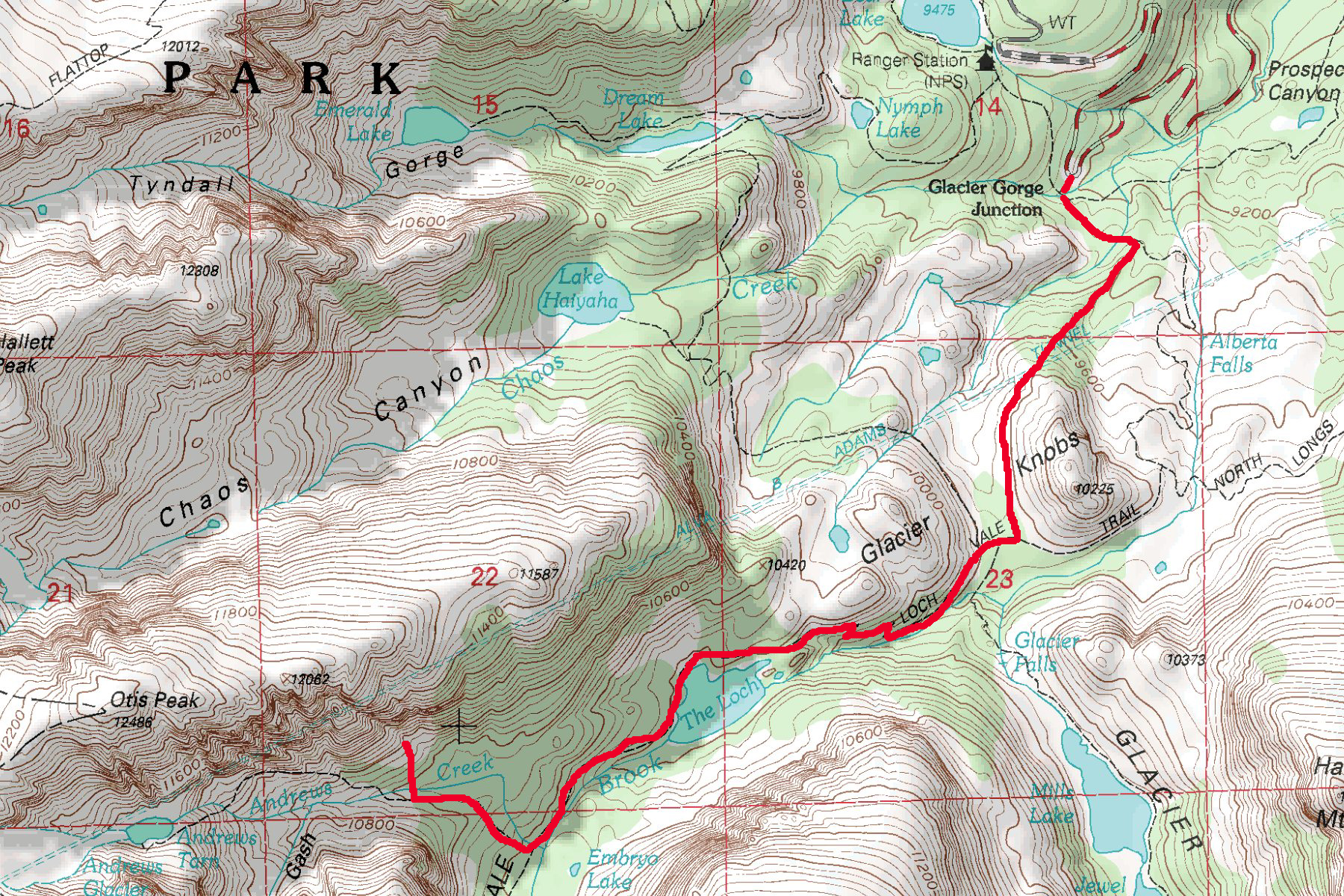
We left Boulder at 3:30am for RMNP.  We started hiking at 4:50am and quickly made our way up the trail toward Loch Vale and then Andrews Glacier before turning off the trail just after leaving the trees.

The start of Wham

We crossed Andrew Creek and ascended toward Zowie, winding our way through the trees and small cliffs. Once out of the trees, we aimed toward Wham and made our way to the gully between Zowie and Wham.  This was infrequently visited terrain; there were no clues about the start. We figured the real start was on top of the shoulder, so we just took the nearest nice looking line that led there.

Reaching the shoulder, we found it was covered in dwarfish trees.  Brian remembers it as a “big shoulder plagued by trees”.   We had to bushwhack our way to the base of the pinnacle; the trees grabbed the rope so badly Brian had to untie before bushwacking. We should have tried to climb directly to the spot where the pillar meets the shoulder.

Finally, we could start the climb.  The guidebook merely said to go up the South Face; over the years we’ve mostly found that to mean it is obvious, but other times it has meant the guidebook author doesn’t know (didn’t do the climb).  We hoped for the “it is obvious” option, but it wasn’t. I remember sitting down and studying the rock, but I couldn’t figure out where the 5.7 line was or even how to get off the ground without performing death-defying acts. In a desperate effort to save the day, I offered the notion of bailing and climbing Zowie instead.

Brian refused to be denied.

Brian recalls:

From the runt trees, the line was a not-too-steep dihedral with a few loose-looking holds.  Again and again I started on it just to find that it magically steepened at my touch.  Each time, I came down and looked at the even steeper route to the left, then discarded that idea.  That one just looked very sustained with no chance of success.  Finally we were ready to bail, and I decided we might as well risk one tricam on the left line.

Sure, the line seemed impossible, but the placement was bomber, so why not?

I hoisted myself up and stared at the next 3 feet.  Hmm, more good cracks, Ok, we’ll just risk one more nut so I can see around the corner.  And on it went for the next 30 minutes and 120 feet, until I looked at the depleted rack and relenting angle of the face and realized the we were actually going to make it.  Not only that, but we’d get our rack back, too.  All I had to do was somehow scratch out a belay and haul Joe and the metal up.

The last pitch was easier, but just as dramatic as the face sharpened up into a ridge of bouldery steps.  That was the best pitch, knowing that nothing could stop us.

Our winding route up the South Face of Wham. Photo taken from Zowie.

We made it. But it sure didn’t feel like 5.7. Maybe we didn’t do the correct route, but we sure tried to do so.

We sat on the summit for a while enjoying our success on our unexpected adventure.  Clearly, we wouldn’t be visiting Zowie.

When it was time to head down, I dug out my notes on the descent I collected from my old Gillette guide (the one I swore I would never use again after my fiasco on Northcutt-Carter):

Several long rappels west into gully.

I looked over the edge to the west.  It looked like a long, long way down — too long even for a double rope rap. Brian and I looked around for a better line but couldn’t find one. I said I’d go down and take a look, hoping to find something, anything.  I rappelled over the edge and spent 30 minutes working around from the west to the north side before finally finding a decent spot on the north side to build a rap station for the 2nd rappel.  Brian recalls:

Joe rapped down the left side and then spent a half hour looking for the next rap while I was on top wondering what the heck was going on.

But we still weren’t out of it. We couldn’t figure out how to get back to the base. We hiked around to the West side, thinking that the 3rd rap must be there.  But we found nothing useful.  It was all loose, steep rock split by a big ledge that provided only false hope for an escape.

We went back to the North side again and carefully worked our way down the gully leading west (toward Zowie) below the ledge. It required a couple 4th class downclimb moves, but it went.

Then we scrambled south toward the bottom of the gully between Zowie and Wham. The terrain was serious enough to require a belay for the final 100 feet to reach the edge of the final cliff where we found a rap anchor with an ancient biner that seemed to be made of lead (heavy, soft metal).  I replaced it with a modern aluminum biner and we escaped to the base of the climb.

Naturally, the rope got stuck and required some delicate scrambling among loose rocks. It was a relief to finally escape the grasp of that little pinnacle that we had so little respect for a mere 8 hours earlier.

The path less traveled sometimes leads to some serious shit (see all axioms).

A Shocking Day on Arapahoe Peak

May 7, 2010


The scene of the crime: a view of South Arapahoe Peak from just below the saddle shared with Mount Baldy.


It was early June 2006, and we thought the conditions were good enough for another traverse of the Arapahoe Peaks, but we didn’t get the chance to find out when the weather took a shocking turn for the worse. We should have been more careful.

Lightning is one of the oldest observed natural phenomena on earth.  Once generally feared as a weapon of the gods or God, scientists now tell us lightning is just a gigantic spark of static electricity. People once avoided lightning above all threats to life due to the heavenly implications of being a target.  Now we are too casual about the low odds of a strike.

It was the late spring season, and that meant the conditions were highly variable. We considered doing the SkyWalker Couloir, but thought the weather might be too warm for a safe ascent. We resolved to take the easy way up the South Arapahoe Peak and then traverse to the North summit to make an interesting day of it. What we didn’t think about was the possibility of lightning, but that is what we got.

We got our interesting day.

Lightning starts with clouds. The sun heats up the spinning earth in an irregular fashion which results in wind. Air rises when it is warmer than the air above it or is pushed up by winds passing over mountains.  When the air & water vapor mixture rises, it can cool enough to turn water vapor into water droplets (or ice crystals) which becomes visible as clouds.

We started up just before first light from the 4th of July trailhead and quickly made our way up the familiar trail. We turned up the trail to the saddle between South Arapahoe and Baldy, pausing only long enough to longingly examine the Sky Walker route. We assured each other that we’d come back another day to do it.

As we made our way up the south ridge below the summit, we could see fast moving storm clouds north and east of us. But it was very early in the day and cold, and nothing was coming from the west.  We didn’t see any risk to us.

Thunderstorms are a special type of cloud that occur when warm, moist air rises high into the atmosphere, reaching to the freezing temperatures at very high altitudes.  The rising warm air and sinking cool air push around the ice crystal and heavier chunks of ice, which bang into each other creating static electricity.  The lighter-weight, positively charged ice crystals are blown to the top of the cloud while the heavier, negatively charged clumps of ice cluster at the bottom of the cloud. The opposite charges attract each other, and the lightning we see in the clouds is them finding each other.


Mountain Finder plate on summit of South Arapahoe Peak


Once on the summit, we started to notice lightning in those storm clouds.  And then we saw something unusual: those clouds off to the east seemed to be nearer to us than before.  Where they flowing east-to-west?  We didn’t know what to make of it. We wondered aloud to each other concerns about possible risk.

We were tempted to continue since we had come so far and were close to our goal; but our mountaineering ambition had dulled enough over the years to allow for reason to prevail. We decided to bail. While we didn’t understand what was happening, we were smart enough to realize that starting a technical traverse in such conditions would be foolish.

Lightning hitting the ground makes for all the excitement. The negatively charged cloud bottom causes electrons in the ground five thousand feet below to flee (like charges repel each other), resulting in an electric field that we can hear, feel and smell. The electric field is strongest on ground-connected objects whose tops are closest to the base of the thundercloud. If the electric field is strong enough, a conductive discharge (called an upward lightning streamer) can develop from these points and the surrounding air component atoms become separated into positive ions and electrons — the air becomes ionized. This ionized air (also known as plasma) is much more conductive allowing for electric current to flow from the cloud to the positively charged streamer or ground that is seeking electrons. We see this as lightning.

But we still didn’t see any immediate risk, so we didn’t take immediate action. We took a break on the South Arapahoe summit to enjoy more of the day before starting back down the trail at a moderate pace.

Familiarity breeds contempt.  While the rarity of lightning incidents makes it easy to become complacent, sometimes lightning doesn’t miss.  Being hit by lightning is a serious event comparable to a bear or lion attack, resulting in death and life altering injuries. See NOAA’s Medical Aspects of Lightning for more information

I kept looking over my shoulder as I worked my way down the ridge. I could see the storm was getting closer much faster than expected. We were losing the race. I told Brian we needed to go faster.

Then the thunder started to boom.

Once we hear the thunder or feel the cold wind or the sting of crashing hail, the thunderstorm is upon us. Our chance to be safe is lost. We are limited to looking for ways to reduce the risk that we can no longer avoid. And, reacting to lightning once caught out is an uncertain art.

Properly motivated, we started moving as fast as we could as the thunder became louder and louder. And then it was right on top of us. Boom, Boom, BOOM!

The flash-bang separation was very short, one second or less.

When we reached the saddle and good ground, we started running to get to the descent trail that would get us off the exposed ridge.


Our route up South Arapahoe Peak


About 1/2 way across the saddle, it happened.

An explosion went off as I felt a sharp, stinging shock hit the top of my head. Stunned by the noise and the sense that I had been hit by lightning, I stopped running. I didn’t know what to think. I wondered if I was dead.

I turned around to see if Brian would have a look of horror on his face. He merely hollered, “Run!”

I paused for an instant to ponder the problem of my metal hiking poles sticking out of my pack, but seeing Brian disappear down the mountain, I decided to just run like scared cat. I caught Brian in an instant and we flew down 1000 feet in about 10 seconds (felt like); and then the storm was gone.

Once we see or decide that the weather environment is unsafe, our goal for the day must change immediately and permanently to getting to a “safe” shelter.  In the high peaks, that almost always means getting to the vehicle, and the path to safety will often force us to traverse dangerous ground.  Our goal of getting to safety will be achieved by using three strategies:

  1. Move quickly to the vehicle to minimize our exposure to the dangerous environment and
  2. Avoid high lightning risk spots on the trail to reduce exposure to risk and be able to stop and
  3. Become a small target with a single point of ground contact when a lightning strike is imminent.

Going as fast as possible to safety is the most important thing, but it isn’t enough. Avoiding high risk locations means to minimize the chance of injury while moving while allowing us to safely get small when necessary.  Our ability to make fast, correct decisions in juggling these strategies is the key to our continuing health. (See more info about dealing with Imminent Lighting Threats)

We slowed and then stopped to gather our wits and remove our rain gear. I asked Brian if he saw the lightning bolt hit me. He said ‘no’ and I couldn’t find any evidence of burns on my hat or head. But none of that mattered; in the instant I thought I’d been hit by lightning, I was sorry for my casual attitude that allowed me to accept such a risk.  My life was changed forever.

I was hit by a low-power ‘upward lightning streamer

Upward lightning streamers that do not connect with the downward leader to complete a lightning channel are estimated to cause approximately 30% of lightning related injuries.  High-current pulses are launched from the ground (often tall, pointy, isolated objects) near the lightning bolt as it initially approaches the ground. These “streamer currents” are much less powerful than the full lightning strike but can be strong enough to cause injury or death to humans. (more)

I felt lucky to be alive.

And I have dedicated myself to understanding lightning and staying safe in a lightning filled environment like the high peaks of Colorado. In the time since, I’ve identified for my own use five levels of lightning danger for Colorado high peaks: low danger, approaching danger, high danger, extreme danger, and imminent strike.

Below, each category is described with conditions that may be observable or audible, depending on the presence of terrain or wind noise obstructions:

For any of us High Peaks Adventurers, our rational reaction to these levels of danger depend on our willingness to assume lightning risk. The only way to be “safe” is to stay home. But if we insist on proceeding with our risky venture, we can break down the situation into four questions that must be answered; and because we are dealing with uncertainly about deadly risk, the answers will be different for each person:

  1. What risk level am I willing to assume? There is a continuum of reactions we each can take in the face of lightning danger.  On the extreme conservative end, we could choose to never go outside when clouds are in the sky.  On the extreme aggressive end, we could choose to never worry about lightning since it doesn’t seem to hit many people.  The right strategy for most of us is between the two extremes.  (more)
  2. How to plan to avoid lightning? There is no safe haven from lightning atop the high peaks; the only way to be safe is to avoid lightning all together.  Either we stay home on a bad weather day or we start early enough that we can get less exposed before the lightning shows up. (more)
  3. How to read the sky for early warnings? Sometimes the lightning threatens to show up when we are vulnerable, despite our best efforts to avoid it.  But we can only hear thunder 10 miles away or less.  Since an air mass thunderstorm will travel over ground at 15-25 mph, we may have only 20-30 minutes before the storm is overhead (and the worst lightning risk begins).  We need more lead-time; we need to be able to get an early, even if imperfect, indication of when to turn around. (more)
  4. How to reduce the risk when the chance to be safe is lost? If we accept some lightning risk, we should expect to eventually get caught away from safe shelter when the lightning arrives.  Too often, the mountains obscure our view of the horizon and oncoming storms, and the wind noise keeps us from hearing thunder.  When we’ve been caught in a vulnerable position, we need to know what to do reduce the likelihood of being hit or injured by a lightning strike. (more)

The chart below that I’ve created for my own use is based on the advice provided by experts for minimizing lightning risks; the ‘moderate’ level of risk is the only usable information for me. The high-risk option is merely behaviors I have observed and even used before I knew better. I include this level and the low-risk level to provide contrast.


My personal lightning risk management cheatsheet


But please do not take my word for it. Do your own research and make your own decisions; it is your life.

My sources:

(1) NOAA:  The National Oceanic and Atmospheric Administration (www.noaa.gov).  NOAA includes the National Weather Service (www.nws.noaa.gov), JetStream (http://www.srh.weather.gov/srh/jetstream/) and National Severe Storms Laboratory (http://www.nssl.noaa.gov/).

(2) NLSI:  National Lightning Safety Institute is a non-profit, non-product advocacy of lightning safety for both people and structures, founded and run by Richard Kithil (http://www.lightningsafety.com/)

(3) Lightning Safety Group, American Meteorological Society Conference

(4) Mary Ann Cooper, MD, Associate Head of Academic Affairs, Professor, Departments of Emergency Medicine, Neurology and Bioengineering, University of Illinois at Chicago

(5) NOLS:  National Outdoor Leadership School, Backcountry Lightning Safety Guidelines (www.nols.edu/resources/research/pdfs/lightningsafetyguideline.pdf)

To see more more details of what I found for myself, see the following:

Managing Lightning Risk

See all trip reports

17-Hour Saber

May 1, 2010

It had already been a full summer, and it was only July 11 of 1998.  I had been hitting the rocks hard since my early June summit on Mount of the Holy Cross, and had done a number of hard climbs at Lumpy Ridge, Eldorado Canyon, Red Rocks (NV).  I was in good rock climbing form and looking for good routes; and what could be better than a Layton Kor Route?

Brian was angling again for his notion to visit Vedauvoo for some hard crack climbing; but I had my eye on The Saber, Kor Route:  11 pitches, 5.9. Brian is an easy mark for classic climbs in RMNP.

We knew it would be a long day with darkness at both ends. We tried to start early enough, hitting the road from Boulder at 4am.  Still, when we arrived at the (old Glacier Gorge) parking lot a little after 5am, it was 1/3 full already anyway.  Still, it was odd that we didn’t see anyone on the trail; either they were fast hikers or they arrived the night before for bivies in Glacier Gorge and Loch Vale.

From the parking lot, we hiked up the trail for 2 hours to cover the 3.5 miles to Sky Pond.  As we arrived, we could see The Saber sitting between the Petit Grepon and the Foil, towering over both and Sky Pond. We couldn’t afford a break yet as we had already lost a bit of daylight that we’d never get back. (Sunrise: 5:42 AM Sunset: 8:29 PM Day Length: 14h 47m 19s).

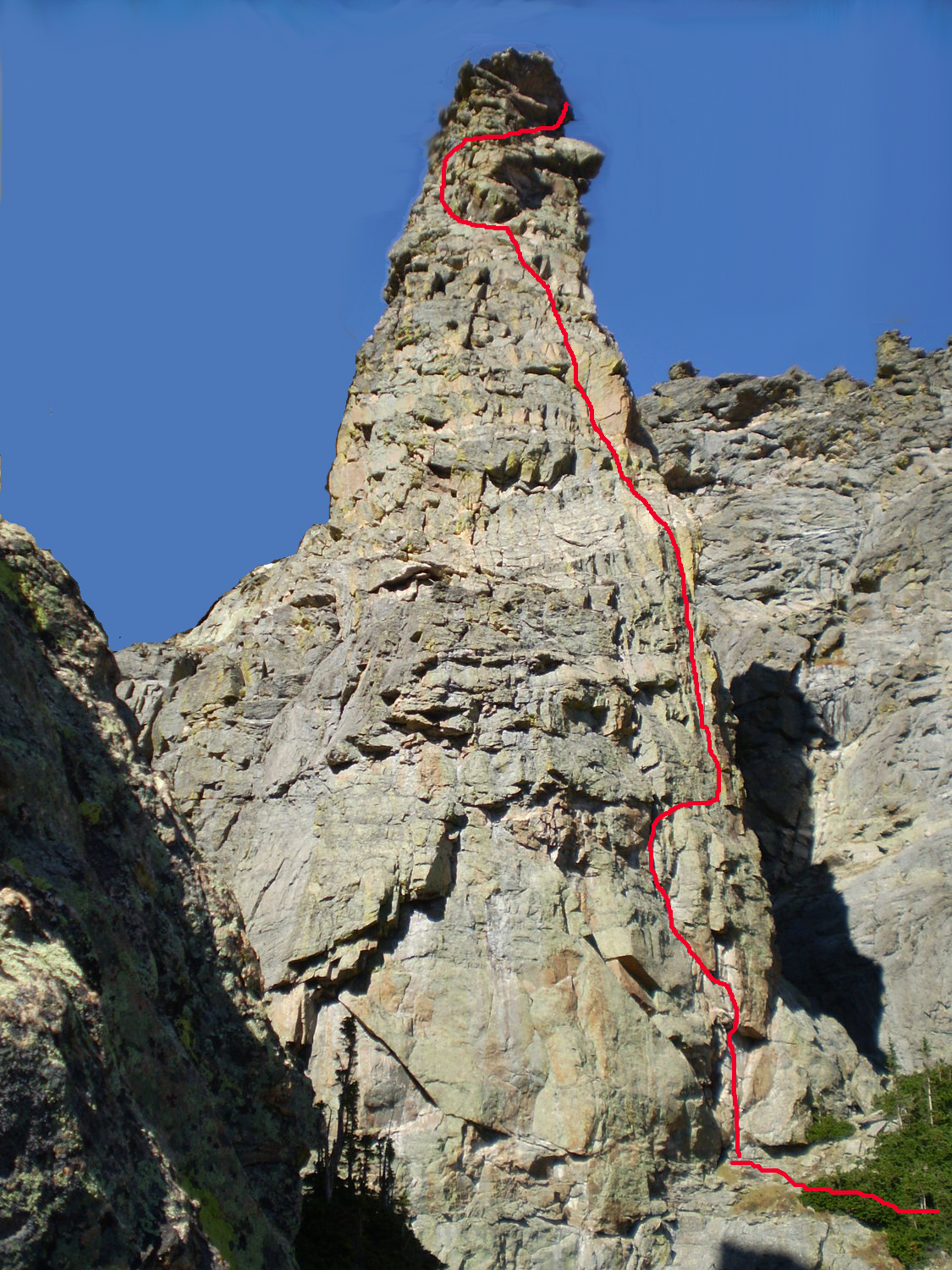
A view from below The Saber of the 'Kor Route' which Layton Kor put up in 1962.

Layton Kor did the initial ascent of The Sabor  in 1962 during a period of time during which he put up many great climbs, including a few that I’ve been able to enjoy:

  • Yellow Spur, Rosy Crucifixion, Calypso, Ruper, and West Buttress in Eldorado Canyon State Park
  • Kor’s Flake & Pear Buttress in Lumpy Ridge, Estes Park
  • Satan’s Slab & Southeast Arete on the 2nd Flatiron in the Boulder Flatirons
  • The Owl in Boulder Canyon

The initial name for the Kor Route was The Saber, which was some years later stolen to provide a name for the pinnacle.

The first third of the Saber is lower angled. We skipped a big chuck of ugly climbing by hiking up 300′ of talus to the right of the SE corner of The Saber.

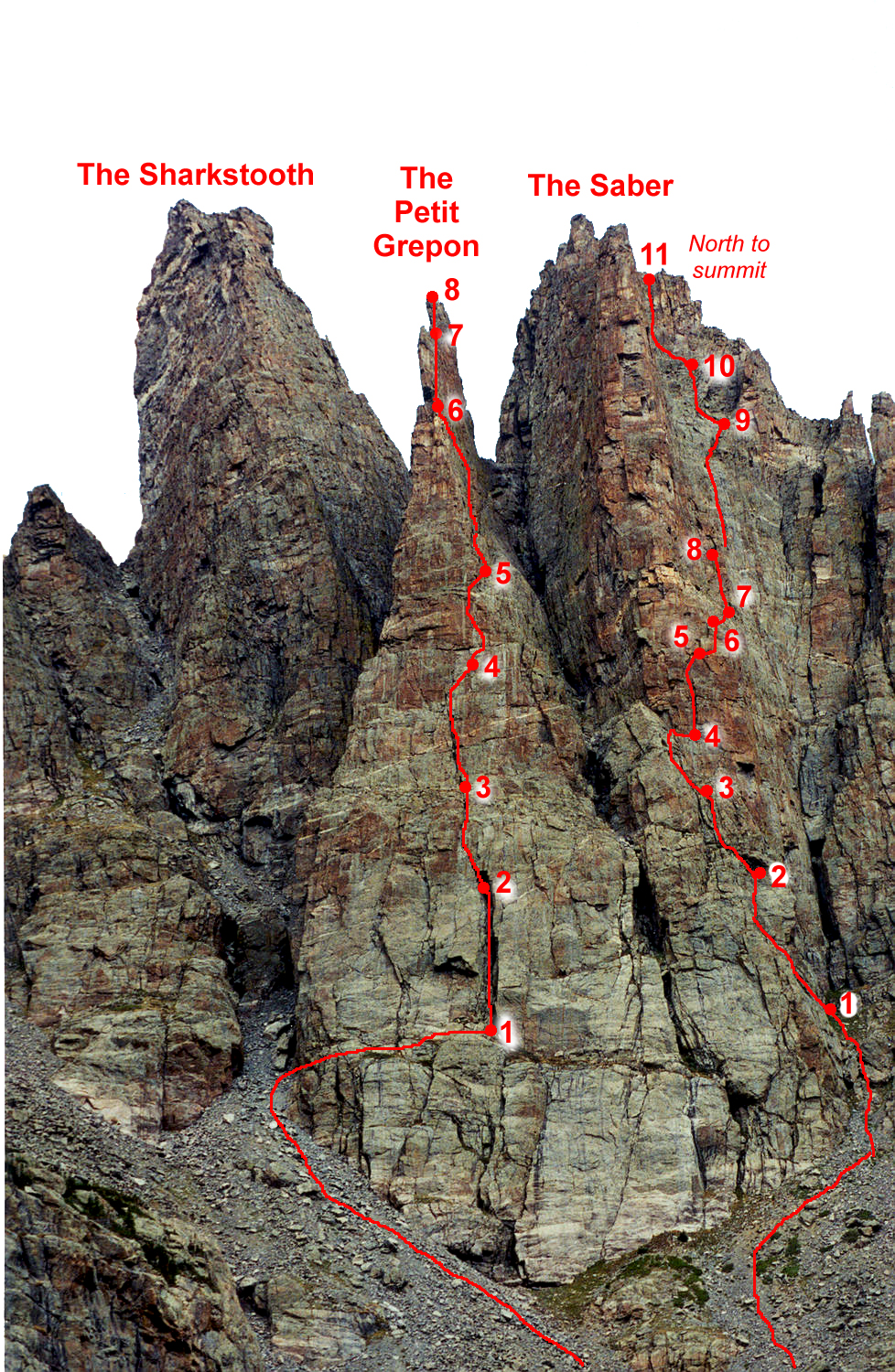
The Kor Route on The Saber. Topo constructed from original work in Rossiter's High Peaks guidebook

Below are the pitch descriptions by the position numbers indicated on photo & topo:

Position #1:

When we reached a grassy meadow and the first of two big, slanting ledge systems, we put on harnesses and rock shoes, and roped up for a few warm-up pitches to start the day.

I took the first lead and scrambled up and left along the easy ramp, and then straight up some low 5th class climbing to reach a grassy ledge (position #2).

Position #2:

Brian moved left and climbed some mid 5th class terrain to reach a ledge with some large blocks (position #3)

Position #3:

I had two options, as I recall. I could have gone up & right or up & left to reach the big grassy ledge that would make the real start of the technical difficulties. I chose the left ramp since it was described best by Rossiter.  When I could, a short distance later, I climbed straight up some low 5th class rock to reach the large grassy ledge. I moved about 1/2 way toward the big dihedral to save some rope drag on the crux pitch (position #4).

Position #4:

Brian had the pleasure leading the prominent, 100 foot long, left-facing dihedral that starts off in the middle of the ledge. The crux pitch. He is more likely to succeed quickly on a 5.9 lead, so that is his honor.

He climbed up the dihedral until it ended at a small roof.  He then moved left to pass the roof and reach another left-facing dihedral that led to a good ledge right on top of the crux pitch (position #5).

This was the crux of the climb, and really the only difficult climbing of the day, rating-wise. But our fast start was a thing of the past due to a variety of obstacles.

I followed badly at first and then well.  The 5.7 section right off the ledge was a strange combination of dead vertical plus giant holds; the crux felt easy by comparison. I joined Brian on the small ledge and prepared for some route-finding difficulty as we left the SE Ridgeline and entered the ‘Open Book’ section.

Position #5:

I started by downclimbing and traversing right to reach another ledge from which I could climb an easy dihedral to reach the ‘long’ grassy ledge (position #6). I had thought about taking the belay to the next position, but feared rope drag and a (unlikely but serious) long whipper for Brian.

Position #6:

After Brian arrived, we moved the belay to the far end of the ledge to the bottom of a large left-facing dihedral (position #7).

Position #7:

Brian took off, heading up the steep dihedral, looking for a ledge with a pinnacle.  He found it and brought me up (position #8). From this belay, we struggled to know where we were and to judge where to go.  I do not claim any of the rest of the climb is the “official” route.

Position #8:

I climbed the dihedral above, looking everywhere for “the second grassy ledge”. I continued up through rock that didn’t look like the topo; I only stopped to belay when it looked like I wouldn’t find another good belay for a while (position #9).

I brought Brian up; he didn’t know where we were either. The climbing wasn’t technically hard although it was steep; rock wasn’t solid and the route-finding took more time than we thought it would.  We were going too slow; the daylight was running out.

Position #9:

Brian started up looking for “a ledge with rappel slings” and possibly a dead tree (Rossiter’s topo). He found lots of old slings, but didn’t find the belay described by Rossiter. But as I had done before, he found a good belay (position #10) and brought me up. Good enough.

Position #10:

I wandered up toward the ridge line towering above me; the closer I got, the steeper the rock.  The climbing felt dead vertical at the very top, but the holds were gigantic and some were even safe to use (position #11). We made it.

Only my dehydration posed any continuing problem, that and the fact that we didn’t really know how to get down, the ground was a long way away, and the wind was trying to force us to take the fast way down.

I brought Brian up and asked him about the rap anchors; he pointed and then turned and pointed toward the summit which he said was a long way off.  He said ‘choose’, and I chose the summit.  Of course.

Position #11:

Brian led a simulclimb of the summit ridge, which involved a lot of up & downs over easy terrain. It was a magnificent exposure but the hurricane winds blew us around mercilessly. Brian had a close call when a gust nearly threw him off the summit after he untied from the rope.

Descent:

Since the daylight was ending, we quickly started down the back side into The Gash (between Sharkstooth & Saber). Fifth class down-climbing in hiking boots on snow and ice covered loose rocks with strong, gusting winds was scary enough to keep me alert despite my physical and mental exhaustion. Brian followed his nose down ledge after ledge; I followed Brian.  Once we reached the talus, we had to traverse underneath the backside of The Saber and The Foil to reach the descent gully. It was endless.

The descent gully was tricky in the failing light.  And we weren’t really sure we were in the right gully until AFTER we rappelled past a section that we couldn’t figure out how to downclimb. Fortunately, it was the right one.

But even then it wasn’t over.  We had to descend toward The Saber and hike back up the talus to collect our gear at the base of the climb. What a pain; and did I mention I was exhausted? All that extra work just so we could stand on the summit. It was almost enough to make me sorry for my choice.

But the good news was that we reached our packs and headlamps with a few minutes of daylight to spare. Finding our way down in the dark without lamps would have been horrific. We got lucky once again.

Still, no water for 13 hours while exercising at high altitude was not smart. And the liter I had stashed was not enough beyond making it home.

A 2+ hour hike back to the parking lot and we had done it.  We spent 17 hours hiking 10.5 miles and climbing 12 pitches on The Saber (Kor Route), another Kor Classic!

And twelve years later (as of 2010), 17 hours is my personal record for continuous climbing/hiking without a bivy. But I still haven’t been to Vedauvoo.

See all trip reports

See all RMNP trip reports

The Monte Cristo Creek Cirque

April 28, 2010

On September 1, 2001, I hiked Quandary with my wife, Susan.  We were looking for something easy and I had never done the standard route on Quandary, so we chose it and had a nice hike up.  My only previous visit to Quandary had been up the Monte Cristo couloir and was the scene of the longest sustained glissade I ever had, at least in the 13 years since. Let’s just say I’ve liked Quandary ever since.

While on the summit, I decided to spice things up a bit. I asked Susan if she’d be okay descending alone so I could climb down the west ridge to bag Fletcher Mountain, a Colorado Centennial.  She agreed to meet me in the parking below the Blue Lakes dam, and I started down the ridge.

Almost immediately I was thinking I’d have to bail. The ridge was significantly harder than I expected with a series of ledges with loose rock covered by snow.  And with my non-collapsible ski poles sticking out of my pack trying to push me off the mountain every time I bent down, I had to work hard to avoid the many opportunities for long and short falls along the way. But in between my chances for fame, I was able to notice the beautiful cirque surrounding the Monte Cristo Creek (that fills the Blue Lakes below Quandary).  Since I was about to finish my 2nd peak in the area, I made a mental note to come back and tag all the remaining summits in the Monte Cristo Creek cirque.

I finished the hike to Fletcher and returned down a very pretty valley below Quandary to reach the Blue Lakes dam and my wife.

Two peaks done; four more to go.

My routes up the various peaks in the Monte Cristo Cirque

Monte Cristo Creek Cirque Peaks and Dates Climbed

  1. Quandry Peak (14,265′) – June 14, 1997
  2. Fletcher Mountain (13,951′) – September 1, 2001
  3. North Star Mountain (13,614′) – April 7, 2002
  4. “The Drift” (13,860′) – May 4, 2002
  5. ‘Ol No Name (13,698’) – May 11, 2002
  6. Wheeler Mountain (13,690′) – May 17, 2003

Brian thought it was a fine idea and signed on. Following the 2002 ski season, we decided to get started right away. We figured we’d get it done in 3 weeks, assuming everything went well.

North Star Mountain – April 7, 2002

No Name summit looking toward Wheeler with Lincoln off in the distance

We started with North Star primarily because it is a ridge route.  The idea was to avoid postholing in the early season, unconsolidated snow.  It didn’t work.

We started from Hooser Pass with a plan to stay on the ridge-line which was also the Continental Divide. Fairly quickly that plan proved unviable, and we modified it to simply stay as close to the ridgeline as practicable (and moving left when necessary).  The repeated gaining and losing altitude made the climb more arduous that would be suggested by the short 3 mile approach starting from 11,542′  and only climbing to 13,614.

The descent included a rather poor ski effort over rather poor snow.  I managed to nearly fall off a cornice and tweak my knee, in separate incidents.

The effort took 7.5 hours to cover 6 miles.


A Blowout – April 27, 2002

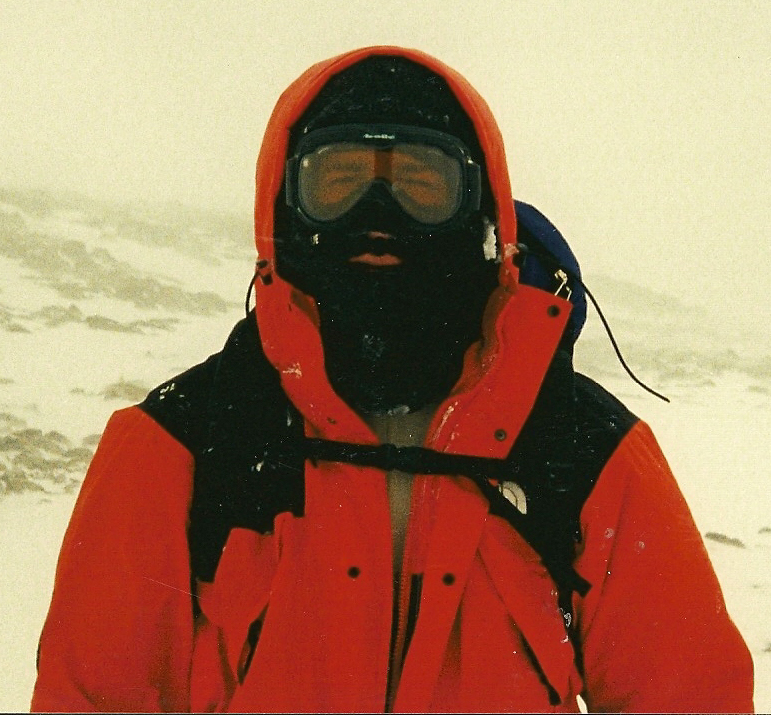
Brian bundled up for the brutal windstorm. Fletcher in the background.

We returned to the Monte Cristo Creek Cirque in late April after a 2 week detour to bag the nearby Atlantic & Pacific and to make an attempt on Longs. It was a classic case of mountaineering ADD.

Our target for the day was “The Drift”.

We started up Blue Lakes Road around 7am only to find the road blocked about 1/2 way up and hurricane winds in our faces. We pushed on hoping for a break in the winds.

Joe bundled up against the windstorm

Visibility varied between zero and 50 feet, but I knew the way and we made good progress over firm snow. Unfortunately, the higher we got, the stronger the winds got.  The winds would gust up every few minutes and push us to the ground. We made it to the base of Fletcher (13,400′) before we decided to call it off and save our noses.

“The Drift” – May 4, 2002

We came back the following week to settle up with “The Drift”. This time the weather was perfect. The only problem we faced was the many “summits” in the vicinity.  Our approach wandered a bit and took us around to touch the various points that might have been “The Drift”. The descent was worth the trip.  Brian recalls:

We struggled to guess which couloir to take, since all the bumps on the ridge looked the same from below.  There were some places near the top where we were scrambling over nearly dry rock and loose scree

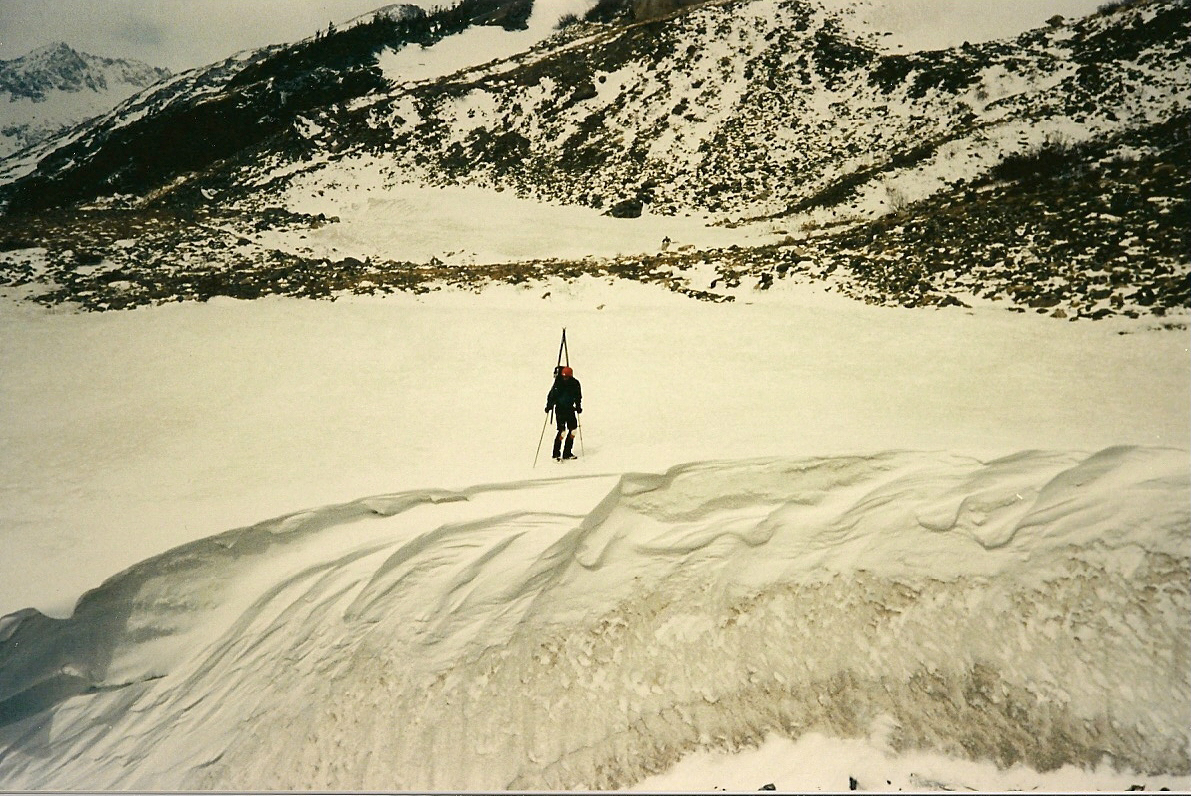
Brian looking for another adventure near the Blue Lakes dam

‘Ol No Name – May 11, 2002

While it wasn’t really on the original list and we were way behind schedule, Brian thought we should the climb the peak we saw just to the south of “The Drift”, in-between Drift and Wheeler. Even though we couldn’t find a name for the thing, it looked higher than Wheeler; I agreed.

On the next trip, this time in May, we took the southern route into the Monte Cristo Creek Basin.  The descent down the dam added an interesting element to the adventure.  Since we approached from the south, we took the southern couloir to the summit to save us from hiking around the east rib.  This led to some interesting scrambling as the snow at the top was soft and melted out in key spots; I had to do some exposed scrambling over loose rocks. Brian recalls:

We hiked up to a minor ridge, then crossed over it into another bowl.  We put on crampons at a point of avalanche debris.  The final part before the summit was extremely steep snow (to me), and I only stayed on it because it was soft enough to punch my arms into it.

Brian admiring an old mining shack below Quandary

But the descent was magnificently steep!

To avoid the willows along the creek on the warmer hike out, we used the central rocky area to travel as far east as we could before descending to complete the hike out on the snow.  But the willows take their toll.  Just the short distance I had to cross was a nightmarish mind and body breaking exercise.  If there is one thing worse than hiking on soft snow, it is hiking on snow covered willows. My sanity was only retained by thoughts of how great the descent had been from the peak.

Unfortunately, this also signaled the end of the Spring snow climbing season for 2002.  The last chunk of rock (and snow), Wheeler, would have to wait until 2003.

Brian standing on a chunk of cornice that had fallen

Wheeler Mountain – May 17, 2003

A year later we remembered to come back.  We chose the NE Couloir to finish off the last peak in the Monte Cristo area, Wheeler.  Starting again on the snow-blocked Blue Lakes road, we again took the southern route. The willows were buried deep and so the hike in and climb started well but soon degraded into a snow-over-loose-rocks misery and then a scary semi-technical rock climb. Brian recalls:

Wheeler was steeper and drier than the others.  We had worked our way around the back side, and went up a 40-ft low-angle dihedral, stemming ski boots on rock edges, and hooking the self-arrest poles on holds.

The tiny summit and great views tipped the scales back to the good.  The fun, scary descent down the NW couloir solidified the day into a great experience.

And we were done.  We’d climbed all the peaks in the Monte Cristo Creek Cirque. And it only took 2 years.

Overall, bagging the peaks in the Monte Cristo Creek Cirque was an enjoyable experience. The unexpected pleasure was our getting to know the terrain so well that it felt like a backyard: the terrain, trails, and, to a lesser extent, the weather became less wild and even friendly.

It still reminds me of what Edward Whymper said about preferring to climb favorite mountains again and again because they become like old friends. I couldn’t agree more.

See all trip reports

Last Gasp Mountain

April 19, 2010

The thought of recording the glorious horror of this trip helped to sustain me during the many hours of this largely miserable experience that ended well.

And that is the makings of a great adventure:

Great Adventure (my personal definition)

A dangerous undertaking demanding a higher than expected level of physical, emotional, and intellectual effort that ends well.

A trip like this is an unexpected but secretly hoped for blessing.  In fact, if we dare expect it, then the possibility evaporates.  Such opportunities only come from pushing the envelope of capability by selecting adventures that match our most optimistic opinion of our willingness to suffer. This was such a trip.

It was the first trip of the season; I was not yet in shape, but figured I could pull it off by trying harder.

The trip started bad:  driving in the dark with bad visibility and roads from falling snow, not sure how to find the turnoff to the trailhead in a whiteout, setting up camp in a snow storm.

But we persevered.  And by morning, our day was perfect:  single digit temperature with no wind.

My friend, Joe, had joined us for some prep work for a trip to Bolivia that he and I were taking 30 days hence.  The three of us started off from the Missouri Gulch trailhead at 7am.  We managed a good pace early on — the first 2000′ of elevation fell in 1 hour and 45 minutes. Then our luck turn against us.

The Joes in Missouri Gulch on the way to Mt Missouri

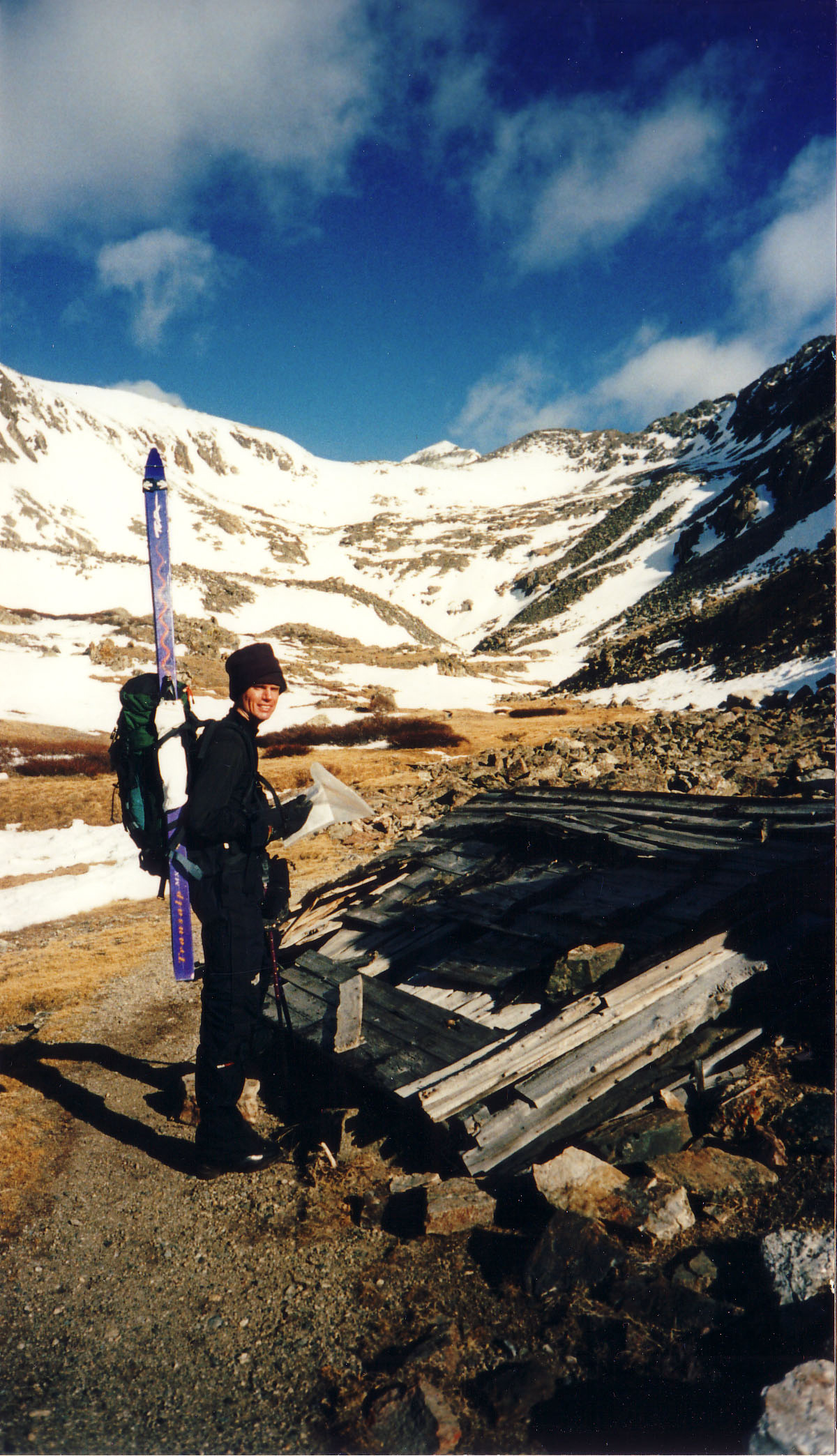
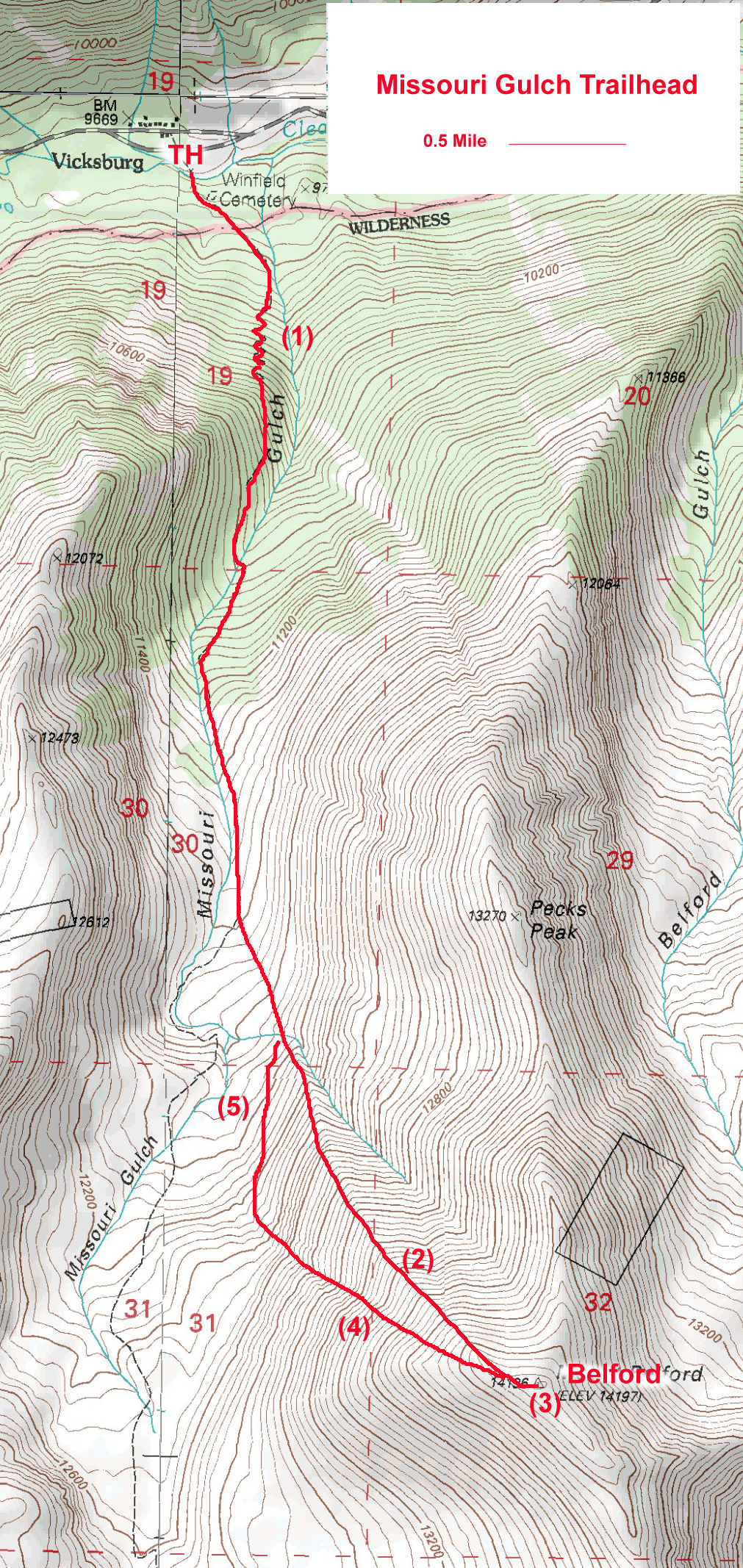
We made a route finding error.  Rather than continue closer to the end of the Gulch, we turned up about 1 mile too soon (position #1 on map) to climb a couloir to reach the ridgeline above us on our right. Dawson’s guidebook said, “crest the ridge at the obvious saddle.”  I guess we should have been more careful than assume anything is obvious once surrounded by peaks on 3 sides. This mistake would cost us by putting us in steeper and looser

Our route up and down Mt Missouri from Missouri Gulch trailhead. The correct route is our descent route.

terrain and force us to traverse a long, rocky ridge instead of a smooth valley floor.  And the snow was loose; it felt like climbing a pile of sugar:  three steps up and two slides back. This more challenging terrain kicked my ass and depleted my main fuel tank; I had not yet gotten into high peak climbing shape since the end of downhill ski season.

About 1/2 way up the to the ridge, Joe yelled up that he was turning back to wait at the truck.  I wasn’t tempted to retreat, but I sure could understand the decision.

I reached the ridge line at 12:20pm. It had taken me nearly 3 hours to climb to the ridge. The spot we reached was a pleasant spot with a wide flat area and a view of the entire Rockies, and we were perfectly happy to enjoy the wonderful views because we didn’t yet know that we had climbed up the wrong place.

It took over an hour of carrying skis while stumbling across thinly snow-covered rocky slopes for over a mile to figure out we had done it wrong; and that conclusion only known for certain after we reached the top of the correct couloir.

We had burned precious time and energy, but now we were close.

From the saddle above the correct couloir (where we left our skis), we climbed up a steep, icy slope. As I struggled up the slope toward the summit gasping for air and resting every 5 steps, I had the dread of a false summit. I willed myself into hoping it was the summit.  I needed it to be the summit.

It wasn’t the summit.  I looked left and three-quarters of a mile down the ridge was a peak apparently 100-200 feet higher.  It was 2pm; Brian said, “let’s hurry, we have a long way to go!”  I was too tired to say what I was thinking.

Cleaned up a bit, my thoughts went along the lines of:  “Hurry?  I don’t know if I can keep going!”

I put one foot in front of the other and slowly made progress.  Time was ticking away, but I could do little more than shorten the length of my frequent rests.

About 300 feet from the summit, a steep cornice blocked the ridge. To continue, we had to descend a short distance and make a technical traverse above a steep slope on Missouri’s SW corner; I made it across by kicking steps and desperately using the self arrest handle on my ski poles to find some purchase on the loose snow.  As I stepped out of danger, I immediately dreaded the return trip.

We reached the summit @ 3pm; it took 8 hours to reach the summit. After taking a few minutes to collect my breath, I remarked to Brian that this was such a terrible climb that it will be remembered fondly. He agreed; always, the glory is in the struggle.

I ate and drank the rest of my supplies and hoped for a second wind; I couldn’t afford to save anything for the trip back.  I had to hope a ski descent would be fast enough to get me back to civilization before running completely out of fuel.

With 4 hours of light left, we started back across the summit ridge, hoping for good luck.

The traverse back to the descent saddle was legal murder, so no one filed a police report.  And then it was time for another change in luck.

Once the skis went on the feet, the trip took on a flavor of wonder which only comes of the best possible backcountry skiing conditions.

The snow was perfect.  We skied down the couloir and on down to within 100 yards of the truck.  It was miraculous: pure joy.  We got back to the car at 6pm.

When asked, Joe said he turned around because he couldn’t stand the slow pace of the climb to the ridge: it was too boring. I said it was true that I suffered for much of the day, but that having reached the summit and returned safely, the day felt like a great day.

Misery Axiom: never turn back because of mental misery.

More mental suffering (e.g., boredom, frustration, irritation) leads to more personal rewards, which can only be harvested through perseverance (corollary to Reward Rule).

Fourteener #20 in the bag.

See all trip reports

See all 14er trip reports

Sometimes two is one too many

April 17, 2010

With only 13 of 58 fourteeners done, I cherished any opportunity to bag more than one in a trip.  We were going to do a snow climb on Belford and then traverse over to Oxford.  I loved the plan; but, sometimes, two is one too many.

For these intermediate distant peaks, we generally prefer to camp at the trail head the night before to avoid having to get up at 1am.  But my travel plans ruined it.  I didn’t get home from a week in Detroit until 10pm on April 24, 1998; so, we couldn’t get to the Missouri Gulch until 3am.  With a wake up call coming at 5am, I wouldn’t get much sleep or acclimatization for my first 14er of 1998.

And then it snowed hard all night.  We awoke to a fluffy start, and a quick elevation gain.  The trail gets steep immediately as it switch-backs up through the trees (position #1 on map).

The mountain was ours.  No sign of humanity as far as the eye could see.  It was a spectacular setting; almost enough to make me forget how tired I was.  Almost.

Our route up from Missouri Gulch trailhead to Mt Belford

We took the northwest ridge route:  2000 feet straight up.  It was sort of boring, really.  And that was the last thing my sleep deprived mind could tolerate.  I felt terrible (position #2).

I was tired and dizzy, and the higher I climbed, the worse it got.  Brian moved ahead while I struggled up the slope.  Twice I nearly fell over backward and one time I fell asleep while taking a break.  It was my worst performance ever (I mean ‘ever’ as in before or since).

Since Brian wasn’t around, I couldn’t stop without telling him. So I kept plugging along, a few inches at a time.  By the time I reached the summit, Brian had been sleeping on the large boulder for an hour.

I felt badly about being so slow, but Brian’s first comment was “never give up, huh?”.  It was too late to push onto Oxford; hell, I was lucky to get Belford (position #3).

We started down, and I felt better immediately.  With all the snow, I was glissading down the entire mountain.  The first glissade was a real howler….snow flying up all around me as I flew down the slope.  I came to a stop just before a steep couloir (position #4).

Brian caught up to me and said he didn’t like the look of the snow.  I said, “let’s find out”, and push myself down the chute.  About 15 seconds in, the snow in the chute let go.

But rather than throw my stupid bones down the mountain, the snow just ran out from under me and dumped me on the crusty snow layer underneath. It was a strange feeling watching the snow crash down the mountain; it could have been me with it.  And with the good snow gone, the good glissades were over.

Three hours of postholing (position #5) got me to the trees, and a short time later we reached the truck.

We had taken 10 hours to climb 4,500′ of elevation in only 4 miles one-way (8 miles round trip).  My feet of elevation per hour of sleep was at the high end of the human potential scale, in my opinion.

Thank God that Brian drove.  I couldn’t stay awake to save my life.  We packed up our camp and piled into the truck.  I fell asleep immediately, and slept for 2 hours while Brian drove.

He woke me around Eisenhower Tunnel to help him navigate the whiteout he was driving in down I-70. The snow was falling so hard that we couldn’t see more than 10 feet, which is bad when driving at 30 miles per hour.  My job was to watch the guard rail to warn Brian when he was drifting too far to the side of the road; he couldn’t afford to take his attention from the faint lights in front of him. Every 15 minutes or so, he’d pull off the road so I could run out and wipe the snow off the headlights.  I don’t know how we avoided getting crushed by a blinded truck driver.

It was completely insane, but at least I had a nap before hand.  And with the success of this trip, Brian and I would go on a tear, bagging 5 14ers during the Spring of 1998.

Unfortunately, Oxford wouldn’t fall until September 2000 on a trip with my wife.  We didn’t have snow problems, but the wind was historic.

See all trip reports

See all 14er trip reports

Long’s Southwest Ridge

April 15, 2010

For my 9th summit of Longs Peak, I wanted to do something new.  I had already done an iced-over Keyhole (late fall), a winter Cable Route, a spring Notch and Kieners, a summer Stettners and Diamond, and had even done a Keyhole Ridge and a traverse from Meeker via Gorrells and a climb out of the Notch to the Longs summit ridge.  This time we’d do the Southwest Ridge route pioneered by J. Alexander in 1924.

We got an early start (4:30am) but still had to park 1/2 mile down the road due to a full parking lot.  I have never been able to get right with the notion that the safest way to climb Longs Peak is to do it in the dark to avoid the lightning.  Shit; I like to see what I’m doing.  And I’ve not been chased off Longs by lightning yet.

We passed a hundred people on the way to the Boulderfield which we reached at 7am.  We needed to let the rock warm up a bit, so we lounged in the Boulderfield for a while and speculated on new routes we could put up.  Big talkers.

Longs Peak from Taylor with our route marked in red

Position #1

Then we continued along the Keyhole route until we reached the top of the Tough, from which we scrambled up 40 feet to reach the start of the Southwest Ridge Route climb.  We started the rock climb at 9am.

The rock was freezing.  I was freezing.  The rock was covered in lichen.  It must not get much traffic.

Brian took the first pitch.  The guide book says traverse left and up ledges until a steep gully leads back to a belay on the ridge, but I don’t remember what Brian did.

For the second pitch, the guide book says to pass an overhang, then work up to an exposed belay.  All I can remember is crawling up licheny, cold rock with numb toes and frozen fingers, and then not being able to find a belay spot until I ran out of rope.  Calling down 175′ in high altitude winds is impossible, so I put in the best belay I could.  You should imagine a very terrible belay.

Brian finished up by climbing over some ledges and moving somewhat right.

Position #2

At noon, as we sat on the summit block just above the Southwest Ridge, we both suffered a bit from the altitude and were really huffing and puffing. Brian dared me to hold my breath for a minute, but I feared at least a stroke and at most my head exploding, so I declined.

Position #3

We then wandered over to the summit proper to enjoy the views and receive our honors.

After a short disappointing wait, we descended via the Cable Route.

Position #4

We descended past Chasm View and into the Boulderfield to get more water and then becgan the long march home.

That last 1/2 mile down the road always feels like a bit of insult on top of injury from a day of pounding. At the end, we’d used 10.5 hours and hiked 15 miles to get 3 pitches of 5.4 climbing.  We must love Longs Peak, eh?

Once back at the truck, all that was left was to imagine a new way to reach the Longs Peak summit.

See all trip reports

See all Longs Peak Massif trip reports

Crucified on Mount of the Holy Cross

April 11, 2010

What a way to end the snow climbing season!  It was so hard that I was at once beaming with pride over the accomplishment and too exhausted to think I could do another 14er any time soon.  What a peak!

Brian and I decided the conditions were ideal for Mount of the Holy Cross.  In the evening of June 5, 1998, we drove up I-70, past Vail, and past the White River National Forest Ranger Station in Minturn to reach the Tigiwon (dirt) Road (Forest Service Road 707), which was supposed to take us to the Halfmoon trailhead 8+ miles up the road.  But 2.5 miles before the trailhead (at approx. 9,500′), the road was blocked by a snow drift at a creek crossing.

We tried to power over it, but only succeeded in getting stuck.  We spent the next 30 minutes digging out so we could at least go home after the climb.  Defeated by a snow drift, we decided we’d just add the 5 miles to the hiking round trip, and turned in for a night on the side of the road.

It was a cold night, and then we overslept.  Brian’s alarm was muffled by his sleeping bag and we didn’t hear the tiny beep, beep, beep offered by his watch as an alarm.  At 5:30am I heard Brian say “shit!”, and we were up.  We hit the road at 5:50am and followed it up and down and around the knoll ending at the trailhead at 10,300′ about 50 minutes later.

We logged in and continued up the trail, which was soft and muddy, reflecting the recent rain & snow but not the very cold temperatures of the night a few hours prior.

Our route up Mount of the Holy Cross

I could feel a growing nausea in my body; I pushed on hoping it would grow bored and leave me alone.

We crossed the Halfmoon pass (11,640′) and then started to traverse the side slope of Point 12,743.  The trail was cut into this slope and thus had an angle perpendicular to its direction.  Since it was also partially covered with alternating patches of soft and hard snow, anytime I managed to avoid post-holing, I was tearing my groin muscles as I did the splits whiles slipping and sliding off the side of the trail.

Once past the SW ridge of Point 12,743 Brian, I, and my remaining intact muscles could see the poor condition of the Cross Couloir before we descended to East Cross Creek at 10,670.  After hiking a short distance past the creek, we turned south to skirt around the peak to reach the SE corner; but not before stashing our snow flotation gear which was useless in the patchy snow.

Three hours in and we had only gained a net 900′. And that last 1000′ descent we’d have to reclimb on the way out.  I knew this was going to be a hard day.

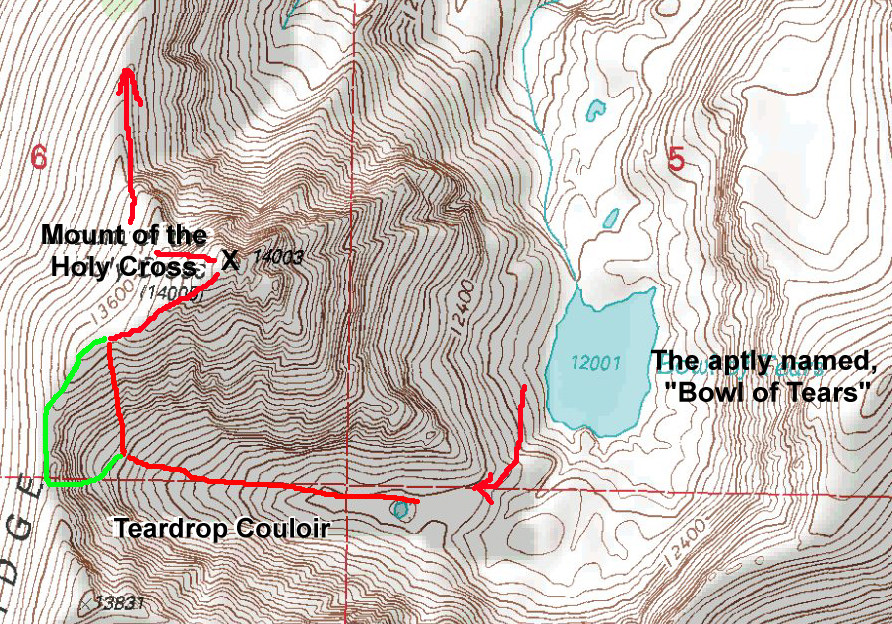
“Where’s the trail?”…”this seems too close to the creek.”  After 10 minutes, we gave up and just started bushwhacking and boulder hopping (to avoid the soft snow).  The bushwhacking turned into scrambling, and at one point, into a technical free solo up an icy chimney.  “I don’t think this is the trail,” I offered. We eventually found our way to the talus field along the west ridge which we followed south toward the Cross Couloir.  We had already decided that the Cross Couloir looked too hard (too much exposed rock); so we were on our way to the Teardrop Couloir (actually the name “Teardrop” showed up some years after we did the climb using Dawson’s guidebook published in 1995 which said it was a “hidden cirque”).

After a while, I was thinking that the effort to hike past the Cross Couloir and the Lake of Tears to reach the Teardrop Couloir was the crux of day.  Our late start, the soft snow, and the missing trail conspired to threaten our summit.  Six hours in and we were still postholing by the Lake of Tear around the corner from the start of the couloir on the SE corner.  At least I knew how the lake received its name.

While I couldn’t imagine what new variable could be added to the soup to make it even harder, a short while later I’d find out that fear would do the trick.

We finally reached the base of the couloir around 1pm (7 hours after starting) where we stopped to put on crampons before starting up. My nausea had long since passed and Brian and I made good time up the couloir.  As we neared the top, the cornice started looking bigger and bigger; and, finally, it was undeniably huge.

The Teardrop Couloir (Brian's route in green)

Brian and I stopped to consider our options.  There were only two obvious paths:

  1. go through a cleft in the middle of the cornice , reached by traversing left over some steep snow directly underneath the bulk of the cornice, or
  2. traverse right toward some rocks and what appeared to be easier ground

Brian proclaimed that tunneling up through the cornice via the cleft would be fun; I announced I would head toward the easy ground.

My path actually did start off pretty easy, but soon became wickedly steep.  But I was able to get a solid grip on the snow with my axe and crampons, so I continued with the plan still feeling it was the best path.

Then the snow got hard, and I got scared.  I was on 60 degree rock-hard snow with nothing but the tips of my crampons on the snow and air below me for 1000 feet.

After a moment, I steeled myself to the task of surviving and found a rhythm of repeatedly kicking each foot to gain some friction on the hard snow to take a step and repeatedly pounding my axe into the snow every 2-3 steps.  This action was exhausting but successful in safely taking me to the Holy Cross Ridge line between the summits of Holy Cross and Point 13,831.  And, oh what a beautiful feeling it was to pull over the crest to safety.  It was like a rebirth.  Brian had waited until he saw I would make it, then he took off for the summit.

The wind was really blowing on the ridge, and almost immediately after my arrival, it started snowing.  The visibility was poor and I couldn’t see the summit.  I figured I had to be close.  But as I sat there finding my breath, I saw it:  still a quarter mile to go.  Shit.

I pushed as hard as I could and reached the summit at 2:30pm (8.5 hours after starting).  Brian and I enjoyed the view for a short time and then left to descend via the North Ridge.  But we couldn’t find it.  It is always amazing how easy it is to lose something so massive.  But we didn’t come up that way and the visibility was once again poor.

After studying the map a bit, we decided to head west and then north to find the proper ridge.  It worked. We found the North Ridge but also found it was covered in a powdery snow which concealed loose rocks beneath.  On separate occasions, I hyper-extended my left knee, over-extended my right Achilles tendon, and smashed my right knee cap after slipping on loose rocks.  I would have paid a lot of money to be able to glissade any part of the descent, but I couldn’t find a decent patch of snow to save my life (or my legs).

At the bottom of the ridge, we aimed ourselves north to try to intersect the lost trail as it angled toward Cross Creek.  It worked.

At 5pm, I was sitting on the ground and Brian was laying in the grass near Cross Creek; we rested and pondered our completion time. We were sorry to conclude that we had 2-3 hours of hiking left, and that would get us home by 11pm if we didn’t stop for dinner. It would be a hungry night.

Coming back up the other side of the canyon was as exhausting as anything I’ve done. We made good time (at one point, we ascended 500 feet in 30 minutes), but I felt like I was going to either puke or die, and I didn’t want to puke.

Somehow continuing to live with my stomach intact, the mountain threw a curve.  We had to recross the angled-snowfield-of-torn-muscles beneath Point 12,743, and now the snow was all very soft. I was quickly out of energy but had to continue to fight for every step. I needed snowshoes the size of pickup trucks to avoid postholing in that air that looked like snow.

By the time we reached the pass, I was spent. Panting heavily despite no apparent need, I looked like I’d been crucified.  Brian took pity on me and offered me a piece of candy.  In the past, I had always rejected such as junk food; but I was desperate.  So I took it, and that made all the difference.

Almost immediately I felt better and was able to haul ass back to the truck.  We reached the truck just before 8pm, leaving plenty of light to find our way back to Minturn.  But with a late night already locked in, we couldn’t stop for dinner before jumping on I-70 for the long drive home.

We had taken 14 hours to climb 6,500′ feet and hike 17 miles on our successful quest to bag Mount of the Holy Cross via the Teardrop Couloir, contributing only a few tears to the stash.

No more soft snow!

See all trip reports

See all 14er trip reports

A Winter Longs

April 2, 2010

I had long wanted to do Longs Peak in winter, but it didn’t seem likely due to the requirement to give up a downhill ski weekend, which was the source of all joy.  Fortunately, good climbing partners are good for all sorts of things.

The Weekend Before

Driving back from one of the best ski days of all time, Brian says, “Are you interested in doing Longs Peak over President’s Day weekend?”

Stunned into silence, my mind grasped for a handle on the situation. What could he be thinking about? Why would we even consider giving up the complete joy of downhill skiing to seek pain & misery for the sake of mere accomplishment?

But I had never done Longs Peak or any high peak in winter, and my passion to bag many different types of Longs Peak ascents won out in a high vs. low brain wrestling contest using a rapid take-down maneuver.  I don’t think I managed to squeeze out a “huh?” until I announced that “I’m in” a few moments later.

The thought that Vail was closed on President’s Day weekend for Colorado Pass holders was a serious handicap for the ski contingent.

The Night Before

Brian called to confirm our meet up schedule and reported that the Boulderfield had winds of 80 mph.  I was unnerved to say the least.  I had made a bargain with my Maker 10 months earlier that I would take better care of my nose after getting frostbite on an wickedly windy Mt. Silverheels.  That was a serious bargain that had worked out very well so far; it didn’t seem right to push it. But, I reasoned, if I brought a facemask and extra wind protection, that would qualify as “taking better care” of my nose. I threw my facemask and an extra balaclava into the pack and put the issue behind me.

The First Day

We left Boulder at 7:30am on Saturday, February 19, 2000.  The Longs Peak Ranger Station Parking lot was empty, of course. But it still felt weird, like in Vanilla Sky when Tom Cruise finds himself in an empty Times Square. That said, it is still better to park right up front and avoid the extra 1/4 mile of hiking to reach the trail head.

The trail was completely obscured and invisible in many spots; it made for very slow going. About 1/2 way to tree line, we lost the trail all together and had to break trail the rest of the way. Still, we had all day to make it to our planned camp in the Boulderfield, so we just endured the struggle.

Just above treeline with Mt Lady Washington & Longs in background. The hurricane winds would start at the Boulderfield.

Once at the Boulderfield, my poor condition began to demand a price.  A price paid in pain. I hadn’t been over 11,600′ (Vail Mountain) in 6 months, had spent a good part of the last month in Atlanta (elevation 750′), and hadn’t carried a full pack since my trip to the Tetons 2 years earlier. It was all I could do to keep moving.

For motivation, the mountain offered blasting, freezing winds. My Gorilla Mask was the only thing between my nose and my reckoning with the Maker. And, I had no idea how we could keep the tent from being destroyed in the hurricane winds, but that was a problem for later.  It was going to be an interesting trip.

I arrived at camp enough time after Brian to find him chest deep in a hole he was shoveling, in the only patch of snow in the boulderfield that looked deep enough for such an pit. He informed me that we needed to build an igloo for shelter from the wind. And, he just happened to have his snow saw handy.  I didn’t even know there was such a thing.  I think I’ll start saying that if you’re not an ex-Boy Scout, it’s good to bring one with you.

And, it was a good idea except that neither one of us knew how to build an igloo. We started with Brian cutting and me placing the blocks.  But my back was spent from the hike in, so after a short time, my back started cramping.   It turns out that compacted snow is heavy, especially when cut into massive blocks.

To give my back a break, I went to dig the entrance tunnel while Brian cut and placed blocks.  By the time I was done with my fabulous tunnel, the igloo looked like it needed some scaffolding to keep from falling in on itself.  We understood the theory of arches (and domes) but didn’t know any safe way to keep the blocks from falling down while we placed the remaining blocks, including the capstone or keystone or whatever you call the last block that transfers the weight of the dome down to the ground.  We resolved that someone was going to have to get into the pit beneath the blocks and hold them up.

Brian offered to go into the “pit of crushing death” to act as the scaffolding, but I couldn’t place the blocks with my back issues. So, standing beneath and holding up 500 pounds of snow blocks was my pleasure while Brian layed on block after block until he placed the final block on top. And in a gift from the heavens, the wind disappeared during the time the igloo was in its most unstable condition.

Somehow it worked.  It took 4 hours to build, but it was magnificent. And huge. Apparently, making the igloo too big is a common beginner mistake. The inside was big enough to hold 4-5 people.

Me standing behind the ugliest igloo ever made on purpose. On the other hand, the entrance tunnel was the epitome of functional elegance.

We found the igloo had many cracks between the uneven blocks.  To avoid a nasty draft during the night, we packed loose snow into the cracks. And to get some idea on whether the structure was sturdy at all, we pounded on the sides with the shovel.  Every time we hit it the sides moved inward but held; we both thought the pounding made it stronger.

As I ate my dinner, I expressed some concern to Brian that if the igloo did collapse while we slept, however unlikely that was, we might not get out.  We decided that we could at least avoid being knocked senseless or crushed by moving out from directly underneath the blocks.  To accomplish this, we dug alcoves into the sides of the igloo pit (which was dug into the raw, compacted snow) to create a roof of compacted natural snow as protection.

We exited the igloo to watch the sun set and then ran for for shelter.  The temperature was dropping very fast, and the wind was picking back up.  But, that sunset was a sight I’ll never forget.

Then it was time for sleep, which came surprisingly easy despite lingering worries about the stability of the igloo.

The Second Day

We awoke around 7am to find ourselves alive and the interior of the igloo covered in a light layer of snow. Apparently, the wind had been bad enough during the night to blast out our snow plaster and begin to eat away at the blocks themselves.

After a light breakfast, we emerged to find a clear day with light winds.  A serious good luck move.  But it was cold.

Of course those initial winter morning moments are agony, as the body temperature struggles to catch up.  But the hike to Chasm View was a nice warm up.  I warmed up enough to think it wasn’t all that cold, so I put on fleece instead of down.  But that foolishness lasted only a short while and cost me some frozen fingers most of the way up.

We used the rope only on the initial pitch where the rock was exposed and we could use rock protection .  Above that, the snow was perfectly firm and had excellent depth over the rock in most of the steep sections.  Still, those few spots with crampons and ice tools scratching for purchase on hard rock with my ass hanging over a 1000 foot drop down the North Face with no protection made a lasting impression.  If that sentence was too long, let me summarize:  it was scary in spots.

Me on the summit of Longs Peak on February 20, 2000.

We lounged on the summit for only 15 minutes.  The sky was still clear and the views were magnificent, but we had many miles to go before we sleep, as it were.

The Descent

The downclimb was utterly unnerving.  In my mental preparations for the trip, I had visions of glissading; but there was no way:  too steep. And just like in rock climbing, downclimbing is much harder than up-climbing because you lead with your feet while your eyes are on the other end.  Plus we made the mistake of following our ascent path, which meant the snow coverage was now poor since we knocked much of it off on the way up. Somehow, I managed to avoid a long dive back to the igloo.

On the way down, we bumped into a couple fellows coming up who told us their tent blew down during the night winds.  Hurray for Brian, his snow saw, and his igloo!

We arrived at the igloo around 2pm and started packing and refueling.  Sunset would be around 5:40pm, so we needed to hurry to avoid the headlamps; but, it just wasn’t in the cards.  At 3pm we started down toward the Ranger Station.

Despite a high misery factor, the hike out went quickly.  The more tired I am the more effective my hiking trance.  Brian tried out his new skis with new-fangled bindings that fit his plastic climbing boots.  I asked him if the setup was tight enough to control his skis; he said we find out. His poor binding combined with a massive pack caused him to crash enough times that I was able to stay with him just by hiking fast.

We got to the car in the twilight around 6pm.

It was another great one! And my nose survived!

See all trip reports

See all Longs Peak Massif trip reports