Posts Tagged ‘Brian’

Snow Massive

January 7, 2010

Out of the blue, Brian wanted to do a full weekend trip to collect something hard and fun; apparently, his girlfriend went out of town on short notice.  Now this is a good thing, but caught off guard, I couldn’t think of anything besides Longs Peak.  Brian says, “How about Snowmass?”

Of course, I known for a while that Brian is always interested in a few extra ski turns and my brain locked onto the obvious ski connection; “The ski resort?” I blurted out while thinking that June is way too late for that.  Brian says, “No, but close.” And that is how our “Snow Massive” adventure got started.

I had done a few 14ers that year and had a exertion-level in my mind that I thought roughly fit the requirements of a 14er.  And it was an investment that I was willing to make without any thought.  I agreed quickly while also registering with great excitement that Snowmass Mountain was a 14er I hadn’t done yet; I’m always up for checking another off that long list.

When I got off the phone, I pulled out my Dawson guidebook to check it out.  Boy, was I in for a shock!

14ers done already in 1999

  • Huron Peak on 4/24 (10 miles, 11.5 hours)
  • Mt Yale on 5/1 (10 miles, 13 hours)
  • Mt Evans on 5/30 (3 miles, 6 hours)

….compared to…

  • Snowmass Mountain (23 miles, 2 days)

Yikes!  An eight mile approach with gear for a snow climb & a cold weather bivy and then a 7 mile round trip to the summit plus an eight mile retreat to the trailhead.  Well, it sure sounded like an adventure.

I couldn’t imagine hauling an entire campsite 8 miles up 2600 feet; I’m just not in to backpacking.  I told Brian I was bringing a bivy sack and lightweight sleeping bag; I’d just have to sleep in my clothes to stay warm.  And I’d gamble on the rain.  I also decided to live on cold food to avoid bringing a stove and fuel. Even still I had to bring a ton of stuff, e.g., snowshoes, poles, crampons, ice axe, food, extra base layer, fleece, gore-tex upper and lower, water bottles, small rock rack (Brian had rope) and helmet.  Let’s just say I had to bring my big pack.

On June 19, 1999, we started the long drive up to Aspen in the early morning to allow plenty of time to reach the bivy site.  We followed Dawson’s directions to the trailhead on Snowmass Falls Ranch, and then began our very long hike to Snowmass Lake.

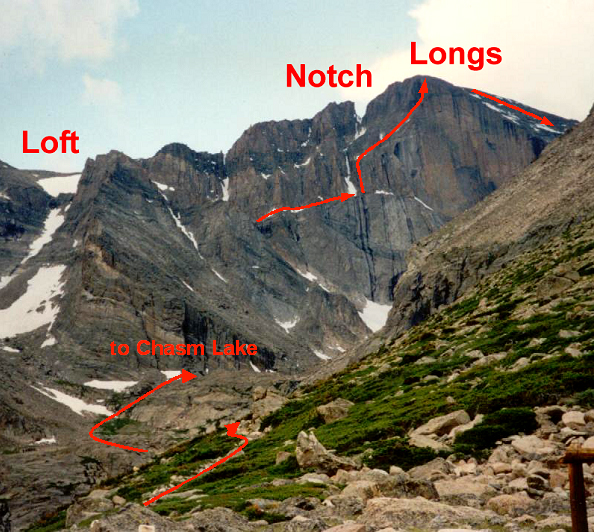
Snowmassive route map

Around 1/2 way up the trail, we came to a creek crossing.  I mean the trail led up to the creek and another trail started on the other side of the creek, so the evidence pointed to us needing to cross.  But there was no kind of footbridge or any sort of solid structure for us to use to cross the 90-foot wide & up to several foot deep creek; the only thing to use was a pile of dead logs that had accumulated in that spot.

Some of the logs where piled high enough to be non-floating, but they were still unstable as they tended to move and roll.  Many others were simply floating on the creek but trapped by the other stuck logs.

….and with a heavy pack on my back?  No way!.

But it was true, we had to balance our way across without a fall or lose the entire trip, or worse.  I did have my snowshoe poles with me, so I used them to help balance my pack as my feet shifted around with the unstable footing.

A failed adventure due to a creek crossing would be all the harder to live with because it wouldn’t just be a failure, it would be a stupid failure.  But we made it.

Joe posing in front of Hagerman Peak....I thought it was Snowmass at the time.

Continuing on we eventually started to get close enough to see the nearby peaks.  We posed with Hagerman’s Peak in the background thinking it was Snowmass Mountain, only to find Snowmass was still around the corner.  And then we were there; it was one of the nicest bivy spots I’ve ever seen.

Snowmass Lake is very large for its 11,000′ elevation and ringed by cliffs on one side with the peaks in the background.  It looked like a nice place to spend a couple weeks, as long as the cold temps kept away the bugs.

The first thing we did was scout the entire area to find the best spot for a tentless bivy; we didn’t want to wake up in a puddle if the rain came.  Nothing was quite perfect, but we each settled on our own “best” spot and then took care of some chores, such as getting water & hanging our food.

Sunset was around 8:30pm, which accelerated the cooling trend for the day.  I put on all my clothes and crawled into my sack to warm up.  It luxurious until the snowy rain started.  But the precipitation didn’t last long and I drifted off.

With only a 3.5 mile hike remaining, we didn’t feel the need for a pre-light start.  Plus, there was another log crossing at the start of the day, and I wanted to be able to see it. So, at rather late-ish 4:30am the alarm went off and we scurried to be ready for a 5am start.

Summit day route map

The first thing we had to do was cross that one last log bridge.  I was relieved to see it was much shorter and we started across.  About midway, I tried to plant my pole in the creek bed, but found it was too deep.  In the process, I lost my balance and had to put my foot down blindly to catch my self before toppling into the creek.  Once I caught my balance, I looked down to see that my left boot was submerged.  With my boots water proofed and my gaiters on, I wondered if I would get away with that mistake.  And in that same instant, my foot felt the flood of freezing water.

Our view of Snowmass from the bivy site.

Oh, great.

Once on the other side, it was the dreaded, yet familiar,  squish, squish, squish sound and sensation as I walked.  After 100 yards, I told Brian I needed to sort out a problem and sat down for some work.  I got the boot off and poured out a 1/2 liter of water and then wrung another pint out of my sock.  I hoped a fresh sock would do the trick but the inside of the boot soaked up too much water for that.  Twenty socks might have done the trick.

With no choice but to continue, it was squish, squish, squish all day as my softened skin eroded away.  At least the temperature was moderate, so I wouldn’t have to worry about frostbite.

Me on the summit....enjoying a well earned rest. And wondering why I didn't get a haircut.

We traversed around the lake to the terminal moraine of the Snowmass snowfield which we scrambled up to reach the giant, low-angle snowfield that must have been the source of the peak name, “snowmass”.  There wasn’t any trail, it was a loose, muddy mess.  But it went.

Once we reached the peak, we broke out the harnesses and climbing gear for the climb up the side of the ridge.  It was a steep snow climb that ended with a few mixed climbing moves to reach the summit ridge.  Brian was right to insist on the gear.

After a brief rest, we then scrambled up the long rocky ridge to stand on a spectacular summit.  It had only taken 3.5 hours; but with the sun burning down on the snow, we didn’t want to get caught in a giant puddle of soft and melting snow.  We quickly went back down the way we came up, ending with a rappel off the ridge.

Brian had carried his skis a long way for these turns.  I had my mind set on the longest glissade of my life. My record glissade to-date was almost 2/3rds of the Cristo couloir on Quandary in a single run (a 1600′ descent over 0.8 miles), only missing the top 750-1000 feet of rocky & overly steep terrain at the top. The Snowmass Big Bowl promised to be even better.

I started off slowly, to get the feel of the snow.  The snow was softening quickly and grabbing at me so I let my speed pickup to get me over any soft spots; it worked.  I was hauling ass down the snowfield, shifting my weight to steer between the rocks, and hollering all the way.  I made it almost to the terminal moraine before I lost my nerve and slowed down.  The soft snow then ended my fast paced adventure.  When Brian finally arrived sometime later, he said, “You were going very fast; that was pretty dangerous.”  It was true, but it was fun.
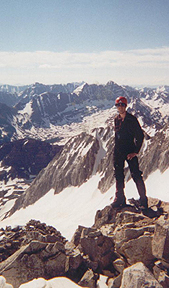
Brian showing off his Snowmass pride

And for the 10 years since, I have been proclaiming Snowmass Mountain as my longest glissade. But my calculations done in writing this report tell me that the glissade was a similar 1600′ over 0.8 miles…not a new record.  But I’ll still say it was the most exhilarating due to the speed I used to make it so far over soft, lower angled snow.  And, yes, I promise not to do that again.

The hike back to camp went quickly on painless adrenaline. Even the short log crossing offered little resistance.  It wasn’t until after sitting in camp for a rest while trying to dry my socks in the sun that my body started to stiffen.  The pain of pulling on that big pack and the cold, wet sock foreshadowed the agony of that hike out.

Another death march.  It went on and on.  I was so bored that I even enjoyed the 90-foot log crossing on the way back.

And then it was done.  23 miles and 5800′ over 2 days, and another 14er done.  It was a great weekend.

And only 36 more to go; I wouldn’t finish for another 8 years.

See all trip reports
2 Classic Climbs: Northcutt Carter & Petit Grepon

January 5, 2010

It was one of those things that gets into your head and you just have to do it.  When I first heard of it, I wanted to do all or at least a lot of the 50 climbs listed in the Fifty Classic Climbs Of North America (a climbing guidebook and history) written by Steve Roper & Alan Steck in 1979. Out of all the climbs in North America, the best 50; the ultimate tick list.  Since two of them were within my reach as a climber and nearby my house (in Boulder), I wanted to start as soon as possible.

The Colorado Climbs within “The Fifty”

  1. Hallett Peak, Northcutt-Carter Route III 5.7 [1956] (in RMNP; top of my list for a while)
  2. Petit Grepon, South Face III 5.8 [1961](in RMNP; had done once before)
  3. Longs Peak, The Diamond, D1, V 5.11 (in RMNP, but too hard; did “Casual Route” instead)
  4. Crestone Needle, Ellingwood Ledges III 5.7

Brian wasn’t crazy about the list (he is too anti-establishment to follow someone else’s list), but he did want to do the Petit Grepon and was willing to re-do Northcutt Carter; so, for next two weekends in 1997, we agreed to focus on 2 of the 50 classic climbs: Petit Grepon & Northcutt Carter.

Petit Grepon (August 30)

It probably wasn’t the smartest plan, to climb the most popular rock climb in RMNP on the busiest weekend of the year (labor day). I guess we just didn’t think of it in time to start the “classic” program earlier and couldn’t wait any longer with the changing season. And, the Petit climb is long enough (8 pitches = 5-8 hours, depending on difficulty and avg length of pitch) compared to the daylight hours before the probable rain (7am to somewhere between noon-2pm = 5-7 hours) such that we had to be first on the climb or expect to fail. [Note: learning to climb faster was another option, but it would take too long to get ready.]

Another complication was the planning for the descent.  The details we could find on returning to the base of the climb were too vague and included ugly descriptions of a “death gully”. So we agreed to escape over “The Gash” as I had done a few years earlier with my CMC rock climbing class, and descend down the Sharkstooth approach.  But, this meant we had to carry everything with us on the climb. It is never ideal to carry everything up the rock, but sometimes that is the best or only way to do it; the obvious key is to not bring too much.

The fact that we couldn’t get a bivy permit worked well with this detail.  We bring very little, start very early, and blast up the trail to be first on the rock.  In reality, we figured we’d be tip-toeing past the sleeping climbers to beat them to the rock. It was a great plan.

We hit the trail at 4am and got in line.  It was crowded like I had never seen it before in the pre-dawn hours.  We put it into high gear and passed everyone and got to the rock ahead first.  One group of sleepy climbers tried to pull themselves together quickly as we passed by, but it was too late; we were first on the rock. “I love it when a plan comes together.” (Col. John “Hannibal” Smith, A-Team)

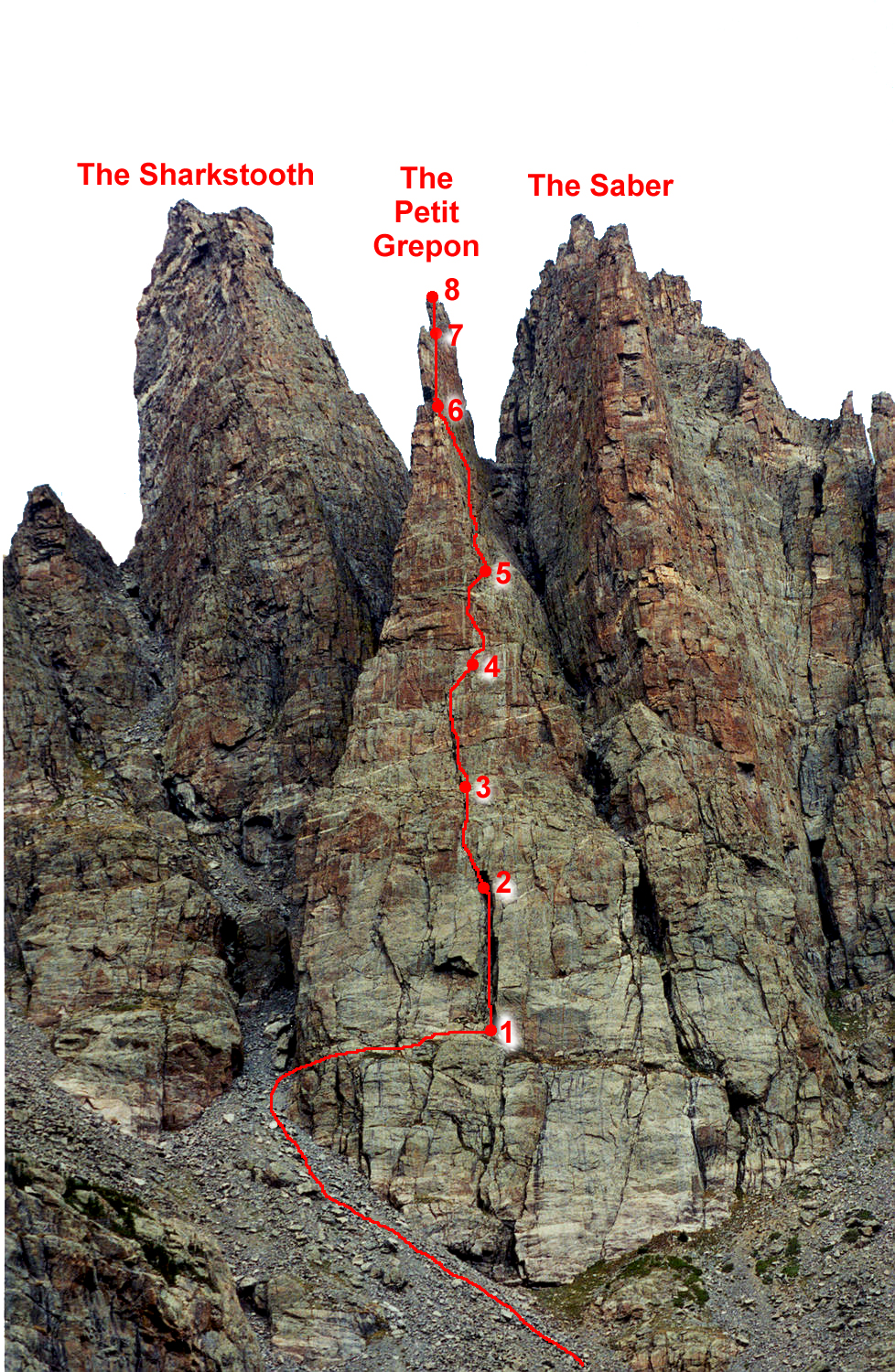
Our path up the South Face route (III 5.8) of the Petit Grepon. We descended over "The Gash" which is directly behind the Petit Grepon, between the Sharkstooth and the Saber, from this vantage point.

To make sure we stayed in front, we skipped the initial pitch by scrambling up the west-side talus to reach a ledge which we used to traverse back to the South Face III 5.8 climb.

Still in a race to be first or at least not hold up anyone else, we quickly got ready for the next part of the day.  After putting on more clothing (we wouldn’t be burning calories like we did on the hike in) including rock shoes and harness, organizing the climbing gear & ropes, and eating a quick breakfast (a couple bits and a swig of water), we packed away everything else we brought into our small packs.

And, then, without another glance back at the climbers jostling for position, we started up.

Pitches

  1. Traversed right to reach the giant chimney in the center of the face
  2. Exited the “cave” to the left and climbed to a large ledge below another, but smaller chimney
  3. Climbed the chimney, then traverse right to a belay below the right end of a roof
  4. Moved right and then climbed a steep crack, into a left-facing corner with a finger crack (crux), and continued up and right to a ledge on the east side of the Petit Grepon
  5. Climbed up, then right and then left to a small stance on the southeast arete.  I believe this spot is called the “Pizza Pan” belay
  6. Climbed a crack above the belay to a ledge, and then up the wall. Belayed on ridgeline
  7. Followed the ridge to the teeny tiny summit
  8. Enjoyed the spectacular views of the world from the sofa-sized summit while resisting an urge to lay flat on the rock

It was incredible; the summit was a 10×30 diving board offering lots of air time before the sudden end.  The summit was so small that I had to look at my feet when I stood upright to keep my balance; the ground was outside of my peripheral vision.  And the fear of falling off was somehow magnified by this phenomenon.  When I sat down, I thought I could feel the rock swaying, which brought on fears of the rock breaking off.  It was the coolest place I’ve ever been, and getting down right away felt important and promised to be interesting.

A profile view of the top 1/3rd of the Petit Grepon from behind. It is a really disconcerting sight that forces you to wonder if it might break off!

We looked around for rap anchors and found a good set on the back side (NE corner).  We then scrambled up a deep chimney to the north to reach the Sharkstooth side of “The Gash.”  From there we descended back down the Sharkstooth approach.  Once we reached the the Loch Vale lake, we found the crowds again; the trails were packed elbow to elbow; it was horrific.  Welcome to Labor Day weekend at RMNP.

But the weather stayed perfect the entire day:  clear skies, warm temperature, no wind, and after 11 hours, we made it back to the parking lot.  We got back so early that a Ranger questioned us intently to see if we had done an illegal bivy.  All we had to do was point at our tiny packs to prove we didn’t do so.

One classic down, and one to go.

Northcutt Carter (September 6)

Then it was time for my test-piece.  And I was scared for a number of reasons.  At the top of the list, the route was famous for route-finding disasters; a rating of 5.7 was only true if you could stay on route. Undoubtedly, the actual difficulty would be harder.  Another was that I had never climbed on Hallett Peak before; I just hadn’t worked up the courage yet. If I could overcome my fear and successfully climb Northcutt Carter, if I could pass the test, then I could call myself a real climber.  Well, that’s how it felt, anyway.

To combat the legendary route-finding difficulty, I studied my copy of Bernard Gillett’s High Peaks, 1st edition (the importance of this detail will become clear later) more carefully than ever before.  And, of course, I made a photocopy of the topo and route description to remind should I become confused.

Just as the week before, we were planning on climbing a very popular route.  And this time, the weather report promised bad weather in the afternoon.  We needed to get an early start and move fast to make it.  Yet, since the approach was far shorter, we slept in a bit; my alarm didn’t go off until 3am.

We hit the trail from the Bear Lake parking lot at just after 5am and took only 30 minutes to reach Emerald Lake.  It was still dark so we couldn’t see how far we had to go.  I thought we might have started too early, but we didn’t reach the bottom of Northcutt Carter until 6:45am.  And once again, we were the first to arrive; and we didn’t waste any time getting started by scrambling up the broken rock to the right of a break in the “white band” to reach the bottom of the climb.

Pitch 1

Brian took the first pitch, and climbed a corner for about 1/2 a rope before moving a bit left and climbing up a slabby rock.

Pitch 2

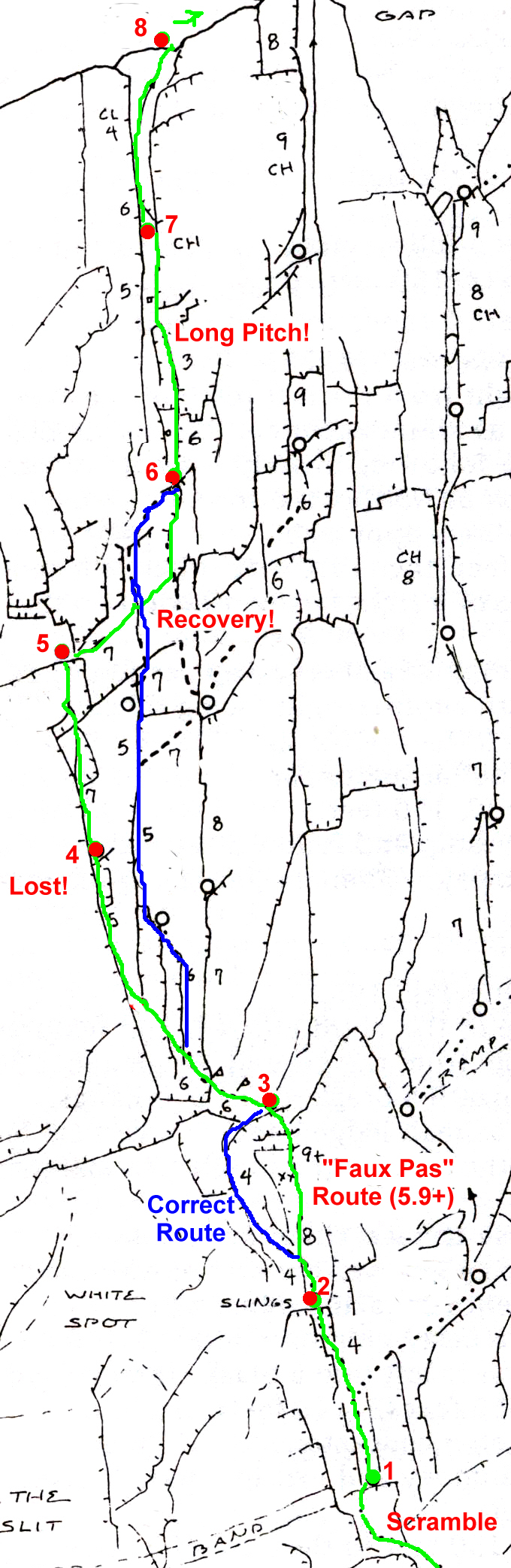
We were swapping pitches, so the 2nd pitch was mine.  I took out my topo for a quick refresher; Gillett said, “go straight up a crack, then move a bit right to the belay.” Unfortunately, the guide book was wrong!  Mr. Gillett was describing what Rossiter calls the “Faux Pas” route…a common mistake on Northcutt-Carter.  Of course, I didn’t know this until I later bought a copy of Rossiter’s book.

As directed by Gillett, I started straight up and then passed a roof.  It was pretty hard (turned out to be 5.8), so I figured I did something wrong; the pitch was only rated 5.4.

As I looked up I could see a couple pins with some gear left behind.  Booty!  I scrambled up to claim it without a thought to why someone would have bailed at that point.  And then it started to really get hard.  With the rock still a bit wet and the terrain now a bit overhanging, I was in trouble.

I kept making progress, but I was wearing out.  I found an unlikely leg jam that I could hang on with no hands.  That gave me a life-saving rest.

The rock was overlapping plates of rock like tiles on a roof…the pieces of rock were loose and the downward slope of the rock plates didn’t offer much to hold on to.  While I struggled to find the right piece of gear, one of the loops on Brian’s gearsling broke and sent the two large cams into oblivion.

Running out of gear and strength, I took to hanging on the pro to gather enough strength to make it another few feet.  But eventually I made it.

After Brian came up, we both were very confused about the route.  We couldn’t begin to think of how we got off-route.  But since the belay looked right, we decided to push on.

Pitch 3

Brian took the third pitch.  The rock all looked similar (the reason for the route-finding difficulties for many); following his nose, he took the original line of Northcutt-Carter, which was a bit to the left of the route we were trying to follow.  We had to simul-climb a bit so he could reach a good anchor.

Pitch 4

I had no idea where the route went.  I continued up the line until I got to a good belay stance in an alcove; the route didn’t seem to go anywhere from where I was; I hoped that Brian could find the route.

Pitch 5

Brian thought he knew where to go and traversed far right to link up with the route.  Once at the belay together, we both felt confident we had re-acquired the route.  This was the good news; the bad news was that the rain had started.

Pitch 6

I continued up toward a chimney and then climbed the chimney.  I saw a great belay spot and got to within 3 feet of it when I ran out of rope.  I had to jam my foot in a crack for balance while I struggled to find a place for one of the last pieces of gear remaining.  I then clipped a long sling to that questionable piece of gear and lowered myself to a sloping ledge where I could find a good placement for my last cam.

My anchor contained 1 good cam, a questionable tricam & my ass on a ledge; I wasn’t happy, but I was out of options.  I gave the rope 3 tugs and hoped Brian wouldn’t fall on the slippery rocks.  I sat in the rain wondering how we would get out with our lives.

Brian didn’t fall.

Pitch 7

Brian slowly crept up the wet rock while I froze in a freezing rain.  By the time he reached the top, I was a stiff, wet fool.  But since Brian was at the top, we were going to make it…I could just fall up the rest of the way.  Retaining a bit of pride, I managed to reach the top without resorting to falling.  And once I started to thaw out, my fingers hurt like the devil was eating them.

Descent

The descent gully was very hard to find.  Brian had been in it once the year before but I had never been on Hallett’s north face.  We eventually found something awful that Brian was certain was the right gully, and we started down.  I didn’t believe we were in the right place until climbers descending above us nearly killed us in a rock fall. Eventually we reached the bottom and spent 40 minutes fruitlessly looking for the fallen gear.

After a fruitless search we gave up and hiked out to go eat.  We reached the car at 7pm for a 14 hour day, and then went into Estes Park for a Mexican Food celebration.  I felt that I had accomplished something important, but that was the end of my obsession with the Classic 50; just too many great things to do close to home.  And, while 2 of 50 isn’t really a great accomplishment; not finishing the list at all seems to be rather common.  According to Wikipedia, no one has ever done all 50; perhaps everyone has too many good things to do nearby home.

That was also the end of my use of Gillett’s guidebook; I’ve used Rossiter’s book ever since.  I’ve heard that Gillett fixed that mistake in his 2nd edition, but I wouldn’t know for sure as I never bought it; some mistakes are simply unforgivable.

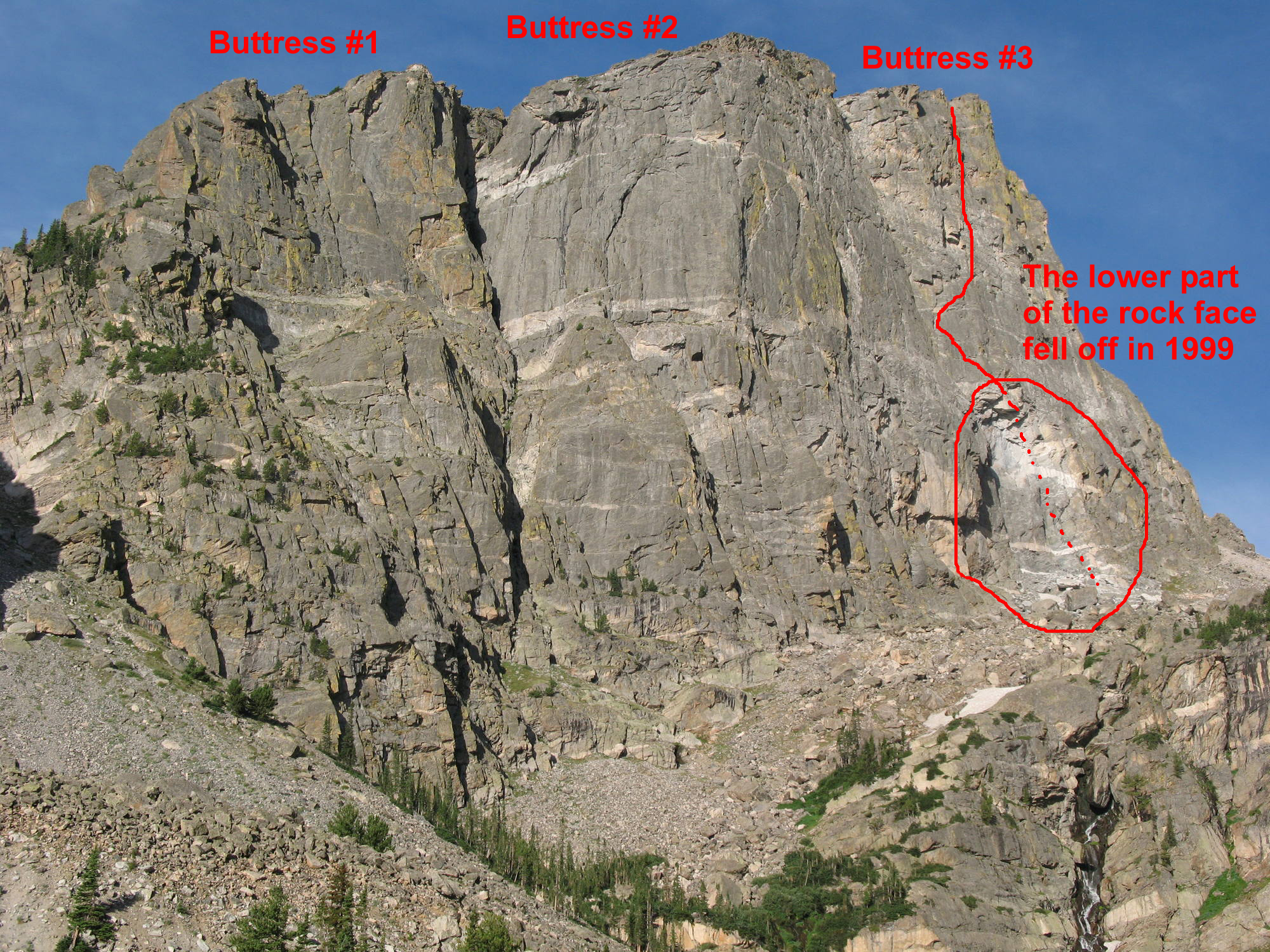
It is worth noting that it was good that we got Northcutt-Carter done when we did.  A few years later (I believe 1999), the bottom 2 pitches fell off the face into a pile of rubble at the base of the climb.  Northcutt-Carter was dead.

Hallett Peak with "dead" Northcutt-Carter route indicated

See all trip reports

Sharkstooth: My first RMNP love

January 2, 2010

The Sharkstooth taken on approach in July 1992

Sharkstooth.  My first RMNP love.

The Sharkstooth is well named.  It is the highest (12,630′) of the Cathedral Spires group of pinnacles on the ridge that splits the Loch Vale area and separates the Sky Pond/Taylor Glacier area from the Andrews Glacier area. When viewed from below Andrews Glacier, it looks like a massive tooth jutting up from the jaws of the Earth. It is located just east of the Continental Divide and Taylor Peak, and is a stone’s throw from the popular Petit Grepon.

In July of 1992, the Sharkstooth was the very first alpine climb I ever did, using the Northeast Ridge (II, 5.6) route. At the time, the 5 mile approach in darkness and 6 pitches of technical climbing for a total of 3350’ in elevation gain over snowy rock were far beyond anything I had ever experienced to that point in my life. I honestly felt I might not survive but thought the experience would be worth the risk. Adding to the allure, I was told that Sharkstooth was the only officially named peak (i.e., name is on map) in RMNP that required a technical climb to stand on the summit.  It seemed the perfect candidate to be the only peak I would ever summit, and I planned to brag about it for the rest of my

Me and a couple buddies on the Sharkstooth summit in 1992. From left to right, Mark, Jim, Joe

life. Fortunately, survival was not an issue; and in the months that followed, I couldn’t stop thinking about climbing more peaks.

My inevitable return visit to Sharkstooth occurred in October 1996, and was the first climb I ever did with Brian. It was a freeze-fest due to the late season effort that concluded with a 4pm summit, leaving only 2 hours of light to rappel down and hike out (in case you don’t know, it takes at least 3 hours).  And we didn’t bring headlamps.  As you may guess, it was another epic experience, cementing the Sharkstooth’s place in my heart.

Despite being my first RMNP love, so many peaks to climb meant it would take 3 years before we’d return once again; and this time, to complete the North Face [5.8] route, the key factor in success would be perseverance.  Return trips would come much more quickly, out of necessity.

The Climb

After digging deep into Rossiter’s guidebook, Brian had the idea of climbing the obscure North Face route [III, 5.8] which starts at the popular Northeast Ridge route but then spirals up and right around to reach the summit from the west side.  And on August 29, 1999, we set out to climb Sharkstooth once again.

We drove into RMNP in the predawn twilight and parked at the now extinct Glacier Gorge access parking lot.  With a quick sorting of gear, we were hiking at 5am.  We kept up a good pace and reached the base of the climb at 8am to find the rock wet & very slippery.  Our only hope was that the wind would dry the rock before the climbing got too hard.

Progress made in initial attempt of North Face route on the Sharkstooth. Photo from 1992 climb.

From the start, we knew it was going to be an adventure.  Rossiter’s description of the route was more like a set of tips than detailed description of the pitches he generally lays out:

“Climb the first pitch of the Northeast Ridge route, then traverse right to the higher of two grassy ledges.  Work up and right onto the North face following the easiest line. Continue in a spiral onto the West face until it is reasonable to climb directly up to the summit. Beware of climbing too high on the North face before rounding the Northwest arete; follow the line of least resistance.”

Essentially, he says to start at the SE Ridge route and go up and right. And the topo didn’t help very much either, as it just showed an arrow pointing around the corner of the NW arete.

But that is okay; more adventure for us.  We enjoyed and were good at route-finding.  We just hoped we had time for that sort of adventure.

Route-finding Rule of Fun

Good Route-finding Skills plus Enough Time

=  Fun Adventure

The first couple pitches were clean rock alternating with grassy ledges which brought us to the shoulder where we could see the north face above us.  That was our last sunlight for the day.  An ascending traverse right over broken terrain took us to the far right base of the north face.  And by 11am, I found a windy belay perch on a ledge from where we could peek around the corner and see the steep unlikely-looking west side.  This spot was about 150 feet short of the summit (2 short pitches).

And a few drops fell.

In a valorous effort to intimidate the weather, Brian ignored the mosture and started up the pitch.

Brian adds the following details regarding the crux pitch:

I led over couple blocks, then onto a grand piano sized flake.  It seemed like something we didn’t want the rope connected to.  After some more traversing past a grungy flaring chimney, I could see the slope start to ease off above me.  A couple more moves, and then I had my chin and a bomber brown tricam right at the crux move.

All I had to do was pull over onto easier ground.  Unfortunately, the rain drops that I had been denying were now becoming very insistent.  I could see that we still had more than a pitch to go, and while it was less steep, it was also thin on protection, and getting wetter by the second.  I must have been staring at it quite a while, because Joe politely yelled up that it was obvious we would have to bail, so why was I just standing there getting both of us more and more soaked…

We were fortunate to have the double ropes that day.

I think he was tempted to push it, since he was so close; but since we were in a good position to retreat back down the path we had taken, we had to take the only safe option.  If we continued up our spiral route but didn’t make the summit, we’d probably have no choice but to try to rappel into the gully below us, between Taylor and Sharkstooth.  And since we didn’t know if such a rappel was possible or how dangerous it would be to escape from that gully if we reached it, well… it was another time for a bit of discretion.

  • “Courage would fight, but discretion won’t let him” — Poor Richard’s Almanack, B. Franklin (1747)
  • “The better part of valour is discretion, in the which better part I have saved my life.” — Falstaff in Henry IV p.1, W. Shakespeare (1597)
  • “Than as wyse and discrete he withdrewe him sayng that more is worth a good retrayte than a folisshe abydinge — Jason, Caxton (1477).
  • “Bravery consists in foresight” — Suppliants, Euripides (510)

Brian managed to escape his position losing very little gear.  Then we backtracked around the North face and rappelled down the east face to our packs and the hiking terrain. And after the long, wet hike out, we reached the parking lot after a total of 11 hours of fruitless labor.  It was only the 2nd time either of us could remember bailing on a climb; we agreed that we’d come back soon to complete the effort.

Attempt #2

The approach to The Sharkstooth

We had tentatively set September 12th as the return trip, but the weather didn’t cooperate.  In fact, on the 11th, we decided to climb at Eldorado Canyon State Park due to the forecast; but at the very last minute, we decided to go for it.  We were worried about losing the season and not being able to finish until the next summer.

To give ourselves a better chance of beating the rain, we started hiking at 4:30am. Unfortunately, the rain started @ 5am.  It is a strange experience to hike in the dark while it is raining.  My initial reaction was, of course, disappointment; but quickly I realized that it was early enough to go back to Eldo and still get a full day.  Brian again convinced me to press on with the reasoning that the rain might stop and the rock would eventually dry.

The rain didn’t stop until we reached the base of the climb at 7:30am.  We sat for a minute to ponder our fate, but the cold temperature and wet conditions had us shivering before long.  We decided that it was possible that we could climb up the decent route,  and quickly started scrambling up to the start.  On such a bad weather day and with our early start, we correctly guessed that we wouldn’t be in anyone’s way.

Once we reached the descent gully, we could see it was full of snow.  Rather than give up, we decided to climb in our hiking boots. We knew the rock from previous visits and knew we could bail at any time.  And while the climbing was slick, we progressed steadily and reached the summit by noon.  We both insisted on a stop for lunch, and as we ate and shivered, we enjoyed our latest “alpine” experience.

The descent was uneventful and we arrived back at the parking lot after a 10 hour effort.  On the drive home, Brian made sure I understood that we had to go back to finish the North Face route.  Who was I to disagree?

Attempt #3

Against all the odds, the RMNP rock climbing season stayed open for another week (actually two additional weeks, but that is another story).  With a good weather report, we set out for Sharkstooth once again on September 18, 1999.  To give us an even better chance for success, we started hiking at 4am.  This meant we’d be in darkness for nearly all of the approach, but we absolutely didn’t want to miss what was almost certainly our last chance for the next 6 months.

The completed North Face route on The Sharkstooth.

Hiking over broken ground in the dark is hard, but we knew the trail better than most after 3 trips in the last 4 weeks.  And we almost made it without mishaps except for an overhanging rock that clipped my cheekbone as I sped by while my headlamp and attention were focused on my footing.  But without a serious delay we still reached the base of the climb at 7am…and we found beautifully dry rock.  Oh, the joy!  Our goal was to complete the climb by 11am, which was the time of the rainfall that ended our initial attempt.

We knew the initial pitches very well and cruised up quickly.  The last two pitches were very interesting…and hard.  It was my opinion that if we had pushed it on our initial attempt, we’d have gotten into serious trouble.

We reached the summit at 11am and enjoyed the fruits of Brian’s persistance.  Unfortunately, when we tried to leave, we had to share the descent gully with a team of 6 climbers climbing up the East Gully route (5.4). Through excruciatingly slow movement and brain numbing care, we managed to avoid knocking down any rocks or pebbles and made it back to the base of the climb and our packs.  A very fast hike back (1 hour 40 minutes) got us back to the parking lot in time for some guiltless football watching.

As they say, “Persistence Pays.”

“Nothing in this world can take the place of persistence. Talent will not; nothing is more common than unsuccessful people with talent. Genius will not; unrewarded genius is almost a proverb. Education will not; the world is full of educated derelicts. Persistence and determination alone are omnipotent. The slogan “press on” has solved and always will solve the problems of the human race”

~ Calvin Coolidge

See all trip reports

The Loft Whiteout

December 17, 2009

The ski season had ended for us in early April, and we were fully into the Spring snow climbing season.  On the previous weekend, we climbed Atlantic and Pacific mountains (see “Swimming the Atlantic & Pacific“), which involved a small bit of rock scrambling (and a lot of post-holing).  That experience got me thinking about how much I love climbing Longs Peak.  I thought it would be a good time to get another summit of Longs via the Loft.

I was wrong.

Frozen hair on approach to The Loft

The weather forecast was iffy with a storm front predicted to move through late in the day.  We decided that we’d hike up to the Loft from the Longs Ranger Station, and then use Clark’s Arrow, or if possible, use Gorrell’s Traverse route to get into the Notch which we’d climb to reach the summit ridge.  If the weather turned ugly too early, our “worst case” scenario plan was to merely summit Meeker.  It would be a glorious day!

This entire plan in the face of an approaching storm was a clear “optimism bias” failure.

The Optimism bias is the tendency for a good feeling towards a situation to lead to a lower risk perception and a higher benefit perception, even when this is logically not warranted for that situation.

We started hiking at 7am (a bit later than planned) from an empty Longs Peak Ranger Station parking lot.  We had the mountain to ourselves!  The trail was well packed and frozen overnight; and with our late start, we pushed the pace to make up for lost time.

Almost immediately, we noticed a strange quietness in the air.  There was no wind at all.  Even when we exited the treeline, there was no wind.  Instead, there was a heavy fog limiting visibility to 500 feet in every direction; we were stuck in a cloud.  Fortunately, we knew where to go, and we could occasionally see a patch of blue to indicate that the cloud wasn’t a part of an impending storm, but just a cloud allowed to remain in place by the lack of wind.

The confirming-evidence trap is caused by two aspects of human nature combining to trap us: (1) people tend to decide what to do before gathering facts and (2) people tend to look for and more readily believe information that agrees with their preconceived notion of what to do.

Our path around the Ship's Prow toward The Loft

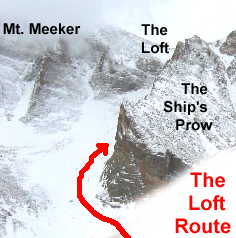
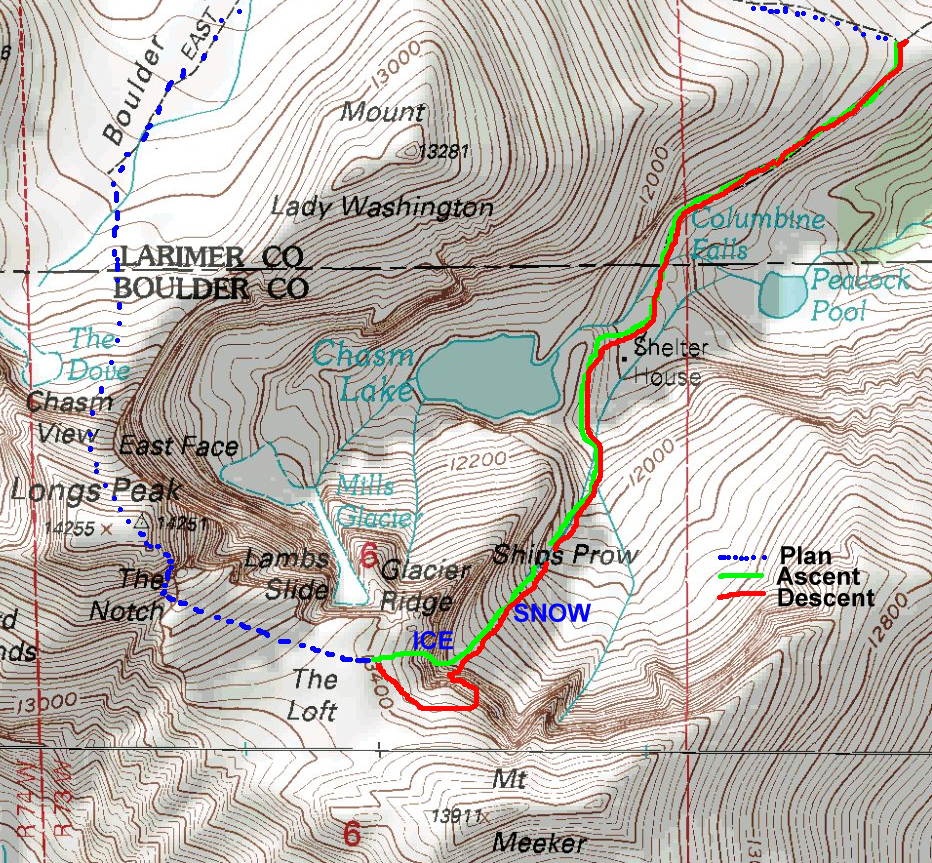
By 10am, we had made our way around the Ship’s Prow and up to the cliff band below the Loft where a prominent ledge system (called “The Ramp”) slants up and left for 200 feet from the base of the cliff.

The Ramp is usually a 3rd class route providing easy, but shockingly exposed, access to Meeker and Longs. On better days, the route would follow the 200 foot ramp before ascending straight up an easy scrambling rib, but this was not one of those days.  Ice covered everything.   And, adding to the challenge of ice was a light snowfall signaling the arrival of the storm.

After a lengthy bit of scouting followed by a bit of back and forth discussion, we decided to bail on the Longs and the Meeker effort and make an adventure out of climbing straight up over the ice and icy rocks (an ice climbing route called “The Apron” I believe) using for protection the rock gear we brought along for the technical climb out of the Notch.

The standard ramp route to the Loft

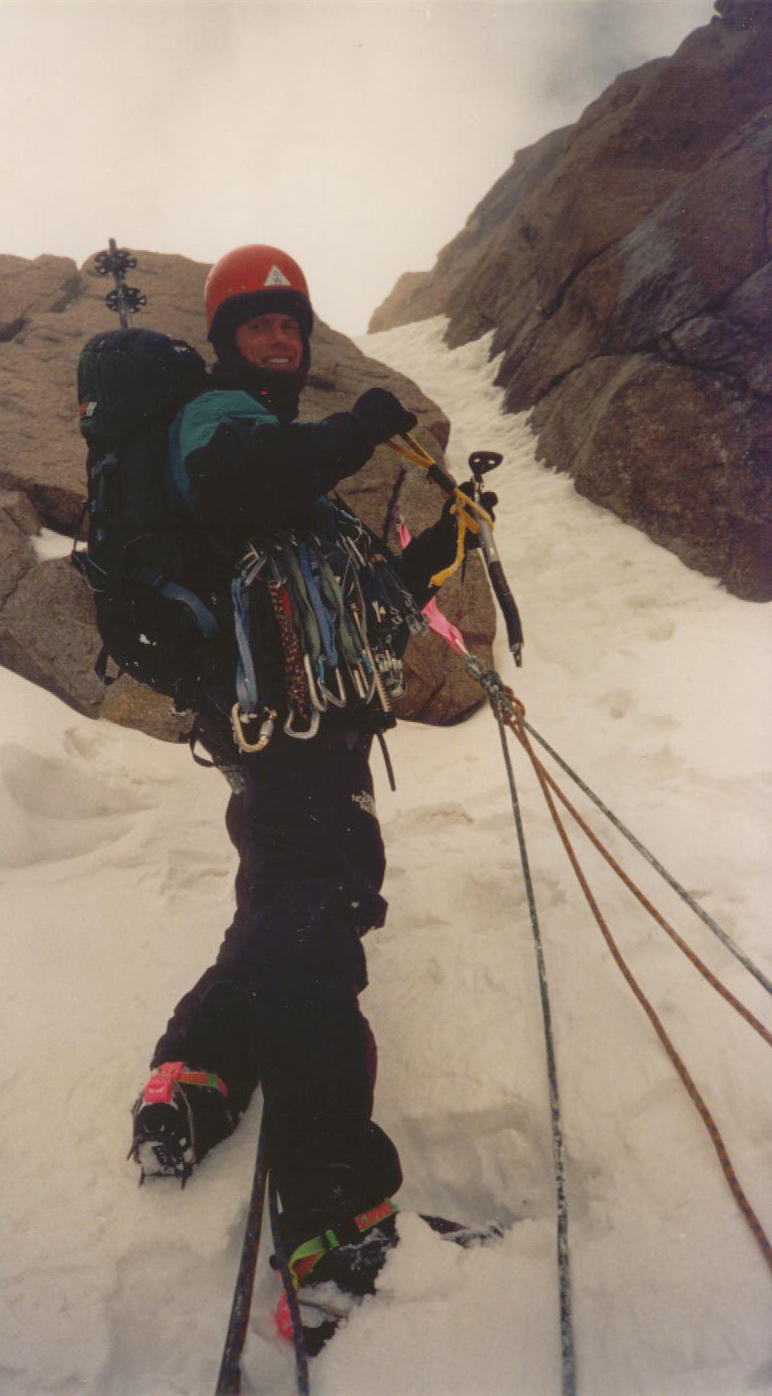
Brian took the first lead up 30 feet of ice and across a patch of snow to reach a good anchor spot.  I took the final lead up mixed ice and rock to some old rappel anchors on the edge of the Loft.  It was an exhilarating bit of climbing.

Ice or mixed climbing is always a little extra scary (and afterwards remembered as “fun”) due to the challenge of frozen hands and a quantity of sharp, pointy objects carried along to impale the body in the event of a fall.  It would be the equivalent of rock climbing with a string of knives around the neck and waist.

Our route to The Loft....straight up instead of veering to the left.

What we didn’t judge carefully was the extra time-suck of route-finding and slow movement over the ice and icy rocks. In total, it took us 4 hours to get over the cliff band below the Loft. And, by that time, the storm had fully arrived. One to two inches of snowfall was predicted for the entire day, but 6 inches had fallen on us by 2pm.  And the wind had arrived with the snow, so visibility had fallen from 500 feet to 50 feet.

Brian belaying me up "The Apron"

We had delayed the inevitable for a long time, but faced with overwhelming evidence, even a couple fools could see there was no reasonable option but retreat.  At 2pm, we turned back.

After ruling out the old rap anchors and without sufficient gear to create another anchor (without leaving behind a lot of iron), we decided that a rappel was too dangerous.  That left only the Loft Route for our descent, so we stumbled over snow covered talus to look for the start.

The poor visibility conditions combined with thick snow covering the cairns to obscure the start of the ramp.  We knew approximately where it should be, but didn’t want to find out how far a fool could fall.  After a bit of blind wandering, we committed to a down-climb of loose snowdrifts covering icy rocks that went in the right direction for 20 feet, which was as far as we could see by that time.

Inching our way down, prepared to retrace our steps if we cliffed-out, we successfully made our way below the cliff band and to the steep snow field below our ice climb.

By this time, the visibility was 3-4 feet.  The snow was falling and blowing hard enough to blend into the snowy background.  I could see my feet, but not what I was standing on or anything around me more than a few feet away.   “Seeing” with my toes, I slowly worked my way down the at first very steep but gradually easier snowfield, reaching the base of the Ships Prow by 5pm (3 hours since our decision to retreat).

The snowfall eased off at this point, but it was already past sunset and would soon be dark.  It took us  2.5 hours of knee-twisting, ankle-turning, back-wrenching stumbling in the dark over snow covered loose rocks to get back to the Ranger Station.  But, finally, we made it back.

And since we got home without injury that would take more than a few days to heal up, we had no choice but to call it like it was…it was the classic definition of a “great adventure”.

Great Adventure (my personal definition)

A dangerous undertaking demanding a higher than expected level of physical, emotional, and intellectual effort that ends well.

We had hiked (and climbed) 13 miles over 12.5 hours to ascend approx. 4000 feet to The Loft.

Our route, planned and actual, via The Loft

Swimming Atlantic & Pacific Peaks

August 3, 2009

I had 14ers on the brain, but the unchecked peaks were too far for a day trip, and Brian couldn’t get away for an overnighter. Brian suggested we do “Atlantic” as it is nearby (near Copper Mountain) and would provide a good ski descent.  We could also add in Pacific if we made good time. I agreed.

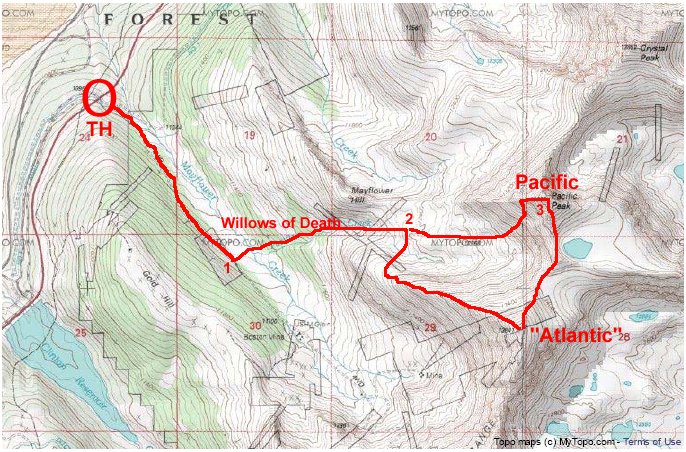
Our plan for April 13, 2002 had 4 easy steps:

  1. Follow the mining road until we could cross the streambed to pass between Mayflower Hill and “Atlantic Peak”
  2. Ascend the West (summit) Ridge to “Atlantic” and proceed east to the summit of “Atlantic”
  3. Traverse to Pacific Peak, if time, conditions, and fitness permit
  4. Descend back to the trailhead and reach home alive
Our route from the Mayflower Gulch TH to Atlantic and Pacific Peaks

Our route from the Mayflower Gulch TH to Atlantic and Pacific Peaks

And everything started off so well….

We left the Mayflower TH parking lot around 7am and made good time along an old mining road.  After about 1 mile we turned to head NE up a stream bed headed between “Atlantic” and Mayflower Hill toward Pacific Mt.  Before leaving the road, I put on my snowshoes for floatation, which I brought instead of skis to give my aching knees a rest.  My optimism was not well founded, but at least I could blame this one on Brian.

Fletcher (right) and Atlantic (left) on the way to the Atlantic & Pacific peaks

Oh, the soft snow misery!  If only I was postholing…but I was drowning.  I needed snowshoes the size of freight trains.  The snow was at least 5 feet deep and soft as far down as I dared during my tank-less deep dives.  I had fallen into a giant bowl of sugar and had move through it to find an escape.  It took us 1.5 hours to travel ½ mile.  It sucked, big time.

Finally, we reached the Atlantic-Pacific cirque and mounted the Atlantic West Ridge.  I was ready for better conditions, but I wouldn’t find it.  The ascent required a steep climb up a wall of loose rocks covered by thin layer of fresh snow.  It was a slog.  But at least the ridge proper was much easier, with a lower angle and exposed rocks for footing.  We reached the Atlantic summit around 1pm.

The wind was stiff and cold, but I needed a rest as well as some water and food.  I sat on the eastern slope and ate my lunch despite a rather uncomfortable sitting position.  We decided to keep going to descend into the valley below from Pacific’s summit ridge.

The ¾ mile traverse (and 400 foot altitude gain/loss) went quickly.  The Pacific summit rose to a point, 2 feet by 2 feet…just as a summit should.  Without a pause, we immediately turned down the west ridge toward a tongue of snow which would lead us to the foot of the mountain.

Pacific is a twin-peak with no easy way to get down the west ridge.  As we skirted the west (lower) town, I had to down climb a loose rock chimney. I stepped into the chimney putting my left foot on a questionable foothold.  I proceeded only because I had good holds for both hands, although, my left hand also held my collapsed trekking poles.  My right hand held a jug on a large detached block. As I lowered myself to the next foothold, my only foothold failed…the rock broke off!  As my weight suddenly shifted to my hands, my right hand hold failed.  The detached block shifted and pulled out of its slot.  My mind raced for options and a quick glance revealed no other holds.  To buy a few milliseconds, I continued holding the detached block as it toppeled out and down toward my head.  As I twisted to avoid the rock, I shifted my right hand from the falling rock up to the ledge where the detached block once rested.  In the meantime (all 1.2 seconds of it), I traded a wrenched left shoulder and chest muscle for my life.

As I explained to Brian afterward, “it was a good trade.”

Fairly quickly we reached the tongue of snow that reached to the valley below.  The snow was a bit soft, but still allowed for a fun descent.  I had a fantastic glissade off the summit ridge.

Naturally, once we got down to the streambed, it was worse than before.  The snow was hell.  I tried to stay in my old tracks to find any purchase, but the snow had turned into quicksand.  The snowshoes provided no floatation, but instead became anchors that would hook under any vegetation beneath the snow.  I ended up taking off the snowshoes and just crawling back to the road….I didn’t know if I’d drown or go crazy first.  When I finally reached the road, I just rolled onto it out of the snow…and then let loose a blue streak of curses until my remaining energy was exhausted. It was the worst experience of my life.

But once I got back to the truck, it had turned into a great day!  And after all these years, I finally started to get an inkling of what that Dickens fellow had been talking about.

Brian’s Fork: Attempt on Yale

July 13, 2009

We were pushing it hard.  I was trying to get my body ready for a trip to Bolivia (to do Illimani & Huayna Potosi) while Brian was happy just to suffer at altitude.  Following the end of ski season in March (we always end resort skiing at the beginning of April to start the snow climbing season), we had done Mummy Mountain (13,425’), Mt. Silverheels (13,829’), Huron Peak (14,003’), and Missouri Mountain (14,067’).  The last peak on my prep list for Bolivia was Mt. Columbia (14,077’).  We scheduled Friday, May 1, 1999 for this ascent.

Unfortunately, the weatherman wasn’t cooperating.  In the 3 days prior to the climb, it snowed 24 inches.  We didn’t know what to expect, but we were just dumb enough to just go for it.

Friday after work, we drove south toward Buena Vista and found the access road to Columbia covered in soft snow up to the fenders.  I managed to get my 4Runner about 0.5 mile up the road before we decided that the chance for disaster was too high; then I got to enjoy backing up in the dark for a 0.5 mile.

Using a flashlight, Brian quickly rifled through the guidebook to find an alternative; we couldn’t let the weekend go to waste.  He found that Avalanche Gulch trailhead (9300’) for Mt. Yale was only 10 miles away via paved roads.  In a rush to get going, we settled on it quickly and started driving.  Looking back and considering the conditions, I can say the route selection was foolish; between the 2 winter accessible routes on Mt Yale  (Avalanche Gulch and Denny Creek), we picked the longer and more technical path.

Brian’s Fork:  if there are two ways to go and one of them is much harder and more dangerous, somebody will want to go that way (corollary to Murphy’s Law, and named in honor of my climbing partner, Brian, who is always looking to make life interesting).

As we drove down US 24, it started snowing again.  We drove through a white, ghostly Buena Vista before finding the turnoff and, eventually, the large parking lot at the trailhead.  We setup camp in front of the truck just after midnight and settled in to collect 4 hours of sleep.

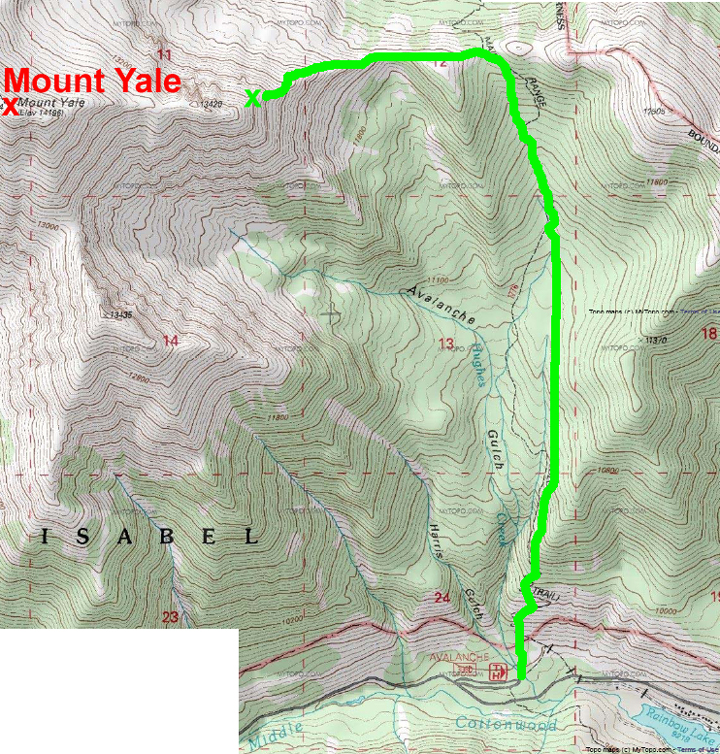
Morning came quickly and we awoke to an ocean of snow.  It was only 5 miles to the summit, but 5 miles is a long way to swim and crawl while navigating via compass and dead reckoning.  The one good thing about the route selected was simple navigation…we just needed to head north until we could see the summit ridge to our left (west); and hope that the visibility would be good.

We took down the camp and set off @ 5:30am into the white hell.  And then it started snowing. The visibility during the climb was generally about 100 feet, with occasional ½ mile views.

Brian ponders the use of a map in a whiteout

Brian ponders the use of a map in a whiteout

The snow was very soft and our path was a bit meandering to overcome the terrain; the result was our progress was very slow.  It took 6 hours to travel 3 miles and ascend 2600’ to reach the 11,900’ saddle linking our route to the summit ridge.  And then it took us another 2 hours to reach approx. 13,000’.  We could barely make out that we were below a steep section of the ridge (how we gauged altitude) before fog rolled in and limited visibility to 10 feet.  We stopped at 2pm for lunch and to assess the situation.  It would be 2:30pm before we started again…5.5 hours of daylight left.  If we took 2 more hours to reach the summit, we’d only have 3.5 hours to find our way out before dark.  And we’d probably already lost our tracks to snowfall.  It was a bad bet; it was time to bail.

Our route up Mt. Yale's Avalaunche Gulch route

Our route up Mt. Yale's Avalanche Gulch route

I turned to retrace my steps and found that I couldn’t see the ground.  I could see my boots, but not the ground I was standing on.  The ground, the sky, the skyline…everything was white…I was floating in white air.  It was very disorienting to my sense of balance and direction to not be able to see anything for reference to my body.  And the real problem was that I was standing on a cornice.

On the ascent of the summit ridge, we were not able to stay on the ridge proper due to a cornice.  We skirted the ridge along the north side before mounting the cornice just below the steep portion of the ridge where I turned around.  And I couldn’t venture more than a foot to the south side as the angle steeped quickly and the hard-packed snow very slippery even with crampons on.   So now I had to walk along the edge of the cornice with my eyes closed!

I tried to stay toward the south side to avoid stepping too close and falling over the edge of the cornice on the north side.  But the only way I could tell if I was too far to the south side was by slipping down and self arresting.  So I tried to shift my balance carefully to avoid stepping on naught but thin air.  Twice I stepped through the cornice edge and barely caught myself with my axe.  After recovering from the initial fall, I just stood there and marveled at the absurdity of the situation.

It was a long retreat.  We couldn’t find our tracks due to the additional snowfall, but we recognized the terrain well enough to find our way back before dark.   We had taken 13 hours to climb and descend 7 miles (RT) & 3700 feet of elevation.  Some might call it pigheadedness, but we called it good exercise.

Joe catching a rest in the soft snow

Joe catching a rest in the soft snow

It was our first retreat on a 14er first attempt; I was sorry to see our record go by the boards.  But it would also be the only failure to summit on an intial 14er attempt…57 out of 58 ain’t bad.

See all trip reports

The “Casual” Route?

March 31, 2009

The Diamond.

The East Face of Rocky Mountain National Park’s Longs Peak is the greatest alpine climbing wall in the Universe.   Sure, it’s just my opinion, but read on and judge for yourself.


The Diamond of Longs Peak

The Diamond of Longs Peak (photo taken 7/1/94)


When I started rock climbing some years ago, the Diamond was a place of legend:  only the climbing Greats dared challenge the gods with an attempt on the Diamond.

It requires nearly 1,000 feet of high-altitude technical rock climbing in a lightning-filled environment over wet, cold, vertical rock that cannot even begin until completing an approach of nearly 7 miles and well over 3,000′ of elevation gain.   And the easiest route up the face requires the skill and stamina to complete two pitches of 5.9-5.10a, three pitches of 5.8, and three pitches of 5.5-5.7 at nearly 14,000′ elevation.

Adding insult to this impossible dream, the easiest route is called, “The Casual Route, ” in honor of Charlie Fowler’s description of his free solo (no rope, no protection) climb of the route in 1978…he said it was “casual” in the sense of…

…not difficult, child’s play, a cinch, easily done, effortless, inconsiderable, no problem, no sweat, no trouble, nothing to it, a picnic, a piece of cake, straightforward, and undemanding.

Uh huh.  Thanks for your opinion, Mr. Fowler.  I guess that’s one for and one against, as far as voting goes.

Back in the old days, my Midwest climbing friends and I didn’t dare admit having such ambitions; we would only talk about how amazing and crazy some climbers were, and we’d keep our true feelings of envy and aspiration to ourselves. But, over the years, as I grew into a better climber and a mountaineer, I dared imagine that I, too, could climb the Diamond. Someday.

This trip report is about the effort my buddy, Brian, and I made in an effort to climb The Diamond.

Story

Having brought ourselves to thinking that we could really do it, Brian and I decided that we’d use the Spring & Summer of 1998 to prepare our skills,  fitness and confidence for a late Summer attempt.  During the 4 month preparation, we completed the following alpine snow & rock climbs to ready ourselves physically, intellectually, & emotionally:

  1. Squaretop Mountain; snowclimb (4/98)
  2. Mt Belford; snowclimb  (4/98)
  3. Mt. Princeton; snowclimb  (5/98)
  4. Mt. Harvard; snowclimb  (5/98)
  5. Mt. Tauberguache; snowclimb  (5/98)
  6. Mt. of the Holy Cross; snowclimb  (6/98)
  7. Longs Peak via Kieners; snow and rock scramble (7/98)
  8. The Saber in RMNP; 11 pitches up to 5.9 (7/98)
  9. Jackson-Johnson on Hallets Peak; 9 pitches up to 5.9 (7/98)
  10. The Love Route on Hallets Peak; 8 pitches up to 5.9 (8/98)

We had prepared very hard and felt ready to proceed.  When the weatherman predicted good weather, we set the date:  August 8, 1998.

The overall plan was:

  1. Hike in the day before to save energy for the climbing day
  2. Camp in the Boulderfield (to avoid a free solo of the 4th class plus, 320′ plus North Chimney)
  3. Descend to Broadway Ledge via the Chasm View rappels (3 150′ rappels in the pitch black darkness)
  4. Traverse the snowy ledge to the Casual Route start, skirting the opening of the North Chimney
  5. Climb the Casual Route (7 pitches plus traversing finish)
  6. If unsuccessful, escape via many rappels down the Diamond’s face, and then ascend the Camel Route to reach our campsite
  7. If successful, traverse the Table Ledge to finish the climb via Kiener’s Route
  8. Traverse to the North Face Cable Route and rappel back to Chasm View
  9. Hike back to the Boulderfield to pack up and head home

Before it was over, we’d be sleep-deprived, starved, dehydrated, exhausted, rained and hailed on, surprised, horrified, and delighted.


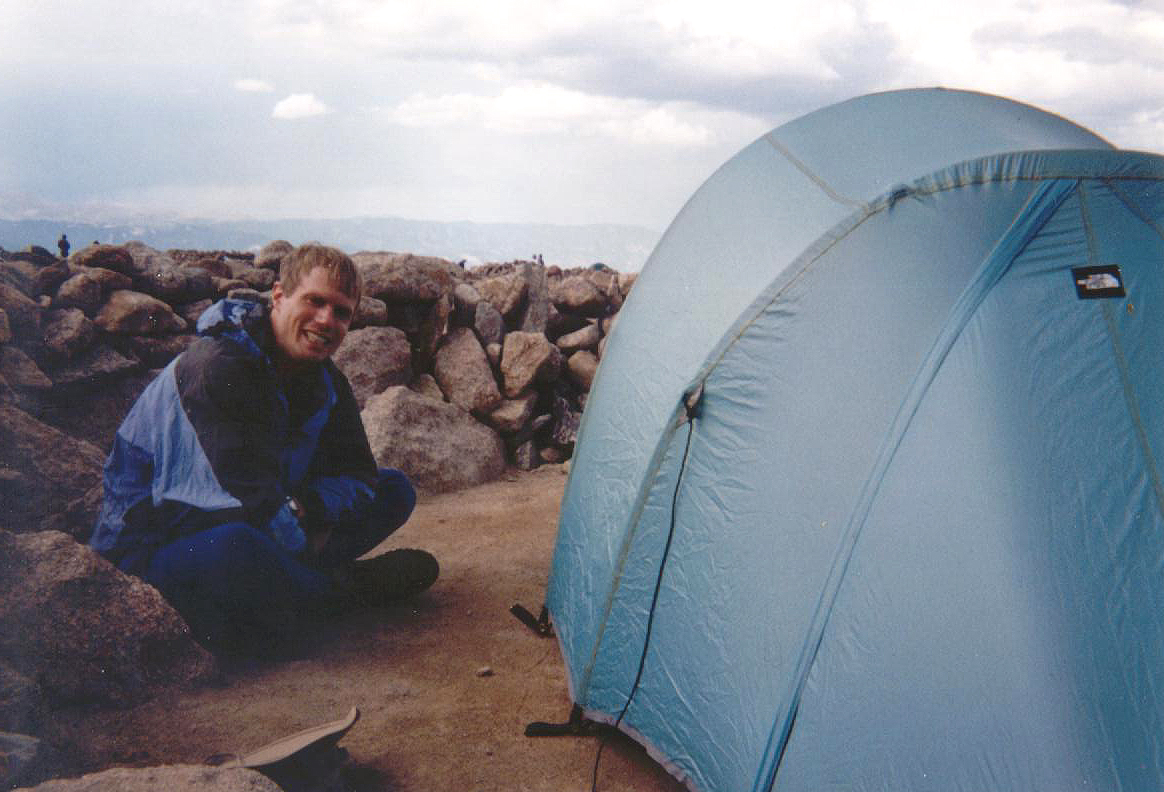
Brian next to his tent in the Longs Peak Boulderfield

Brian enjoying a moment of rest in the Longs Peak Boulderfield


The Hike into Camp

We started hiking in toward the Boulderfield at 9am.  We had all day to cover the distance, so we took our time.  We arrived at the Boulderfield and setup camp; and we still had hours to kill.

We wandered up to Chasm View to take in the sights, snap a few photos, and prepare ourselves to find the rappel anchors in the dark a few hours hence. All was proceeding well until we noticed the clouds building.


Joe posing with the Diamond looming in the background

Joe posing with the Diamond looming in the background


The weatherman was wrong.

One of the key problems in climbing the Diamond is the weather.  It is east facing, so any approaching weather cannot be seen until it is overhead; and with escape only possible via multiple rappels requiring one or more hours to perform, we’d have to move very fast to have any chance.  And we’d have to be lucky.

The Approach to the Climb

We arose in the dark and started for Chasm View at 4:15am.  Using headlamps, we wandered among the refrigerator-sized boulders, orienting ourselves using the faint outline of Longs against the dark sky.

Reaching the Chasm View area, our previous day efforts paid off with the quick acquisition of the Chasm View rappel anchors.  We unpacked the harnesses and the rope and made ready for a descent into a pit of darkness.

I took the first rappel.  The light from my headlamp illuminated the canyon walls, but couldn’t reach to the bottom. It was a creepy feeling to rappel into an abyss, but my lack of sleep muted any strong emotional response.


A view of the Chasm View rappel area from the start of the Casual Route; 3 150 foot rappels to descend to Broadway Ledge.

A view of the Chasm View rappel area from the start of the Casual Route; three 150 foot rappels to descend to Broadway Ledge.


My only job besides not dying was to find the next set of rappel anchors.  I only had one chance to find them as we couldn’t go back up without losing the day.

But the day started well; I found the anchor. I clipped into the bolts and then unclipped from the rope. I called out for Brian to come on down by yelling, “Off rappel!”  Brian stepped over the edge carrying our gear pack, rappelled down and clipped in next to me.  After he unclipped from the rope, I started pulling the rope down from the initial rappel anchor while he threaded it through the 2nd anchor. As we neared the end of the process, his headlamp died.

I couldn’t believe it.  After 4 months of planning, he didn’t replace the 50 cent batteries. Fortunately, it wasn’t really a big deal.  I would just have to find the next two anchors.  Although, it was possible that we’d have to wait a few minutes at the bottom of the raps for the sky to brighten enough for Brian to accomplish the traverse to the start of the climb without falling off Broadway Ledge.

I finished getting ready for the next rappel while Brian put the dead headlamp away in our gear pack.  I heard him say, “Shit!”  With some reluctance, he explained that when he unzipped the backpack, one of his rock climbing shoes fell out and disappeared into the darkness.  Now that was a big deal.  No shoe, no climb.

If the shoe fell below Broadway Ledge, all the way down to Mills Glacier, it would take us too long to recover it even if we could find it.  We’d lose the day. Brian says, “Sorry.”  I replied, “Maybe we’ll get lucky; maybe it stopped at Broadway Ledge.”  In one part of my mind, I was mad; all this effort wasted.  In another part of my mind, I was relieved that we would be going home alive.

But we had to try to find it, so we continued down into the black pit.

At the bottom of the 2nd rappel, there it was.  Brian’s shoe had stopped on a small ledge. The climb was on.

We completed the 3rd rappel and then started the traverse immediately.  The daylight had begun, and we could see without the headlamps.  And we could see that the sky was already threatening.  Top of the North Chimney was a loose, snowy, narrow, sloping trap.  We decided to do a belay while skirting the rim of the North Chimney and then found “The Ramp” about 20 feet further.  At the top of that large sloping ledge, we started the climb with the knowledge that we had to go fast.

The Climb


Joe on top of the D1 pillar, about to start the 5.9 crack of Pitch 2

Joe on top of the D1 pillar, about to start the 5.9 crack of Pitch 2


Pitch 1: Brian gave me the pack and took the first lead up a left-facing corner, and then up and left to a ledge. I followed without incident. We were delighted to see that the weather was clearing. (5.5)

Pitch 2: I took the second lead up a short easy section to the top of a pillar, and then up a tough crack to a belay stance near the start of the traverse.  My primary concern was to find the correct traverse starting point.  The correct traverse is a protectable 5.7 while the improper one is poorly protected 5.10c.  I found it right at a spot with a nice stance. Brian followed quickly behind. (5.9)

Pitch 3: Brian took the traverse.  While technically not difficult, crawling sideways is always harder than climbing up. I found it hard to find the best route over the flakes and small ledges, negotiating past wet rock, and trying to keep the gear pack from pulling me off-balance.  We belayed beneath a squeeze chimney. (5.7)


A view straight up of Brian leading the 5th pitch

A view straight up of Brian leading the 5th pitch


Pitch 4: I led the fourth pitch up a short, challenging squeeze chimney, and then up and slightly left on easier terrain to the end of “The Ramp2.”  I made sure to continue past the initial piton to give Brian enough rope for a long 5th pitch. Brian followed without incident. The weather started worsening. (5.8)

Pitch 5: Brian then led up a long dihedral and belayed at a grassy ledge.  I followed in light rain & hail.  By the time I reached the belay, the rain & hail had stopped.  We didn’t even discuss bailing. (5.9)

Pitch 6: I took a short lead to the Yellow Wall Bivy Ledge, which was a magnificent ledge for such a vertical environment.  I could see how it would be possible to sleep on the ledge quite comfortably.  Once Brian arrived, it started to hail and rain again, but this time a bit harder.  And then it stopped again.  Still no lightning, so we didn’t speak of retreating.  We took a short break to give the wind some time to dry out the technical crux of the route.

Pitch 7: The crux pitch.  If we could get up this last pitch, we would make it. But failure was still within our grasp:  if the rock got too wet or if lightning started, we’d fail and bail.  Brian took this lead and moved very quickly.  After a short time, the slack in the rope started being pulled up.  After 3 quick rope tugs, it was my turn to make it past the several hardest moves of the climb. As I started climbing, the rain & hail started again.  I continued up through the wet, narrow inset, and then started up the squeeze chimney.  I struggled to get through the chimney with the pack on; when I finally got past it, I was completely exhausted.  I took off the pack and passed it up to Brian, then I steeled myself to move past the bulge blocking my path to Table Ledge. Then it was over.

We had made it.  I needed a short break, despite the threatening weather; but we couldn’t fail now.  We had finished the Casual Route, but we still needed to escape the face and the mountain.

The Escape


Joe sitting on the far end of Table Ledge, preparing to belay Brian to complete our escape from the East Face of Longs Peak

Joe sitting on the far end of Table Ledge, preparing to belay Brian to complete our escape from the East Face of Longs Peak


We were sitting on the Table Ledge which we needed to traverse left to link up with the Kieners Route.  But the ledge had a break in it, so we had to do a descending and then ascending traverse to find our escape.  I started by traversing left past a piton, and then down and left about 25 feet to another ledge called Almost Table Ledge.  A wet downclimb is challenging in any case, but at nearly 14000 feet and after hours of climbing, it was very unnerving.  I carefully traversed left until I could climb up to the Table Ledge again and belayed off some fixed gear backed up by two cams.  Brian followed quickly, and then we continued left, walking along the ledge until we could move above the Diamond onto the north face.

As we stepped above the Diamond, we were shaken by thunder.  To minimize our exposure to the elements, we traversed directly to the Cables Route.  We were rained and hailed upon, but no close lightning strikes.

After a short hike, we rappelled down to Chasm View, where we had started the day many hours earlier.


The Diamond, with key locations and pitches referenced.  Note:  the photo is from a different trip.

The Diamond, with key locations and pitches referenced. Note: the photo is from a different trip.


The Return Home

It seemed that the entire Boulderfield camp ground was out watching our return.  I wanted to believe that it was admiration for a job well done, but there is no doubt it was pity.  We felt like and must have looked like the walking dead, as we walked back into camp.   One wonderful fellow walked


Joe eating the greatest meal of all time...using a nut tool as a replacement spoon

Joe eating the greatest meal of all time...using a nut tool as a replacement spoon


over to our bivy site with a steaming hot dinner, which we gratefully accepted since we had no food left at all.  I had only eaten 1,000 calories during the day, and Brian even less.  That Hawaiian Chicken dinner tasted better than any meal I ever had before or since, and it got us home.

Thanks, neighbor!

It had taken us 2 days to hike 15 miles and 4,000 feet of elevation gain, while climbing nearly 1,000 feet of 5th class terrain and descending 600 feet on rappel.

It was and continues to be a great feeling to  accomplish such a long held goal.

So what’s your vote?

See all Trip Reports

See all Longs Peak Massif Trip Reports
Brian’s Lucky Day: Longs via Kieners

March 27, 2009

Neither Brian or I had ever successfully completed the classic “Kiener’s Route” on Longs Peak (I had failed on an earlier effort in June of 1996). Making this effort all the more unavoidable, this route is also called, “The Mountaineers Route.” Ensnared by the gravity of such inspiration, the limits of our so called “free will” were all too apparent.

And while this adventure shared many attributes with many other adventures, this one would be characterized by the lucky breaks Brian used to survive the day. For that reason, I call our ascent of Longs Peak via Kieners Route on July 3rd, 1998, “Brian’s Lucky Day.”

Start

We started at 4:20am and hiked up the trail toward Chasm Lake beneath the North Face of Longs Peak. It was a beautiful clear night with millions of stars filling the black sky. We took a left at the Y-Junction (right goes to Boulderfield) and arrived at Chasm Lake at 7:30am.

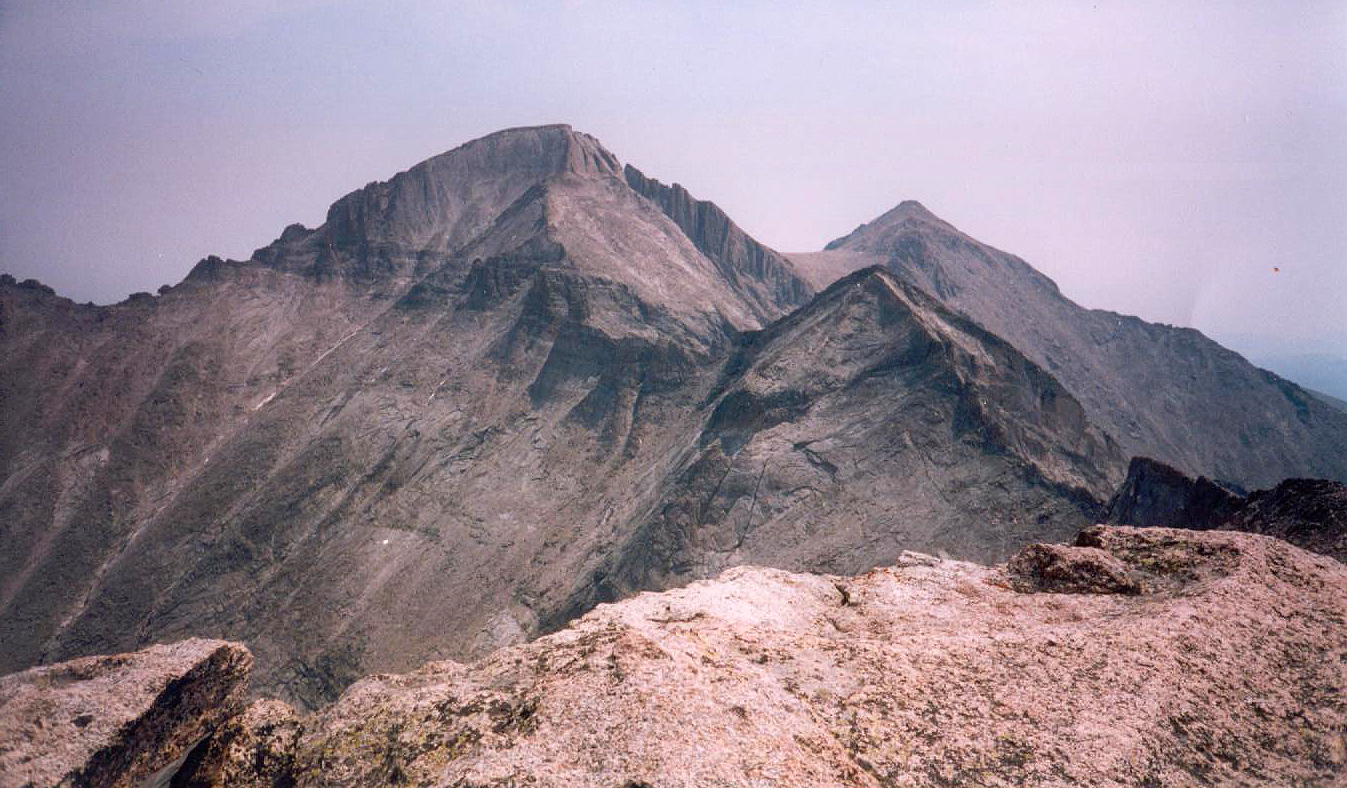
A preview of our plan to summit Longs Peak via the Kiener's Route

A preview of our plan to summit Longs Peak via the Kiener's Route

(1) Chasm Lake

As we approached the lake’s dam, we were hoping the lake would still be frozen over so we could hike over instead of around it. Going around is a significant bother as there is no “shore”; it requires a scramble over talus. And worse, the southern shore (the direct line to Lamb’s Slide) is blocked by cliffs, so we’d have to take a big detour to our right, around the northern side of the lake. But no; the ice was melted through in the center. We had to go around.

As I moved across the talus, I lost sight of Brian. I assumed he found a path lower down the talus, closer to the lake. Once I was about ½ way around the lake, I was surprised for a moment to see Brian walking on the ice about 20-30 feet from shore. But my surprise didn’t last as Brian frequently likes to push it when it comes to walking on lake ice.

Then I noticed he was shiny. He looked wet!

(2) Brian’s Self Rescue

Brian noticed me looking at him, and he motioned for me to approach. I moved down to the lake to join him, and found that the ice did not reach back to shore. Brian asked me to extend a hiking pole to pull him as he jumped the gap from the ice to the shore. He made it without adding significantly to his moisture level, so I asked how he came to be dripping wet. He explained that he had fallen through the ice, but had managed to escape a watery grave by crawling back onto it. I guess the ice was thin enough that when he went through, it broke up all around him into small floes: small enough to not trap him; big enough for him to get on.

He hadn’t yelled for help or even let me know he was on the ice. I would never have found him. He was lucky to be able to save himself.

(3) Complete the trek to Lamb’s Slide

After a short break to let Brian pour water out of his boots and wring out his socks, we continued around the lake and then up to the foot of Lamb’s Slide.

(4) Climb Lamb’s Slide

We reached the bottom of Lamb Slide and stopped to put on crampons and get out the ice axes. Then, we turned left to head up towards the Loft and Mt Meeker. We climbed about 800′ of elevation and exited at the first place it looked possible onto snowy ledges. We would traverse these ledges to the right until we reached the Broadway ledge proper. Along this thin ledge, we knew we would encounter snow & ice and at least one exposed technical section.

And, Brian needed to drain his boots again so we took another short break.

(5) Traverse Broadway Ledges to Horsby Direct Dihedral

The first corner we reached was covered in snow; I think it was the dihedral used by the Hornsby Direct finish to Stettner’s Ledges route. Brian headed across to check the conditions, to see if we needed a belay. He was planting his axe and kicking steps until about half-way across, he hit rocks just under the snow. Unable to gain secure footing on the main path, and with a large bulge of rock above him partially blocking his way, he moved lower to find solid footing on some exposed rocks below

I yelled out that the rocks looked unstable, and that we should setup a belay. Brian said he thought it would be okay. Just as he stepped down and put his full weight on a large boulder, it rolled over and fell out from under him.  It careened down onto Lamb’s Slide, hundreds of feet below. In that instant, I knew he was a goner. I stared blankly and screamed “rock” as a warning to anyone below.

By pure chance, Brian dropped straight down and landed squarely on another boulder only a foot or so lower that stopped his rapid descent into the afterlife. Brian looked back at me and offered up a profound, “whoa.” He then took the last step to reach the far ledge. We paused for a moment to listen for voices, but heard nothing but our own hearts pounding in our ears.

No one had been hurt, and we wanted to keep it that way.  Brian set up a belay anchor, and then I threw his end of the rope to him so I could get a belay past the airy bulge.

(6) Complete Broadway Traverse

We continued the traverse past several loose, snowy slopes to reach the far side of the notch couloir.  The route directions in Rossiter’s “High Peaks” guide book indicated a start within the Notch, but once again (as in 1996 see my Kieners’ …er, Notch Route trip report) I could not spot a likely start.  We decided to stop beneath a broken rock face leading up toward some fins of rocks. This looked to be a way to get into the Kiener’s Route.

We stopped for a snack and to change gear. Brian took his boots off and poured out a combined pint of fluid.  I didn’t think to see if it was just water, or if he’d peed himself a short while earlier.

Sitting squarely in the center of the “East Face” of Longs Peak, I felt that I was in the best spot on the greatest Colorado mountain. The combination of spectacular views, modest danger of dying at the moment, and the thrill of expected excitement to come felt unmatched.

(7) Climb Kiener’s Route to the Summit of Longs Peak

The upper portion of the Kiener's Route

The upper portion of the Kiener's Route

Brian took the first lead up the broken rock and over a chockstone; it was low 5th class climbing. I took the second lead up a narrowing chimney (about 3 feet across) to its end, and then up a waterfall to a big, grassy ledge. This pitch was 4th to low 5th class, and was the end of the technical portion of the route.

To speed things up without completely throwing caution to the wind, we simul-climbed up the broad ledges at the margin of the face (above the Diamond) for about 500′.  Once the terrain became gully-like with good hand and footholds, we unroped.  From this point on, the climbing difficulty was never harder than 3rd class.

At the end of this section, we stood in front of a massive cliff that separated us from the summit. It was very imposing and looked impossible to overcome.  I remember that my heart sank the first time I stood on that spot and looked at the impassable obstacle until I remembered the escape used by my guide to finish a climb on The Diamond.

Brian and I headed up and right, toward the Diamond face, and looked for large blocky rocks on the right. We climbed over the blocks and around the corner on a ledge to mount the north face of Longs.

From here, it was a 10-minute, 2nd class hike to the summit.  We reached the summit at 2pm; naturally the weather was deteriorating.  In addition, the summit was covered by flies and gnats, so we got ready to leave quickly.

(8) Descend the Cables Route

Just as we rose to head toward the Cable Route raps, a cloud rolled in and obscured visibility beyond 50 feet. Fortunately, we were able to feel our way down, having made the descent a couple times before. In a short time, we completed the second rappel and were looking over the impressive “Chasm View” to admire our path.

The hike down from the Boulderfield was a long one, as always. But, in the end, we had suffered and persevered 14.5 hours to ascend approximately 4800 feet and accomplish a classic mountaineering goal. And Brian had a very lucky day.

Our "lucky day" route up and down Longs Peak. The "X's" mark the spots of Brian's found luck.

Our "lucky day" route up and down Longs Peak. The "X's" mark the spots of Brian's found luck.

Our route had 8 major sections

  1. Hike to Chasm Lake
  2. Traverse around lake and Brian’s self rescue
  3. Completion of traverse to foot of Lamb’s Slide
  4. Ascent of Lamb’s Slide to Broadway Ledges
  5. Traverse to top of Hornsby Direct dihedral and Brian’s second lucky break
  6. Completion of traverse to start of Kiener’s Route
  7. Ascent of Kiener’s Route to Longs Peak summit
  8. Descent of Cables Route to Chasm View and back to car

See all Trip Reports

The Double Crown: Chiefs Head & Mt Alice

March 19, 2009

Time after time, I find that an ambitious goal combined with an equal willingness to suffer optimizes personal reward.  I’ll admit this statement doesn’t feel true during my adventures, but is clear afterwards.  Of course, larger goals lead to larger rewards; but, overly large goals, exceeding my willingness to suffer, lead to bitter disappointment.   And, naturally, small goals accomplished easily mean nothing.

To find situations where I must try as hard as I can to just barely succeed, I look to harmonize aggressive goals with an optimistic assessment of my willingness to suffer.  This mental model helps me to imprint two attributes on my adventure plans:

  1. My goals are probably attainable; high success rates
  2. I’ll have to suffer more than I wanted, but be rewarded more than I expected

My trip to RMNP to collect the summits of Chief Head (13,579′) and Mt Alice (13,310′) was aggressive for obvious and non-obvious reasons.  In success, I found tremendous satisfaction, even if some of the suffering was self induced.

Story

When the alarm went off at 4:30am I was reminded of the Cardinal Rule of sleep:

“It doesn’t matter how badly you’ve slept the night, the sleep you were getting when the alarm went off was great.”

Still, I managed to get ready to meet Brian and then drive to the Glacier Gorge trailhead before 6am.   As I tied into my new La Sportiva Eigers, which just replaced my old Makalus, I silently hoped wearing them around the house for a couple days the previous week was enough to break them in.

It wasn’t.

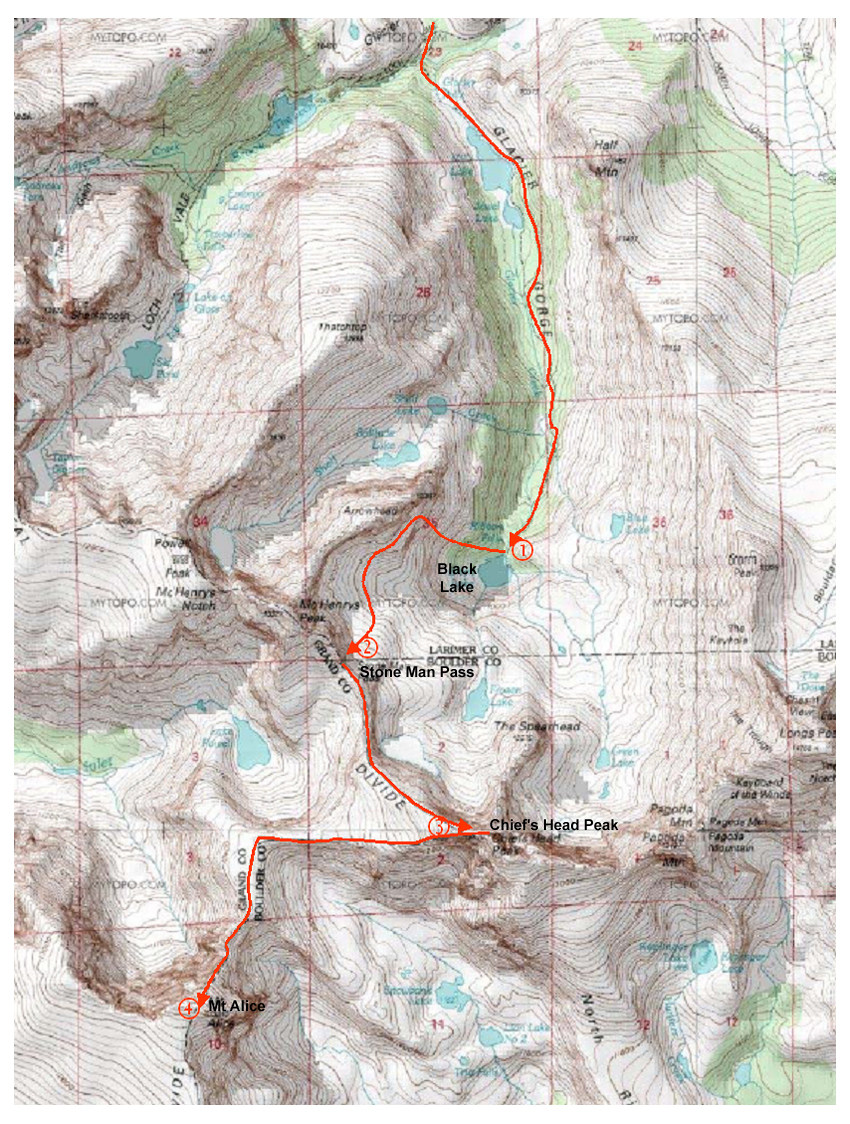
We started hiking right at 6am and made good time until the battle between my feet and my new boots began to resolve itself into a win for the boots. By 8:45am I reached Black Lake where I performed my second boot/sock refit of the day.  Afterward, we left Black Lake for the shortcut to Stone Man Pass, aiming directly for Arrowhead.

We scrambled up the steep grass and cliffy slope, and reached the bench above Black Lake just in time for a boot pit stop.  In a blatant escalation of hostilities, I dug out the moleskin and athletic tape, and hoped for a stalemate.  We then turned south to head underneath McHenry and to Stone Man Pass.

Below McHenry, we stopped at a waterfall to refill our bottles.  This would be our last water source until returning to the spot hours hence.  Brian had his usual thimble-sized container, while I brought a surprisingly modest two 1-liter bottles.  To compensate for a dry future, I finished and refilled both liters before heading up the partially snow-clogged couloir to Stone Man Pass.

A view back down the ridge toward Stone Man Pass

A view back down the ridge toward Stone Man Pass. The route starts from the top of Stone Man Pass.

We reached Stone Man pass around 10:30am and examined the ridge leading up to Chief’s Head for clues about the route.  The available guidebooks were not very clear about the exact route to Chiefs Head.  I have found that this can mean the route is obvious or, alternatively, it could mean nothing at all.

We took another 2 minutes to study the Stone Man himself for possible future climbing; Brian assessed it a “five-easy” while I thought it looked hard to protect.  Brian is often right about these things and we made a mental note to give it a try another time.

Note:  a later trip confirmed the climbing is easy but awkward; however, a safe escape from the Stoneman’s head required the sacrifice of a long cordelette.

The Chiefs Head Keyhole

The Chiefs Head Keyhole

The route finding quickly became very interesting.  I spied a lonely cairn 90 degrees west (right) from where the route looked to go up a couloir to the ridgeline.  Brian went to investigate while I resorted my boots again.
I feared for torrents of blood pouring out of my boots each time I took them off.

We continued scrambling below the ridgeline on the west side along a ledge until we reached the end of the ledge.  Then we took a hard left through a “keyhole” of sorts, and climbed up to the summit ridge of Chief’s Head.  It was very good rock and a pleasant scramble (3rd class).  We reached the summit ridge at 11:15am and took another 30 minutes to ascend the remaining 700 feet of elevation to the Chiefs Head summit.

This last 700 feet consumed the last of my “still feel strong” status.  We stopped for lunch, during which I consumed ½ of the water that would have to sustain me until I return to the bottom of Stone Man Pass.  I was 1.75 hours into a 5-hour circuit and my water was ½ gone.   I also made another futile attempt to save my feet, and resolved to go barefoot if the pain got worse.

A view of Pagota, Keyboard of the Winds, Longs, and Meeker, taken from Chiefs Head summit

A view of Pagota, Keyboard of the Winds, Longs, and Meeker, taken from Chiefs Head summit

The views from Chief’s Head are worth the trip.  The line from Meeker to Longs to Pagoda to Chiefs Head is spectacular. The thought of doing the entire traverse appealed to my ego, but I concluded it would require too much suffering.

As I looked over toward McHenry, I joked that if we felt like it we could climb McHenry again to claim the Triple Crown (Gerry Roach’s title for bagging McHenry, Chief’s Head, and Mt. Alice in a day).  Brian just grumbled as he had done every other time I mentioned the possibility in the previous 24 hours.

Looking back toward McHenry and Stone Man Pass from Mt Alice

Looking back toward McHenry and Stone Man Pass from Mt Alice

Somewhat refreshed, we started down the talus boulders making very good time to reach the grassy field that lies between Chief’s Head and Mt. Alice.  We were approaching Mt. Alice when, looking back, we noticed a couple of people behind us about ½ way across the grassy field coming toward Mt. Alice as well.  We were surprised and wondered how they had gotten so close without us noticing. Looking back a few moments later, Brian noted they had gained a lot of distance on us.  I reasoned that they were traveling downhill while we where doing a bit of scrambling and climbing.  It seemed like a reasonable conclusion.

A view of Mt Alice from below the summit of Chiefs Head

A view of Mt Alice and the narrow ramp summit route from below the summit of Chiefs Head.

Over the next 30 minutes, these fellows proved that people are not all the same.

They must be young, I thought.  The first to pass me was a young fellow, but his partner right behind him looked like my father.   Brian strained to beat the old guy to the summit, marginally holding up the honor of the team.

When I arrived at 1:30pm, they were gone.  As I looked around, Brian indicated that they had gone on to grab more peaks before heading back to Wild Basin.  They had done Meeker, Longs, Pagoda, Chief’s Head, and Mt. Alice (so far) in shorts and sneakers.  The older guy had said he was tired, while the younger guy said he was running out of food because he didn’t have bread to make peanut butter and jelly sandwiches that morning.  Poor guy.

Our route map to (1) Black Lake, (2) Stone Man Pass, (3) Chiefs Head, and (4) Mt Alice

Our route map to: (1) Black Lake, (2) Stone Man Pass, (3) Chiefs Head, and (4) Mt Alice

After a short snack and another boot repair, I was out of water.  I was tired and 9 miles from the car, but at least I was turning around.

I managed to get back to the grassy field in decent time; downhill is always okay.  But climbing back up to the Chief’s Head ridge was murder.  And my body didn’t work that well anymore, forcing me to think carefully about moves that I did unconsciously a few hours earlier.  I really needed some water.

We reached Stone Man pass at around 4:30pm, which left us 4 hours of light to get down the snow/talus slope below Stone Man Pass, get over to and down the steep trail west and above Black lake, and then hike 4+ miles to get to the car.  We didn’t even talk about McHenry.

We descended the snowy Pass with a bit of heel plunging and a bit of scrambling to reach the bottom by 5pm.  I found a nice fountain of melted snow to refill my long-empty bottles; but I had to wait 30 minutes before drinking to allow the iodine to work its magic.  I was very tempted to throw caution to the wind and just drink it.

Thirty minutes later, I yelled to Brian to stop.  I was going to have that damned water right then.  As I was pulling my water out of the pack, I nearly trembled with fear as I lifted the 1st bottle up to the light . . . It was not dissolved.  The damned thing looked just like it did when I put it in there. As I was losing my composure, Brian reminded me that hiking equals shaking, in the world of iodine tablets.  I started hiking without taking a drink.

We scrambled down the steep slopes above Black lake with a bit of rock scrambling and steep grass maneuvering.  The plan was to stop at Black lake for a break, but once I was past the hard part of the descent, I just sat in the dirt and drank a liter of water.  That was good water; even the iodine tasted good.  I then joined Brian at Black lake where I finished off another liter and a bar, and then I refilled one of the bottles for the ride home.

I didn’t even bother with the boots any more.  I was just stumps below the ankles.

On flat terrain and using good trails, we took less than 1.5 hours to cover the 5 miles to the car, arriving at 8pm.  I finally was able to get those miserable boots off my feet.  I didn’t have the courage to examine the damaged tissues so I just put on my sneakers, drank my iodine water and started driving.

Driving home, it started to feel like a day well spent.  The pleasure of our successful 14 hour effort to hike 18 miles and climb 5,300 feet to reach the summits of two new 13ers spread throughout my body like a slow, warm wave.  My feet almost didn’t hurt anymore.  Almost.

Our trek to bag Chiefs Head and Mt. Alice in RMNP was another of those harder-than-expected- but-glorious-in-its-successful-completion efforts. It was perfect.

See all Trip Reports

Longs Peak Keyhole Route

March 14, 2009

Story

Brian invited me to join him and some friends on a late Fall Longs Peak ascent via the Keyhole.  I had never done that route, so I was glad for the chance.

I met the group in the parking lot, and we started from the Ranger Station at 5am.  We passed the Goblins Forest and a frozen alpine brook a couple of times as we switch backed up a hill before finally crossing the brook on some log bridges approximately 1 hour and 1.5 miles from TH.  It was a cold day, but I was sweating like a boxer.  I needed to lose some layers, but I didn’t want to stop the group to shift my clothing. 

The trail left the heavy forest shortly after the log bridge crossing and continued up to tree line near 11,000′ (approximately 2.5 miles from the TH).  We stayed on the main trail through Mills Moraine heading toward Chasm Lake trail junction (11,550′) because Jim’s Grove trail was in poor shape.  We reached the Chasm Lake junction (11,550′), 3 miles from TH, and then turned toward Granite Pass.  Underneath Mt. Lady Washington, just before Granite Pass, we stopped for a water break.

My wet clothes had me shivering like a vibrating bed. The group said, “wearing cotton, eh?”…nope, just wet.  Now that I was cold and wet, I couldn’t stop wearing the clothes that got me wet in the first place.  I was dreaming of a dry base layer; I was destined for misery, but I was going to finish off the Keyhole route.

We then hiked past Granite Pass and then on to the Boulder Field. We continue through the Keyhole, then over The Ledges until we reached the Trough (~13,300′).  The Trough was full of soft snow and was very slow going for the 600′ ascent.  Once we scrambled over the top of the Trough, we started the icy Narrows, a wildly exposed ledge.  Transitioning between ice/snow and rock was nearly fatal for me twice as my crampons were as much a hazard as a lifesaver.

We reached the final pitch, called the Homestretch. It is a steep section of rock about 300′ tall that is often reported to be icy and treacherous.  However, this time it was covered in somewhat soft, but still rather stable snow.  We reached the summit quickly and took a long break.  The weather was fine, but it was getting late in the day.  I started wondering about how long before it got dark; I didn’t have a headlamp.

After our water and food break, we hurried down the Keyhole route and reached the Boulder Field when it occurred to me that we had about 1 hour of light remaining.  I decided to hurry ahead to get as far as I could with the remaining light.  I got as far as the Chasm Lake trail junction before I was hiking in the shadows.  The sky remained light for a while longer, but the icy trail was in the shadows and I couldn’t see the icy spots anymore.  I slowed to a crawl after two separate head-over-heals sliding tumbles on the ice.  I made it to the car by 7pm and drove home thinking about being better prepared.


Complications

  • Late fall meant a short day
  • Cold weather plus fast pace makes for difficult body temperature management
  • I was the guest and just went along with the existing plans


Mistakes

(1) Managed by body temperature badly

  • Didn’t remove layers to avoid sweating


(2) Prepared badly

  1. Didn’t bring extra dry base layers
  2. Didn’t bring a headlamp
  3. Didn’t anticipate that it would be dark well before getting back to the car


(3) Made several bad decisions along the way due to flaws & biases in my thinking.

  • Denial Bias:  I just didn’t think about the trip very much; I trusted that the group I was with would have planned well.  I also didn’t think about going ahead without the rest of the group; if I had hurt myself there was a chance I could be stranded out overnight.  Besides, I could have walked more safely with them guiding the way (they had headlamps)


How I Got Lucky

  1. The weather stayed safe all day
  2. I was able to avoid hypothermia despite being wet on a cold day
  3. I managed to avoid getting injured in the dark while hiking alone 


Go to “Learning from Mistakes” index

Go to Index of all essays