Posts Tagged ‘RMNP’

The “Casual” Route?

March 31, 2009

The Diamond.

The East Face of Rocky Mountain National Park’s Longs Peak is the greatest alpine climbing wall in the Universe.   Sure, it’s just my opinion, but read on and judge for yourself.


The Diamond of Longs Peak

The Diamond of Longs Peak (photo taken 7/1/94)


When I started rock climbing some years ago, the Diamond was a place of legend:  only the climbing Greats dared challenge the gods with an attempt on the Diamond.

It requires nearly 1,000 feet of high-altitude technical rock climbing in a lightning-filled environment over wet, cold, vertical rock that cannot even begin until completing an approach of nearly 7 miles and well over 3,000′ of elevation gain.   And the easiest route up the face requires the skill and stamina to complete two pitches of 5.9-5.10a, three pitches of 5.8, and three pitches of 5.5-5.7 at nearly 14,000′ elevation.

Adding insult to this impossible dream, the easiest route is called, “The Casual Route, ” in honor of Charlie Fowler’s description of his free solo (no rope, no protection) climb of the route in 1978…he said it was “casual” in the sense of…

…not difficult, child’s play, a cinch, easily done, effortless, inconsiderable, no problem, no sweat, no trouble, nothing to it, a picnic, a piece of cake, straightforward, and undemanding.

Uh huh.  Thanks for your opinion, Mr. Fowler.  I guess that’s one for and one against, as far as voting goes.

Back in the old days, my Midwest climbing friends and I didn’t dare admit having such ambitions; we would only talk about how amazing and crazy some climbers were, and we’d keep our true feelings of envy and aspiration to ourselves. But, over the years, as I grew into a better climber and a mountaineer, I dared imagine that I, too, could climb the Diamond. Someday.

This trip report is about the effort my buddy, Brian, and I made in an effort to climb The Diamond.

Story

Having brought ourselves to thinking that we could really do it, Brian and I decided that we’d use the Spring & Summer of 1998 to prepare our skills,  fitness and confidence for a late Summer attempt.  During the 4 month preparation, we completed the following alpine snow & rock climbs to ready ourselves physically, intellectually, & emotionally:

  1. Squaretop Mountain; snowclimb (4/98)
  2. Mt Belford; snowclimb  (4/98)
  3. Mt. Princeton; snowclimb  (5/98)
  4. Mt. Harvard; snowclimb  (5/98)
  5. Mt. Tauberguache; snowclimb  (5/98)
  6. Mt. of the Holy Cross; snowclimb  (6/98)
  7. Longs Peak via Kieners; snow and rock scramble (7/98)
  8. The Saber in RMNP; 11 pitches up to 5.9 (7/98)
  9. Jackson-Johnson on Hallets Peak; 9 pitches up to 5.9 (7/98)
  10. The Love Route on Hallets Peak; 8 pitches up to 5.9 (8/98)

We had prepared very hard and felt ready to proceed.  When the weatherman predicted good weather, we set the date:  August 8, 1998.

The overall plan was:

  1. Hike in the day before to save energy for the climbing day
  2. Camp in the Boulderfield (to avoid a free solo of the 4th class plus, 320′ plus North Chimney)
  3. Descend to Broadway Ledge via the Chasm View rappels (3 150′ rappels in the pitch black darkness)
  4. Traverse the snowy ledge to the Casual Route start, skirting the opening of the North Chimney
  5. Climb the Casual Route (7 pitches plus traversing finish)
  6. If unsuccessful, escape via many rappels down the Diamond’s face, and then ascend the Camel Route to reach our campsite
  7. If successful, traverse the Table Ledge to finish the climb via Kiener’s Route
  8. Traverse to the North Face Cable Route and rappel back to Chasm View
  9. Hike back to the Boulderfield to pack up and head home

Before it was over, we’d be sleep-deprived, starved, dehydrated, exhausted, rained and hailed on, surprised, horrified, and delighted.
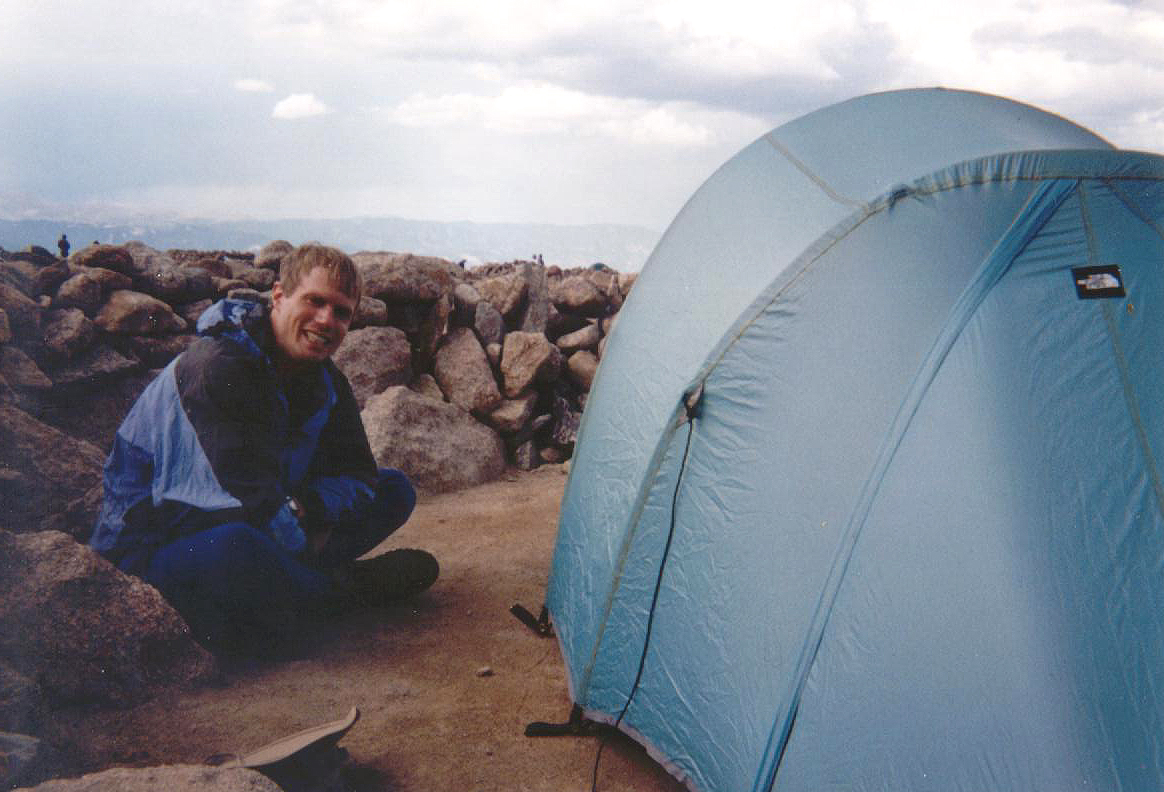
 

Brian next to his tent in the Longs Peak Boulderfield

Brian enjoying a moment of rest in the Longs Peak Boulderfield


The Hike into Camp

We started hiking in toward the Boulderfield at 9am.  We had all day to cover the distance, so we took our time.  We arrived at the Boulderfield and setup camp; and we still had hours to kill.

We wandered up to Chasm View to take in the sights, snap a few photos, and prepare ourselves to find the rappel anchors in the dark a few hours hence. All was proceeding well until we noticed the clouds building.


Joe posing with the Diamond looming in the background

Joe posing with the Diamond looming in the background


The weatherman was wrong.

One of the key problems in climbing the Diamond is the weather.  It is east facing, so any approaching weather cannot be seen until it is overhead; and with escape only possible via multiple rappels requiring one or more hours to perform, we’d have to move very fast to have any chance.  And we’d have to be lucky.

The Approach to the Climb

We arose in the dark and started for Chasm View at 4:15am.  Using headlamps, we wandered among the refrigerator-sized boulders, orienting ourselves using the faint outline of Longs against the dark sky.

Reaching the Chasm View area, our previous day efforts paid off with the quick acquisition of the Chasm View rappel anchors.  We unpacked the harnesses and the rope and made ready for a descent into a pit of darkness.

I took the first rappel.  The light from my headlamp illuminated the canyon walls, but couldn’t reach to the bottom. It was a creepy feeling to rappel into an abyss, but my lack of sleep muted any strong emotional response.


A view of the Chasm View rappel area from the start of the Casual Route; 3 150 foot rappels to descend to Broadway Ledge.

A view of the Chasm View rappel area from the start of the Casual Route; three 150 foot rappels to descend to Broadway Ledge.


My only job besides not dying was to find the next set of rappel anchors.  I only had one chance to find them as we couldn’t go back up without losing the day.

But the day started well; I found the anchor. I clipped into the bolts and then unclipped from the rope. I called out for Brian to come on down by yelling, “Off rappel!”  Brian stepped over the edge carrying our gear pack, rappelled down and clipped in next to me.  After he unclipped from the rope, I started pulling the rope down from the initial rappel anchor while he threaded it through the 2nd anchor. As we neared the end of the process, his headlamp died.

I couldn’t believe it.  After 4 months of planning, he didn’t replace the 50 cent batteries. Fortunately, it wasn’t really a big deal.  I would just have to find the next two anchors.  Although, it was possible that we’d have to wait a few minutes at the bottom of the raps for the sky to brighten enough for Brian to accomplish the traverse to the start of the climb without falling off Broadway Ledge.

I finished getting ready for the next rappel while Brian put the dead headlamp away in our gear pack.  I heard him say, “Shit!”  With some reluctance, he explained that when he unzipped the backpack, one of his rock climbing shoes fell out and disappeared into the darkness.  Now that was a big deal.  No shoe, no climb.

If the shoe fell below Broadway Ledge, all the way down to Mills Glacier, it would take us too long to recover it even if we could find it.  We’d lose the day. Brian says, “Sorry.”  I replied, “Maybe we’ll get lucky; maybe it stopped at Broadway Ledge.”  In one part of my mind, I was mad; all this effort wasted.  In another part of my mind, I was relieved that we would be going home alive.

But we had to try to find it, so we continued down into the black pit.

At the bottom of the 2nd rappel, there it was.  Brian’s shoe had stopped on a small ledge. The climb was on.

We completed the 3rd rappel and then started the traverse immediately.  The daylight had begun, and we could see without the headlamps.  And we could see that the sky was already threatening.  Top of the North Chimney was a loose, snowy, narrow, sloping trap.  We decided to do a belay while skirting the rim of the North Chimney and then found “The Ramp” about 20 feet further.  At the top of that large sloping ledge, we started the climb with the knowledge that we had to go fast.

The Climb


Joe on top of the D1 pillar, about to start the 5.9 crack of Pitch 2

Joe on top of the D1 pillar, about to start the 5.9 crack of Pitch 2


Pitch 1: Brian gave me the pack and took the first lead up a left-facing corner, and then up and left to a ledge. I followed without incident. We were delighted to see that the weather was clearing. (5.5)

Pitch 2: I took the second lead up a short easy section to the top of a pillar, and then up a tough crack to a belay stance near the start of the traverse.  My primary concern was to find the correct traverse starting point.  The correct traverse is a protectable 5.7 while the improper one is poorly protected 5.10c.  I found it right at a spot with a nice stance. Brian followed quickly behind. (5.9)

Pitch 3: Brian took the traverse.  While technically not difficult, crawling sideways is always harder than climbing up. I found it hard to find the best route over the flakes and small ledges, negotiating past wet rock, and trying to keep the gear pack from pulling me off-balance.  We belayed beneath a squeeze chimney. (5.7)


A view straight up of Brian leading the 5th pitch

A view straight up of Brian leading the 5th pitch


Pitch 4: I led the fourth pitch up a short, challenging squeeze chimney, and then up and slightly left on easier terrain to the end of “The Ramp2.”  I made sure to continue past the initial piton to give Brian enough rope for a long 5th pitch. Brian followed without incident. The weather started worsening. (5.8)

Pitch 5: Brian then led up a long dihedral and belayed at a grassy ledge.  I followed in light rain & hail.  By the time I reached the belay, the rain & hail had stopped.  We didn’t even discuss bailing. (5.9)

Pitch 6: I took a short lead to the Yellow Wall Bivy Ledge, which was a magnificent ledge for such a vertical environment.  I could see how it would be possible to sleep on the ledge quite comfortably.  Once Brian arrived, it started to hail and rain again, but this time a bit harder.  And then it stopped again.  Still no lightning, so we didn’t speak of retreating.  We took a short break to give the wind some time to dry out the technical crux of the route.

Pitch 7: The crux pitch.  If we could get up this last pitch, we would make it. But failure was still within our grasp:  if the rock got too wet or if lightning started, we’d fail and bail.  Brian took this lead and moved very quickly.  After a short time, the slack in the rope started being pulled up.  After 3 quick rope tugs, it was my turn to make it past the several hardest moves of the climb. As I started climbing, the rain & hail started again.  I continued up through the wet, narrow inset, and then started up the squeeze chimney.  I struggled to get through the chimney with the pack on; when I finally got past it, I was completely exhausted.  I took off the pack and passed it up to Brian, then I steeled myself to move past the bulge blocking my path to Table Ledge. Then it was over.

We had made it.  I needed a short break, despite the threatening weather; but we couldn’t fail now.  We had finished the Casual Route, but we still needed to escape the face and the mountain.

The Escape


Joe sitting on the far end of Table Ledge, preparing to belay Brian to complete our escape from the East Face of Longs Peak

Joe sitting on the far end of Table Ledge, preparing to belay Brian to complete our escape from the East Face of Longs Peak


We were sitting on the Table Ledge which we needed to traverse left to link up with the Kieners Route.  But the ledge had a break in it, so we had to do a descending and then ascending traverse to find our escape.  I started by traversing left past a piton, and then down and left about 25 feet to another ledge called Almost Table Ledge.  A wet downclimb is challenging in any case, but at nearly 14000 feet and after hours of climbing, it was very unnerving.  I carefully traversed left until I could climb up to the Table Ledge again and belayed off some fixed gear backed up by two cams.  Brian followed quickly, and then we continued left, walking along the ledge until we could move above the Diamond onto the north face.

As we stepped above the Diamond, we were shaken by thunder.  To minimize our exposure to the elements, we traversed directly to the Cables Route.  We were rained and hailed upon, but no close lightning strikes.

After a short hike, we rappelled down to Chasm View, where we had started the day many hours earlier.


The Diamond, with key locations and pitches referenced.  Note:  the photo is from a different trip.

The Diamond, with key locations and pitches referenced. Note: the photo is from a different trip.


The Return Home

It seemed that the entire Boulderfield camp ground was out watching our return.  I wanted to believe that it was admiration for a job well done, but there is no doubt it was pity.  We felt like and must have looked like the walking dead, as we walked back into camp.   One wonderful fellow walked


Joe eating the greatest meal of all time...using a nut tool as a replacement spoon

Joe eating the greatest meal of all time...using a nut tool as a replacement spoon


over to our bivy site with a steaming hot dinner, which we gratefully accepted since we had no food left at all.  I had only eaten 1,000 calories during the day, and Brian even less.  That Hawaiian Chicken dinner tasted better than any meal I ever had before or since, and it got us home.

Thanks, neighbor!

It had taken us 2 days to hike 15 miles and 4,000 feet of elevation gain, while climbing nearly 1,000 feet of 5th class terrain and descending 600 feet on rappel.

It was and continues to be a great feeling to  accomplish such a long held goal.

So what’s your vote?
See all Trip Reports

See all Longs Peak Massif Trip Reports

Brian’s Lucky Day: Longs via Kieners

March 27, 2009

Neither Brian or I had ever successfully completed the classic “Kiener’s Route” on Longs Peak (I had failed on an earlier effort in June of 1996). Making this effort all the more unavoidable, this route is also called, “The Mountaineers Route.” Ensnared by the gravity of such inspiration, the limits of our so called “free will” were all too apparent.

And while this adventure shared many attributes with many other adventures, this one would be characterized by the lucky breaks Brian used to survive the day. For that reason, I call our ascent of Longs Peak via Kieners Route on July 3rd, 1998, “Brian’s Lucky Day.”

Start

We started at 4:20am and hiked up the trail toward Chasm Lake beneath the North Face of Longs Peak. It was a beautiful clear night with millions of stars filling the black sky. We took a left at the Y-Junction (right goes to Boulderfield) and arrived at Chasm Lake at 7:30am.

A preview of our plan to summit Longs Peak via the Kiener's Route

A preview of our plan to summit Longs Peak via the Kiener's Route

(1) Chasm Lake

As we approached the lake’s dam, we were hoping the lake would still be frozen over so we could hike over instead of around it. Going around is a significant bother as there is no “shore”; it requires a scramble over talus. And worse, the southern shore (the direct line to Lamb’s Slide) is blocked by cliffs, so we’d have to take a big detour to our right, around the northern side of the lake. But no; the ice was melted through in the center. We had to go around.

As I moved across the talus, I lost sight of Brian. I assumed he found a path lower down the talus, closer to the lake. Once I was about ½ way around the lake, I was surprised for a moment to see Brian walking on the ice about 20-30 feet from shore. But my surprise didn’t last as Brian frequently likes to push it when it comes to walking on lake ice.

Then I noticed he was shiny. He looked wet!

(2) Brian’s Self Rescue

Brian noticed me looking at him, and he motioned for me to approach. I moved down to the lake to join him, and found that the ice did not reach back to shore. Brian asked me to extend a hiking pole to pull him as he jumped the gap from the ice to the shore. He made it without adding significantly to his moisture level, so I asked how he came to be dripping wet. He explained that he had fallen through the ice, but had managed to escape a watery grave by crawling back onto it. I guess the ice was thin enough that when he went through, it broke up all around him into small floes: small enough to not trap him; big enough for him to get on.

He hadn’t yelled for help or even let me know he was on the ice. I would never have found him. He was lucky to be able to save himself.

(3) Complete the trek to Lamb’s Slide

After a short break to let Brian pour water out of his boots and wring out his socks, we continued around the lake and then up to the foot of Lamb’s Slide.

(4) Climb Lamb’s Slide

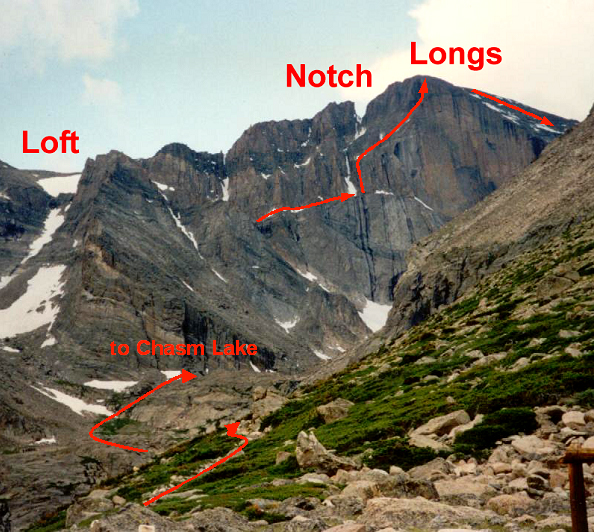
We reached the bottom of Lamb Slide and stopped to put on crampons and get out the ice axes. Then, we turned left to head up towards the Loft and Mt Meeker. We climbed about 800′ of elevation and exited at the first place it looked possible onto snowy ledges. We would traverse these ledges to the right until we reached the Broadway ledge proper. Along this thin ledge, we knew we would encounter snow & ice and at least one exposed technical section.

And, Brian needed to drain his boots again so we took another short break.

(5) Traverse Broadway Ledges to Horsby Direct Dihedral

The first corner we reached was covered in snow; I think it was the dihedral used by the Hornsby Direct finish to Stettner’s Ledges route. Brian headed across to check the conditions, to see if we needed a belay. He was planting his axe and kicking steps until about half-way across, he hit rocks just under the snow. Unable to gain secure footing on the main path, and with a large bulge of rock above him partially blocking his way, he moved lower to find solid footing on some exposed rocks below

I yelled out that the rocks looked unstable, and that we should setup a belay. Brian said he thought it would be okay. Just as he stepped down and put his full weight on a large boulder, it rolled over and fell out from under him.  It careened down onto Lamb’s Slide, hundreds of feet below. In that instant, I knew he was a goner. I stared blankly and screamed “rock” as a warning to anyone below.

By pure chance, Brian dropped straight down and landed squarely on another boulder only a foot or so lower that stopped his rapid descent into the afterlife. Brian looked back at me and offered up a profound, “whoa.” He then took the last step to reach the far ledge. We paused for a moment to listen for voices, but heard nothing but our own hearts pounding in our ears.

No one had been hurt, and we wanted to keep it that way.  Brian set up a belay anchor, and then I threw his end of the rope to him so I could get a belay past the airy bulge.

(6) Complete Broadway Traverse

We continued the traverse past several loose, snowy slopes to reach the far side of the notch couloir.  The route directions in Rossiter’s “High Peaks” guide book indicated a start within the Notch, but once again (as in 1996 see my Kieners’ …er, Notch Route trip report) I could not spot a likely start.  We decided to stop beneath a broken rock face leading up toward some fins of rocks. This looked to be a way to get into the Kiener’s Route.

We stopped for a snack and to change gear. Brian took his boots off and poured out a combined pint of fluid.  I didn’t think to see if it was just water, or if he’d peed himself a short while earlier.

Sitting squarely in the center of the “East Face” of Longs Peak, I felt that I was in the best spot on the greatest Colorado mountain. The combination of spectacular views, modest danger of dying at the moment, and the thrill of expected excitement to come felt unmatched.

(7) Climb Kiener’s Route to the Summit of Longs Peak

The upper portion of the Kiener's Route

The upper portion of the Kiener's Route

Brian took the first lead up the broken rock and over a chockstone; it was low 5th class climbing. I took the second lead up a narrowing chimney (about 3 feet across) to its end, and then up a waterfall to a big, grassy ledge. This pitch was 4th to low 5th class, and was the end of the technical portion of the route.

To speed things up without completely throwing caution to the wind, we simul-climbed up the broad ledges at the margin of the face (above the Diamond) for about 500′.  Once the terrain became gully-like with good hand and footholds, we unroped.  From this point on, the climbing difficulty was never harder than 3rd class.

At the end of this section, we stood in front of a massive cliff that separated us from the summit. It was very imposing and looked impossible to overcome.  I remember that my heart sank the first time I stood on that spot and looked at the impassable obstacle until I remembered the escape used by my guide to finish a climb on The Diamond.

Brian and I headed up and right, toward the Diamond face, and looked for large blocky rocks on the right. We climbed over the blocks and around the corner on a ledge to mount the north face of Longs.

From here, it was a 10-minute, 2nd class hike to the summit.  We reached the summit at 2pm; naturally the weather was deteriorating.  In addition, the summit was covered by flies and gnats, so we got ready to leave quickly.

(8) Descend the Cables Route

Just as we rose to head toward the Cable Route raps, a cloud rolled in and obscured visibility beyond 50 feet. Fortunately, we were able to feel our way down, having made the descent a couple times before. In a short time, we completed the second rappel and were looking over the impressive “Chasm View” to admire our path.

The hike down from the Boulderfield was a long one, as always. But, in the end, we had suffered and persevered 14.5 hours to ascend approximately 4800 feet and accomplish a classic mountaineering goal. And Brian had a very lucky day.

Our "lucky day" route up and down Longs Peak. The "X's" mark the spots of Brian's found luck.

Our "lucky day" route up and down Longs Peak. The "X's" mark the spots of Brian's found luck.

Our route had 8 major sections

  1. Hike to Chasm Lake
  2. Traverse around lake and Brian’s self rescue
  3. Completion of traverse to foot of Lamb’s Slide
  4. Ascent of Lamb’s Slide to Broadway Ledges
  5. Traverse to top of Hornsby Direct dihedral and Brian’s second lucky break
  6. Completion of traverse to start of Kiener’s Route
  7. Ascent of Kiener’s Route to Longs Peak summit
  8. Descent of Cables Route to Chasm View and back to car

See all Trip Reports

A Mummy Range Weekend

March 21, 2009

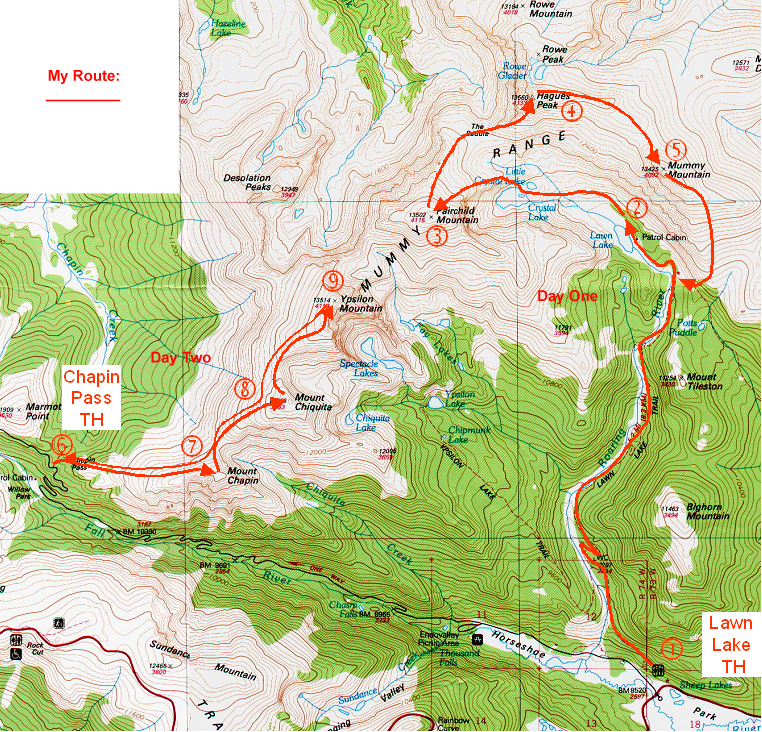
I had a free weekend on July 10-11, 1999 and decided I’d go after the seven 13ers in the Mummy Range.  

I had recently hiked to Mummy Mountain, and from the summit had seen how close and accessible were Fairchild and Hagues.  I decided then that I would return to get them all in a day.  Reading Roach’s 1988 RMNP book for planning information, I learned that the Mummy Range included Ypsilon, Chiquita and Chapin as well.  I figured I could get them all in 2 days:  

  1. Starting from the Lawn Lake trailhead (8530′), use the Lawn Lake trail to reach Lawn Lake (10900′), and then climb the cirque bagging in order, Fairchild (13502′), Hagues (13560′), Rowe Peak (13,400′), Rowe Mtn (13184′) & Mummy (13425′).
  2. Start further up Old Fall River Road at the Chapin Pass trailhead (11020′) and use Chapin Creek Trail to get access to the west side of the Mummy Range to bag in order, Chapin (12454′), Chiquita (13069′) & Ypsilon (13514′).

Day 1

It was going to be a long day.  I was going to hike 21 miles and 6,800 feet of elevation gain, if my body and the weather held out.  I decided to gamble a bit on the weather and water availability to reduce weight; I only packed a rain jacket, two 1-liter bottles of water, and iodine pills.  The  “plan” was for the rain and related cold wind to stay away, and for me to be able to find enough water to drink an estimated 6 liters (13.2 lbs) without having to carry more than 2 liters in my pack at any one time (4.4 lbs).  With such a small load, I figured I could do it. 

I started hiking at 6am along the Roaring River, and was amazed at the wild river bed that looked like it contained a wild amount of runoff in some years. Later, I found out that the dam on Lawn Lake had failed in 1982, and the water carved out the river bed as it roared into the town of Estes Park.

The trail was completely empty of humans.  Walking on an excellent trail didn’t exactly feel wild, but the sense of adventure was certainly heightened by my isolation.  My adrenaline was running high; I was feeling very good.

I broke out of the trees just after reaching Lawn Lake.  I could finally see the peaks I was attempting; I could see the entire cirque.  Based on my trip planning, I was thinking that I needed to cross over to the SE slope of Fairchild, but the route didn’t seem obvious.  I decided to head over to Crystal Lake and use “The Saddle” approach.  But first, I finished the last of my initial 2 liters and refilled both bottles.

A view of Cystal Lake with Fairchild Mtn beyond.  My route followed the right skyline to the summit.

A view of Cystal Lake with Fairchild Mtn beyond. My route followed the right skyline to the summit.

Unlike all other Colorado lakes I’ve seen, Crystal Lake has perfectly clear water.  I suppose that is where the name came from.  It reminded me of spring-fed lakes I had played in as a kid in Florida.  I was tempted to go swimming, but managed to stay focused on making progess; I had a long way to go.   I did make a mental note to return someday for a swim.

To get a good view of Crystal Lake, I had come in too close to take a direct route up the slope toward “The Saddle” (actual name on map).  Rather than take the detour to get around the cliffs surrounding the lake, I decided to climb up one of the steep gullies. As is almost always the case, I regretting my casual acceptance of unnecessary risk about half-way up the loose, steep rock.  But I made it, and then worked my way up along the rim to the summit of Fairchild where I took my first break.

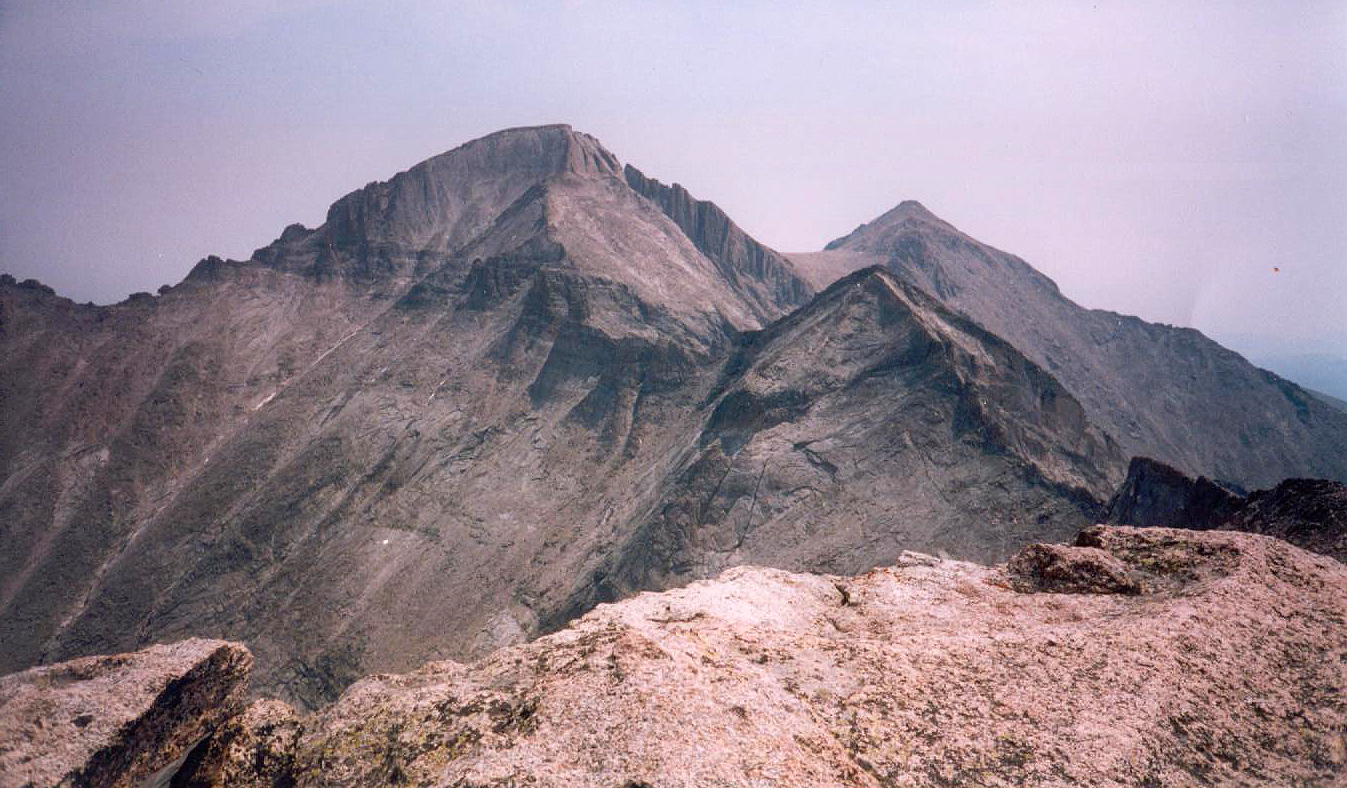
slkdjfsd;lk

A view of Fairchild (and Ypsilon) from Mummy. I ascended the cliff band to the right of Crystal Lake and then to the summit. Then I traversed right to The Saddle and further right to Hagues Peak.

I didn’t know the Mummy Range well so I didn’t know that right behind me was Ypsilon, less than 2 miles away.  I thought it was an impressive looking peak and took a picture, but I had no idea about the possibility of linking all the peaks together.  

I started down to The Saddle after only a few minutes, and enjoyed the beautiful flowers.  It was the biggest collection of mountain flowers I had ever seen;  I made my second mental note of the day:  to return to this incredible spot with others to share it with them.

Beautiful flowers on "The Saddle".  My route ascended the slope to the left to Hagues, and then followed the skyline to Mummy on the right.

Beautiful flowers on The Saddle. My route ascended the slope to the left to Hagues, and then followed the skyline to Mummy on the right.

Approaching Hagues, the hiking turned into scambling and then to climbing. Near the summit level, the difficulty felt 4th class; but I was insisting on the direct path.

 As I was climbing up a crack leading to the summit level, a roaring sound from above got my attention.  As I heaved my bulk over the top, I quickly looked up to see a B1 bomber doing a low-altitude, tight turn; he looked like he was having some fun before heading off over the Continental Divide. It was a strange feeling. All alone deep in the mountains and watching an air show.  

At this point, I could feel the mileage of the day.  I was tired, and I was out of water.  As I looked over at Rowe Peak and beyond it to Rowe Mountain, I was thinking that I was moving too slowly (and getting slower), had a long way to go, and was far above treeline.  I thought I’d be taking too big of a chance by doing the 2 mile round trip over that tricky terrain.  I was disappointed to skip the Rowes, but I needed to start heading back down very soon.

I tagged the Hagues summit and took off for Mummy with an eye for water. On the Hagues side of the saddle between Hagues and Mummy, I found a mossy puddle.  It was nasty water with lots of floating and suspended matter.  Worried that I wouldn’t find anything better, I filled one of my empty bottles.  I reasoned that one liter of bad water might keep me alive, but that two liters of that nastiness would definitely kill me.    

Looking back at Hagues from the summit of Mummy.

Looking back at Hagues from the summit of Mummy.

I pushed my body to keep going with some speed.  I was tired, but I could make hard 20-30 step pushes followed by a bent over, hands on knees rest. And, the ascent to Mummy was mercifully short.  On the Mummy summit, I decided I needed to thin my blood with some of my water supply.  

To my mind, it was like drinking a liter of loogey, chewing to keep from choking.  

Loogey (lōō-gē)

  1. A chewy substance that is difficult to swallow. 
  2. An unidentifiable mass of goo of probably disgusting origins.
  3. A blob of snot. lung butter.

With a queazy stomach and somewhat less tired legs, I started down the south slope toward the Black Canyon trail.  The thunder in the distance encouraged me to take advantage of the downhill terrain.  I always feel stronger going downhill for some reason; it’s a mystery.

Near the bottom, I cut the corner to reduce the distance to the Black Canyon trail and get below treeline.  The Black Canyon trail quickly led to the Lawn Lake trail and the Roaring River.

The hike out along the Roaring River was an unending death march.  But water was nearby and I was below treeline.  I managed to get my 6 liters of water on the day, and I was very happy to reach the car and end my suffering.  I had hiked just over 19 miles and accumulated just over 6,500 feet of elevation gain in 12 hours.  That was enough; I figured I’d do the rest of the Mummy Range some other weekend.  

When I got home, I found a message from my friend, Joe.  He wanted to join me on my final day in the Mummy Range.  Now I had to continue with my Mummy Range weekend.   At least the suffering was so high that I knew I’d be proud of myself when it was all done.

My route through the Mummy Range

My route through the Mummy Range

Day Two

I picked up Joe and we drove to RMNP and up the Old Fall River Road to Chapin Pass trailhead.  

The first mile or so was through the trees, but it thinned out quickly as we approached Chapin.  As we broke above treeline, we saw two big bull elks giving us the eye.  They both had massive racks, and we had none. We gave them room by doing a rising traverse of the Chapin flank.

A view of our route taken on the drive out

A view of our route taken on the drive out. Ypsilon is further to the left of Chiquita.

We continued on to the northern most of the two Chapin summits. Once there, I admitted to Joe that I was tired.  He expressed some surprise at my slow pace.  I didn’t feel like explaining.

My tiredness was not going to be resolved or even aided by a break on the summit of Chapin, so we continued hiking, now heading to the Chapin-Chiquita saddle.  My morale was boosted by the impressive views down to Chiquita Creek.

We continued hiking, now heading up the long ascent to the Chiquita summit. When I could afford to take my attention from my footing, I enjoyed a spectacular view of the areas I had investigated in great detail the day before. Oddly, it still didn’t occur to me how those peaks could be linked to my current location.  From the Chiquita summit, Joe and I enjoyed the great view of Ypsilon’s Donner Ridge before heading down Chiquita’s northern slopes to the Chiquita-Ypsilon saddle. 

The climb up Ypsilon Mountain was another grind for my tired body.  Joe kept looking back at me, wishing I’d move faster as we hiked up boulder-filled terrain. Once we could see down into the basin, we were lost in wonder. The Spectacle Lakes basin is very impressively boxed in by the the Donner and Blitzen ridges. 

Sitting on the summit of Ypsilon, the pieces of the puzzle came together in a rush.  My eyes followed the line from Fairchild to Ypsilon, and I thought, that looks doable.  Suddenly, it hit me…I should have gone that way!  

Looking for excuses anywhere, I complained that Roach didn’t say anything about the possibility of linking all of these peaks together.  I wondered out loud if perhaps no one had done it before.  The prospect of being a trail blazer burned in my mind and powered my failing body as we hiked back to the Chapin Pass trailhead.  We managed to get lost for a short time and had to take a detour around a giant Porcupine, but we made it.  We had taken 7 hours to climb almost 7 miles and approximately 3,200 feet of elevation gain; the weekend total was nearly 26 miles and 9,800 feet in 19 hours.

When I got home, I quickly dug out Roach’s RMNP book to confirm my assertion that he makes no mention of the linkup.  Of course, I quickly found his “Mummy Mania” description and regretted not being more careful in my research.  Using this route would have saved me 11 miles and 3700 feet.

Mileage and elevation gain for my Mummy Range weekend

Mileage and elevation gain for my Mummy Range weekend

Wow, what a lesson!  Even though I wasn’t very smart, I still retained a measure of pride for the effort to reach 6 Mummy Range summits in a weekend.

See all trip reports

The Double Crown: Chiefs Head & Mt Alice

March 19, 2009

Time after time, I find that an ambitious goal combined with an equal willingness to suffer optimizes personal reward.  I’ll admit this statement doesn’t feel true during my adventures, but is clear afterwards.  Of course, larger goals lead to larger rewards; but, overly large goals, exceeding my willingness to suffer, lead to bitter disappointment.   And, naturally, small goals accomplished easily mean nothing.

To find situations where I must try as hard as I can to just barely succeed, I look to harmonize aggressive goals with an optimistic assessment of my willingness to suffer.  This mental model helps me to imprint two attributes on my adventure plans:

  1. My goals are probably attainable; high success rates
  2. I’ll have to suffer more than I wanted, but be rewarded more than I expected

My trip to RMNP to collect the summits of Chief Head (13,579′) and Mt Alice (13,310′) was aggressive for obvious and non-obvious reasons.  In success, I found tremendous satisfaction, even if some of the suffering was self induced.

Story

When the alarm went off at 4:30am I was reminded of the Cardinal Rule of sleep:

“It doesn’t matter how badly you’ve slept the night, the sleep you were getting when the alarm went off was great.”

Still, I managed to get ready to meet Brian and then drive to the Glacier Gorge trailhead before 6am.   As I tied into my new La Sportiva Eigers, which just replaced my old Makalus, I silently hoped wearing them around the house for a couple days the previous week was enough to break them in.

It wasn’t.

We started hiking right at 6am and made good time until the battle between my feet and my new boots began to resolve itself into a win for the boots. By 8:45am I reached Black Lake where I performed my second boot/sock refit of the day.  Afterward, we left Black Lake for the shortcut to Stone Man Pass, aiming directly for Arrowhead.

We scrambled up the steep grass and cliffy slope, and reached the bench above Black Lake just in time for a boot pit stop.  In a blatant escalation of hostilities, I dug out the moleskin and athletic tape, and hoped for a stalemate.  We then turned south to head underneath McHenry and to Stone Man Pass.

Below McHenry, we stopped at a waterfall to refill our bottles.  This would be our last water source until returning to the spot hours hence.  Brian had his usual thimble-sized container, while I brought a surprisingly modest two 1-liter bottles.  To compensate for a dry future, I finished and refilled both liters before heading up the partially snow-clogged couloir to Stone Man Pass.

A view back down the ridge toward Stone Man Pass

A view back down the ridge toward Stone Man Pass. The route starts from the top of Stone Man Pass.

We reached Stone Man pass around 10:30am and examined the ridge leading up to Chief’s Head for clues about the route.  The available guidebooks were not very clear about the exact route to Chiefs Head.  I have found that this can mean the route is obvious or, alternatively, it could mean nothing at all.

We took another 2 minutes to study the Stone Man himself for possible future climbing; Brian assessed it a “five-easy” while I thought it looked hard to protect.  Brian is often right about these things and we made a mental note to give it a try another time.

Note:  a later trip confirmed the climbing is easy but awkward; however, a safe escape from the Stoneman’s head required the sacrifice of a long cordelette.

The Chiefs Head Keyhole

The Chiefs Head Keyhole

The route finding quickly became very interesting.  I spied a lonely cairn 90 degrees west (right) from where the route looked to go up a couloir to the ridgeline.  Brian went to investigate while I resorted my boots again.

I feared for torrents of blood pouring out of my boots each time I took them off.

We continued scrambling below the ridgeline on the west side along a ledge until we reached the end of the ledge.  Then we took a hard left through a “keyhole” of sorts, and climbed up to the summit ridge of Chief’s Head.  It was very good rock and a pleasant scramble (3rd class).  We reached the summit ridge at 11:15am and took another 30 minutes to ascend the remaining 700 feet of elevation to the Chiefs Head summit.

This last 700 feet consumed the last of my “still feel strong” status.  We stopped for lunch, during which I consumed ½ of the water that would have to sustain me until I return to the bottom of Stone Man Pass.  I was 1.75 hours into a 5-hour circuit and my water was ½ gone.   I also made another futile attempt to save my feet, and resolved to go barefoot if the pain got worse.

A view of Pagota, Keyboard of the Winds, Longs, and Meeker, taken from Chiefs Head summit

A view of Pagota, Keyboard of the Winds, Longs, and Meeker, taken from Chiefs Head summit

The views from Chief’s Head are worth the trip.  The line from Meeker to Longs to Pagoda to Chiefs Head is spectacular. The thought of doing the entire traverse appealed to my ego, but I concluded it would require too much suffering.

As I looked over toward McHenry, I joked that if we felt like it we could climb McHenry again to claim the Triple Crown (Gerry Roach’s title for bagging McHenry, Chief’s Head, and Mt. Alice in a day).  Brian just grumbled as he had done every other time I mentioned the possibility in the previous 24 hours.

Looking back toward McHenry and Stone Man Pass from Mt Alice

Looking back toward McHenry and Stone Man Pass from Mt Alice

Somewhat refreshed, we started down the talus boulders making very good time to reach the grassy field that lies between Chief’s Head and Mt. Alice.  We were approaching Mt. Alice when, looking back, we noticed a couple of people behind us about ½ way across the grassy field coming toward Mt. Alice as well.  We were surprised and wondered how they had gotten so close without us noticing. Looking back a few moments later, Brian noted they had gained a lot of distance on us.  I reasoned that they were traveling downhill while we where doing a bit of scrambling and climbing.  It seemed like a reasonable conclusion.

A view of Mt Alice from below the summit of Chiefs Head

A view of Mt Alice and the narrow ramp summit route from below the summit of Chiefs Head.

Over the next 30 minutes, these fellows proved that people are not all the same.

They must be young, I thought.  The first to pass me was a young fellow, but his partner right behind him looked like my father.   Brian strained to beat the old guy to the summit, marginally holding up the honor of the team.

When I arrived at 1:30pm, they were gone.  As I looked around, Brian indicated that they had gone on to grab more peaks before heading back to Wild Basin.  They had done Meeker, Longs, Pagoda, Chief’s Head, and Mt. Alice (so far) in shorts and sneakers.  The older guy had said he was tired, while the younger guy said he was running out of food because he didn’t have bread to make peanut butter and jelly sandwiches that morning.  Poor guy.

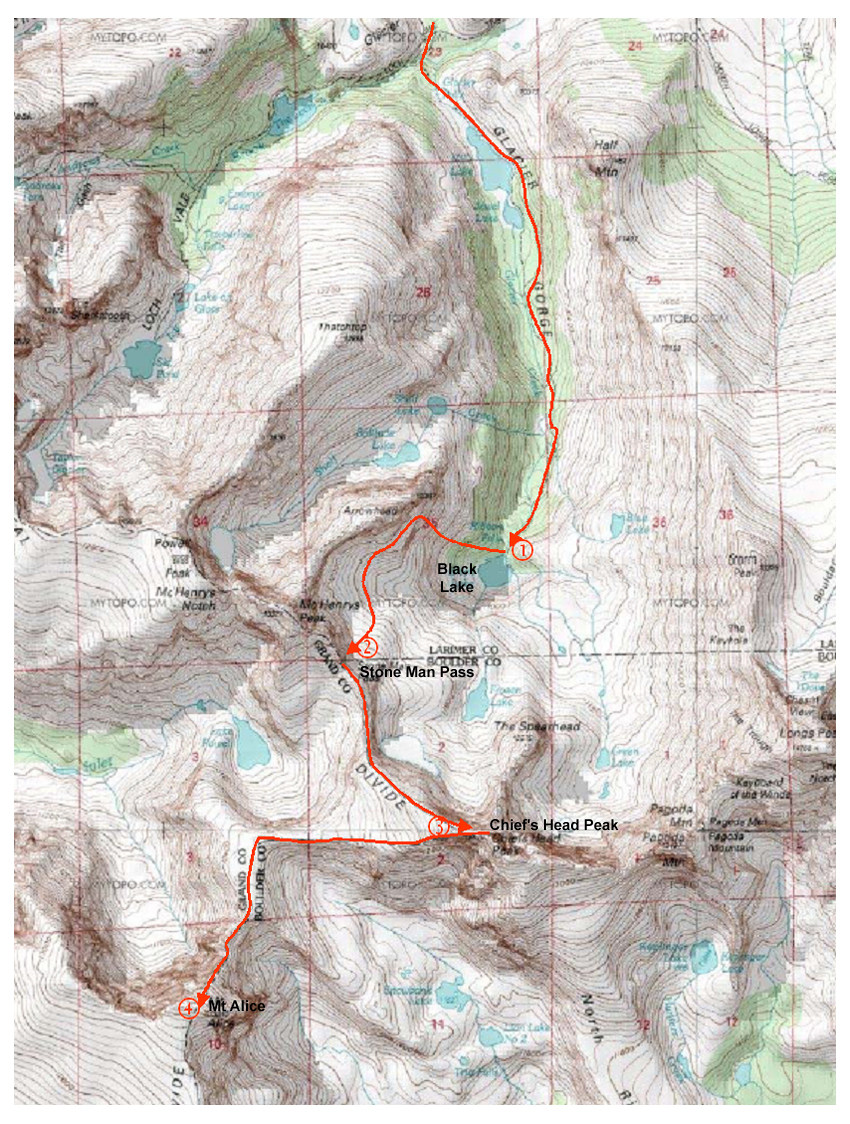
Our route map to (1) Black Lake, (2) Stone Man Pass, (3) Chiefs Head, and (4) Mt Alice

Our route map to: (1) Black Lake, (2) Stone Man Pass, (3) Chiefs Head, and (4) Mt Alice

After a short snack and another boot repair, I was out of water.  I was tired and 9 miles from the car, but at least I was turning around.

I managed to get back to the grassy field in decent time; downhill is always okay.  But climbing back up to the Chief’s Head ridge was murder.  And my body didn’t work that well anymore, forcing me to think carefully about moves that I did unconsciously a few hours earlier.  I really needed some water.

We reached Stone Man pass at around 4:30pm, which left us 4 hours of light to get down the snow/talus slope below Stone Man Pass, get over to and down the steep trail west and above Black lake, and then hike 4+ miles to get to the car.  We didn’t even talk about McHenry.

We descended the snowy Pass with a bit of heel plunging and a bit of scrambling to reach the bottom by 5pm.  I found a nice fountain of melted snow to refill my long-empty bottles; but I had to wait 30 minutes before drinking to allow the iodine to work its magic.  I was very tempted to throw caution to the wind and just drink it.

Thirty minutes later, I yelled to Brian to stop.  I was going to have that damned water right then.  As I was pulling my water out of the pack, I nearly trembled with fear as I lifted the 1st bottle up to the light . . . It was not dissolved.  The damned thing looked just like it did when I put it in there. As I was losing my composure, Brian reminded me that hiking equals shaking, in the world of iodine tablets.  I started hiking without taking a drink.

We scrambled down the steep slopes above Black lake with a bit of rock scrambling and steep grass maneuvering.  The plan was to stop at Black lake for a break, but once I was past the hard part of the descent, I just sat in the dirt and drank a liter of water.  That was good water; even the iodine tasted good.  I then joined Brian at Black lake where I finished off another liter and a bar, and then I refilled one of the bottles for the ride home.

I didn’t even bother with the boots any more.  I was just stumps below the ankles.

On flat terrain and using good trails, we took less than 1.5 hours to cover the 5 miles to the car, arriving at 8pm.  I finally was able to get those miserable boots off my feet.  I didn’t have the courage to examine the damaged tissues so I just put on my sneakers, drank my iodine water and started driving.

Driving home, it started to feel like a day well spent.  The pleasure of our successful 14 hour effort to hike 18 miles and climb 5,300 feet to reach the summits of two new 13ers spread throughout my body like a slow, warm wave.  My feet almost didn’t hurt anymore.  Almost.

Our trek to bag Chiefs Head and Mt. Alice in RMNP was another of those harder-than-expected- but-glorious-in-its-successful-completion efforts. It was perfect.

See all Trip Reports

Wrongway Arrowhead

March 14, 2009

Story

I had a free weekend and decided it was time to do Arrowhead Peak and take a look at the 4th class ridge to McHenry Peak.  I had followed Brian up to Solitude Lake some years ago in the winter and figured it wouldn’t be too hard to find in the summer.  Plus, I studied Roach’s RMNP guide for pertinent details.  The approach and climb were fairly short, and the weather forecast was good; I didn’t expect to have any difficulty with time, so I took advantage of a late start.

The hike in followed the normal approach to Black Lake but with an early exit from the trail below Arrowhead and Thatchtop at approx. 10,200 ft.  After 1.5 hours, about 2 miles up the Black Lake trail, I crossed the creek and headed up toward Solitude Lake.

I never did find a clear trail, but managed to bushwhack using an approximation of the winter route I used with Brian.  Since I didn’t get a predawn start, the steep ascent to Solitude Lake (11,400′) was a sweaty affair made terrible by swarms of hungry mosquitoes.  I arrived a bit lighter of water and blood, approximately 2.5 hours into the day.

From Solitude Lake, I hiked to the low point in the ridge between Arrowhead and McHenry.  A specific climbing route did not look obvious, but a lone cairn seemed to show a way; so, I took it.  The scrambling was fairly easy, and I soon found myself near the ridgeline.  I continued scrambling along the ridgeline until I reached the distinctive Arrowhead summit.

As I enjoyed a brief rest and water break, I examined the other side of the ridge for future climbing opportunities (many) and studied the ridgeline extending to McHenry for a possible extension to the days fun.  The ridge to McHenry looked rather difficult, so I decided I would wait until I could bring better climbing shoes and get an earlier start.

As I packed up my gear, I decided I would avoid the long detour of following the ridgeline.  I didn’t have a topographical map with me, but I recalled thinking that the route could be straightened out a bit.  Looking down the slope of Arrowhead, it all looked about the same; I picked a line that I thought was a few degrees to the right of my ascent route and started hiking.

Arrowhead viewed from Thatchtop, with ascent route indicated in red and descent route indicated in orange

Arrowhead viewed from Thatchtop, with ascent route indicated in red and descent route indicated in orange

Almost immediately, I was lost.  It is not easy to get lost on a small peak like Arrowhead, but I was lost just the same.  I knew I could just backtrack to the summit area, and I suppose that means I wasn’t completely lost; but I sure didn’t know the way down.  But the knowledge that I could always go back to the summit and the continuing good weather gave me the confidence to keep exploring.

As I got lower, I got into a gully that looked familiar, and followed it lower.  The gully became a chimney and the climbing became steeper until it felt technical; but I could see a big ledge 20 feet below that would allow me to exit the chimney and look around to see where I was; so I continued.  The last move to reach the ledge was so difficult that didn’t want to repeat it.  From the ledge, I could see that I was several hundred yards off course, directly above Solitude Lake.  Strangely, I found a rap anchor, but no way down without a rope.  The rap anchor gave me visions of a down climb of the sheer cliff beneath me, but I came to my senses and realized that I had to find a way back to the top.

I hunted a bit for a better route, and found a chimney that looked better that what I had descended.  I climbed it a short bit before realizing it was going to be even harder.  I had to make a couple of unprotected, mid 5th class moves over loose blocks stuck in the chimney. Once I reached the flatter summit slope near the summit, I was still lost but not in any immediate danger of being stuck for the rest of my life.  I decided, finally, to go back toward the ridge before descending the way I had come up.

Finally, down to the main trail and 3 miles back to the car, and my surprisingly adventurous day was done.  I had hiked approximately 10 miles, gained approx 3,400 feet in an 8-hour day filled with adventure and lessons learned.

Complications

  • I was alone
  • The available route information was indefinite
  • The guide book didn’t have a topo map

Mistakes

(1) Prepared badly

  1. Didn’t bring a map or compass
  2. Didn’t study the map; just thought I’d be able to figure it out

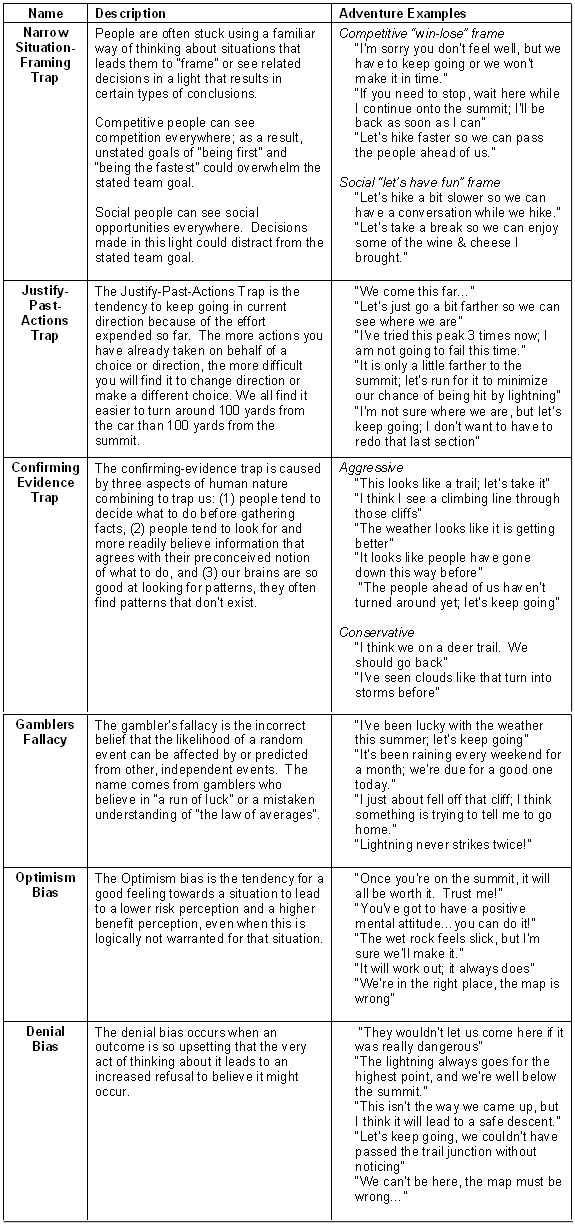
(2) Made several bad decisions along the way due to flaws & biases in my thinking.

  1. Optimism Bias:  I was foolishly optimistic about being able to figure out a way down when I didn’t know enough about the terrain.  Even when the decision started to go badly, I continued to feel that everything would turn out okay somehow.
  2. Confirming Evidence Trap:  I continued to be motivated by false evidence & silly rationalizations, while ignoring evidence that I was making a mistake, e.g.,
  • “the gully looks familiar”
  • “I’ll be able to see where I am”

How I Got Lucky

  • The weather stayed good during my “explorations”
  • I was able to make the technical climbing moves

Go to “Learning from Mistakes” index

Go to Index of all essays

Thatchtop Traverse

March 14, 2009

Story

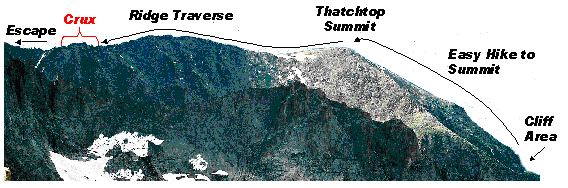
While reading Rossiter’s High Peaks guidebook, I found a passage that said, “…or you can descend via Thatchtop – it’s only 4th class…” I love traverses and so I decided I would use the traverse to the Continental Divide to bag Mt. Powell (13,208′) after summiting Thatchtop Mountain (12,668′) and then use it again to get home.

Foolishly, I got a late start – only hiking by 8:15am.  And I had to start from Bear Lake, since the close lot was already full, adding 15 minutes to the hike in.  I reached the foot of Thatchtop Mountain around 10am, and hoped I had four hours before any bad weather might start.

I started up the wooded east slope toward a gully I hoped would lead past the cliff band that separated me from the flatter summit slope above.  The climbing was ugly and dirty as is typical for an unpopular hike, and for a slope enduring a recent avalanche; scrambling over fallen logs and avoiding sharp, broken branches added to the delays.  (Note:  on a subsequent trip in 2010, I discovered I was badly off-route.)  Finally, I was able to look up the gully and confirm that only a few moderate moves would take me past the cliff.  And by 11:30am, I was enjoying my barely earned but desperately needed water on the Thatchtop summit.  I was also enjoying the great Glacier Gorge view, lined with my favorite RMNP peaks:  Longs Peak, Pagoda Peak, Chiefs Head, and McHenry.

From the summit, I noticed the western sky was blocked by McHenry Peak and the nearby Continental Divide (both close and above me).  I was worried that I would not have any advance notice of approaching weather; but I figured I could turn around later.  And I hoped my long-standing good weather luck would continue.

Leaving the summit, I began the traverse with a full sense of thrill.  With a shot of adrenaline, my mind became clearer and better focused on the work at hand, my body became more coordinated and better balanced, and my mind adopted a higher pain tolerance.  It was the easiest climbing of the day.

I stayed on the ridge whenever possible and moved a bit lower to the south when necessary to avoid difficulties such as cliff-outs or gendarmes.  I was still making excellent progress when the rain and lightning started.  It only lasted a minute, but the lichen-covered rock was now slick; the further I went, the more difficult the climbing became.  I thought about going back, but felt that the climbing I had done would be too hard to do again when slick, so I kept going.  Besides, I was very close to achieving my goal. (Note:  on my 2010 return visit to the area, I discovered that my ‘stay on the ridge’ strategy was unnecessarily hard; a much flatter, safer path was mere yards down the slope)

I kept thinking the hard part must be behind me, as it was “only 4th class.”  But then I reached what must have been the normal crux.  In dry conditions, it would have been a difficult climb over a knife edged ridge, but wet, it was impossible.  I couldn’t even climb up the sloping rock to start the knife-edge due to the slick conditions.  I hunted around and found a passage around to the north side:  atop a 1,500 foot cliff hanging over Sky Pond, there was 1 foot wide ledge that would lead back to the ridge beyond the crux; but the start of the ledge was six feet away with only a 2 x 1 inch sized foot hold protruding from a sheer rock face with no hand holds between me at the ledge.  During the 2-second move, I would have only the toe of my boot on the mossy hold with nothing else holding me up as I long-stepped through to the ledge six feet away.  This was not the sort of fun I was hoping to have.

thatchtop

In a state of denial, I went back to look for something else and to consider retreating over the difficult ground that I had passed to get here; but I once again decided I had no choice but to proceed.  And I couldn’t wait as the rain and lightning had started again.  I was able to hang on to a rock while I stuck my foot out to kick the horrible foothold to see if it was strong (it was) and to clean it off.  And then I put my boot toe on the hold, weighted it, and stepped through.  Fortunately, I was able to stay focused on the move and not be distracted by the potential fall or the lightning.  After the relief of not dying wore off, it hit me that there was no way I could go back now.  I simply had to find a way to the Continental Divide and then find another way home.

Fortunately, the rest of the Thatchtop ridge was much easier, and I was even able to get some shelter below Mt. Powell when another fast-moving lightning storm blew in.  With a brief bit of good weather, I was able to get the Mt. Powell summit (Note:  on a later trip, I discovered that I missed the actual, and obvious, summit by 40 feet) and begin my long trek home.  I figured that the only safe way back down was to traverse north beneath Mt. Taylor and then on to Flattop (~4 miles away) and then down the established trail to Bear Lake (another 4.4 miles).  This way I would stay beneath the high points and avoid steep descents on snow, but I would still be exposed to lightning for a long time as I worked my way to the treeline near Bear Lake.  The only reasonable alternative was Andrews Glacier between Mt Taylor and Mt Otis, but I just didn’t think it would be safe to attempt without an ice axe.

My circuitous route back to the Bear Lake parking lot, to avoid the return traverse of Thatchtop

My circuitous route back to the Bear Lake parking lot, to avoid the return traverse over Thatchtop

Much rained on, badly dehydrated, and having hiking through a large herd of Elk, I arrived at Bear Lake and my car at 7:15pm. I hiked and climbed a 12.5-mile circuit in 11 hours, and felt lucky to be alive.  But at least I got my 15 minutes back as I didn’t have to hike any farther than Bear Lake.

The next two nights I slept badly with dreams of falling down a cliff toward Sky Pond.

Complications

  • The route was not well known (not described in detail).
  • “4th Class” is a subjective rating
  • It wasn’t clear if it was one difficult section or several difficult sections
  • The route did not have a good “retreat” option (as is typically true of ridge traverse climbs)
  • The weather was poor
  • I was hiking/climbing alone

Mistakes

(1) Prepared Badly

  1. Didn’t think about the ramifications of being late when driving into a popular destination:  traffic, parking, etc.
  2. Didn’t imagine “what if I cannot return via the ascent route” (didn’t bring an ice axe)
  3. Didn’t consider the impact of possible rain on the “4th class” rating (I brought rock shoes, but wasn’t prepared to react aggressively to initial rain)
  4. Assumed my turnaround time was 2pm instead of noon.

(2) Made several bad decisions along the way due to flaws & biases in my thinking.

  1. Justify-Past-Actions Trap:  I didn’t want to waste my efforts, so I resisted turning around when the initial rain fell and the conditions became much worse than I expected.
  2. Optimism Bias:  Felt overconfident about unknown terrain; I consistently thought the climbing ahead of me would be easier than the terrain I had passed even though I had no facts available. This kept me from retreating when I could have done so.
  3. Gamblers Fallacy:  Felt I could count on being lucky with the weather since I had been fortunate many times in a row.

How I Got Lucky

  1. The weather was only periodically stormy; most of the time I was on the Continental Divide the sky was just sprinkling.
  2. I made it past a move with a 50% chance of success, when failure meant death
  3. I found a puddle of clean rain water to drink on the long descent hike
  4. I knew the area well enough to figure out a completely different route to descend without a map

Note:  After my later trip to bag the Solitude Lake Cirque, and my discoveries of even more stupid mistakes I made on my Thatchtop Traverse, I am even more amazed at how my carelessness  magnified the overall challenge and forced me into needless risk-taking.  Wow, what a lesson!

Go to “Learning from Mistakes” index

Go to Index of all essays

The Great Cirque: Meeker to Longs traverse

March 10, 2009

The idea for the Mt. Meeker to Long’s Peak traverse came to me last December after climbing Mt. Meeker on a clear, cool morning.  Sitting on the Meeker summit rock, I looked over the Loft to Longs Peak and saw the potential for a beautiful traverse.  At that moment, I decided I would come back to bag the two-summit traverse.  The idea eventually grew into a quest to bag “Colorado’s greatest mountain cirque” (Roach).

Of course it is a long bit of hiking, but there is also a short technical obstacle to overcome:  Mt Meeker and Longs Peak are separated by “The Notch”.  The Notch is a gap in the rock approximately 75′ deep at the ridgeline and which continues as a deep and steep gully down each side of the mountain.

Nevertheless, where there’s a will . . .


The Great Circ Route

The Great Circ Route


Brian and I were recovering from a full summer of rock climbing and related injuries, so I was able to convince Brian to do an alpine hike.  To do the entire cirque, we chose to start the loop at the Longs Peak  cut-off to Chasm Lake, which we would take toward the Mt. Meeker East Ridge, and after summiting on Meeker and then Longs, we’d return via the Boulderfield (about a 5 mile loop).

In total, the Great Cirque trek would take approximately 12 hours including the hike from and to the parking lot and would cover approximately 15 miles and an elevation gain of approximately 5700′.

Our plan had eight steps:

  1. Hike from Longs Ranger station toward Longs to Chasm Lake cutoff
  2. Hike past Chasm Lake and up through Iron Gates (class 2) approach to Mt. Meeker East Ridge
  3. Traverse Mt. Meeker ridge (class 3) to summit
  4. Descend to Loft & hike (class 2) to high point on Loft north side
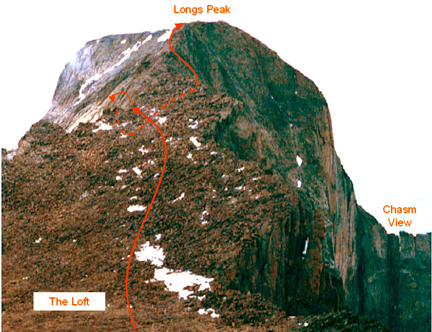
  5. Descend Gorrells Traverse route (4th Class crack system) to Notch gully and ascend to Notch high point (class 4), and then climb to Longs ridge and summit using the 5th class rock finish to the Notch Coulior route
  6. Descend Longs North face via Cables route (two single rope rappels) to Chasm View
  7. Hike to Boulder Field
  8. Hike around Lady Mount Washington to complete circuit at Chasm Lake cutoff

Alternatives to avoid carrying ropes and difficult scrambling:

  1. Take Clark’s Arrow from Loft to join Keyhole route – avoid 4th class chimney and technical pitch
  2. Take Keyhole route from Long’s summit back to Boulderfield – avoid rappels

Time table:

  • Start hiking – 4am
  • Reach bottom of Iron Gates – 7am (first light)
  • Mt. Meeker summit – 9am
  • Long’s Peak summit – Noon
  • Reach car – 4pm

Report

Brian picked me up at 3am.  I was ready to go when he arrived, for a change, and we immediately headed out of Boulder for Lyons, and then the Long’s Peak Ranger Station parking lot.  We arrived just before 4am to find a parking space right in front.  A good omen.  The cold weather a week earlier must have suspended the weekend cattle drive for Longs Peak.

We powered up the trail needing only long underwear to stay warm despite the high winds and temperatures in the 30’s.  Around 5:30, still an hour or so before dawn, we reached a popular rest stop, the fork to Chasm Lake (left) or the Boulderfield (right).  The frigid winds eliminated any thought of a rest and we hurried onward toward  Chasm Lake to find some shelter.  We found a suitable rock formation approximately 300 yards further where we could stop to put on fleece and wind jackets.  My numb fingers made me regret leaving my regular gloves at home, and I would later find another reason to regret bringing only fingerless gloves.

The trail from the Ranger Hut below the Ship’s Prow (rock formation which separates the canyons below Mt. Meeker to the left and Long’s Peak & Chasm Lake to the right) to the Iron Gates is indistinct and generally over talus.  We knew the Iron Gates gully ran up the left of the buttress which is to the left of Cathedral Buttress (the awe inspiring buttress which runs down from the Mt. Meeker summit to the canyon floor), but of course this is difficult to see in the twilight.  Fortunately, a moment of hesitation allowed the sunrise to show us the path.

The Iron Gates gully proved to be a wonderful route to the Mt. Meeker East Ridge.  At the top of the 2nd class gully, a short 3rd class scramble brought us to the ridge and the endless vistas of the Eastern and Southern horizons. More importantly, an eastern view brought us exposure to the sun on a cold windy morning.

We paused to enjoy the radiation, eat a quick snack and apply sunscreen. After a few minutes, we continued on our quest.  This leg of the cirque led us west up the ridge toward the Mt. Meeker summit.  The easiest path was the ridgeline itself, which slopes about 20 degrees to the south (left) and 90 degrees to the north (right).  With the wind gusting up to 40 mph, we took care to avoid becoming a cliff diver and wasting all our efforts.


Our route from Meeker

Our route from Meeker


In a couple places, the traverse exhibited a common 4th class difficulty: it was 5th class without good route finding instincts.  We reached the summit at 9am with increased respect for the smaller sister of the mighty Longs Peak.  The summit itself is an unlikely square block sitting about 4 feet higher than the surrounding rock.  Underneath the block is an alcove that provided shelter from the wind and a nice spot for another snack.


The approach to and descent into the hidden Notch (dotted portion), then the ascent to the summit

The approach to and descent into the hidden Notch (dotted portion), then the ascent to the summit


We continued the traverse across the ridge and then down to the Loft, following the natural line.  In order to find Gorrells Traverse route on the far side of the Loft, we angled toward the high point (North end) of the Loft that forms one side of the Notch.  The Notch separates the Loft from Long’s Peak and prevents the easy hike to Long’s summit.

Gorrells Traverse route is a 4th class crack system  that descends into the Notch gully, SW side.

Per Rossiter’s guide book, RMNP: The High Peaks:

Hike NW to the highpoint of the SE ridge above The Notch. Descend to the west and locate cairns that mark the tops of two chimneys.  Downclimb the north chimney for about 200 feet to a broken platform that is about 100 feet above the gully leading up to The Notch.  Rappel into the gully from the north end of the platform or traverse up and left toward The Notch until it is possible to scramble down into the gully.


Gorrells Traverse

Gorrells Traverse. Photo from a later trip.


As in all guide book ratings, the rating is right if your technique and route finding is up to snuff.  There is also well-used rappel anchor for the unsure. We jammed down the cracks:  blind feet and bomber hands.   I got a tear in my wind jacket for the effort.  At the bottom of the first downclimb, we traversed right and slightly uphill to reach another gully which we downclimbed.  It was quite exposed but went rather easily as well.  From the bottom of the downclimb, we turned right and scrambled up to reach the top of the Notch.


Our route from the Notch to Longs Peak summit

Our route from the Notch to Longs Peak summit. Photo from earlier trip.


From the top of the Notch, we could see down the Notch Couloir toward the Broadway Ledge.  We also speculated on the feasibility of a tyrrolian traverse across the Notch without conclusion.  Since the rock was still non-technical at that point, we continued scrambling and moved out of the Notch toward the summit ridge.  We got to within 90 feet of the ridge before we ran out of scrambling terrain.

Since we brought rock gear, we didn’t feel compelled to stay with the Notch Couloir route (rated 5.2); in fact, we specifically wanted to find something more interesting…more memorable.  Brian spotted a rappel anchor at the top of the Long’s side of the Notch, approximately 90 feet above us; we agreed to climb toward it over the moderate looking moves.


A view of the technical climb to reach the summit ridge

A view of the technical climb to reach the summit ridge


We roped up and Brian took off for the ridge, his hiking boots scraping on clean 5.5  rock.  Our “mini-rack” of climbing gear was sparse enough to fit in a coat pocket, but it turned out to be ideal for a short pitch at 14,000 ft. elevation.   Near the top, Brian decided to pull a roof directly above rather than take the obvious ramp to the left.  When I questioned his intentions (with a yell from below), he explained, “you’ll thank me.”  Later, after pulling over the top on monstrous buckets, I did.

All that was left was the short but interesting ridge scramble and then a walk to the summit marker, which we reached at 11:54am.  We rested in luxurious bivy site and congratulated ourselves for a great trek.  It was, after all, quite literally all downhill from there.


Our descent route to the Boulderfield

Our descent route to the Boulderfield. Photo from later trip.


The descent through the Cable Route was interesting as a result of snow and ice adding frictionless treachery to the loose rocks in our path.  I lost my concentration on a relatively flat section and slipped on the ice.  My fall on the rock sheared off the front half of my right thumbnail.  This shockingly painful and bloody injury would cause me considerable grief during the rappels to come.  We scrambled down to the lower rappel anchors and made it to the Boulderfield in good time.

The hike out of the Boulderfield is always a death march, but this time I felt so good about the climb that I didn’t mind it at all. We reached the car at 4pm and drove into Lyons for some Mexican food.

It was all good, I just shouldn’t have ordered fajitas. They’re too hard to roll with just one hand!

See all trip reports

Longs Peak: Keyhole Ridge

December 3, 2008

Story

With a long break coming up, Brian and I looked for a long, high-altitude climb to keep us sore for a few extra days.  We settled on Longs Peak Keyhole Ridge: a moderate ridge climb with spectacular views and a direct route to the summit.  I also had a private agenda; I was going to see if I could avoid dehydration rather than tolerate it.

The route included a 7.25 mile one-way hike with a 3,600 foot elevation gain (ranger station to false keyhole) plus 5 mostly adventurous pitches of 4th class to 5.5 climbing. We thought we’d start early despite a perfect Summer weather forecast.

keyholeridgeroute3

We arrived at the full parking lot just before 4am and started out under a clear sky and bright moon right at 4am. Brian and I are still fairly fast hikers, even with a pack full of metal and rope; we reached the first bridge (just before tree line) in 45 minutes, which is a good a speed as we’ve done. We reached the cut-off to Jim’s Grove around 5am and the Boulder Field corral after 2.5 hours. With no small amount of pleasure, we noted that 2.5 hours to the Boulder Field is as fast as we’ve ever done.

We took a short break to enjoy a snack, tank up on water, stash some gear, and be amazed by the crush of people milling around the center of the Boulder Field. Rested and me with a full belly (a bar and 1 ½ liters of water), we started hiking toward the Keyhole. Just before the Keyhole is a NW-facing ramp that leads to the False Keyhole further up the NW Ridge of Longs Peak. From the False Keyhole (between the 1st & 2nd towers along the NW Ridge), we were able to mount the ridge and begin climbing toward the peak with the following pitches / sections of climbing:

  1. 4th Class Scramble: to reach the initial climbing section, we scrambled up along the ridge line for about 50 feet.
  2. Ridge Tiptoe & Climb to Second Tower: a scary, exposed section of blocks create a 4th class scramble along a 3 foot wide staircase with hundred foot drops to either side; we roped up. This scramble leads to the foot of the 2nd tower. From the foot of the tower, we traversed left (5.2) to reach a steep ramp that leads to the top of the tower. The ramp (5.4) led up to a number of options to reach the top of the tower; we went left to a ledge and then up to the top of the tower (5.5).
  3. Downclimb and Ledge Traverse: From the top of the 2nd tower, we descended to the west side of the ridge, down climbing 10 feet to a ledge.
    Longs Peak Keyhole Ridge Tower

    Longs Peak Keyhole Ridge Tower

    The ledge led to a low point between the 2nd tower and the remaining NW Ridge.

  4. Scramble to top of ramp: From the saddle, we moved up a broad, low angle ramp to reach a cliff below the NW Ridge. At the end of this pitch, I had a beautiful sit-on-the-cliff-edge, feet dangling belay overlooking the Boulder Field.
  5. Face Climb to Ridge Top: Finally, we climbed the cliff to get back to the top of the ridge (5.5)
  6. Scramble & Hike to Summit: We unroped and climbed along the ridge crest. Near the end of the ridge, we dropped down 10 feet to the left to pass the last tower (3rd class). We then scrambled to the summit level. Once we reached the summit block, we had a 100 yard hike to the summit and the masses milling and lounging around like on Miami Beach.

keyholeridgeroute

On the summit at noon was right on schedule. We rested and I ate a bite of lunch while finishing my 2nd liter of water since the Boulder Field.

After our short break, we descended the Cables Route down the north face without incident.

keyholeridgeroute2
Once we reached the corral and our stash, we refilled bottles and bellies with water.

As we left the Boulder Field, my toes were already feeling the beginnings of “Fire Toes” syndrome, a very painful friction condition brought on by my newish Makalus. I’ve found that the newer style boots with rubber rands covering the toes will not break in; they insist on breaking in your feet.

The hike out of the Boulder Field and through Jim’s Grove was long and hot, but went without any ankle turns. We took a short break after the bridge that reconnects with the main trail, where I finished my 7th liter of water for the day.

Trudge, trudge, trudge. It is always the same death march back to the car after a Longs Peak summit. The only sign of aging I can discern is a strong preference for going uphill in the morning; the downhill return is always a dread. My toes felt horribly abused.

Still, the time passed relatively quickly due to our use of “Movie Quiz”: a game of guessing movie sources for quotes or naming movies that a particular actor was in. We reached the car at 4pm, where I was pleasantly surprised to find that, once again, the toes were still attached.

And, aside from boot tortures, I felt great, thanks to my water guzzling efforts.

Route Map: Yellow is standard Keyhole route. Our variations are in red.

14.5 miles, ~4,850 ft elevation gain, 12 hours; not bad for two old guys

14.5 miles, ~4,850 ft elevation gain, 12 hours; not bad for two old guys

Complications

  • None

Mistakes

  • None

How I Got Lucky

  • The weather was great all day
  • I was able to find a lot of water on the trail to avoid dehydration without carrying more than 2 liters at a time

Return to PeakMind blog