Archive for the ‘Trip Reports’ Category

The Monte Cristo Creek Cirque

April 28, 2010

On September 1, 2001, I hiked Quandary with my wife, Susan.  We were looking for something easy and I had never done the standard route on Quandary, so we chose it and had a nice hike up.  My only previous visit to Quandary had been up the Monte Cristo couloir and was the scene of the longest sustained glissade I ever had, at least in the 13 years since. Let’s just say I’ve liked Quandary ever since.

While on the summit, I decided to spice things up a bit. I asked Susan if she’d be okay descending alone so I could climb down the west ridge to bag Fletcher Mountain, a Colorado Centennial.  She agreed to meet me in the parking below the Blue Lakes dam, and I started down the ridge.

Almost immediately I was thinking I’d have to bail. The ridge was significantly harder than I expected with a series of ledges with loose rock covered by snow.  And with my non-collapsible ski poles sticking out of my pack trying to push me off the mountain every time I bent down, I had to work hard to avoid the many opportunities for long and short falls along the way. But in between my chances for fame, I was able to notice the beautiful cirque surrounding the Monte Cristo Creek (that fills the Blue Lakes below Quandary).  Since I was about to finish my 2nd peak in the area, I made a mental note to come back and tag all the remaining summits in the Monte Cristo Creek cirque.

I finished the hike to Fletcher and returned down a very pretty valley below Quandary to reach the Blue Lakes dam and my wife.

Two peaks done; four more to go.

My routes up the various peaks in the Monte Cristo Cirque

Monte Cristo Creek Cirque Peaks and Dates Climbed

  1. Quandry Peak (14,265′) – June 14, 1997
  2. Fletcher Mountain (13,951′) – September 1, 2001
  3. North Star Mountain (13,614′) – April 7, 2002
  4. “The Drift” (13,860′) – May 4, 2002
  5. ‘Ol No Name (13,698’) – May 11, 2002
  6. Wheeler Mountain (13,690′) – May 17, 2003

Brian thought it was a fine idea and signed on. Following the 2002 ski season, we decided to get started right away. We figured we’d get it done in 3 weeks, assuming everything went well.

North Star Mountain – April 7, 2002

No Name summit looking toward Wheeler with Lincoln off in the distance

We started with North Star primarily because it is a ridge route.  The idea was to avoid postholing in the early season, unconsolidated snow.  It didn’t work.

We started from Hooser Pass with a plan to stay on the ridge-line which was also the Continental Divide. Fairly quickly that plan proved unviable, and we modified it to simply stay as close to the ridgeline as practicable (and moving left when necessary).  The repeated gaining and losing altitude made the climb more arduous that would be suggested by the short 3 mile approach starting from 11,542′  and only climbing to 13,614.

The descent included a rather poor ski effort over rather poor snow.  I managed to nearly fall off a cornice and tweak my knee, in separate incidents.

The effort took 7.5 hours to cover 6 miles.


A Blowout – April 27, 2002

Brian bundled up for the brutal windstorm. Fletcher in the background.

We returned to the Monte Cristo Creek Cirque in late April after a 2 week detour to bag the nearby Atlantic & Pacific and to make an attempt on Longs. It was a classic case of mountaineering ADD.

Our target for the day was “The Drift”.

We started up Blue Lakes Road around 7am only to find the road blocked about 1/2 way up and hurricane winds in our faces. We pushed on hoping for a break in the winds.
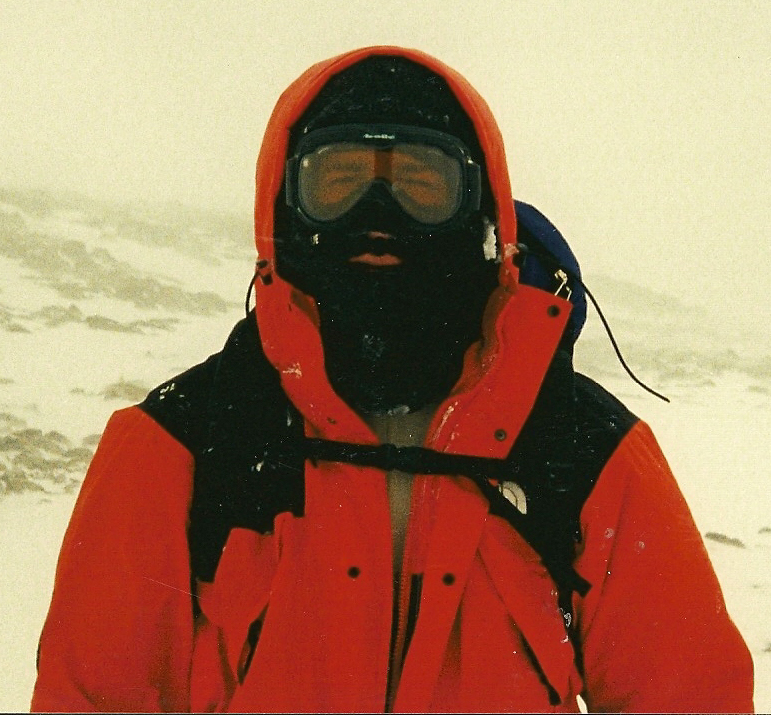
Joe bundled up against the windstorm

Visibility varied between zero and 50 feet, but I knew the way and we made good progress over firm snow. Unfortunately, the higher we got, the stronger the winds got.  The winds would gust up every few minutes and push us to the ground. We made it to the base of Fletcher (13,400′) before we decided to call it off and save our noses.

“The Drift” – May 4, 2002

We came back the following week to settle up with “The Drift”. This time the weather was perfect. The only problem we faced was the many “summits” in the vicinity.  Our approach wandered a bit and took us around to touch the various points that might have been “The Drift”. The descent was worth the trip.  Brian recalls:

We struggled to guess which couloir to take, since all the bumps on the ridge looked the same from below.  There were some places near the top where we were scrambling over nearly dry rock and loose scree
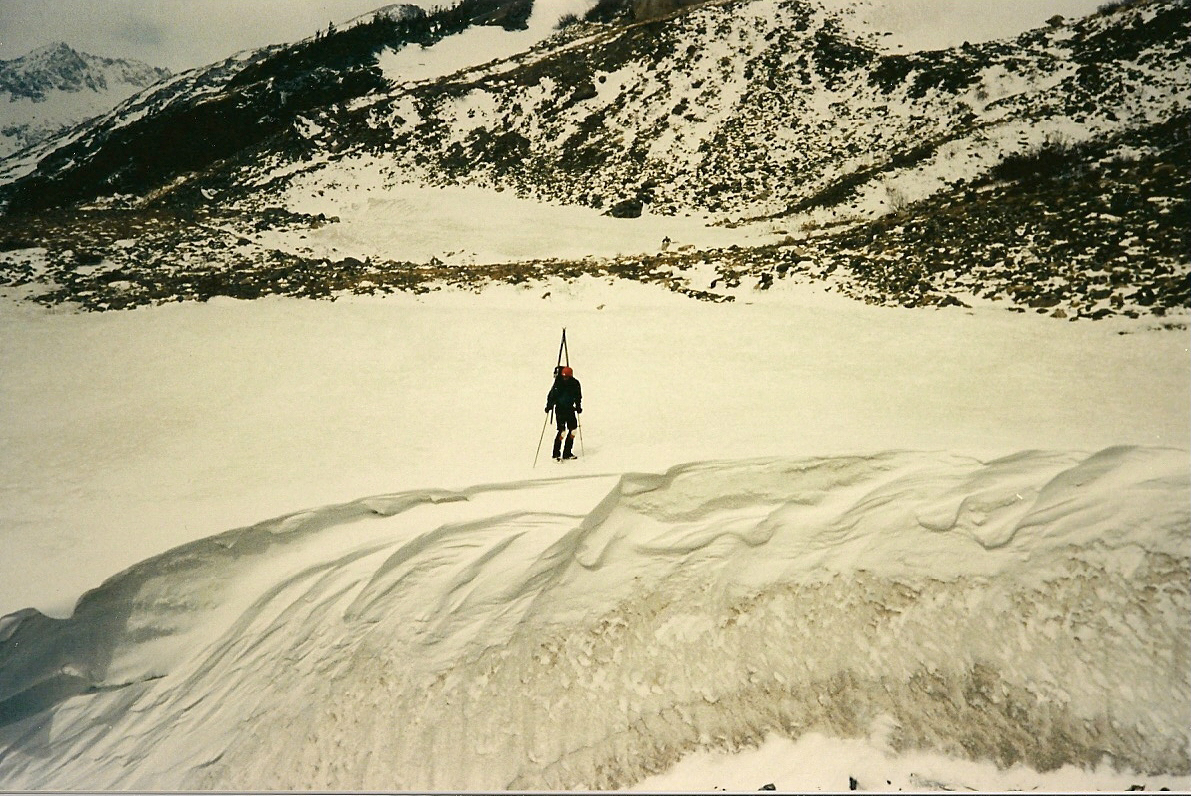
Brian looking for another adventure near the Blue Lakes dam

‘Ol No Name – May 11, 2002

While it wasn’t really on the original list and we were way behind schedule, Brian thought we should the climb the peak we saw just to the south of “The Drift”, in-between Drift and Wheeler. Even though we couldn’t find a name for the thing, it looked higher than Wheeler; I agreed.

On the next trip, this time in May, we took the southern route into the Monte Cristo Creek Basin.  The descent down the dam added an interesting element to the adventure.  Since we approached from the south, we took the southern couloir to the summit to save us from hiking around the east rib.  This led to some interesting scrambling as the snow at the top was soft and melted out in key spots; I had to do some exposed scrambling over loose rocks. Brian recalls:

We hiked up to a minor ridge, then crossed over it into another bowl.  We put on crampons at a point of avalanche debris.  The final part before the summit was extremely steep snow (to me), and I only stayed on it because it was soft enough to punch my arms into it.
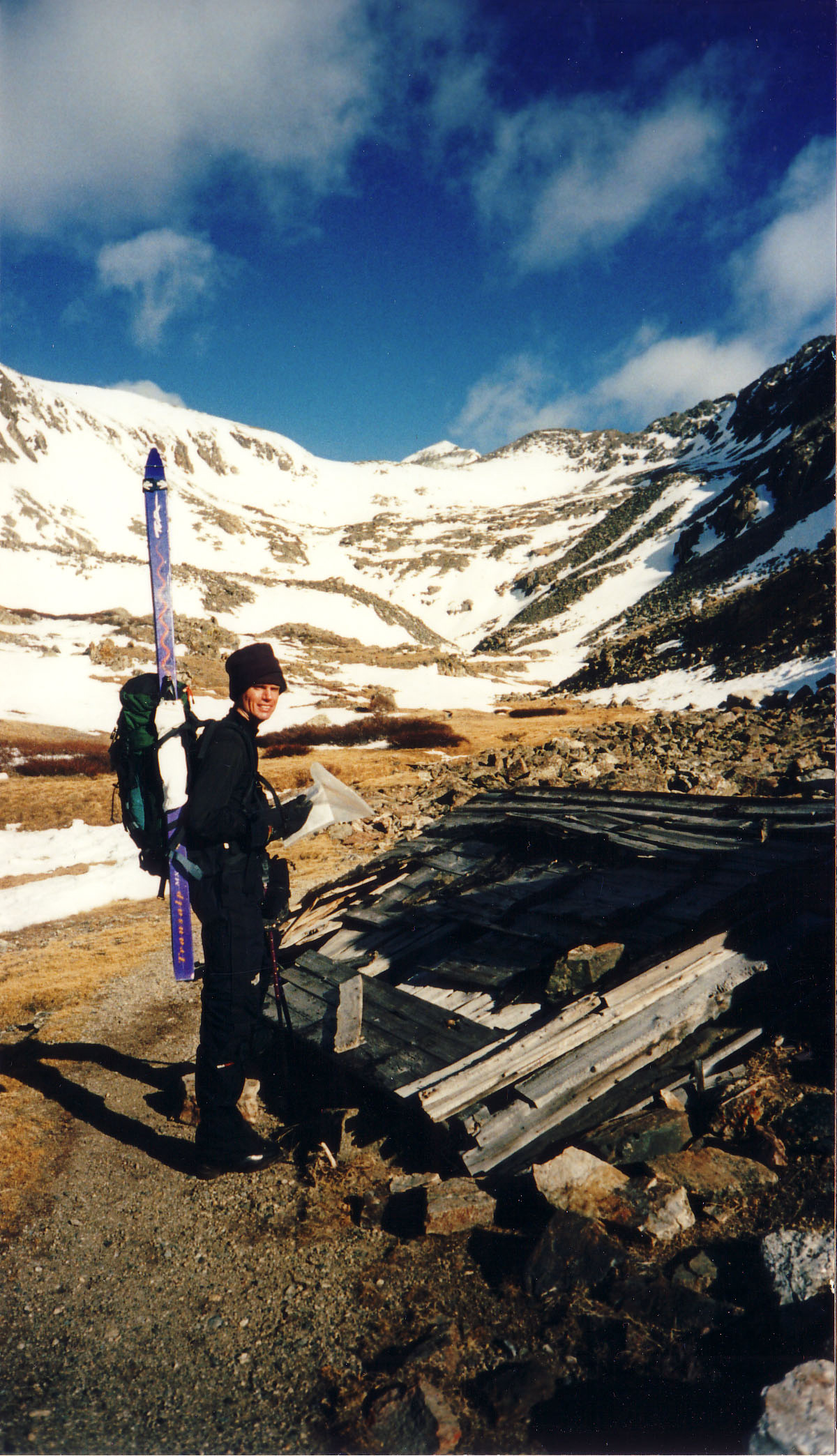
Brian admiring an old mining shack below Quandary

But the descent was magnificently steep!

To avoid the willows along the creek on the warmer hike out, we used the central rocky area to travel as far east as we could before descending to complete the hike out on the snow.  But the willows take their toll.  Just the short distance I had to cross was a nightmarish mind and body breaking exercise.  If there is one thing worse than hiking on soft snow, it is hiking on snow covered willows. My sanity was only retained by thoughts of how great the descent had been from the peak.

Unfortunately, this also signaled the end of the Spring snow climbing season for 2002.  The last chunk of rock (and snow), Wheeler, would have to wait until 2003.

Brian standing on a chunk of cornice that had fallen

Wheeler Mountain – May 17, 2003

A year later we remembered to come back.  We chose the NE Couloir to finish off the last peak in the Monte Cristo area, Wheeler.  Starting again on the snow-blocked Blue Lakes road, we again took the southern route. The willows were buried deep and so the hike in and climb started well but soon degraded into a snow-over-loose-rocks misery and then a scary semi-technical rock climb. Brian recalls:

Wheeler was steeper and drier than the others.  We had worked our way around the back side, and went up a 40-ft low-angle dihedral, stemming ski boots on rock edges, and hooking the self-arrest poles on holds.

The tiny summit and great views tipped the scales back to the good.  The fun, scary descent down the NW couloir solidified the day into a great experience.

And we were done.  We’d climbed all the peaks in the Monte Cristo Creek Cirque. And it only took 2 years.

Overall, bagging the peaks in the Monte Cristo Creek Cirque was an enjoyable experience. The unexpected pleasure was our getting to know the terrain so well that it felt like a backyard: the terrain, trails, and, to a lesser extent, the weather became less wild and even friendly.

It still reminds me of what Edward Whymper said about preferring to climb favorite mountains again and again because they become like old friends. I couldn’t agree more.
See all trip reports

Tying Up Loose Ends

April 23, 2010

It was time.  Finally, it was time that I finished up the list of Colorado 14ers.  I had done all but a few as of three years ago. I didn’t do the last ones in part because they are on the far corner of the state. But the larger part of it was my dying enthusiasm for the list.

My most recent big push was in July/August of 2003; that year I did 14 Fourteeners in July and August. After doing the four in the Sange de Cristo range, I had invited Brian to participate as desired in my plan to finish the 14er list that year:

Brian:

I am looking to finish the 14ers this summer.  My approx. plan for 14ers is follows:

  • Capitol (7/26)
  • Sneffels/San Lois (approx. 7/30-31)
  • Chicago Basin Peaks (during vaca?)
  • Telluride Area Peaks (during vaca?)
  • Pyramid/N.Maroon (?)
Interested in any?
Joe

Brian could only join me on N. Maroon during a N-S-N traverse of the Bells. But, by the end of that August, Brian asked about my 14er “mania” when I indicated I was interested in a non-14er  adventure.  I responded via email with a telling lack of enthusiasm:

Brian:

The mania has dimmed a little:  only 1 trip left and I cannot finish without Culebra (next year at earliest).  I’ll get in the last trip in the next few weeks.

What do you want to do this weekend?

Joe

It didn’t happen.

Three years later, I had worked up another head of steam and was ready to bag Mt Sneffels & San Luis Peak.  The two represented an odd combination of peaks:  one very well regarded among climbers and the other not so much; on average, I hoped it would be a good trip.

I picked August 9-11, 2006 to do it.

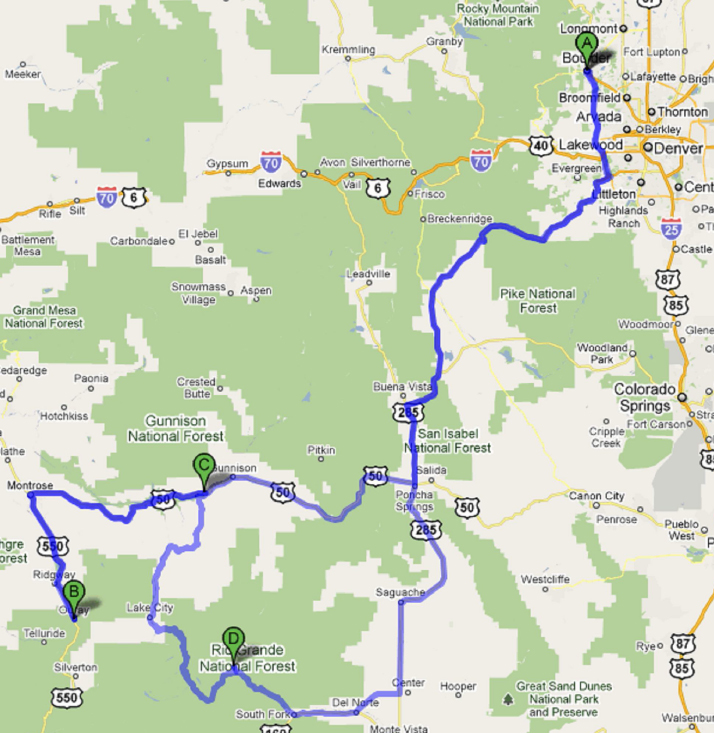
My driving route to collect Sneffels and San Luis covering 770 miles and taking 16.5 hours.

It would be a solo adventure, once again.  It turns out nobody wants to spend 16.5 hours driving 770 miles to climb 2 14ers on the far side of the state, and almost no one will do it.

But that’s okay. While I prefer to climb with friends, I also enjoy the added stress and thrill of climbing alone. I also sleep better.

Day 1 – August 9

As I packed for my trip I realized I couldn’t stand to listen to Paul Simon’s Greatest Hits CD another time.  I decided it was time to pickup a Beatles Greatest Hits, like I had when I was a kid.  I love the Beatles. Heck, I was even looking forward to some free hours to just listen to my old music favorites.

I also threw in a couple of gallons of water, a box of food bars, and a book about Abraham Lincoln. And then I was off.

First on the list was Sneffels. It was the good one, plus I wanted to return home from San Luis via 160 & 285 (a very fast trip home I discovered during a return from Durango).

I left Boulder at midday for South Denver, and then 285 south to 50 heading west toward Montrose.

Climbing two peaks 100 miles apart presents pleasant logistical challenges.  Being sequential, any failure in timing would likely cause the plan to fail.  I had to include sufficient cushions and avoid as many unknowns as possible in my planning to avoid the disaster of going home without both peaks (horrors).  My plan was to plan on the easiest route and then op for more interesting climbing, if any, if my speed and the weather were good.

The two standard options for climbing Mt. Sneffels start from the Yankee Boy basin just outside of Ouray.  There is a class 2+ Lavendar Col scramble and a Class 3 ridge climb.  I decided to aim for Lavender Col but take the ridge, if possible, in order to bag the Tour de Sneffels.

Six hours later, I hated the Beatles.  I couldn’t listen again for over 24 hours.  But I needed to concentrate on my driving anyway once past Montrose.

An overview of the approach to Yankee Boy Basin and climb of Mt Sneffels

The access to Yankee Boy Basin was surprisingly easy.  And the shelf road along the way is definitely something to see. I drove up the County Road 361 until I reached County Road 26 which I took to around 11,200′ to preserve a solid approach effort. I had to hunt a bit for a good place to park & camp.  I couldn’t find anything solid, so I decided to sleep in the back of the truck.

Per my usual method, I wanted to explore the road a bit to be sure I knew where to go when hiking in the dark, but I ran out of daylight. I’d just have to wing it.

Then I went old school.  I ate my luxurious Burger King meal and turned in about 30 minutes after dark.  I don’t think I’ve fallen asleep that early since kindergarten.  But then I woke up at 1am.  I dug out my Abraham Lincoln book and read until 3am when I fell asleep until the alarm went off at 5am.

Day 2 – August 10

So there I was, hiking up County Road 26 in the pitch dark and the only person alive on the planet as far as I could tell.  It added a special thrill to an exciting, stressful situation. I loved it!  It also made me think hard about staying safe (position #1 on map). No one would be looking for my body for several days.

The road led to a big looping trail that I followed to Wrights Lake at 12,200′ (position #2).  The daylight was creeping in and I could see Sneffels and the Blue Lakes Pass. My prep work had indicated that the SW Ridge route was far more interesting than the standard cattle path, so I followed the trail around the lake and aimed myself for the pass.

As I stood atop the pass (position #3), I looked around and saw that I was still all alone. It was an awesome feeling. I looked to the north at the confusing mass of ridges that made up the SW Ridge and thought to myself, ‘this could take some figuring.’  I was right.

I had a copy of Roach’s photo and description, but it didn’t matter.  Neither the photo or description resembled like the mountain I was looking at once I was nose-to-nose with the peak.

I stayed to the left side to avoid some early pinnacles, per the guidebook, and then didn’t know what to do.  I continued to the left of the main features to see if I could see anything useful.  I couldn’t, so I returned and found cairns marking a gully.  I climbed the gully to its dead-end and paused to look around.  I could see back down to where I had hiked earlier, and I could see that I could ascend to the ridge if I had rock gear and a belay.

I decided I’d have to backtrack to the beginning to try another way and started down.  But after a short distance, I found a weakness in the rock that looked promising so I gambled on it.  It led to a notch in the ridge and another gully heading down the other side of the ridge.  I climbed into the new gully and saw that I could scramble up to reach some steep climbing just to the west of the ridge that might lead to the top of the ridge.  I was tempted but was afraid I couldn’t reverse those moves if the path dead ended.  So, instead, I descended the gully to the east to see if I might strike gold.  But no.

Left with only two choices, go all the way back to the bottom or try the hard moves (4th class), I took a chance on the hard moves.  It worked (position #4). The hard climbing lasted only 15 feet and then it was easy scrambling to the top of the ridge.

Once on the ridge, I was able to stay on top the rest of the way to the summit (position #5).  There was some terrific exposure that kept the pressure on even after I was past the route-finding difficulties, but the rock was good enough to be safe.

It was a very good route; one of the best among the 14ers.

The Sneffels summit was a good one.  Clearly it was the tip of a mountain, and the views were awe-inspiring. I sat down for my first break for the day and enjoyed an early lunch and a relaxing few minutes. I figured this was the high point of the trip (literally and figuratively) and should be sure to appreciate it.  I didn’t think San Luis would be so nice.

When I heard voices approaching, I started thinking about my need to get to San Luis before dark. It was time to go.

I scrambled down into the standard route and maneuvered around the snow patches and loose rock to reach the saddle.  I then followed a well beaten cattle trail down under the SW Ridge where I found some Colorado Fourteeners Initiative people working hard on a new trail. I stopped to chat briefly and then continued down to the 4×4 parking lot. I thought I would use the nice lot on any return trips, and then followed the road down to my truck (position #7).

I figured I needed 4 hours to drive back up to Montrose and then over to and down CO-149 to Lake City and then to Creede.  As an alternative, I had a vague notion of the possibility of using back country roads to cut across to Lake City.  I figured it might save several hours; but since I didn’t know the roads and didn’t have any way to figure it out quickly, I decided to simply take the way I knew.  Heck, I was even thinking I might be able to tolerate listening to the Beatles again.

My route up Mt Sneffels

As I drove over to Lake City, I realized that I had not done as much prep work for San Luis since the plan was to do Sneffels first.  The route-finding for the climb was supposed to be easy, but the route-finding on the drive in started to feel confusing as I read and drove.  My drive through Lake City reminded me of an earlier reading-while-driving error (see Flying Blind) and I committed to finding a place in Creede to stop and figure it out.

Yet, I already decided I would use the West Willow Creek trailhead because the drive was shorter and the trailhead was higher and closer to San Luis summit.  Also I decided I would take the longer but more gentle drive offered by Roach.  So I knew to look for 3 dirt roads heading west just south of Creede.  But the directions assumed I was coming from the south (from Creede), while I was coming from the north (from Lake City), so I couldn’t follow the mileage instructions. I hoped it would be obvious.

As I approached Creede, I looked for the three dirt roads on my left.  I could only see 2 dirt roads. Shit.

I continued into town and then back out, staying on CO-149, without learning anything useful.  I turned around and started measuring mileage heading south after crossing the bridge over what I hoped was Willow Creek.  The mileage told me that the turnoff for Bachelor Rd was the right one, assuming that I was measuring from the right bridge.  I thought it was my best bet, so I started up the road to see if the remaining directions would confirm I was on the right road.  The first couple turns did seem to work, even if the road signs were wildly confusing. I continued up the road.

About 1/2 way up the road, I became confident I was in the right place. I eventually found a parking lot near a large mine complex, just like Roach said I would. I parked and started getting ready for the night.

I was worried about how I would hike through the mining area, so I decided to use the 30 minutes before dark to figure it out. I found a passage about the approach that said, “…or continue up a 4×4 road 100 yards before parking lot for 1.6 miles to reach 4×4 parking”.  I looked back down the road I’d driven and saw a dirt road heading up a steep hill.  I thought I should give that a try before dark.

I took off just as another vehicle pulled into the lot.  I made the turn and powered up the steep dirt road.  It was a wandering road through some very isolated terrain and crossing the creek a couple times. I wasn’t certain I was in the right place, so I wanted to hurry to drive the 1.6 miles described by Roach to see it would end in a place that looked promising.

The road abruptly turned up another hill, just as Roach’s book described.  I stopped and walked up the road, and found an old road just as Roach described; I concluded that I had found the 4×4 parking, except that I didn’t see anywhere to park.  I pulled off as well as I could at an old campsite and turned in for the night just as darkness fell upon me.

Below is the sequence I used to find the upper trailhead; numbers noted on map:

  1. Turned west off CO-149 County Rd 505 which becomes Bachelor Rd which becomes County Rd 504
  2. Turned left onto West Willow Creek Road (Google says it is USFS 503) after crossing West Willow Creek and continued end of road (4×2 Parking)
  3. Went 100 yards back up West Willow Creek Road
  4. Turned right (northwest) onto unmarked 4×4 road (Google says it is USFS 503) heading up a steep hill and proceeding north 1.5 miles past Equity Creek Mine and to end of road before it turns uphill again to leave the valley

Day 3 – August 11

I set my alarm for first light.  I needed some daylight to figure out where to go since I wasn’t really sure about where I was.

I started up the old road that led to a ridge and a small bump of a hill.  The road stayed to the right of the hill; once on top I could see a nice trail below me that turned out to be the Colorado Trail. I had found it!

Now it was just a matter of time and weather.

I hurried down to meet the trail and then toward San Luis; I wanted to minimize the chance of getting thwarted by weather after coming so far.  My initial thought was, ‘why is the trail going downhill?’

My campsite was at about 11,500′  Then I hiked to the small bump on the ridge at about 12,500′.  Now I was descending toward the low point in the trail at 11,900′. And that is how the day would go: up and down and up and down, etc. I tried to get my mind right and just hike, but it continued to bother me; somehow knowing that the elevation gain/loss would get me my 3k elevation gain just didn’t help.

The trail also had to contour around two basins to avoid losing even more altitude, so it also gave me a “longer-then-necessary” feeling which added to the boredom. And then the South Ridge route was also boring. I plodded up the ridge to the summit and decided that I would not be back.  San Luis was only worth doing once.

I had thought about bagging Stewart Peak while I was close by, but I did not have the proper attitude.  I knew it meant I would probably not be able to complete the Colorado Highest 100 list, but it just didn’t feel worth it after such a boring day.

I started back toward home. I got back to the truck after hiking 10.5 miles and 3500 feet without a single drop of adrenaline. It might as well have been a Stairmaster Machine.  But at least it was done.  But what an anti-climactic finish!

At least Sneffels was a good one.

Six more hours to get home, and I was done with all the Colorado 14ers I could legally climb. I could almost feel good about it except for the nagging in my mind over Culebra. I had tried the CMC lottery to get a permit, but gave up after not getting selected two years in a row.

Perhaps, someday, I’ll really finish: 57 down and one to go.

See all trip reports

See all 14er trip reports

Last Gasp Mountain

April 19, 2010

The thought of recording the glorious horror of this trip helped to sustain me during the many hours of this largely miserable experience that ended well.

And that is the makings of a great adventure:

Great Adventure (my personal definition)

A dangerous undertaking demanding a higher than expected level of physical, emotional, and intellectual effort that ends well.

A trip like this is an unexpected but secretly hoped for blessing.  In fact, if we dare expect it, then the possibility evaporates.  Such opportunities only come from pushing the envelope of capability by selecting adventures that match our most optimistic opinion of our willingness to suffer. This was such a trip.

It was the first trip of the season; I was not yet in shape, but figured I could pull it off by trying harder.

The trip started bad:  driving in the dark with bad visibility and roads from falling snow, not sure how to find the turnoff to the trailhead in a whiteout, setting up camp in a snow storm.

But we persevered.  And by morning, our day was perfect:  single digit temperature with no wind.

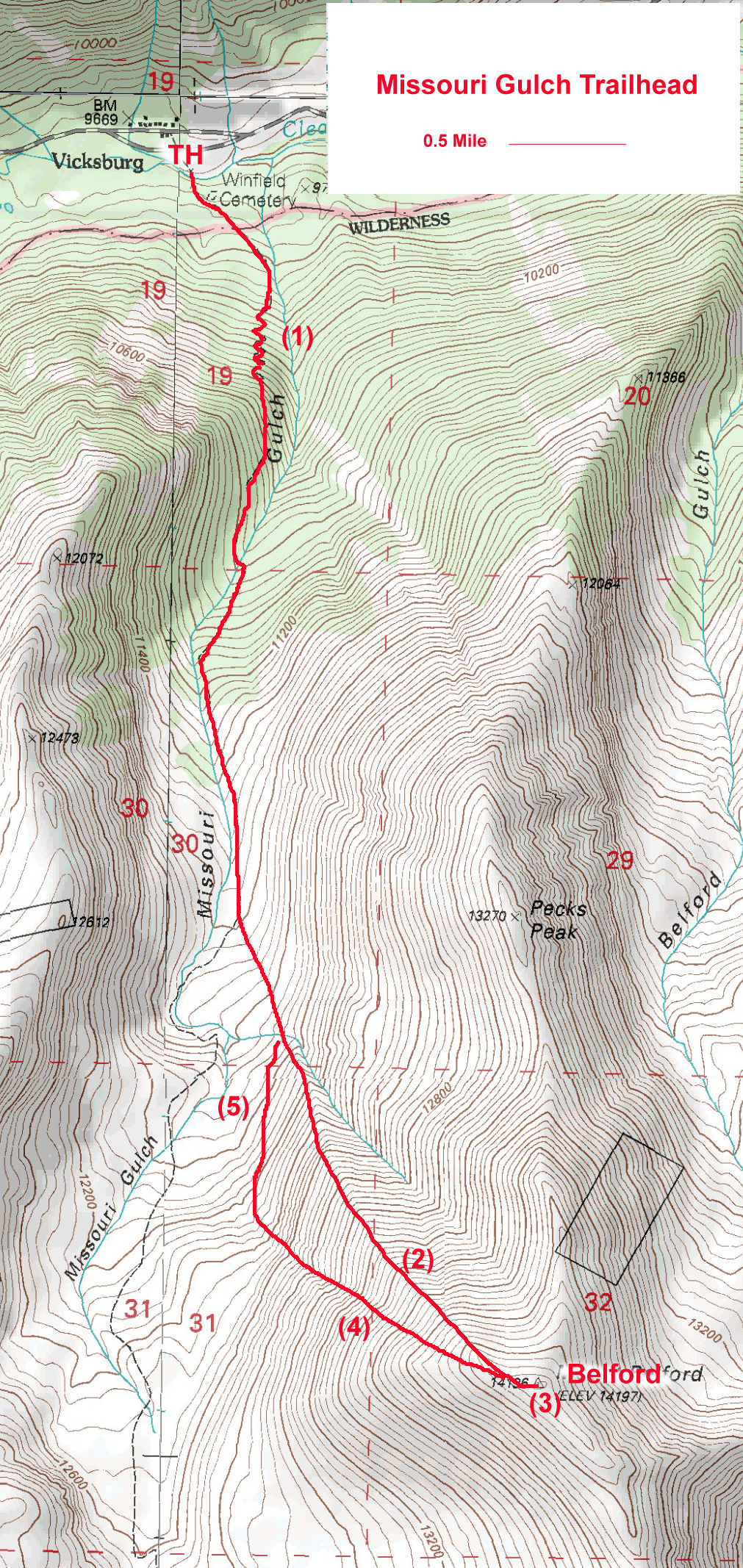
My friend, Joe, had joined us for some prep work for a trip to Bolivia that he and I were taking 30 days hence.  The three of us started off from the Missouri Gulch trailhead at 7am.  We managed a good pace early on — the first 2000′ of elevation fell in 1 hour and 45 minutes. Then our luck turn against us.

The Joes in Missouri Gulch on the way to Mt Missouri

We made a route finding error.  Rather than continue closer to the end of the Gulch, we turned up about 1 mile too soon (position #1 on map) to climb a couloir to reach the ridgeline above us on our right. Dawson’s guidebook said, “crest the ridge at the obvious saddle.”  I guess we should have been more careful than assume anything is obvious once surrounded by peaks on 3 sides. This mistake would cost us by putting us in steeper and looser

Our route up and down Mt Missouri from Missouri Gulch trailhead. The correct route is our descent route.

terrain and force us to traverse a long, rocky ridge instead of a smooth valley floor.  And the snow was loose; it felt like climbing a pile of sugar:  three steps up and two slides back. This more challenging terrain kicked my ass and depleted my main fuel tank; I had not yet gotten into high peak climbing shape since the end of downhill ski season.

About 1/2 way up the to the ridge, Joe yelled up that he was turning back to wait at the truck.  I wasn’t tempted to retreat, but I sure could understand the decision.

I reached the ridge line at 12:20pm. It had taken me nearly 3 hours to climb to the ridge. The spot we reached was a pleasant spot with a wide flat area and a view of the entire Rockies, and we were perfectly happy to enjoy the wonderful views because we didn’t yet know that we had climbed up the wrong place.

It took over an hour of carrying skis while stumbling across thinly snow-covered rocky slopes for over a mile to figure out we had done it wrong; and that conclusion only known for certain after we reached the top of the correct couloir.

We had burned precious time and energy, but now we were close.

From the saddle above the correct couloir (where we left our skis), we climbed up a steep, icy slope. As I struggled up the slope toward the summit gasping for air and resting every 5 steps, I had the dread of a false summit. I willed myself into hoping it was the summit.  I needed it to be the summit.

It wasn’t the summit.  I looked left and three-quarters of a mile down the ridge was a peak apparently 100-200 feet higher.  It was 2pm; Brian said, “let’s hurry, we have a long way to go!”  I was too tired to say what I was thinking.

Cleaned up a bit, my thoughts went along the lines of:  “Hurry?  I don’t know if I can keep going!”

I put one foot in front of the other and slowly made progress.  Time was ticking away, but I could do little more than shorten the length of my frequent rests.

About 300 feet from the summit, a steep cornice blocked the ridge. To continue, we had to descend a short distance and make a technical traverse above a steep slope on Missouri’s SW corner; I made it across by kicking steps and desperately using the self arrest handle on my ski poles to find some purchase on the loose snow.  As I stepped out of danger, I immediately dreaded the return trip.

We reached the summit @ 3pm; it took 8 hours to reach the summit. After taking a few minutes to collect my breath, I remarked to Brian that this was such a terrible climb that it will be remembered fondly. He agreed; always, the glory is in the struggle.

I ate and drank the rest of my supplies and hoped for a second wind; I couldn’t afford to save anything for the trip back.  I had to hope a ski descent would be fast enough to get me back to civilization before running completely out of fuel.

With 4 hours of light left, we started back across the summit ridge, hoping for good luck.

The traverse back to the descent saddle was legal murder, so no one filed a police report.  And then it was time for another change in luck.

Once the skis went on the feet, the trip took on a flavor of wonder which only comes of the best possible backcountry skiing conditions.

The snow was perfect.  We skied down the couloir and on down to within 100 yards of the truck.  It was miraculous: pure joy.  We got back to the car at 6pm.

When asked, Joe said he turned around because he couldn’t stand the slow pace of the climb to the ridge: it was too boring. I said it was true that I suffered for much of the day, but that having reached the summit and returned safely, the day felt like a great day.

Misery Axiom: never turn back because of mental misery.

More mental suffering (e.g., boredom, frustration, irritation) leads to more personal rewards, which can only be harvested through perseverance (corollary to Reward Rule).

Fourteener #20 in the bag.

See all trip reports

See all 14er trip reports

How I Spent $150 Well

April 18, 2010

Culebra means snake in Spanish, at least according to an old boss of mine who grew up in Mexico.  I couldn’t help but make a connection to the name and the behavior of the owners to restrict access.

But I had reached the summit of 57 Colorado 14ers and every time I tried to tell someone that I had climbed the 14ers, I’d have to explain my rationale for NOT climbing Culebra. After a while, it sounded like whining.  When I learned that I could climb it by merely paying a $100 fee, I signed up and put the 14er list behind me forever.

I registered for Culebra & Red (for an extra $50) and made plans to drive down to the Cielo Vista Ranch the morning of August 18, 2007.  It was a 5.5 hour drive and I had to be at the gate at or before 6am; if I was late, I would miss the gate opening for the morning.  I decided to leave Boulder at midnight to give myself a 30 minute margin for error.  It was a long way to drive by myself, but somehow it felt appropriate that I completed the list alone.

Culebra would be my 22nd solo summit of the 23 14ers completed over the past 5 years.  While I don’t prefer to climb alone, I find that doing these adventures alone adds a thrill that cannot be duplicated when climbing with partners.  Going solo doesn’t make the trip more fun, but does make the adventure more adventurous.

The Long Drive

Oh my God, it was a long drive.  All alone and in the dark.  It felt surreal while I was driving south on I-25.  The highway was so empty, all I had to do was not fall asleep behind the wheel. I couldn’t even call anyone to talk on the phone…everyone was asleep!  I had the strange sense of being alone in space with the capsule window pointed in the wrong direction:  exciting because I was doing something big, but also terribly boring as I was trapped in my seat with nothing to do for a long time before I could do more exciting bits.

Then it got stressful in a hurry.

After not making more than one turn per hour, once I reached an area that looked absolutely 3rd world I had to make a series of intricate maneuvers to find the ranch gate.  And this in the dark; I couldn’t find the road signs keeping a focus on staying on the road. If I made a wrong turn without realizing the error quickly, I would lose the entire effort. But I made it with only one wrong turn quickly corrected.  I arrived to find a few cars already waiting, and I had about 30 minutes to kill while we waited for the ranch staff to arrive.

I used the time to refill my water bottles and get my pack ready to go.  And still I waited.  It was another unreal experience to let the precious morning minutes tick away unused; I sure hoped the weather would let me bag both Culebra & Red.

Just to be clear:  I was not coming back.

The ranch guys showed up and led us up to the Ranch house where we lined to pay and sign our liability waivers in the slowest process invented by Mankind.  I’m not sure they really wanted our money.  It was one more injustice: please take my money and let me go!

Finally I was allowed to hand over my $150 in cash.  I quickly hustled to the truck to drive up to the high parking area so I could finally get started.  However, with people milling about like they had nothing to do that day, I had to carefully maneuver out of the parking lot. Once I was really free, I hauled ass up a very nice dirt road.  I will give them credit for a fine dirt road.

I reached the place that looked like the upper parking lot.  I couldn’t be sure since there weren’t any signs. And then I took off for the ridge line using the “Talus Route”.

The standard Culebra map; I paid $150 for a copy. DO NOT LOOK AT IT UNLESS YOU HAVE BEEN AUTHORIZED BY CIELO VISTA RANCH

The Hike

I hiked east up a trail on the left (north) side of the drainage.  My pace was good while I worked my way around various obstacles and reached the ridge at approx. 13,400′. The long ridge curved east (like a snake?) toward the summit. I hurried south along the ridge crest and past the biggest cairn I ever saw in my life.

Everything was going well except my boots. I had brought some lightweight Timberland boots that turned out to have the slickest tread I have ever had on my feet. They were comfortable, but they were trying to kill me anytime I stepped on lichen. Running shoes would have been better.

I reached Culebra’s summit (14,047’) rather quickly for a 14er; it felt much like Quandary.  On the summit, I stopped for a drink of water and a look around.  It was a beautiful place.

I started down the ridge toward Red.  The terrain was more broken but still easy.  I reached the summit of Red and stopped to watch the people on the summit of Culebra.  I wondered if anyone would make the trek to my position, but none did.  I figured I should head back over to Culebra to say hello.  Besides, I was ready to go home.

When I reached the Culebra summit, everyone was gone.  All that was left was some prayer flags and other miscellaneous trash left behind.  So, I continued toward the trailhead, thinking about the long, long drive home.  I decided to use the “Roach Route” on the way down, just to see if it was any better.  It was.

After working my way back to the dirt road on the far side of the creek, I walked back up to the parking lot where a group of people were chatting.  They asked me what I had climbed, since they hadn’t seen me on Culebra.  I’m not sure they believed me when I told them I did Culebra and then Red before returning to Culebra after everyone had left.  Still, it was as nice a bunch of people as I’ve ever met on a 14er.

Then it was time to go home.  But first I needed to get myself ready for the launch.  I stopped at the Phillips 66 and stocked up on gasoline and caffeinated beverages and used the bathroom with great relish.  Then it was time for blast-off.

And six hours later it was over.  I had finished the Colorado 14ers. It was $150 well spent. Still, it was a muted celebration; it felt bittersweet, like saying good-bye to a good friend who was moving away for a great job.  Good bye, Colorado 14ers list.

So, now what?

See 14er Project analysis

See all trip reports

See all 14er trip reports

Oxford Windstorm

April 17, 2010

I was trying to make some progress on my 14er list, and my wife, Susan, wanted to do 14ers as well. Earlier in the summer of 2000, we had collected two of the three that had gotten away from me during the big push made in the last few years:

  • July 1 – Massive (somehow went untried)
  • July 8 – Yale (Brian and I failed to summit in a Spring whiteout)

The only one left was Oxford, which had gotten away when I was too slow on trip to collect Belford and Oxford with Brian.  When Susan and I had a free weekend in early September, project Oxford was a go.

Rather than repeat the camping exercise, we just got up super early and left Boulder @ 2:45pm to drive back to the Missouri Gulch trailhead outside of Vicksburg (the non-existent town up county road 390).

Our route from Missouri Gulch trailhead to Belford and Oxford

Everything started well.  We got started at 6am and made a steady but moderate pace up the treed switch-backs.  When we stepped out of the trees around 11,500′, a powerful wind turned the experience into a cold Spring climb.  And we were wearing Summer clothes (position #1 on map).

The trail had been worked on since my last visit; it was a great trail.  But since it was covered with snow and ice, it made for adventurous hiking:  slipping and sliding everywhere.  We persevered to reach the start of the NW corner of Mt Belford (position #2), and then we started up.

We were freezing, but could continue as long as we kept burning calories.  The wind was brutally cold and strong enough to push us around.  Susan was worried about the possibility of being blown off the mountain.  I was able to demonstrate that was not possible by jumping into the air during a strong gust; it could only move me a few inches.  Still, we had to stay low and balanced to avoid being blown down (position #3).

We hit the summit at 9am (position #4) and were met by the strongest winds so far (I estimated it was up to 60 mph). We sought some shelter on the backside of the summit where we found a couple fellows planning to head back down to Missouri Gulch trailhead.

Susan said she needed to get out of the wind and would descend with our new friends.  We said our farewells and I headed SE from Belford.

As I looked down the ridge at the peak a few miles distant, I suddenly regretted not bringing a map.  I thought Oxford was so close as to be obvious, but I could only see a peak that looked several miles away. Resigned to a long trek, I started toward the peak (it was Harvard).

After a short distance (position #5), I decided that something was wrong.  I could see that I would have to descend too far to reach the peak I was aimed at.  I stopped to look around and found a big peak behind my left shoulder.  It didn’t look high enough to be a 14er, but it was the only thing that made sense.  I did a u-turn and worked across the saddle to the bland looking peak that I hoped was Oxford.

I stayed on the Oxford summit (position #6) for a minute to snap a photo and then headed back to Belford, where I arrived at 12:20pm.

Looking back toward Belford from the summit of Oxford

The trek back from Belford was made very easy by the brand new trail; I tried to go fast to catch up to Susan.  But, they were already at the trailhead when I left Belford’s summit; they had not lingered in the wind. I found Susan waiting at the truck when I arrived at 2:20pm.

It was a good day; my effort included 5800′ of elevation in 11 miles of hiking over 8.5 hours to bag my 28th 14er.  Susan’s day was a bit shorter, but she’s a beginner who hung when cold and afraid of the conditions; she’s a trooper with six 14ers to her credit.

See all trip reports

See all 14er trip reports

Sometimes two is one too many

April 17, 2010

With only 13 of 58 fourteeners done, I cherished any opportunity to bag more than one in a trip.  We were going to do a snow climb on Belford and then traverse over to Oxford.  I loved the plan; but, sometimes, two is one too many.

For these intermediate distant peaks, we generally prefer to camp at the trail head the night before to avoid having to get up at 1am.  But my travel plans ruined it.  I didn’t get home from a week in Detroit until 10pm on April 24, 1998; so, we couldn’t get to the Missouri Gulch until 3am.  With a wake up call coming at 5am, I wouldn’t get much sleep or acclimatization for my first 14er of 1998.

And then it snowed hard all night.  We awoke to a fluffy start, and a quick elevation gain.  The trail gets steep immediately as it switch-backs up through the trees (position #1 on map).

The mountain was ours.  No sign of humanity as far as the eye could see.  It was a spectacular setting; almost enough to make me forget how tired I was.  Almost.

Our route up from Missouri Gulch trailhead to Mt Belford

We took the northwest ridge route:  2000 feet straight up.  It was sort of boring, really.  And that was the last thing my sleep deprived mind could tolerate.  I felt terrible (position #2).

I was tired and dizzy, and the higher I climbed, the worse it got.  Brian moved ahead while I struggled up the slope.  Twice I nearly fell over backward and one time I fell asleep while taking a break.  It was my worst performance ever (I mean ‘ever’ as in before or since).

Since Brian wasn’t around, I couldn’t stop without telling him. So I kept plugging along, a few inches at a time.  By the time I reached the summit, Brian had been sleeping on the large boulder for an hour.

I felt badly about being so slow, but Brian’s first comment was “never give up, huh?”.  It was too late to push onto Oxford; hell, I was lucky to get Belford (position #3).

We started down, and I felt better immediately.  With all the snow, I was glissading down the entire mountain.  The first glissade was a real howler….snow flying up all around me as I flew down the slope.  I came to a stop just before a steep couloir (position #4).

Brian caught up to me and said he didn’t like the look of the snow.  I said, “let’s find out”, and push myself down the chute.  About 15 seconds in, the snow in the chute let go.

But rather than throw my stupid bones down the mountain, the snow just ran out from under me and dumped me on the crusty snow layer underneath. It was a strange feeling watching the snow crash down the mountain; it could have been me with it.  And with the good snow gone, the good glissades were over.

Three hours of postholing (position #5) got me to the trees, and a short time later we reached the truck.

We had taken 10 hours to climb 4,500′ of elevation in only 4 miles one-way (8 miles round trip).  My feet of elevation per hour of sleep was at the high end of the human potential scale, in my opinion.

Thank God that Brian drove.  I couldn’t stay awake to save my life.  We packed up our camp and piled into the truck.  I fell asleep immediately, and slept for 2 hours while Brian drove.

He woke me around Eisenhower Tunnel to help him navigate the whiteout he was driving in down I-70. The snow was falling so hard that we couldn’t see more than 10 feet, which is bad when driving at 30 miles per hour.  My job was to watch the guard rail to warn Brian when he was drifting too far to the side of the road; he couldn’t afford to take his attention from the faint lights in front of him. Every 15 minutes or so, he’d pull off the road so I could run out and wipe the snow off the headlights.  I don’t know how we avoided getting crushed by a blinded truck driver.

It was completely insane, but at least I had a nap before hand.  And with the success of this trip, Brian and I would go on a tear, bagging 5 14ers during the Spring of 1998.

Unfortunately, Oxford wouldn’t fall until September 2000 on a trip with my wife.  We didn’t have snow problems, but the wind was historic.

See all trip reports

See all 14er trip reports

Long’s Southwest Ridge

April 15, 2010

For my 9th summit of Longs Peak, I wanted to do something new.  I had already done an iced-over Keyhole (late fall), a winter Cable Route, a spring Notch and Kieners, a summer Stettners and Diamond, and had even done a Keyhole Ridge and a traverse from Meeker via Gorrells and a climb out of the Notch to the Longs summit ridge.  This time we’d do the Southwest Ridge route pioneered by J. Alexander in 1924.

We got an early start (4:30am) but still had to park 1/2 mile down the road due to a full parking lot.  I have never been able to get right with the notion that the safest way to climb Longs Peak is to do it in the dark to avoid the lightning.  Shit; I like to see what I’m doing.  And I’ve not been chased off Longs by lightning yet.

We passed a hundred people on the way to the Boulderfield which we reached at 7am.  We needed to let the rock warm up a bit, so we lounged in the Boulderfield for a while and speculated on new routes we could put up.  Big talkers.

Longs Peak from Taylor with our route marked in red

Position #1

Then we continued along the Keyhole route until we reached the top of the Tough, from which we scrambled up 40 feet to reach the start of the Southwest Ridge Route climb.  We started the rock climb at 9am.

The rock was freezing.  I was freezing.  The rock was covered in lichen.  It must not get much traffic.

Brian took the first pitch.  The guide book says traverse left and up ledges until a steep gully leads back to a belay on the ridge, but I don’t remember what Brian did.

For the second pitch, the guide book says to pass an overhang, then work up to an exposed belay.  All I can remember is crawling up licheny, cold rock with numb toes and frozen fingers, and then not being able to find a belay spot until I ran out of rope.  Calling down 175′ in high altitude winds is impossible, so I put in the best belay I could.  You should imagine a very terrible belay.

Brian finished up by climbing over some ledges and moving somewhat right.

Position #2

At noon, as we sat on the summit block just above the Southwest Ridge, we both suffered a bit from the altitude and were really huffing and puffing. Brian dared me to hold my breath for a minute, but I feared at least a stroke and at most my head exploding, so I declined.

Position #3

We then wandered over to the summit proper to enjoy the views and receive our honors.

After a short disappointing wait, we descended via the Cable Route.

Position #4

We descended past Chasm View and into the Boulderfield to get more water and then becgan the long march home.

That last 1/2 mile down the road always feels like a bit of insult on top of injury from a day of pounding. At the end, we’d used 10.5 hours and hiked 15 miles to get 3 pitches of 5.4 climbing.  We must love Longs Peak, eh?

Once back at the truck, all that was left was to imagine a new way to reach the Longs Peak summit.

See all trip reports

See all Longs Peak Massif trip reports

Flatiron Blizzard

April 15, 2010

It was April 16, 2000, and the ski season at Vail was over.  Due to an injury, I wasn’t ready for any big snow climbs; I asked Brian if he would accept a chilly 1st flatiron climb as a minor adventure just this one time.  He agreed.

We met at Chautauqua Park at 7am and made the short hike to the 1st Flatiron together.  The weather was cold and overcast, but we didn’t even discuss a change in plans.  We’ve gone up the 1st Flatiron in every kind of condition, including heavy snow, ice, and rain.  Heck, I didn’t even bring water proof pants or gloves.

When we got to the rock, we were surprised to see rivers of water running down the rock.  Apparently, there were enough patches of hidden snow up high melting to create the water of a rain shower.

We started up anyway.  The first couple pitches are short on protection, so we took our time and made our way up carefully.  Still, it was rather nerve-racking.  As we progressed higher and higher, the weather started to show it true nature.  It started snowing.

Our route up the 1st Flatiron during the Blizzard of 2000

Position #1

By the time we reached the big platform one pitch below the ridge, the snow was coming down so heavy we knew we had to bail.  And that was saying something; we had never bailed on a Flatiron before.

It was my lead and I decided to take the easiest possible way to the ridge.  I believed that there was a bail spot and had a vague memory of an anchor on the ridge up and right of our position.  I started up and found the snow was accumulating fast, even as it was melting.  Everything was wet and slick as snot.

Position #2

When I arrived at the ridge, I could see no way to set an anchor without leaving behind some iron.  I decided to head up to the normal belay spot we use after initially reaching the ridge line.  I knew we could set a safe anchor there using just cord.  Unfortunately, I also knew I couldn’t reach it before running out of rope.  I would go as far as I could and then bring Brian up to finish.

Position #3

I found a good belay about 20 feet below the ridge and set it up.  It was a relief to be anchored into the rock, but I was getting cold fast.

I put on my gloves, but they weren’t waterproof and so were soon soaking wet.  My rock climbing shoes were soaked, and my pants were soaked as well.  Thank God I had a waterproof jacket with a hood.  But it wasn’t enough.

Of course Brian climbed very slowly in such conditions.  I was shivering violently by the time he arrived; he had managed to bring waterproof jacket and pants plus had wisely changed into his hiking boots to give him some traction on the slick, wet snow.   Brian offered to let me go ahead so I could warm up, but my hands were bad and my feet were numb below the ankles so I didn’t think I could climb safely.

He hurried as well as he could and shortly pulled up the rope.  I had trouble standing up at first, but slowly was able to get ready to climb. I got my hands warm enough to hold on to big holds, which allowed me to crawl up the rock despite feet slipping off of everything.  I arrived at the anchor and waited for Brian to setup the rappel.  Then I clipped in and started to slide off the edge into space.

Position #4

In a panic, I realized I wouldn’t be able to hang onto the frozen rope with wet-gloved, frozen hands.  I desperately pulled off one glove with my teeth and managed to hold on as I swung out into space.  I was then able to descend to the ground.

While Brian came down, I changed into my hiking boots.  But I could barely walk since my legs were now numb below the knees. Fortunately, the activity warmed me up enough to thaw my legs down to the ankles.  I was able to walk out.

My feet stayed numb for 24 hours while my big toes were numb for 2 weeks.

It turns out that even a Flatiron climb demands and should be given respect by us puny humans.

Pretty stupid, huh?

See all trip reports

See all Boulder Flatirons List

5 14ers in 4 Hours

April 12, 2010

Okay, the title is not quite right, as you’ll see.  But this was the name of the trip report I came up with when I had only climbed 8 14ers, so think of it as an early step along my path in learning about the Colorado High Peaks.

Day One

I couldn’t find anyone to do anything for the weekend of July 20-21, 1997.  I decided I would use the time to bag the 4 of the 14ers in the Mosquito Range after flying back into town friday night.

Unfortunately, flying in from Chicago during the summer months can be tricky business.  An hour of local thunderstorms threw O’Hare airport into such disarray that my 5:45pm flight didn’t leave until 11:30pm.  As I sat in the terminal stewing, I worried that the lack of acclimatization might kill my plans for a fast-paced 4-banger.  The loss of sleep was something I was used to.

The flight arrived at DIA at 1:30am.  Desperate to get home quickly, I powered to my car, loaded my bags into the trunk, buckled my seatbelt, and turned the ignition key to no effect.  Nothing; the batter was dead.  I sat for a moment and did some clever late night thinking. Not wanting to deal with a bad battery while off in the wilderness, I decided I’d leave my car at the airport to deal with later.  I grabbed all my bags and hauled over to the rental counter to pick up a rental car for the weekend.  With the walking and shuttle busing and the driving, I got home and in bed by 2:45am.

Determined to proceed with my plans, I set two alarms for 4am.  How’s that for some unrealistic determination?

I woke with a start at 7am.  I bolted for my gear closet to find that my rain gear was in my car at the airport. I threw a sweater in the day pack with a liter of water and ran for the car.  Then I drove like a bat out of hell to reach Kite Lake at 9:30am.

After figuring out the unclear parking regulations, I grabbed my small pack and took off running.  The skies looked okay, but it wasn’t going to be one of those clear sky days.  I figured it’d just go as fast as I could and see what I could get done.

Mt Democrat fell quickly, but the weather was starting to look bad.  Two hours in the lightning started blasting around my ears and forced me to seek shelter under some rocks along the ridge connecting Democrat and Cameron.  I put on my fleece sweater  and waited for 20 minutes before I got too cold to stay put.  I waited for a lightning blast and then ran for the car.

When I reached the car, I stood in the rain while I hunted through my pack and pockets for my car keys but couldn’t find them.  No!  My mind raced to see where they fell out of my pack or my pocket, with the faint hope that I might retrace my steps to find them.  But then I knew.  I checked everything again before looking where I knew they were.  The driver door was locked, of course, so I had to lean over the hood to look down at the dashboard to confirm that the keys were still in the ignition.  And no other cars around. I’m scrrrrrrrreeeeeewwwwwweeeed!

With water running down my face and once again shivering with the cold water penetrating my fleece sweater, I dreaded the ordeal that lay ahead of me.  I was going to have to walk 6 miles in a thunderstorm and talk someone in Alma into letting me use their phone (no cell phone) to call a tow-truck, who I would have to convince that I really had money locked in my car 6 miles up a dirt road.  Oh, what a terrible, terrible mistake.

My mind replayed the events that led to such an error…I had re-parked the car to get into a legal parking spot after I had already gotten out to re-filled my water bottle.  Somehow, the confusion of re-parking the car had let me make a mistake I had consciously avoided since 1976. I had managed to leave the keys in the ignition after re-parking the car.  Then it occurred to me; if I forgot to get the keys, perhaps I forgot to lock the back seat door that I used to get my pack after the re-park.  I tried the door, AND IT OPENED!

It was a blessing from above.  I drove home at legal speeds to show my respect for my good fortune.

But I was determined to bag those peaks.  On the way home I resolved to return the next day to finish the other peaks if not do all 4. It was still a misery to drive  100 miles each way only to have to return the following day to finish what I was too stupid to complete the first time.

I was not going to fail again!

Day Two

On July 21, I left my house at 4:30am to redrive back to Alma and climb Mt Democrat, Mt Lincoln, Mt Bross, and Mt Cameron.

I was an expert in Kite Lake parking and wasted no time in finding a legal spot and carefully locking the doors using the car keys I held carefully in my hand.  Then I took off for Mt Cameron and the rest.  My plan was to do the other peaks first, and then, if the weather held, reclimb Mt Democrat so I could say I did them all in a day.

And, I was new to the 14er game and didn’t understand why Cameron wasn’t really a 14er when it was clearly higher than 14k feet. So, I decided, to hell with the establishment that can rule a 14er is not a 14er.  I would hit it twice before the day was done, and I would count it both times.  And, henceforth, I would measure my progress using the 58 14er list which included 4 peaks over 14k that do not measure up to the standards set by the 14er accountants.

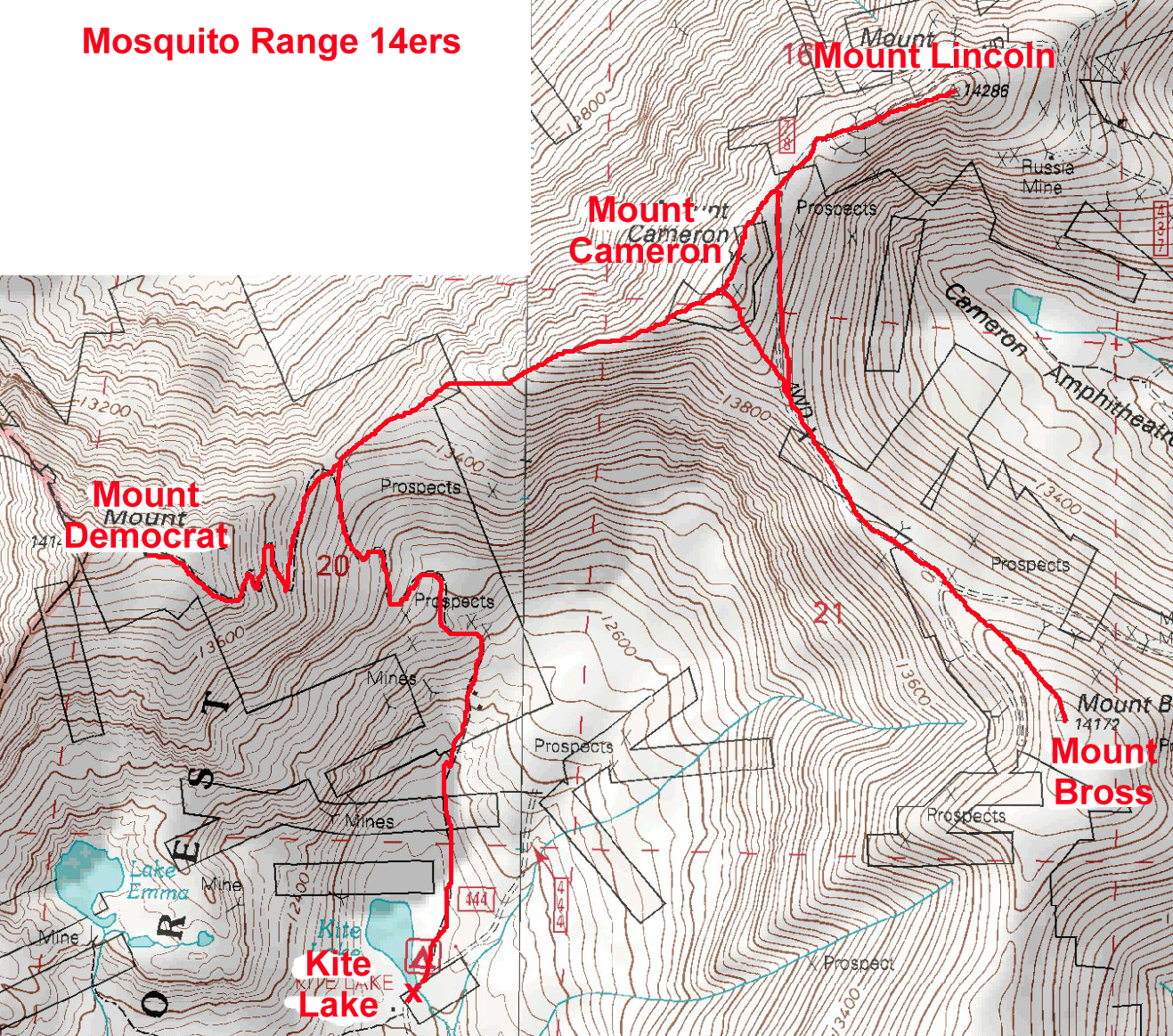
Mosquito Range 14ers route map from Kite Lake

1) Mt. Cameron:

From the parking area, I followed the road past the lake and began the boring hike up the pile of rubble to the Democrat/Cameron saddle. From the saddle, I hiked northeast along the right side of Mt. Cameron’s west ridge. Near 13,500, I regained the ridge and continued until reaching the flat summit area.  A short hike took me to the Cameron summit (#1).

2) Mt. Lincoln:

Without stopping, I left Cameron and descend northeast toward Lincoln; the path was easy to see. The last little bit was rougher but still easy, and then I was standing on the Lincoln summit (#2).  There was another fellow there who left shortly after my arrival.  I took my time to enjoy the good views I had from Lincoln, but then I remembered how quickly the weather can change.  I took off after my new acquaintance, since he seemed to be heading toward Bross, about 1.5 miles away.

3) Mt. Bross:

I hiked southwest back to the Cameron-Lincoln saddle, and then turned south and followed a nice trail towards Mt. Bross. My pace was good and I was steadily gaining ground on my “rabbit.”  I reached the Cameron-Bross saddle (~13,800)’ and headed southeast heading straight for the summit.  I caught up with my “rabbit” just before the summit of Bross (#3).  We chatted and laughed a bit about our “race” before I said my farewells and got up to leave.  I still wanted to do Democrat before the weather hit.

4) Mt. Cameron:

From the Bross summit, I tried to contour around Cameron to reach the Cameron/Democrat saddle, but the terrain was too loose and too steep, so I went only a little out of the way to pass over the Cameron summit once again (#4) on my way to Democrat.

5) Mt. Democrat:

From the saddle I continued west up the ridge. After climbing about 200’ along the ridge, the trail turned left and traversed southwest across the slope. I followed a few small switchbacks that lead to the top of the slope. I was starting to feel tired at this point, and apparently looked tired too.  Some hikers descending from Democrat consoled me with the news that the summit was near.

I couldn’t think of what to say so I just said “thanks” and continued to the Democrat summit where I had been the day before (#5).  I stood on the summit for only a minute because I wanted to do the circuit in under 4 hours.

A fast run/walk down the talus and dirt got me past the friendly hikers and back to my car at 11:15.  It took me exactly 4 hours and 15 minutes to hike 7.5 miles and ascend 3,700 feet.  And it even sounded like a magnificent accomplishment until I did some real climbs in the years hence.  But even today, I feel like it was a good effort, especially the part where I drove to Alma from Boulder twice in the same weekend.

To this day, my only mountaineering paranoia is the fear of losing my car keys.

See all trip reports

See all 14er trip reports

Crucified on Mount of the Holy Cross

April 11, 2010

What a way to end the snow climbing season!  It was so hard that I was at once beaming with pride over the accomplishment and too exhausted to think I could do another 14er any time soon.  What a peak!

Brian and I decided the conditions were ideal for Mount of the Holy Cross.  In the evening of June 5, 1998, we drove up I-70, past Vail, and past the White River National Forest Ranger Station in Minturn to reach the Tigiwon (dirt) Road (Forest Service Road 707), which was supposed to take us to the Halfmoon trailhead 8+ miles up the road.  But 2.5 miles before the trailhead (at approx. 9,500′), the road was blocked by a snow drift at a creek crossing.

We tried to power over it, but only succeeded in getting stuck.  We spent the next 30 minutes digging out so we could at least go home after the climb.  Defeated by a snow drift, we decided we’d just add the 5 miles to the hiking round trip, and turned in for a night on the side of the road.

It was a cold night, and then we overslept.  Brian’s alarm was muffled by his sleeping bag and we didn’t hear the tiny beep, beep, beep offered by his watch as an alarm.  At 5:30am I heard Brian say “shit!”, and we were up.  We hit the road at 5:50am and followed it up and down and around the knoll ending at the trailhead at 10,300′ about 50 minutes later.

We logged in and continued up the trail, which was soft and muddy, reflecting the recent rain & snow but not the very cold temperatures of the night a few hours prior.

Our route up Mount of the Holy Cross

I could feel a growing nausea in my body; I pushed on hoping it would grow bored and leave me alone.

We crossed the Halfmoon pass (11,640′) and then started to traverse the side slope of Point 12,743.  The trail was cut into this slope and thus had an angle perpendicular to its direction.  Since it was also partially covered with alternating patches of soft and hard snow, anytime I managed to avoid post-holing, I was tearing my groin muscles as I did the splits whiles slipping and sliding off the side of the trail.

Once past the SW ridge of Point 12,743 Brian, I, and my remaining intact muscles could see the poor condition of the Cross Couloir before we descended to East Cross Creek at 10,670.  After hiking a short distance past the creek, we turned south to skirt around the peak to reach the SE corner; but not before stashing our snow flotation gear which was useless in the patchy snow.

Three hours in and we had only gained a net 900′. And that last 1000′ descent we’d have to reclimb on the way out.  I knew this was going to be a hard day.

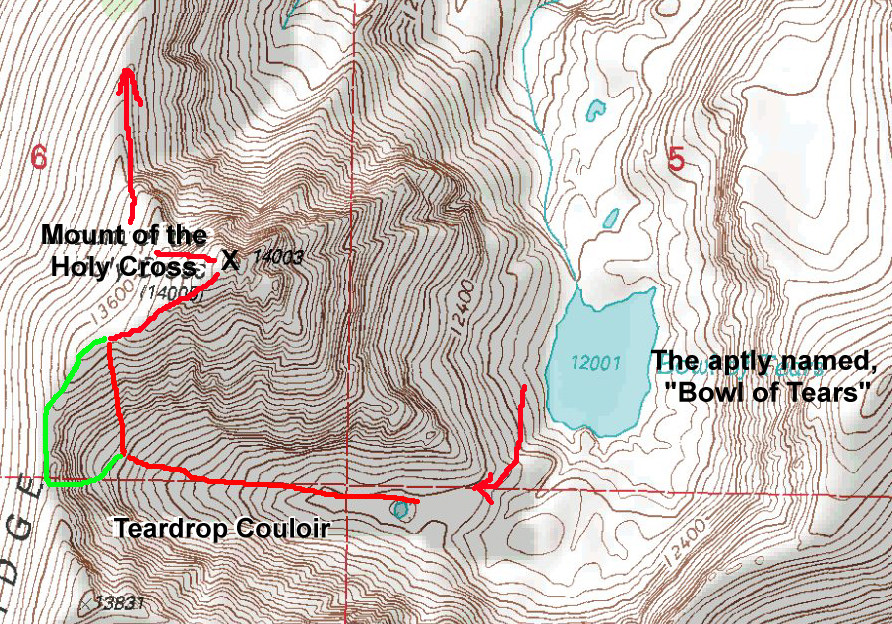
“Where’s the trail?”…”this seems too close to the creek.”  After 10 minutes, we gave up and just started bushwhacking and boulder hopping (to avoid the soft snow).  The bushwhacking turned into scrambling, and at one point, into a technical free solo up an icy chimney.  “I don’t think this is the trail,” I offered. We eventually found our way to the talus field along the west ridge which we followed south toward the Cross Couloir.  We had already decided that the Cross Couloir looked too hard (too much exposed rock); so we were on our way to the Teardrop Couloir (actually the name “Teardrop” showed up some years after we did the climb using Dawson’s guidebook published in 1995 which said it was a “hidden cirque”).

After a while, I was thinking that the effort to hike past the Cross Couloir and the Lake of Tears to reach the Teardrop Couloir was the crux of day.  Our late start, the soft snow, and the missing trail conspired to threaten our summit.  Six hours in and we were still postholing by the Lake of Tear around the corner from the start of the couloir on the SE corner.  At least I knew how the lake received its name.

While I couldn’t imagine what new variable could be added to the soup to make it even harder, a short while later I’d find out that fear would do the trick.

We finally reached the base of the couloir around 1pm (7 hours after starting) where we stopped to put on crampons before starting up. My nausea had long since passed and Brian and I made good time up the couloir.  As we neared the top, the cornice started looking bigger and bigger; and, finally, it was undeniably huge.

The Teardrop Couloir (Brian's route in green)

Brian and I stopped to consider our options.  There were only two obvious paths:

  1. go through a cleft in the middle of the cornice , reached by traversing left over some steep snow directly underneath the bulk of the cornice, or
  2. traverse right toward some rocks and what appeared to be easier ground

Brian proclaimed that tunneling up through the cornice via the cleft would be fun; I announced I would head toward the easy ground.

My path actually did start off pretty easy, but soon became wickedly steep.  But I was able to get a solid grip on the snow with my axe and crampons, so I continued with the plan still feeling it was the best path.

Then the snow got hard, and I got scared.  I was on 60 degree rock-hard snow with nothing but the tips of my crampons on the snow and air below me for 1000 feet.

After a moment, I steeled myself to the task of surviving and found a rhythm of repeatedly kicking each foot to gain some friction on the hard snow to take a step and repeatedly pounding my axe into the snow every 2-3 steps.  This action was exhausting but successful in safely taking me to the Holy Cross Ridge line between the summits of Holy Cross and Point 13,831.  And, oh what a beautiful feeling it was to pull over the crest to safety.  It was like a rebirth.  Brian had waited until he saw I would make it, then he took off for the summit.

The wind was really blowing on the ridge, and almost immediately after my arrival, it started snowing.  The visibility was poor and I couldn’t see the summit.  I figured I had to be close.  But as I sat there finding my breath, I saw it:  still a quarter mile to go.  Shit.

I pushed as hard as I could and reached the summit at 2:30pm (8.5 hours after starting).  Brian and I enjoyed the view for a short time and then left to descend via the North Ridge.  But we couldn’t find it.  It is always amazing how easy it is to lose something so massive.  But we didn’t come up that way and the visibility was once again poor.

After studying the map a bit, we decided to head west and then north to find the proper ridge.  It worked. We found the North Ridge but also found it was covered in a powdery snow which concealed loose rocks beneath.  On separate occasions, I hyper-extended my left knee, over-extended my right Achilles tendon, and smashed my right knee cap after slipping on loose rocks.  I would have paid a lot of money to be able to glissade any part of the descent, but I couldn’t find a decent patch of snow to save my life (or my legs).

At the bottom of the ridge, we aimed ourselves north to try to intersect the lost trail as it angled toward Cross Creek.  It worked.

At 5pm, I was sitting on the ground and Brian was laying in the grass near Cross Creek; we rested and pondered our completion time. We were sorry to conclude that we had 2-3 hours of hiking left, and that would get us home by 11pm if we didn’t stop for dinner. It would be a hungry night.

Coming back up the other side of the canyon was as exhausting as anything I’ve done. We made good time (at one point, we ascended 500 feet in 30 minutes), but I felt like I was going to either puke or die, and I didn’t want to puke.

Somehow continuing to live with my stomach intact, the mountain threw a curve.  We had to recross the angled-snowfield-of-torn-muscles beneath Point 12,743, and now the snow was all very soft. I was quickly out of energy but had to continue to fight for every step. I needed snowshoes the size of pickup trucks to avoid postholing in that air that looked like snow.

By the time we reached the pass, I was spent. Panting heavily despite no apparent need, I looked like I’d been crucified.  Brian took pity on me and offered me a piece of candy.  In the past, I had always rejected such as junk food; but I was desperate.  So I took it, and that made all the difference.

Almost immediately I felt better and was able to haul ass back to the truck.  We reached the truck just before 8pm, leaving plenty of light to find our way back to Minturn.  But with a late night already locked in, we couldn’t stop for dinner before jumping on I-70 for the long drive home.

We had taken 14 hours to climb 6,500′ feet and hike 17 miles on our successful quest to bag Mount of the Holy Cross via the Teardrop Couloir, contributing only a few tears to the stash.

No more soft snow!

See all trip reports

See all 14er trip reports