Archive for the ‘Trip Reports’ Category

A Winter Longs

April 2, 2010

I had long wanted to do Longs Peak in winter, but it didn’t seem likely due to the requirement to give up a downhill ski weekend, which was the source of all joy.  Fortunately, good climbing partners are good for all sorts of things.

The Weekend Before

Driving back from one of the best ski days of all time, Brian says, “Are you interested in doing Longs Peak over President’s Day weekend?”

Stunned into silence, my mind grasped for a handle on the situation. What could he be thinking about? Why would we even consider giving up the complete joy of downhill skiing to seek pain & misery for the sake of mere accomplishment?

But I had never done Longs Peak or any high peak in winter, and my passion to bag many different types of Longs Peak ascents won out in a high vs. low brain wrestling contest using a rapid take-down maneuver.  I don’t think I managed to squeeze out a “huh?” until I announced that “I’m in” a few moments later.

The thought that Vail was closed on President’s Day weekend for Colorado Pass holders was a serious handicap for the ski contingent.

The Night Before

Brian called to confirm our meet up schedule and reported that the Boulderfield had winds of 80 mph.  I was unnerved to say the least.  I had made a bargain with my Maker 10 months earlier that I would take better care of my nose after getting frostbite on an wickedly windy Mt. Silverheels.  That was a serious bargain that had worked out very well so far; it didn’t seem right to push it. But, I reasoned, if I brought a facemask and extra wind protection, that would qualify as “taking better care” of my nose. I threw my facemask and an extra balaclava into the pack and put the issue behind me.

The First Day

We left Boulder at 7:30am on Saturday, February 19, 2000.  The Longs Peak Ranger Station Parking lot was empty, of course. But it still felt weird, like in Vanilla Sky when Tom Cruise finds himself in an empty Times Square. That said, it is still better to park right up front and avoid the extra 1/4 mile of hiking to reach the trail head.

The trail was completely obscured and invisible in many spots; it made for very slow going. About 1/2 way to tree line, we lost the trail all together and had to break trail the rest of the way. Still, we had all day to make it to our planned camp in the Boulderfield, so we just endured the struggle.

Just above treeline with Mt Lady Washington & Longs in background. The hurricane winds would start at the Boulderfield.

Once at the Boulderfield, my poor condition began to demand a price.  A price paid in pain. I hadn’t been over 11,600′ (Vail Mountain) in 6 months, had spent a good part of the last month in Atlanta (elevation 750′), and hadn’t carried a full pack since my trip to the Tetons 2 years earlier. It was all I could do to keep moving.

For motivation, the mountain offered blasting, freezing winds. My Gorilla Mask was the only thing between my nose and my reckoning with the Maker. And, I had no idea how we could keep the tent from being destroyed in the hurricane winds, but that was a problem for later.  It was going to be an interesting trip.

I arrived at camp enough time after Brian to find him chest deep in a hole he was shoveling, in the only patch of snow in the boulderfield that looked deep enough for such an pit. He informed me that we needed to build an igloo for shelter from the wind. And, he just happened to have his snow saw handy.  I didn’t even know there was such a thing.  I think I’ll start saying that if you’re not an ex-Boy Scout, it’s good to bring one with you.

And, it was a good idea except that neither one of us knew how to build an igloo. We started with Brian cutting and me placing the blocks.  But my back was spent from the hike in, so after a short time, my back started cramping.   It turns out that compacted snow is heavy, especially when cut into massive blocks.

To give my back a break, I went to dig the entrance tunnel while Brian cut and placed blocks.  By the time I was done with my fabulous tunnel, the igloo looked like it needed some scaffolding to keep from falling in on itself.  We understood the theory of arches (and domes) but didn’t know any safe way to keep the blocks from falling down while we placed the remaining blocks, including the capstone or keystone or whatever you call the last block that transfers the weight of the dome down to the ground.  We resolved that someone was going to have to get into the pit beneath the blocks and hold them up.

Brian offered to go into the “pit of crushing death” to act as the scaffolding, but I couldn’t place the blocks with my back issues. So, standing beneath and holding up 500 pounds of snow blocks was my pleasure while Brian layed on block after block until he placed the final block on top. And in a gift from the heavens, the wind disappeared during the time the igloo was in its most unstable condition.

Somehow it worked.  It took 4 hours to build, but it was magnificent. And huge. Apparently, making the igloo too big is a common beginner mistake. The inside was big enough to hold 4-5 people.

Me standing behind the ugliest igloo ever made on purpose. On the other hand, the entrance tunnel was the epitome of functional elegance.

We found the igloo had many cracks between the uneven blocks.  To avoid a nasty draft during the night, we packed loose snow into the cracks. And to get some idea on whether the structure was sturdy at all, we pounded on the sides with the shovel.  Every time we hit it the sides moved inward but held; we both thought the pounding made it stronger.

As I ate my dinner, I expressed some concern to Brian that if the igloo did collapse while we slept, however unlikely that was, we might not get out.  We decided that we could at least avoid being knocked senseless or crushed by moving out from directly underneath the blocks.  To accomplish this, we dug alcoves into the sides of the igloo pit (which was dug into the raw, compacted snow) to create a roof of compacted natural snow as protection.

We exited the igloo to watch the sun set and then ran for for shelter.  The temperature was dropping very fast, and the wind was picking back up.  But, that sunset was a sight I’ll never forget.

Then it was time for sleep, which came surprisingly easy despite lingering worries about the stability of the igloo.

The Second Day

We awoke around 7am to find ourselves alive and the interior of the igloo covered in a light layer of snow. Apparently, the wind had been bad enough during the night to blast out our snow plaster and begin to eat away at the blocks themselves.

After a light breakfast, we emerged to find a clear day with light winds.  A serious good luck move.  But it was cold.

Of course those initial winter morning moments are agony, as the body temperature struggles to catch up.  But the hike to Chasm View was a nice warm up.  I warmed up enough to think it wasn’t all that cold, so I put on fleece instead of down.  But that foolishness lasted only a short while and cost me some frozen fingers most of the way up.

We used the rope only on the initial pitch where the rock was exposed and we could use rock protection .  Above that, the snow was perfectly firm and had excellent depth over the rock in most of the steep sections.  Still, those few spots with crampons and ice tools scratching for purchase on hard rock with my ass hanging over a 1000 foot drop down the North Face with no protection made a lasting impression.  If that sentence was too long, let me summarize:  it was scary in spots.

Me on the summit of Longs Peak on February 20, 2000.

We lounged on the summit for only 15 minutes.  The sky was still clear and the views were magnificent, but we had many miles to go before we sleep, as it were.

The Descent

The downclimb was utterly unnerving.  In my mental preparations for the trip, I had visions of glissading; but there was no way:  too steep. And just like in rock climbing, downclimbing is much harder than up-climbing because you lead with your feet while your eyes are on the other end.  Plus we made the mistake of following our ascent path, which meant the snow coverage was now poor since we knocked much of it off on the way up. Somehow, I managed to avoid a long dive back to the igloo.

On the way down, we bumped into a couple fellows coming up who told us their tent blew down during the night winds.  Hurray for Brian, his snow saw, and his igloo!

We arrived at the igloo around 2pm and started packing and refueling.  Sunset would be around 5:40pm, so we needed to hurry to avoid the headlamps; but, it just wasn’t in the cards.  At 3pm we started down toward the Ranger Station.

Despite a high misery factor, the hike out went quickly.  The more tired I am the more effective my hiking trance.  Brian tried out his new skis with new-fangled bindings that fit his plastic climbing boots.  I asked him if the setup was tight enough to control his skis; he said we find out. His poor binding combined with a massive pack caused him to crash enough times that I was able to stay with him just by hiking fast.

We got to the car in the twilight around 6pm.

It was another great one! And my nose survived!

See all trip reports

See all Longs Peak Massif trip reports

The UnTolled Story

March 15, 2010

It has been many years, but I can still remember my first visit to the summit of Green Mountain in the Boulder foothills in 1996 when I discovered the “mountain finder” placed at the summit by the Colorado Mountain Club in 1926.  At the time, I only knew Longs Peak and Mt. Meeker, and learning the names of the visible peaks inspired a longing to explore them all.  I was so happy to have moved to Colorado.

One peak was noteworthy for not being listed.  It had a marker aimed at it, but did not have a name listed; I wondered why and vowed to find out. Unfortunately, my energy for the quest did not last, but, at least, the question did not fade from my memory.

Indian Peaks Wilderness (most of it anyway).

In December, 2003, I was led by the nose to discover that the Indian Peaks Wilderness Area was a wonderful playground even closer to my home than my beloved RMNP. Naturally, I had heard of the Indian Peak and even noticed that many peaks in that area had Indian tribe names, but I was too busy with RMNP and other pursuits to worry about a bunch of 13ers.  But when Brian and I were looking for some new terrain after 7 years of RMNP fun, Brian suggested Mt Audubon for a moderate hike we could do in winter.

And so a new habit began.

After Audubon, the ski season intervened to delay our return until April, when we did Apache via the Apache couloir (a Roach “classic” — 1000 feet of 45 degree snow).  Hiking in and on the summit, we were amazed at the incredible climbing opportunities all around.  Driven to do them as soon as possible, we returned the next week to climb Shoshoni via Pawnee Pass.  On Pawnee Pass, we noticed a perfect looking little peak that sat in between Pawnee Pass and Paiute.  It was time to buy a guidebook; and for our next visit, we would target Mt Toll.

Mt. Toll is described as a “classic” alpine route reaching a 13er summit by Roach (author of the Indian Peaks Guidebook).  His opinion has long carried weight with me in his other books.  Plus, there aren’t many of this type of route and we both were excited about some more high altitude climbing.

The next weekend we went up to Blue Lake below Mt Toll with our rock gear and found we couldn’t get to Mt Toll without snow climbing gear. We decided to use the day to go up Paiute instead.  To reach the Paiute summit, Brian had to lead a pitch across steep, hard snow using just his nut tool while kicking marginal creases in the hard snow for footholds. It was spectacularly stupid.  He made it.

As we sat on the Paiute summit and admired the ridge to Audubon and the spectacular North Ridge of Mt Toll, I still didn’t put two and two together.  I still didn’t know how close I was to the answer of my Green Mountain question from 8 years earlier.

Mt. Toll via the North Ridge – A Classic Alpine Rock Route

Sunday, July 11, 2004 was the day we set aside for our 2nd attempt.

We set off at 3am from Boulder, heading up to Nederland and then to the Indian Peaks entrance.  In the pitch dark, we found a parking spot right at the Mitchell Lake TH and began hiking at 4:15am.

The progress was fast, but slippery (icy) and dark.  I took two full out (laying flat on the ground) spills; one fall skinned and bruised my left knee, tore off a part of my right thumbnail, skinned my right forearm, and hurt like hell.  That fall pissed me off so much that I cursed out loud at the dark sky and icy ground.

We arrived at Blue Lake at first light and then scrambled to the ridgeline toward Paiute before hiking back to Toll. We arrived at the base of the climb around 7am.

A view of Mt Toll from Mt Audobon.  Photo from summer visit to Mt Audobon; background removed to highlight Mt Toll.

We had scouted out the route on the earlier trip and continued to study the “go directly up the ridge” instructions provided by Mr. Roach.  We decided to start to the right of the ridge, following a shallow ramp to a narrow ledge. And, since the descent went down the other side of Mt Toll, we couldn’t stash anything. We had to do the rock climbing while carrying our packs full of headlamps, water, food, and anything else we forgot to take out from previous trips. Fun.

Brian led the first pitch.  When I arrived at the belay, he was shivering in the shade and wind.  The start to my pitch was to traverse left along the ledge toward the North Ridge.  Upon reaching the ridge, I found the sun, shelter from the wind, and a great line.  I brought Brian over to save his misery, and then I started straight up the line.

mttollnorthridgejdl

Mt Toll North Ridge close-up

The first portion involved climbing up into a dihedral, and then escaping left before the grade became difficult.  The climbing then followed a vague line with easy but awkward climbing, simply staying with the easiest terrain.  Along the way I found and used (with backup) an old piton.  My pitch did not quite get to the “big ledge”.  I found a secure anchor that allowed me to sit comfortably in the sun on top of a big block to belay Brian.

Brian took us to the big ledge that traverses right (SW) to gullies for a 4th class ascent to the summit.  Brian had other ideas.

Pinnacle on North Ridge (Brian’s Variation). This piece of the ridge can be seen near the top of Mt Toll in the North Ridge close-up photo.

Brian had been thinking that continuing up the ridge line would be the more elegant way to finish.  We found a couple alternatives, one or more even looked do-able.  Brian picked the most unlikely line:  a start on the left side of the ridge (20 feet left) with a traverse under a roof with good pro (small cams) and poor hand-holds (but good feet).  We made it, and continued up the ridge-line (Brian estimated 5.8, but I thought it was harder).

Brian kept his pitch short to stay within earshot of me (the line turned around a corner into the wind).  It looked as though we were near the top, but we weren’t.  I topped out on the ridgeline after about 30 feet and found a rather large gap between the mini-summit I was on and the real summit of Mt. Toll.  I down climbed carefully and then ascended the far side to find a belay at about the same level as the top of the ridge.  Since I had not placed gear during the descent/ascent of the gap, the rope stretched across the gap like we were setting up a Tyrolean traverse.  I was later sorry not to get a photo of Brian as he popped up on top of the false summit….it was a great image.

Brian quickly scrambled up and we climbed the last 30 feet of elevation to the summit.  There we found 6 people lounging in the wind break after having come up the South face (a walk up) after coming over Pawnee Pass.  We reached the summit at 11:30am.res

After a quick break and change of shoes, we scrambled and glissaded down the talus and snow slopes to the area just west of Blue Lake, arriving at 12:15pm.  Here we rested and ate lunch.  An hour later we were in the 4Runner and heading home after another great day in the Rocky Mountain.

And, still, it was not until several weeks later when pointing out to my wife the Indian Peaks off in the distance that I realized that Mt Toll was the unnamed peak.  And years later, I still have a special place in my heart for Mt Toll whenever I spot it on the horizon.

Our passion for the Indian Peaks persisted for two years, during which time most of the remaining Indian Peaks summits would fall beneath our boots.

But until recently, I didn’t know how Mt. Toll got its name among the Indian tribe-named peaks. I’d read that the Ute tribe name was rejected for one of the peaks due to already being used to name many geographic features in Colorado. Perhaps it was the proposed Mt. Ute that was instead named Mt Toll, but I don’t know.  As far the name, Mt. Toll, I originally thought the name came from Henry W. Toll, a Colorado Senator from 1922-1930; then Brian told me one of his books indicates Mt Toll was named after Roger W. Toll, (the brother of Henry) a charter member of the Colorado Mountain Club and superintendent of RMNP (and Yellowstone & Mt Rainer).  It turns out that the Toll family in Colorado goes back to 1875 and produced several prominent leaders who were also mountaineers.

It seems that Mt Toll is well named.

See all trip reports

See all Indian Peaks trip reports

Arrowhead Slushfest

March 3, 2010

It was the 5th weekend in a row since the end of July that promised rain, and this time with a chance of snow!  What were we to do, since we couldn’t rock climb and couldn’t count on a hike peak due to lightning?

Brian had the idea of attempting Arrowhead in RMNP with a lightning backup plan of simply hiking to Black lake.  He thought it was a good idea to bring a rope just in case the conditions turned a 3rd class scramble into a technical nightmare.  I agreed it was a pretty safe plan.

Packing at the last minute, I couldn’t find my gaiters or my waterproof bibs.  But I figured the odds were for me to be overheating anyway…so I let it go.  I settled for my spring bibs (think: thin), but threw a fleece sweater and balaclava into the pack for insurance.

On September 9, 2006, we left Boulder around 7:30am and reached the parking lot around 8:45am.  The drive in took a few minutes longer than normal due to the later than normal start (more people awake), the Man-Dress Festival in Estes Park, and the poor luck of driving behind two cars driven by old men who were still coasting in from the 1940s. As we drove into Estes Park, I could see blue patches opening up after days of rain.  It looked like it was going to be hot, just like I figured.

Step 1

The hike in followed the normal approach to Black Lake but with an early exit from the trail below Arrowhead and Thatchtop at approx. 10,200 ft.  We went too far initially and had to backtrack to find the right spot which happened to be full of avalanche debris.

Step 2

From the avalanche debris field 2 miles up the Black Lake trail, we exited to the right to find a nice trail across the creek and up the muddy slopes below Thatchtop and Arrowhead leading to Solitude Lake at 11,400.

The hike in was cool, but sunny.  Hiking in just a shirt but with nylon bibs was too hot, as I expected; that is, until it started snowing.  It actually started raining & snowing, but by the time we got near Solitude Lake, it was full on snowing.  I didn’t stop to put on my jacket because my shirt was already soaked with sweat and I was too hot to put on a jacket anyway.  By the time we got to Solitude Lake, I was cold and wet; and it was time for some new clothes.

At that time, the blue sky was obscured by heavy cloud cover and falling snow (it was a whiteout beyond 100 feet), and the visible rocks had a 2-3 inch coating of fresh snow. The snowfall was heavy but was melting fast….dripping from everything and soaking a muddy ground.

Step 3

Fortunately, I brought a spare shirt for just such a need.  I sought shelter from the thick-falling snow by ducking under a large rock. with dripping cold water on my bare skin, I made record time in changing my shirt and donning my waterproof jacket and gloves.  It took a couple minutes for my hands to thaw, but otherwise I felt pretty good….except for the wet feet (no gaiters).

We continued up the valley toward the start of the 3rd class scramble, slipping and falling over snow covered rocks.  I was wondering how far should we go before retreating?  It wasn’t a question of whether to retreat, but when….right?

Step 4

Brian thought we should push on, and I reluctantly agreed.

My bibs were wet and my legs were very cold, acting like radiators for my protected upper body.  I could feel my body temperature falling and knew that it would go lower while moving slowly on the slippery 3rd class climb.  I put on the fleece sweater and balaclava that I had been sure I wouldn’t need.  I could only hope that too much insulation on my head and upper body would overcome wet & cold feet and legs.  I felt very fortunate to have the extra clothes on a cold, wet & windy day.

Step 5

We started up the 3rd class scramble and found that it was covered in a layer of snow and slush that obscured the rock and acted like grease.  We knew right away that this was not going to be easy, and that the descent would be even harder.  We didn’t have axes, and I’m not sure they would have helped anyway. Brian was leading the way, and I followed behind thinking (or hoping) that he would give up soon.

We couldn’t find the exact way and had to backtrack to find our way a couple of time.  The route was usually well-marked with cairns, but the cairns were covered in snow.  Slowly, we worked our way higher.  As we neared the top of the scramble, we faced the crux of the climb, a 15 foot steep wall.

Step 6

I finally said, “this is a mistake; I hope we don’t have to pay a terrible price for it.”  Brian felt it was safe enough because he thought he could downclimb the moves, but I wouldn’t follow until he found an anchor for a rappel on the descent.  He complied, and I followed him to the talus slopes that we climbed to the Arrowhead summit.

We reached the normally impressive summit in a whiteout.  Cold, we didn’t stay long; we only paused to put on our harnesses and take a drink.

Our route up Arrowhead via Solitude Lake

Descent

We scrambled down the snow covered talus with far more comfort than expected due to our ability to follow our own footprints.  The snow had stopped falling so we could still see where we had placed our feet on the way up.  Otherwise, we’d have struggled to descend without multiple slips and falls.

Once we reached the steep section, we stopped to pull out the rope.  Brian offered me the top-rope and I accepted gladly.  I slowly worked my way down the slush-covered grass and gravel to reach the top of the 15-foot cliff.  I had to slowly work my way up to the edge and then ever so carefully work my way down the snow-covered rock.  I worked down a total of 25 feet of terrain before stopping to provide Brian a belay.

He came down quickly, and we setup for the next section.  I started down the next section even slower than before.  Even though my successful downclimb of the previous section gave me a boost of confidence, the ground felt more slippery than ever.  About 10 feet into the second section of descent, I attempted to step down a drop in the ramp.  My uphill foot slipped on the slush.  As I slid forward on my rear end, I jammed my downhill foot on the only exposed rock while Brian’s belay slowed my apparent attempt to jump off the mountain.  Without the rope, I fear Brian would still be dragging my broken bones down the mountain.

We continued with the descent, stopping to move the belay lower when we could find a safe spot.  Eventually we reached easier terrain and put the rope away.  I was never happier to have a rope along for the ride.

Once we reached the bottom of the valley below the climb, I stopped to drain the considerable volume of cold water from my boots.  Afterward, with dryer feet and intact bones, it felt like a good day.

We then hiked back to Solitude Lake, and then back down to the Black Lake trail by 4pm.  We stopped for a drink and a bite, and attempted to do something about our wet clothes.  But it was all in vain as neither of us had anything dry to put on.

Finally, after a 3 miles trek back to the car ending at 5:45pm, the day was done.

We had hiked approximately 10 miles, gained approx 3,400 feet in mud and snow over an 8.5 hour day.  We had been drenched and frozen, but we had persevered to achieved our summit, even if it was against my judgment to do so.

See all trip reports

See all RMNP trip reports

One-day Lindsey

March 1, 2010

To kick-off the 2003 Summer 14er season, I picked Mt. Lindsey from the dwindling list of remaining 14ers for reasons of proximity and difficulty: Mt Lindsey is only 5 hours away and has a maximum difficulty of 3rd class.  I figured on a late afternoon drive down to Redwing followed by an early morning ascent and return home by the evening of the next day.  However, as I am apt to do, I got a brainstorm at the last minute and decided the night before the trip to leave a bit earlier to add the option of completing the climb on the same day if the weather was good.

And one more time I found a way to turn an easy 14er into a thrilling, and unnecessarily dangerous, adventure.

Adding additional indignity, the first 14er of the season is always a logistical hassle since everything is put away (thanks, Susan) and my feeble mind can barely remember what to bring even with visual clues.  In a futile effort to prepare, I spent a few hours the day before to plan the drive and hike (using both Dawson and Roach), and then I packed the gear I thought I might need.

Naturally, no plan is perfect, but the first plan of a season is particularly flaw-prone.  I ended up bringing a ton of stuff I didn’t need and forgetting a few key items, but it all added to the flavor of the stew.

On July 7, 2003, I left Boulder at 6am.  My drive plan was to take Hwy 93 to Golden, C-470 (south) to I-25 which I would take south to exit 52 (Walsenburg), and then take hwy 69 to Redwing and continue on to the Huerfano River Trail.

The drive down went well, and included getting by with only a warning from our friendly Highway Patrol for doing 85 in a 75 zone (thanks, CHP!).  The drive took approx. 5 hours to do 230 miles for an average of 46 mph.  I found the directions in Roach to be completely accurate and sufficient to answer all questions that can up along the way.  Even the off-road portion was short and moderate.

As I drove, first at very fast and later at legal speeds, I was admiring the blue skies and thinking that I should be hiking (read:  wondering why the hell I didn’t leave earlier).  The weather reports indicated a chance of afternoon thunderstorms and then clear for several days; I figured I had a fighting chance to avoid a storm but to maximize my probability of success I needed to move quickly.  So, once I hit the trailhead at 11am, I lit-off down the down the Huerfano trail lickety-split.

All day long I kept saying to myself, “I can always turn around if the weather changes.”  I knew this was dangerous rationalization…I was taking a risk, but I was going to make myself feel better about it by giving the 1-day attempt a full measure of effort.  Unfortunately, I was buried in the trees and could not see any part of the sky that was not directly overhead.

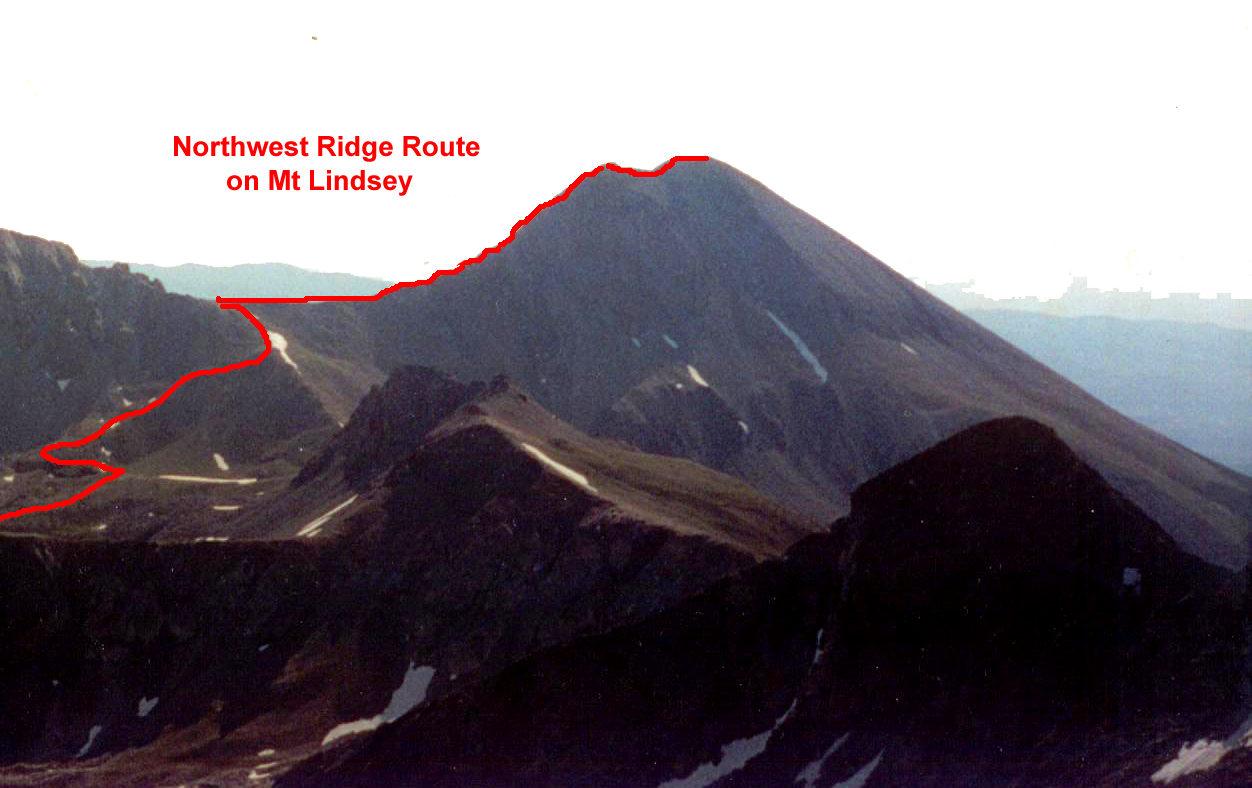
Mt Lindsey NW Ridge route

So off I went armed with a full head of steam and nearly everything a climber could want, e.g., a compass, an altimeter, four liters of water, four Zone Bars, and my 5.10 sticky rubber approach shoes size 12.  What I didn’t have was a clue…it was several hours before it occurred to me that I was missing my rain gear. Duh!

I guess my mind didn’t want to consider the possibility of rain and so I didn’t even think about the rain gear.  Well, I’d have to get lucky, again.

Step 1

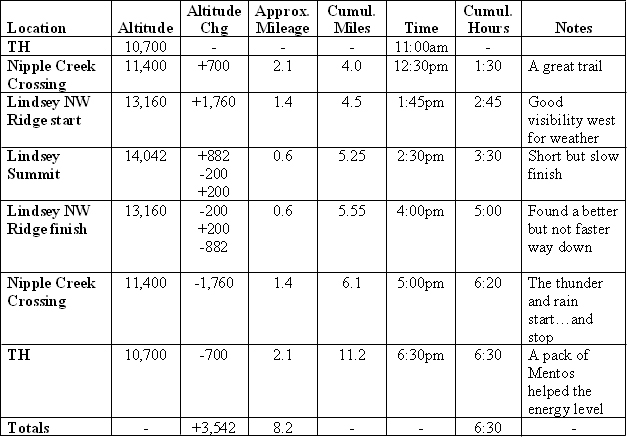
I reached the Huerfano river (a creek, really) crossing at 11:30am and worked across easily.  I was a little disappointed with the quality of the log used for the crossing, but could not find an alternative crossing or any method for upgrading the log.  I made do.

Once across the stream, I looked for a trail heading East (per Dawson), but the obvious trail continuing along the creek and now heading South (per Roach) was too compelling.  In fact, once past the creek crossing, the trail was obvious and no choices seemed to clutter the way.

Step 2

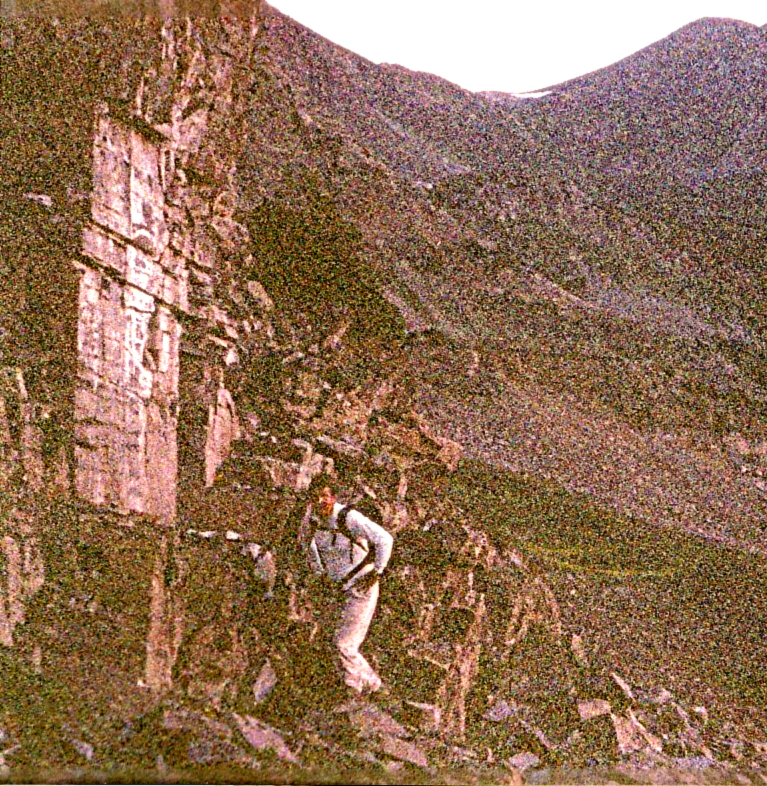
I continued along the creek and then upward passing a talus field (including the remains of some recent significant rock fall that rained large green rocks into the trail and surrounding trees), a moth swarm, and an old mine entrance (a square hole in the rock face that looks like an entrance to the Hyperion labyrinth).  I reached the crossing of Nipple Creek (per Dawson; Roach says “unnamed”) at 12:30pm.

At this point I finished my first liter of water, and then refilled the bottle from the stream and stashed it for the return trip.

Step 3

Just above the creek crossing was treeline and a beautifully flat basin that ended at a ridge connecting Lindsey, Iron Nipple and Blanca.

The ridge was accessible via a grassy ledge which I finished at 1:30pm.  From this position, looking West, I could finally see the weather fairly well.

My route up Mt Lindsey's NW Ridge. Note: photo taken from Blanca Peak on a later trip.

Step 4

The clouds were darkening and moving easterly from positions north and south of me and Mt. Lindsey;  but it was still clear overhead.  I figured all of my huffing and puffing created a high pressure zone that pushed away the clouds.  I decided to push onward while capturing for future use a vision (but no photo for reasons I cannot fathom) of the Flying Buttress-like ramp leading to the summit of Blanca Peak.

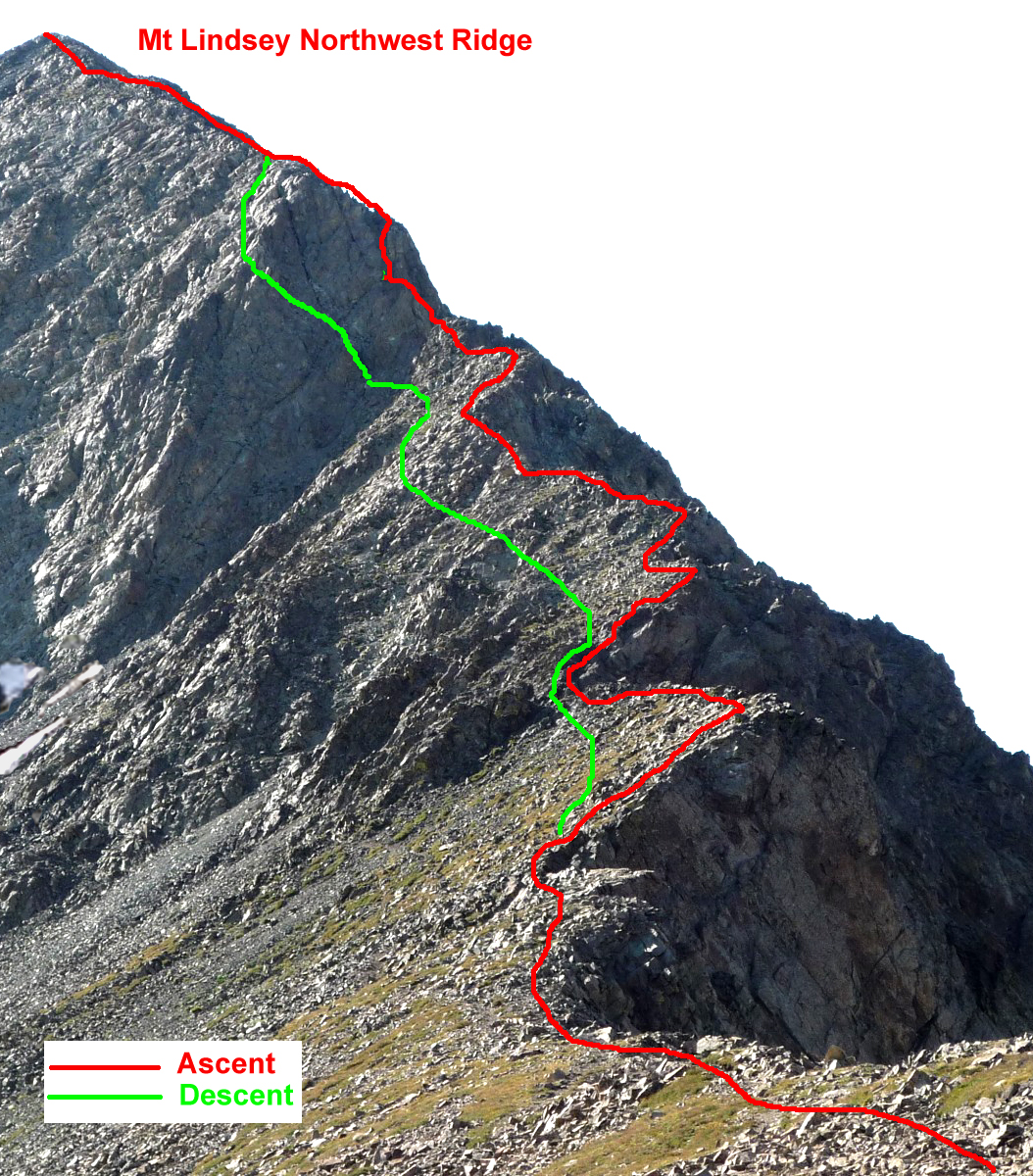
My route up the Mt Lindsey Northwest ridge. I stayed on the ridge nearly the entire way up, but used an easier path on the descent.

Step 5

I reached the NW ridge quickly and decided to stayed on it for the aesthetic pleasure of exposure; I didn’t think it would cost me too much time.

Looking ahead, I could see the notch in the ridge-line would be interesting.  I finished my second liter of water and stashed another to lighten my load before starting again.

Step 6

Surprisingly, the hardest move with the most exposure was just before the notch.  It was a ridiculous spot to take a chance just to stay on the ridge, and it was a move I avoided on the descent.  Once at the notch, the solution was not obvious; a line to the left looked a bit easier but the route description said to stay on the ridgeline…so I did.  It went, but felt harder than necessary (I took the left route on the descent and found it to be very solid and straightforward).  I continued up the ridge while thinking that I needed to hurry back; the descent past the notch would be much harder if wet.

Step 7

I approached the summit with a sense of relief and then dread.  I decided that all false summits would be outlawed in Joe’s National Forest.  I pushed past the extra 200 feet to reach the summit at 2:30pm.  I signed the register and noted that Mt. Lindsey must get thousands of climbers each year.

As I was relaxing and marveling at my weather-luck (and finishing my 3rd liter of water), a shadow passed overhead as dark clouds finally reached me.  I was up quickly and moving again with a hope to at least get down the ridge before the rain came.  I’d worry about avoiding freezing to death after I avoided falling to my death.

The wind was cold and hard, but no rain before I worked my way past the notch. I used a different, safer route to reach good ground, and then took the fastest path to my stashed water which I consumed (my 4th) before continuing on my to safety.  I was amazed to notice that a marmot had chewed on my Nalgene bottle!

I made fast time as I faced for treeline.  Without rain gear, the trees were my best bet against cold wind, rain and lightning.  I reached the Nipple Creek crossing (and my stashed 5th liter of water) at approximately 5pm, and that’s when big clumpy snow flakes started falling amid thunder. I grabbed my water and streaked for the heavy trees; by the time I reached them, the snow and thunder had gone.  Lucky again!

I took a moment to finish 1/2 of my last liter of water and dig out a package of Mentos that I happened to bring along on a whim. Delicious!  They were like little energy packets powering me home.

I reached the car at 6:30pm, finished my water, and headed home.  Consuming 5 liters of water in 7.5 hours meant that dehydration would not be a problem.  However, I had to stop at gas stations far more often than my 4Runner required.

As I was driving, I realized that I had missed climbing Iron Nipple in my haste.  I doubted I’d ever make it back again and regretted not taking more care to get that peak. After a total of 5 hours of driving, I reached home at 10:30pm.  My wife asked me what I was doing back home so soon.  I told her I took a chance and managed to finish the climb, so I came home early.

She said, “Why?”  And then she added, “I would have thought you’d have stayed the night just for the pleasure of it.”

What could I say.  She was right.  Sometimes faster isn’t better.  I just cannot help myself.

See all trip reports

See all 14er trip reports

For Whom the Bells Toll

February 28, 2010

Due to a rare alignment of coincidences, Brian and I were able to join up again for a hard 14er traverse; our last big traverse effort together was the successful Crestone traverse just over 1 year ago done to celebrate my 40th birthday.  We both wanted to do the Maroon Bell traverse, but for different reasons.  Brian had attempted the Maroon Bells traverse seven years prior (summited on North Maroon Bell, but not on South Maroon Bell) while I climbed South Maroon Bell (SMB) in 2002 but had not attempted North Maroon Bell (NMB) yet; a successful traverse would check-off a peak for both of us.  Plus, it is one of Roach’s “Great Traverses.”  We had to do it.

A view of the Bells from Pyramid, taken a few days earlier

Our planning discussions led us to plan on a N-S-N traverse with a N-S option if the weather was bad or we were too slow.  I had done the standard SMB route and felt confident I remembered the trail.  Brian felt that the double traverse and descent via NMB would be faster and easier, if we could finish the traverses before the weather came.

Day One

On Thursday night I made my dutiful check on the weather forecast; and it was bad.  The forecast called for “morning thunderstorms and rain and afternoon thunderstorms and rain; chance of precipitation 50%.”  It was the worst forecast I’ve headed into yet; and this effort would have the longest exposure to weather problems of any climb we’d done to date.  Still, we’ve done enough climbing over the years to know just how unpredictable the weather can be…we decided to proceed and hope for luck.

We started toward Aspen on Friday, August 1, 2003, in the late afternoon with a plan to hike up to a campsite near the starting point for NMB.  Our driving speed was good the entire way and we arrived at 8:00pm.  Anxious to make progress before dark, we quickly hiked up from the Maroon Lake Trailhead west before the fading daylight forced us to pull out the headlamps prior to the cutoff for Pyramid.  Now hiking more carefully, we continued up in the dark, past Crater Lake, and watched carefully for the turnoff for Maroon-Snowmass Trail. We found it and took it for approximately 0.5 mile to where we found a previously used campsite, 20 feet off the trail and buried in the trees. We setup camp and turned in with hopes of a restful nights sleep (position #1 on map).

Our N-S-N route up North & South Maroon Bells

Day Two

I didn’t sleep well and so the pre-dawn alarm was not welcome. But with our bad weather forecast, we both jumped up and got ready for our big day on August 2nd in 2003.

The Climb of North Maroon Bell

A beautiful field of flowers below the North Maroon Bell north face

We quickly found the cut-off a short way above our campsite.  We crossed the Minnehaha Creek before we wandered up through trees and rocks to reach a grassy area and then a rock glacier below North Maroon’s North Face as the daylight started to pick up.

Brian had been more of a speed devil than ever; and I kept up until I was ready to puke.  Oddly, I really felt bad and needed a 15 minute rest in the talus field in the basin below NMB’s north face to recollect myself (position #2). I felt bad enough to go home.

Hiking Pace Maxim: Hike at your own pace or slower

Each of us has a sustainable pace based on our conditioning, our physical mechanics, and the situation; going too fast means to risk illness (mountain sickness, deydration, bonking), injury (falls, twisted ankle) and loss of situational awareness (concentrating too much on footing).

Joe heading toward the grassy gully from the rock glacier (Brian says sorry for taking too long to get film developed)

Starting to feel better and anxious not to lose the weather, I started up again.  We completed the traverse of the rock field and found a trail at “a point below the lowest cliffs on the NE ridge”. We used that trail to do an ascending traverse below the cliffs to get to a broad grassy gully.

It was a very cool setting: a thin trail cut into side of the mountain and a magnificent drop down to the valley floor.

The grassy gully that we took to begin our ascent of North Maroon Bell

We followed the trail south under the grassy gully, and then we started up the left side of the gully following a worn trail (position #3).  We climbed about 600’  before exiting on the left side below some white cliffs.  After we exited the grassy gully, we turned a corner and traversed across ledges to reach a 2nd gully (position #4).

Just like South Maroon Bell, the North is a steep pile of rocks just barely hanging on before committing to a suicide plunge to the bottom. Every rock we stepped on was a potential death missile for any below us.

In the 2nd gully, we worked our way higher to reach some challenging ledges below the ridge crest.  We then hiked up the remaining distance to reach the ridge at approximately 13,100’ (position #5). We stayed approximately on the ridge the rest of the way.

The first major obstacle we found on the ridge was the infamous “rock band” at around 13,600’ where we took our first break.

We found some water run-off and stopped to take advantage. I finished my 1st liter to free up some space, and then refilled with the questionable water.  Brian recalls:

When I filled my water bottle at the rock band, it was full of moss specks, and some had six legs.  I used two iodine pills.

Unfortunately, this turned out to be my only refill opportunity up high….I would have to survive on 3 liters until returning to Minnehaha Creek.

Joe on the climb to NMB (photo by Brian)

We passed the rock band using a short Class 4 chimney, and then we navigated around numerous obstacles to stay near the ridge crest all the way to the NMB summit (position #6).

To our delight, the weather was holding. But we didn’t trust it; so we only dared stop for a quick snack before starting the traverse.

Scrambling down an obstacle on the traverse (photo by Brian)

The Traverse to South Maroon Bell

From the NMB summit, we started by following Roach’s instructions to descend southwest from the summit.  It was a surprisingly exposed first move for a 14er, but it was an effective foreshadowing of things to come.  We scrambled down a loose talus slope and then climbed up, over and around various obstacles to reach a 20-foot cliff that we downclimbed without much difficulty.

We continued the obstacle course until above a 35 foot cliff we couldn’t figure out how to downclimb safely (position #7).  We rappelled to the bottom and continued.

This was the only very difficult part of traverse, other than for the constant exposure to terrifically long falls that would provide the victim enough time to regret the error.

We had to downclimb two short cliff sections to reach the low point of the traverse, which was also the top of the Bell Cord Couloir.

From there, we began our ascent to SMB. We started up some ledges and then climbed up a gully to reach additional ledges which led to the east end of the summit ridge.

The last scrambling section was disappearing beneath our hands and feet pretty well when a big commotion behind us caused us to stop and look. It was a group of college-age men who were running up the route and racing each other to the SMB summit.  We stood aside to avoid being trampled.  Once on the summit (position #8), we learned they had run up NMB and over the entire traverse.  As I was breathing hard from my own modest efforts, I was impressed with their physical ability to do it….even as I was annoyed at the lack of courtesy involved in the process.

Brian & Joe on the summit of South Maroon Bell

The weather was holding, but just barely.  We decided we could make it back across the traverse to NMB based on the hope that our familiarity with the terrain would compensate for the slowing of our tired bodies.  We just needed the weather to hold out a couple more hours.

The Traverse Back to North Maroon Bell

North Maroon Bell from the summit of South Maroon Bell

From South Maroon‘s summit, we returned to the north along the summit ridge to the northeast corner of the peak and started for home.

We descended to the west through a series of small cliff bands and then down a loose gully. Once down the gully, we turned to the north and traversed a series of small ledges to reach the top of the Bell Cord couloir.

From the low point in the traverse, we climbed up the first 20 feet of the cliff to a small ledge, from which we scrambled another 20 feet to mount the cliff band.

From the top of this cliff band the ridge flattened out and narrowed to only a few feet (with a big drop-off to either side). We scrambled for a while along the ridge toward a 20 foot tall bump on the ridge.  We climbed up and over the spire and then down climbed another small cliff band.

More scrambling led us to the cliff that forced a rappel earlier; this time we were able to find a climbing route to get past. We continued staying mostly to the ridge until we returned to the last section below the summit.

We climbed up some talus and then some ledges to reach the summit ridge, and finally the summit where we had been a few hour earlier.

I’d have to say that I preferred the South-to-North pattern due to the predominance of climbing up vs. downclimbing.

The Descent from North Maroon Bell

Looking down at the start of the upper gully from the ridge

Everything had gone better than we had a right to expect.  The only real discomfort was my increasing dehydration.  Of course Brian was satisfied with his thimble-full; but I needed more than 3 liters for such work. Plus, I still had a touch of the mountain sickness I caught early in the day, and I was very anxious to begin losing some serious altitude.

I’ll admit to being irritated that nothing looked the same on the descent of the gully. North Maroon Bell is not a friendly mountain. I tried to follow the cairns but once again found myself lost in a sea of loose rocks.  I managed to avoid knocking anything loose, but it was a serious mental strain.

Brian and a fellow we met on the climb of NMB and SMB

About 1/2 way down the gully, it started raining and then stopped.  And that was the last of the weather. We had really gotten lucky in two ways.  One, the weather was good despite a bad forecast, and, two, the bad forecast had kept the crowd to a manageable level.  I would hate to do NMB or the traverse on a good weather forecast weekend day; the rockfall would be deadly.

Exhausted, we slowly made our way to the Minnehaha creek.  While approaching the creek, the idea formed in my mind to soak my feet in the freezing water to cure my “fire toes.”  I had been thinking about this for a long time, but never took the time to try it.  With the willing sacrifice of a few minutes, it felt so good to freeze my feet after filling my water bottles.

But then Brian reminded me that we need to get to camp to break it down and hike back to the car (Brian’s Mustang, “The Mach”) before starting the long drive home. Reluctantly, I put on my socks and boots and starting hiking, only to find that my feet hurt worse than ever!  The cold water treatment had turned on every nerve ending in my feet and turned every callus into soft cheese. Oh, the misery! The 2 mile hike back to Brian’s car was an ordeal….like hiking with broken glass in my boots.

But, once off my feet and with Brian driving home, I was able to reflect on a great trip.  I was pleased to have completed another of Roach’s Great Traverses and bag my 48th 14er.  This trip was one of the great ones:  full of strenuous effort, difficult problem-solving, and mortal danger; and our betting against the weather forecast and winning made the victory all the sweeter.  The church bells need not toll for us, except in celebration.

Brian heading toward Minihaha Creek

And as I thought about having only ten more 14ers to go, I discovered that I was both happy and sad. I had become addicted to the mental, physical and emotional challenges found on the Colorado 14ers.  Before the month’s end, I’d planned for another seven 14ers to fall beneath my Makalus:  Chicago Basin Group (8/14/03) & Wilson Group (8/6/03).  The list of remaining 14ers would soon be very short indeed.

And a big ‘thank-you’ to Brian for thinking of a great trip report title.

See all trip reports

See all 14er trip reports

Mt Evans Bike Ride (and Climb)

February 22, 2010

In early June, 2004, Brian says, “How about a snowclimb on Mt. Evans?”

“Need a short day?” I inquired.

“No,” he replied, “I just read that the road to the summit is closed because of heavy snow; we can enjoy a rare restoration of wilderness solitude on Mount Evans while we ride our bikes up the road.”

We had taken to riding our bikes in the Brainard Lake area during the Spring climbing season when the road is closed, so the idea wasn’t completely out of the blue.  But there isn’t a lot of altitude gain on the Brainard Lake road, which makes bike riding an ideal way to shorten a boring & time-consuming approach.

“So, how hard will it be to ride up the Mount Evans road?  I seem to recall it is a long, steep drive,” I asked while thinking that I am not capable of a hard bike ride.

“I don’t think so,” Brian reassured me, “I think it will be only be a little harder than the Brainard Lake road. Probably the distance is around 4 miles, but the extra distance will help spread the extra altitude.”

On the morning of June 5, 2004, we loaded Brian’s truck with gear and bikes and set off for Mt. Evans.  We arrived at the gate to find it closed, as expected. Then I noticed the sign that read, “7 miles to Mt Evans”!

“What the….,” I exclaim. Slowly turning to glare at Brian, my tormentor, I see the Snow Plow Truck pulling up to the gate.  I’m saved!

We ask if we can follow him up the road in Brian’s truck, but he says no can do.  And he also said the road will probably open today, but he didn’t know for certain or, if so, when.

Not one for waiting around, Brian says, “Let’s just ride up; it will be fun.”.  I really wanted to wait for the gate to open, but sensed a tragedy in the making (what if it doesn’t open?).  So, I agreed to try; I’d just have to go slow and rest on the flat parts.

Brian recalls:

I remember feeling fortunate that I got Joe on the bike before he had a chance to think about how far it was.

Per our Brainard Lake method, we strap the packs and other gear onto the bikes, and then start up the hill.

The Bike Ride

My bike is an old Schwinn made of solid cast iron with lead wheels (feels like, anyway), and with my personal 220 lbs plus an additional 20 pounds of gear (axe, crampons, water, boots) on the bike, I immediately know I am in trouble.

I down shift into my lowest gear and manage to go just fast enough to keep from toppling over.

Bike & Climb up Mount Evans

The following thoughts [and emotions] occurred to me along the long Mount Evans road (follow number sequence on map):

  1. My lungs are bursting and my mind racings….what am I going to do?…how can I possibly finish this road? [panic]
  2. But after a bit, my body settles into a rhythm and I start to think that I’ll make it.  But I am going very slowly  [relief and embarrassment]
  3. Brian is up ahead waiting for me to catch up; he probably is worried I cannot make it.  I try standing up to go faster, but my back wheel spins on the snowy road.  I cannot go any faster.  And I cannot stop or I’ll never get going again.  Hell, I cannot even stop pedaling for a moment’s rest; there are no flat sections! [resignation plus determination]
  4. The Plow truck comes barreling back down the road, coming around a corner…we swerve violently to dodge out of the way; the shot of adrenaline helps me for a while [amazement]
  5. Now my hands are freezing. I guess they are not getting enough blood flow due to my death grip on the handlebars; but for now, my need to squeeze the brakes is not paramount.  Still, I do not want frozen hands, so I desperately try to keep my balance with with only one hand on the handlebars at a time while letting the other warm up [fear and irritation]
  6. Brian is long gone. I approach a big curve and think I am close to the end.  I have just enough energy to make it as long as I can weave across both lanes to reduce the angle.  I wonder if the road has opened up and let cars through, but I cannot afford to look back  [desperation]
  7. As I turn the corner, I can see I am only half-way and I have 3+ miles to go to reach Summit Lake.  I keep spinning my legs and concentrating on my breathing.  Every time I look up it looks further away. I stop looking and keep pedaling  [determination]
  8. After battling cramps for the final mile or so, I finally make it to Summit Lake and pull off where Brian is sleeping on a rock.  I get off my bike and find I cannot walk, which reminds me of the first triathlon I did many years ago on Key Biscayne [surprise]

Once at the end of my pedaling madness, I also noticed that the upper part of the road was closed by a gate across the road (and the road covered in snow).  It was a tremendous relief; I was not physically capable of riding up the steep road to the summit after the climb, and now I could save face.

After a few minutes of rest and serious contemplation of just going to sleep instead of climbing, I decided to pull myself together (man-up, as it were) and persevere. The summit wasn’t far away, and I could rest at every step if necessary.

The Climb

The snow was soft and getting softer; it was going to be miserable later in the day.  Of course, Elfin-like Brian, floating on his skis, moved effortlessly ahead, gliding across the snow like Legolas crossing the Misty Mountains Pass (think:  Frodo Lives!).  I stumbled along like an elephant in ballet slippers since I left my snowshoes home to avoid carrying them on the bike ride.

Luckily, I found enough rocks and firm patches of snow to keep going to reach the base of the North Face route without too much misery or burning energy I couldn’t afford.  There had been a massive slide recently…the snow was very chunked-up.  Yet, the conditions turned out to be okay…no sun yet…, and we successfully navigated through the avalanche debris and around the rocks to reach the summit ridge.

We sauntered over to the summit to enjoy the views.  But not wanting the snow to get too soft, we decided to leave after a short stay.

The Snow Descent

The snow had softened as predicted, but still yielded some good ski turns for Brian and a nice glissade for me down the steep couloir.  I managed to slide down most of the way before the snow ate my momentum.  Then I had to walk / wade through the snow at the bottom of the couloir which was like wet glue.

The Postholing

Oh, I hate soft snow.  I cannot decide which hell would be worse, but at that moment #3 was the leading candidate between the following:

  1. An eternity of driving in rush hour traffic where other lanes move faster, especially the one you just moved out of.
  2. An eternity of watching TV with a broken remote that can display all the great sporting event and science fiction options available but cannot switch the channel away from All My Children
  3. An eternity of hiking in soft snow

I waded and crawled, I rolled and hopped, I cursed and yelled.  And then I finally lost my cool completely and swore out loud that I’d never do another snow climb.

With my last drop of energy, I crawled onto the road; and then I stood up, collected myself once more, and thought, “that was a good bit of exercise.”

I always tell Brian that I get more exercise than he does with his shamefully fun and easy skiing, but he never changes his ways.

I started walking toward the bikes, and that’s when I saw the cars start coming up the road. And there were lots of them.

The Downhill Ride

Cars were everywhere, including those going back down the road after the family’s annual 5-minute adventure [sure, my attitude is poor, but wait ’til you do it before you judge too harshly].

I tried but could not keep from flying down the road, as I desperately squeezed my brakes as hard as frozen fingers would allow.  The downhill cars were whizzing by me as they tried to time the instant they could get around me without hitting an oncoming car or knocking me off the cliff  (I would lose either way). I was so consumed with staying close-but-not-too-close to the edge of the road that I couldn’t afford a moment’s thought for how my life was utterly at the mercy of drivers I’ve spent thousands of hours (so far) dodging in my daily driving routine.

It was a helpless feeling.  A drop-off, only 1 foot to my right, was at least 500 feet to the bottom, and the cars blazed by only inches to my left, going by so fast that my left ear would have caught fire if it wasn’t frozen.  I kept thinking that if I hit a rock or if my front wheel comes loose or if I get into the gravel, I was a dead man.  I felt real regret for not doing some sort of inspection on my antique mechanical beast before trusting my life to it on this roller coaster adventure.

But by the mid-way point, I had grown accustomed to the speed and began to enjoy it.  I felt increased confidence in my bike and my skills, so I eased up on the brakes a bit as I tried to weigh my rate of progress toward the parking lot against the rate at which my hands were becoming frozen blocks of ice:  would I reach the truck first or die when my hands broke off during the descent?

Brian’s recalls:

The biggest problem was that the road did open up, after we summitted, and we had to dodge cars all the way down.  I also remember the usual peculiar handling of a bike with skis and boots tied to it.  Seeing those skis protrude past the bike stem always makes me wonder if something will bind up and the handle bar will refuse to turn.  By the time I got to the bottom I was getting enough of a feel for half-assed road biking that I was starting to really lean into the turns.

And then it was over.  I sure didn’t feel short changed on exercise or thrills.  And, I even thought I might like to take up cycling again [p.s.: it would take 10 years to buy a road bike; click on Mount Evans Hill Climb Done Right (2014) to see my Mt Evans redemption ] or even look into mountain biking [note: it would take 5 years to start mountain biking].

I was especially pleased to be able to say I rode my bike up America’s highest paved automobile road.  So, ignore my whining, bring a good bike, and enjoy a nice ride.  And, perhaps, have a friend follow in a car.

If you plan to ride from the Entrance Station [to the summit, it is a] 15-mile route [and] an elevation gain of 3,530 feet. Allow 2 to 3 hours to complete the trip to the summit.

Mount Evans – Bicycling the Mount Evans Scenic Byway

See all trip reports

See all 14er trip reports

Dog Star on McHenrys Peak

February 18, 2010

Brian dug deeply into his copy of Rossiter’s High Peaks book of RMNP alpine climbs and found Dog Star (5.8).   When Brian introduced the idea, I was interested right away because I had long wanted to climb McHenrys Peak.  And I love the adventure of climbing up a big alpine wall; Dog Star is recommended in multiple guide books.  But this trip is documented here due to the epic nature of the climb, only partially caused by illness.

“Dog Star:  it’s a bit of both.”  … overall assessment put in writing by me on the following day

We started hiking from the old Glacier Gorge parking lot @ 4am expecting to make our normal fast pace, but I was off.  My body just wouldn’t cooperate with my cerebral wishes and its own best interests; but I suppose losing some of my altitude tolerance (spending 5 of 7 days in Atlanta for the last 3 months) and failing to get a minute of sleep the night before was just too much for my old body.

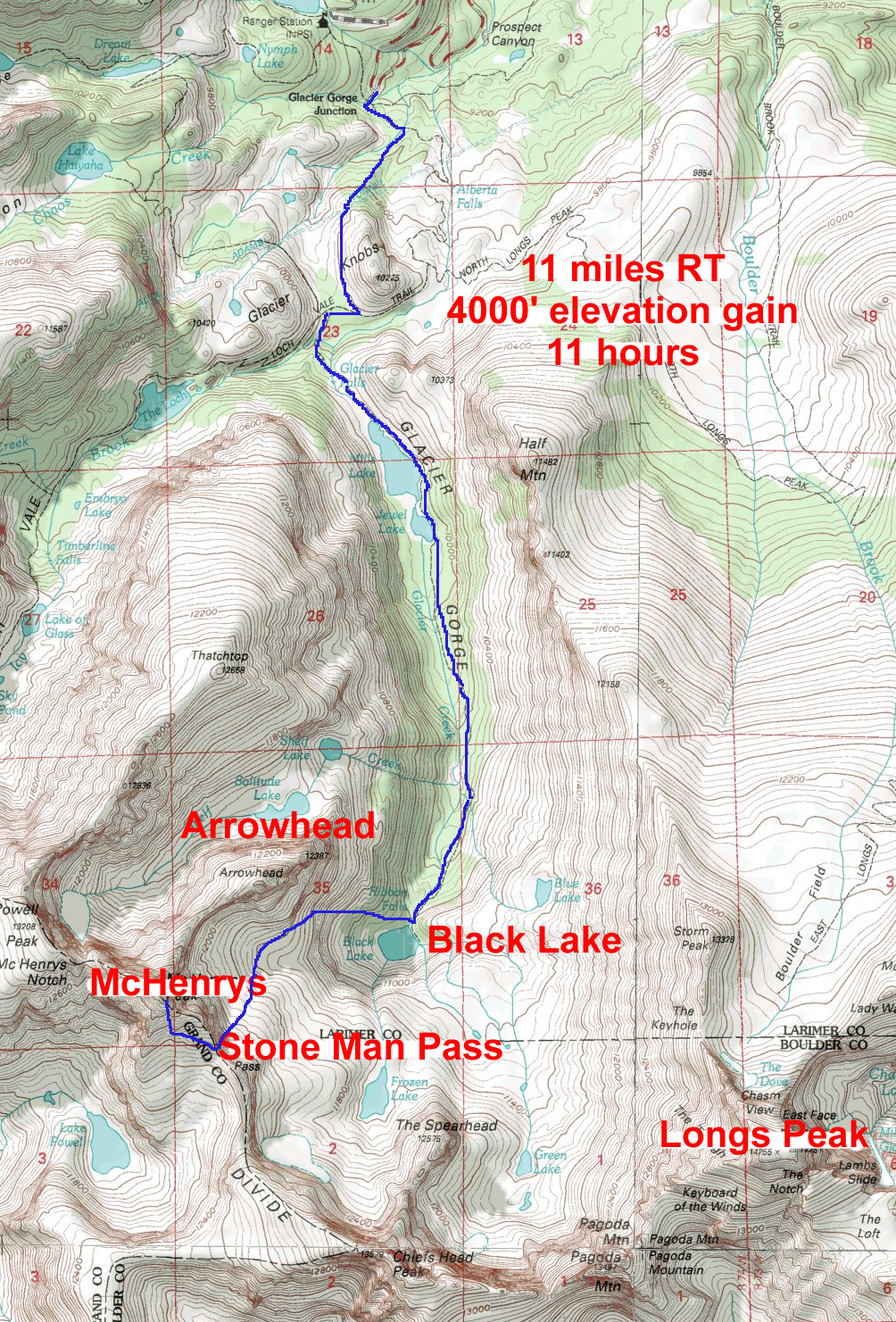
I hiked as fast as I could (read: slow), and we reached Black Lake a little after sunrise, around 6:30am.  We took our normal shortcut toward Arrowhead from Black Lake and worked our way up to the large triangular buttress that dominates McHenry’s northeast face.  At 7:30am, we stopped a few hundred yards below the face to study the rock and find our bearings.  While Brian studied, I slept.

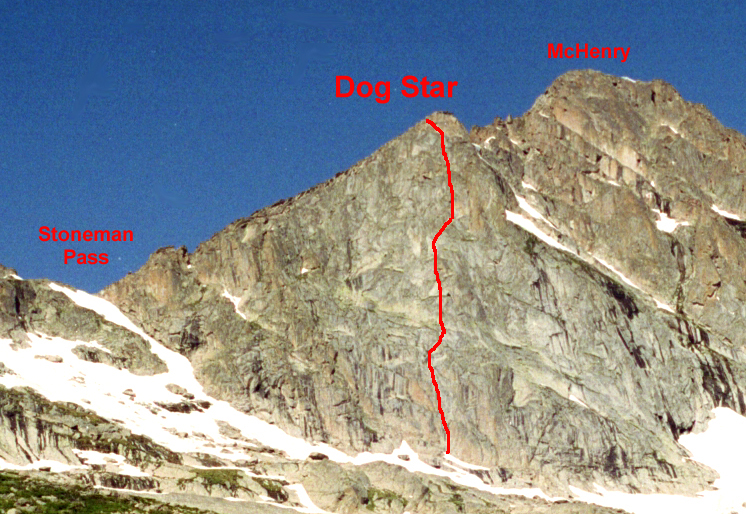
Dog Star on McHenrys Peak

Once we started, it felt like we were off-route half the time.  And it wasn’t just me (sleepy head). We both seemed to spend much of the day figuring out where we were and trying to get back to the route.  Occasionally, we felt we were doing it right; but in the end, we were just glad to make it to the top.

It was good rock, except for the plant life; we just had to follow our nose and hope we didn’t dead-end.  “Faith” can be hard to come by, but without it, this day would have ended much sooner.

Our route up Dog Star. Pitches correspond to description below. Edited from Gillett original

Pitch 1: I started on a wide crack for 50 feet, then recognized a key feature to my right and traversed to get back on route; climbed up a giant detached flake and belayed on a ledge below a hard dihedral


Pitch 2: Brian climbed the dihedral, requiring a hard pull over the lip without holds. He then turned a bulge on his left (route description seemed to point to right bulge) and belayed at ledge above the bulge.

Pitch 3: It was my turn, but I was feeling nauseated.  Brian climbed up a slabby section to a ledge

Pitch 4: Determined to feel better, I started up a curving ramp and reacquired the correct route (I believe).  I belayed at big flake and felt bad enough to think death would be better.

Pitch 5: Brian climbed up a ramp to the right and continued around the bulge to his right and then up another right leaning ramp.  He belayed beneath a big roof & dihedral

Pitch 6:  Brian took a couple falls trying to free climb the bushy, mossy and, in addition, technically difficult roof.  It was rated 5.8, but I’ll eat my computer if that is accurate. He resorted to aiding it so we didn’t have to spend the rest of our lives there.

Brian recalls:

I angled up to the left on thin moves including a finger crack that held a solid cam.  It looked like there was a ledge above that, but when I pulled my head up over the edge, it was actually sloping quite a bit.  The finger crack was full of dirt and moss at that point.  I fell trying to pull over the edge, and after that we were a bit demoralized.  I stood on the cam to get onto the sloping ledge.  After that were some roof moves.  I remember that they actually had good holds and thinking that we could have free climbed them on a good day.  But after the fall, I just wanted to be done with the pitch.

Pitch 7: Brian led a rope length of hard, steep rock that took a bit of wandering to find the easiest climbing.

Pitch 8: Brian continued up the steep section to reach a left-leaning ledge, which he followed to reach the top of the ridge.  The correct route works straight up from the ledge, but I was ready to use a parachute to get off the rock.

Brian looks up at Dogstar with Longs, Pagoda & Chiefs Head in background

At the top, Brian waited for me to announce a decision on proceeding to the summit.  I hate missing out on a summit when I am so close, but I bailed.  If my leg was off, I would have tried. But nausea is an unfightable affliction. And I must have looked bad, too, because Brian took some of my half of the gear weight.

Heading downhill made me feel better, if only psychologically.  We worked down to Stone Man Pass, and then down the gully to reach the base of the climb.

It was over except for the clean up (the boring hike out).  We had done it, sort of.  I regretted missing out on McHenrys Peak’s summit, but I knew I’d come back eventually (in 2 years, actually: see McHenrys At Last).

We got back to the parking lot at 6:30pm for a 14.5 hour effort.

I cannot say I recommend Dog Star or mountain sickness.  But if only for the great memories, I do recommend aiming high.  A bit of suffering seems to make all the difference.

See all trip reports

See RMNP trip reports

Much Ado About Nothing on Chiefs Head

February 16, 2010

For eight years, one of the most significant rock formation in RNMP had stared us in the face every time we’ve ventured into Glacier Gorge, and yet, we’d never thought to venture onto its features.  Primarily, our lack of attention was due to the very long approach, but in some important way, its forbidding and committing look was also a deterrent.

The guidebooks didn’t paint a rosy picture, either.  Rossiter’s guidebook says…

The Northwest Face of Chiefs Head is one of the finest alpine walls in the contiguous United States.  The immense and unusally smooth oval face rises a thousand feet…and is home to some very aesthetic and very hairy routes.  All of the routes have long runouts and no fixed anchors[.] In the event of storm…it is very difficult to escape.

Plus, all the routes seemed to be 5.11X or 5.12R, so our attention was rightly elsewhere.  But one day, Brian sends me an email:

Joe:

How about “Much Ado About Nothing”.  This is about the only climb on Chiefshead that isn’t 5.10 or above.  It’s way right of the big wall, and has five pitches, with the last one 5.8.

Brian

My thoughts were along the lines of: Heck yeah!  Only 5.8, really?  Why haven’t we done it before now?  And we can bag another Chiefs Head summit! I responded via email with agreement and a question about the descent.  Brian replied:

Joe:

Descent may be most interesting part.  Stoneman could be done, but it would be a long way back to pick up packs.  Rositer recommends rapping down his Birds of Prey route, but first you have to find it.  And find it empty.  The third choice is a third class route much closer than Stoneman. Finding that route could be valuable knowledge.

Forgot to mention:  this climb gets no star in the book.  But I thought it would be worth it to do something on that mountain.

Brian

I wondered about the “no star” thing, but was already enthusiastic about the climb. They say, ignorance is bliss, at least for a while.  Soon, we’d find out just how wise it is to be afraid of Chiefs Head’s Northwest Face.  We find out just how hard Chiefs Head climbs really are, even a mere 5.8 route.

The Story

On the morning of August 23, 2003, we caught the 5am shuttle bus (earliest available) to travel up Bear Lake road as we set out for the far end of Glacier Gorge. We had to hike approximately 7 miles and over 3,000 vertical feet just to reach the start of the climb:  we hiked up past Black Lake, over the north shoulder of Spearhead, past Frozen Lake and beneath the west face of Spearhead, and then we scrambled up a rocky shelf before crawling up the snowy talus to reach the northwest face of Chiefs Head.  Then, we turned west and climbed up the snowy ramp to reach the base of the climb.  It was a brutal 3.5 hours; and we hadn’t even started the climb.

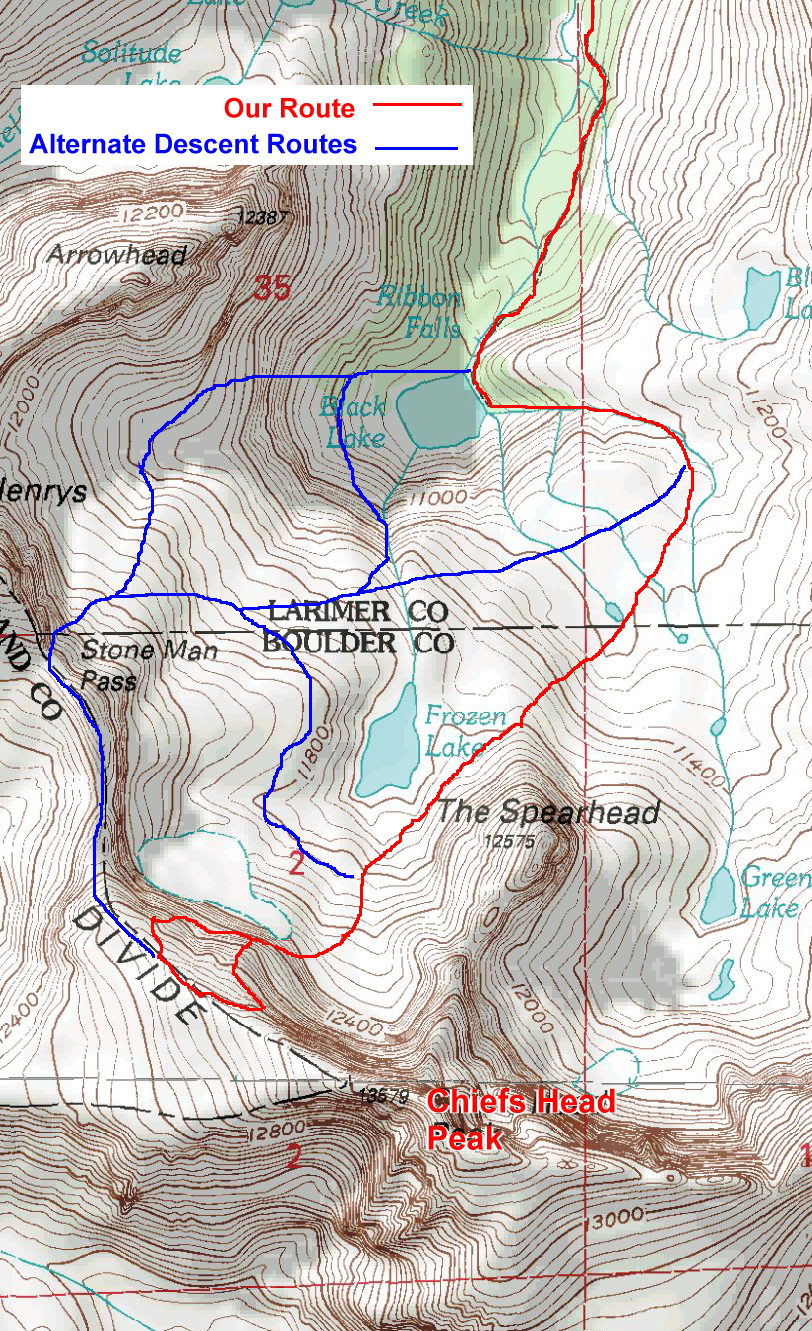
Our route plus alternative descent routes from Chiefs Head

Prior to reaching the base of the climb, we stopped for a moment of study while we could still see the entire wall.  The key was the figure of a head that would guide us to know where to start and where to aim during the initial pitches.  We were looking at shadowy patches trying to find one that looked like a head; Brian claimed to be able to see an “Indian’s head” but I could not.  But with a target in hand, we finished the approach.  Just before 9am, we started up the Much Ado About Nothing route on Chiefs Head’s Northwest Face.

Pitch 1

I took the first pitch and climbed over steep, broken ground that was supposed to end at the base of a “head” I could not see.  I could do no more than take out as much rope as I could and find a good spot to belay.

Pitch 2

Brian took the second pitch, following huge broken flakes that provided small left-facing dihedrals on their left side.  He finished over some easy ledges and belayed at the base of a left leaning ramp.  At this time we noticed that the weather was worsening; our view west was blocked, but the sky above was clouding up and darkening.  We knew we had to hurry since the crux was still ahead.

Pitch 3

I took the third pitch which was to climb the ramp leading up and left angling toward a big dark roof that stretched for more than a pitch as it arched left.  To save some time on an easier section, we decided to simul-climb. Using the ramp to travel diagonally under the  roof started out easy, but then steepened.

And then the rain started.  It was a only a drizzle, but now we were in it.  It was approximately 12pm.

The crux of the climb was still ahead; I knew we had to get past the slabby crux before the lichen turned into grease.  I put in a quick belay with about 1/2 a pitch of the roof remaining so Brian and I could put on our rain jackets. We then moved the belay to below the crux pitch so Brian could race the weather past the crux.

Pitch 4

Just as Brian arrived at the end of the ramp, the rain began again in earnest.  We could see the next ramp approximately 30 feet above us; Brian had to get there before the rock became unclimbable as well as unprotectable (a slab).  He started quickly but soon slowed as the  rock was quickly getting slick.

As I sat in the freezing rain, I could feel the water soak thorugh my rain jacket.  As I watched Brian slowly working his way up, hoping he wouldn’t take a long fall, and as I got colder and colder as my clothes became more and more wet, I came to understand just how important it is to have proper gear when venturing into hard to escape terrain.  Apparently, my windproof, water resistant, insulated and wonderfully packable North Face jacket was not up to the challenge of a real Alpine adventure.  I was going to suffer terribly as a result.

Brian decided to stop before the ramp, but after the hard section, to allow me to get past the crux before it became too wet.  But it was too late, the rock was completely drenched, and I was certain I could not climb the rock.  I was mentally prepared to “fall up” over the slick rock.

And it was like climbing a greased slope, but 3 points of contact allowed me to cling to the rock like a spider in the shower.  Once I reached Brian, we quickly moved the belay up to the ramp so we could figure out where we were.

Pitch 5

We were very confused because, according to the information we had collected, we should be at the summit ridge already.  But there was no summit ridge in sight.  It turned out that Rossiter’s topo only showed the unbroken portion of rock that was set into and below the full NW face.  We didn’t have any certain knowledge or clue as to how to get to the summit ridge.

All we could do was follow the ramp we were on and then follow our noses to try to find the rappel anchors or at worst take the summit ridge down to either Stone Man Pass or find the mysterious “broken ramp” that Rossiter described as an ascent route to the right of the Much Ado About Nothing route.  But first things first.

I took the lead for a simul-climb of the ramp.  After a couple hundred feet with no rap anchors or anything else looking promising, I found a right leaning ramp that promised to intercept the ridge as it sloped down. Desperate for any escape, I abandoned the search for rap anchors and took the right leaning ramp.  It went, and I was able to piece together a climb off the face.

Yes!  We made it.

While I was sopping wet and freezing cold, I now had control over my fate; I knew that I knew how to get home.  I just needed to escape Glacier Gorge before it got dark; it was approximately 3pm.

Much Ado About Nothing route plus descent. Photo from Longs Peak of Chiefs Head edited to highlight Chiefs Head features by removing other peaks (e,g,m Mt. Alice) from the background.


Descent

Shivering with no hope of getting warm, I had no intention of continuing to the Chiefs Head summit.  I wouldn’t have done it even if I had never stood on top of Chiefs Head.  I felt that my life was in play and wanted to take no unnecessary chances.

Brian thought he could find the gully that Rossiter described as an ascent route; from a safety, time & energy management perspective, we desperately wanted to avoid going all the way around to and down Stone Man pass.  We hiked down the much of the NW Ridge to find a likely big gully to descend.  It was more like a series of steep gullies that would work for 40 feet, then we would have to find ledge that would allow us to traverse to another gully.

We kept trying to turn back to the east where the climb started, but each time all we could see was a difficult ledge heading east and then a rock rib would prevent us from seeing whether the ledge continued.  Brian said it reminded him of Pyramid Peak.

Eventually Brian found a ledge that led out to the biggest rib, and from there he could see the start of the climb, and sloping, rubble-covered ramps leading down to it.  We scrambled down and followed it until the terrain started to break up; a path to the right appeared and we took it, hoping it would lead to the snowy ramp we started on.

We had to retrace our steps a couple times as we’d cliff out, and then we split up to double our chances of finding an escape path.  Eventually Brian found a path through tumble that worked.

It was approximately 5pm.  Three hours of light left.

We packed up our gear and headed down as fast as we could manage.  We were going to get caught out by darkness; it was only a question of how much hard hiking we had to do in the dark without headlamps.

We retraced our steps so not to introduce any new variables, and we made it to within a quarter mile of the Bear Lake road before it became too dark to see what we were doing.  Since the buses ran until 10pm, we took our time creeping in the dark to find the Bear Lake road.  Once there, we started downhill and found a small group of people standing by the road.  We confirmed that it was the bus stop and then we layed down on the pavement to wait for its arrival.  We had spent our last ounce of energy.

We made it.  We had hiked 15 miles, and climbed nearly 4,000′ in over 15.5 hours.  And this time we had overcome serious route finding problems, freezing rain, and one serious case of rain gear stupidity to make it home once again.

It was a glorious adventure.

See all trip reports

See all RMNP trip reports

Odessa Gorge Circuit

February 14, 2010

In preparation for my upcoming 40th birthday 14er trip to bag the Crestone Traverse, I wanted to get in some snow climbing and some rock scrambling.  I suggested we try one of the cols in Odessa Gorge for a start; Brian agreed.

We left the Bear Lake parking lot at 7am and headed up toward Lake Helene.

Our route with sequence numbers corresponding to route description below

Step 1

I had originally liked the look of the East Couloir, but a team got into it ahead of us.  We didn’t want to eat rolling snow for 1000’ so we turned up the “Hourglass” (class II W14 per Rossiter); it is the middle couloir of the three Flattop Northface couloirs.

The snow was in good shape but the temperature was very warm, so we hurried to finish before the snow turned problematic.  We made good time until reaching the overhanging cornice blocking our access to Flattop.

We worried about the cornice falling on us and about us falling off the cornice, so we setup a belay behind some big boulders near the top on the left side.  Brian found/made a path over the cornice involving some tunneling and some mantling; my position off to the left provided good protection from the massive snow chunks raining down the slope.  He then brought me up and we moved a few yards east to reach the Tonahutu Creek trail.

Step 2

For the next portion of the day, the plan was to follow the Continental Divide in a traverse of the top edge of the gorge and then descend via a traverse to the summit of the Little Matterhorn.

After a short break, we headed west and then turned the north at Ptarmigan Pass to follow the Continental Divide.  A short bit of hiking led us to the back of Notchtop Mountain (12160’), which we studied for a short time, reminiscing about the climbs we’d done on that rock.

Cool view of Flattop and our snow route from Notchtop, with Longs, Hallett & Taylor in background

Step 3

Continuing roughly north along the Continental Divide, we made it to Knobtop Mountain (12.331’) where we stopped to look for a route to the Little Matterhorn.  I gazed over at Gabletop Mountain, thinking this might be my only chance to bag it, but I needed to get some rock scrambling practice in advance of the upcoming Crestone Traverse.   I stuck with the plan.

Step 4

We started down the Knobtop ridge and found the terrain, while a bit loose, was sufficient for a proper ridge traverse.  We stayed on the ridge much of the time until we reached the end of the ridge and the Little Matterhorn (11586’).  To get onto the summit of the Little Matterhorn, we had to negotiate some challenging, but with a bit of route-finding, not overly difficult terrain.  I’d call it 4th class, just to be conservative.

Joe on Little Matterhorn summit with Notchtop in distance

We scrambled up to the summit of the Little Matterhorn and found it to be a worthy summit with great views into the Odessa Lake area.  We also found a cool chimney on the north side that we descended a bit just to play around on nice rock.  I later read in Roach’s RMNP book that the Little Matterhorn is the lowest elevation peak in his book.

Little Matterhorn

Step 5

Out of water and dried up likes prunes in the hot sun, we scrambled down to Grace Falls.  At the bottom, I turned around to look at the Little Matterhorn.  I could see why it made it into Roach’s book.  It is a spectacular little peak.  And I could even see how it got the name of Little Matterhorn…it sort of looks like the real thing, just on a smaller scale.

Then we bushwhacked up to the Fern Lake trail, which we hiked to cover the 3+ miles back to the Bear Lake parking lot.  Sunburned and dehydrated, we didn’t make any attempt to make a fast escape; we were just glad to be under tree cover and heading back to the parking lot.

We arrived at the parking lot at 4:30pm for a 9.5-hour round trip covering approximately 12 miles.

Come on Crestones! (see 5 14ers for my 40th)

See all trip reports

See RMNP trip reports

McHenrys At Last!

February 10, 2010

I had been looking at McHenrys Peak with great desire for many years and had been close twice, but had never quite set out to bag it.  And McHenrys is not a peak to climb on a whim, or is it?


Close but no cigar on McHenry


Close but no cigar:

  1. Spring Climb of Stone Man Pass; no thought of trying for summit
  2. Rock climb of Dog Star route (climbs the center of triangular buttress on McHenrys NE face); ran out of time for attempt on summit

On June 2, 2002, Brian and I decided to visit Stone Man Pass for a bit of exercise.  We didn’t think we’d move fast enough or weather would stay good long enough to do more.  But we were mistaken.

We left the parking lot at 6am and hiked 5 miles to Black Lake by 8am.  The trail was in good shape even though it was mostly snow covered.


Looking toward Chiefs Head from above Black Lake


We decide to take a shortcut to the pass by heading directly toward Arrowhead, and by 10am we reached the bottom of the snowfield reaching toward Stone Man Pass.  This snow was also in good shape and we reach the top of the pass at 11am.

The conditions had allowed us to finish early; and the weather was too good to think about going home.  While resting at the pass we looked around for something interesting.

I looked to the summit of McHenrys, but hesitated.  I thought it looked hard, even technical.  But it was on the top of my wish list, so eventually I suggested we give it a go; Brian agreed.


Looking back down toward the Stoneman from McHenrys


We didn’t have any route info aside from a vague memory Brian held of a descent of the route some years before (after climbing NE ridge), and snow covered anything that might look like a trail or a trail marker. We figured we’d just wander on up and see what we can see.  I didn’t have any concerns, at least not at first.


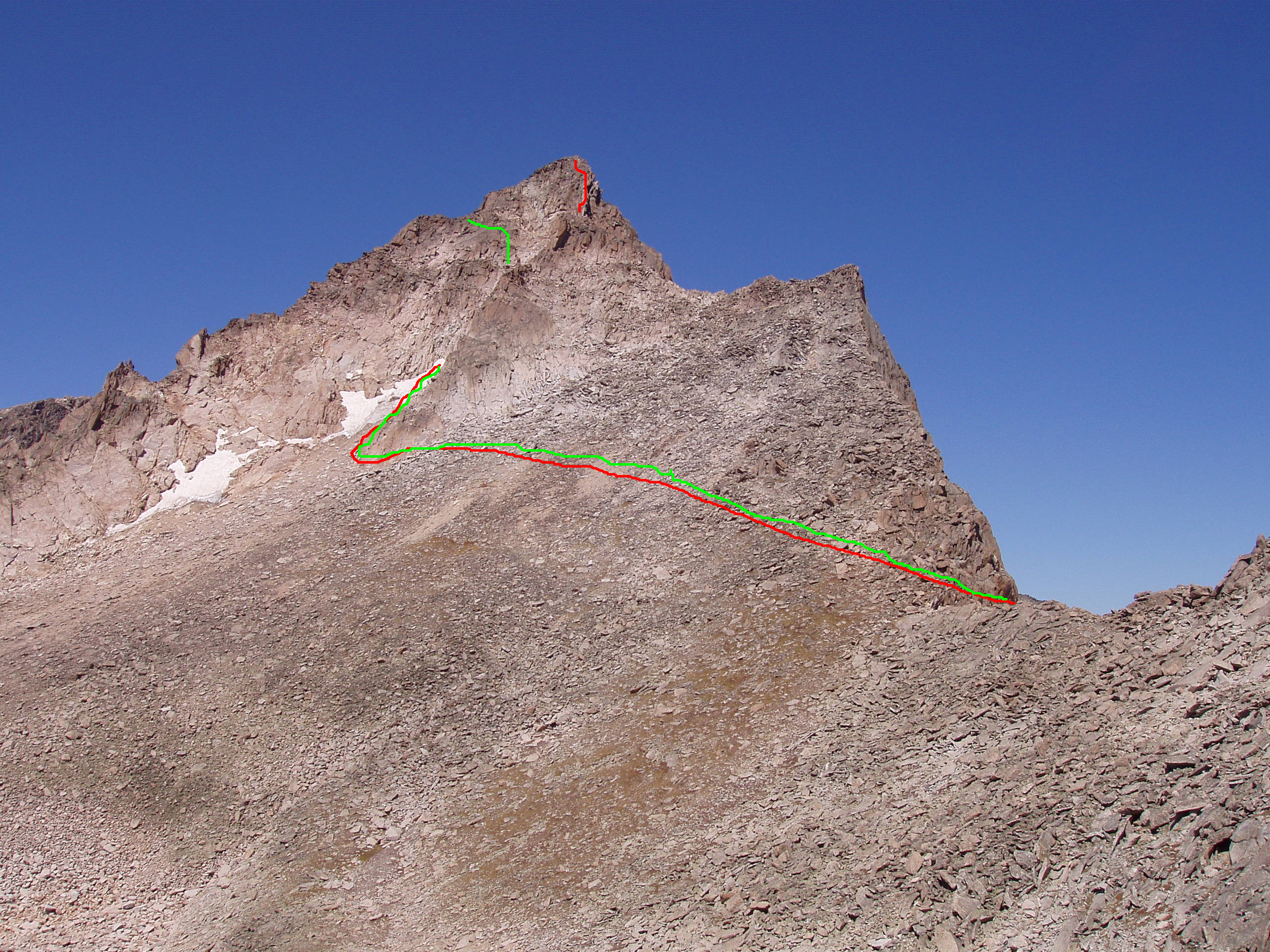
Our ascent (red) and descent (green) routes. Photo taken from climb of Chiefs Head.


We wandered low to get around the first major buttress, and then went straight up the gully toward the summit.  This path worked fine until near the top where the climbing got hard.  It was big blocks and pillars that we had to climb up and around; I’d call it 4th class in spots.  It was 5th class if not careful; I was not careful.

I got stuck on a ledge with no good way off.  I had made hard-to-reverse moves to gain the ledge thinking that I could escape it; but the only move I found was a dynamic one that would be fatal if I missed the mark.  I just didn’t like it in my Makalus, so I just kept looking for anything else; and perhaps just delaying the inevitable.

To my delight (and relief), I found a less risky move and took it.  A short while later, I joined Brian on the summit.


Brian atop McHenrys enjoying the spectacular views of Longs, Pagoda & Chiefs Head


It is far better than any summit in RMNP; completely awe-inspiring. The valley floor drops away dramatically from all sides.  It is a must climb.


Our routes on McHenrys Peak; Red for ascent, Green for descent.


The decent was easier and exhilarating.  We found a better path on the way down (isn’t it always so?) to Stone Man Pass and then glissaded down from Stone Man Pass and later down the bench below Arrowhead to reach the Black Lake area.

Another 2 hours of hiking got us back to the car for an 11 mile, 11 hour round trip.

It was a great day!

But I don’t recommend climbing McHenrys Peak on a whim.  It is a peak that deserves respect, and some preparation.


The long trek to Stone Man Pass & McHenrys Peak


See Solitude Lake Cirque for another route up McHenrys

See all trip reports

See RMNP trip reports